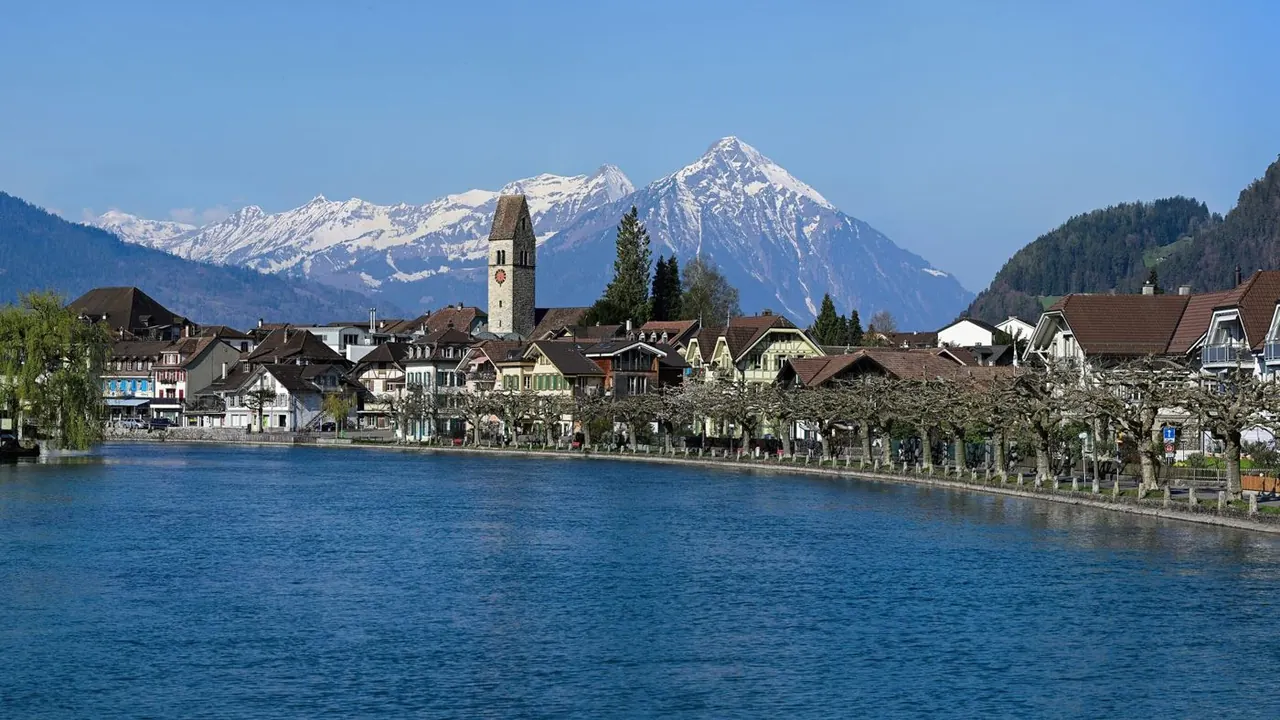
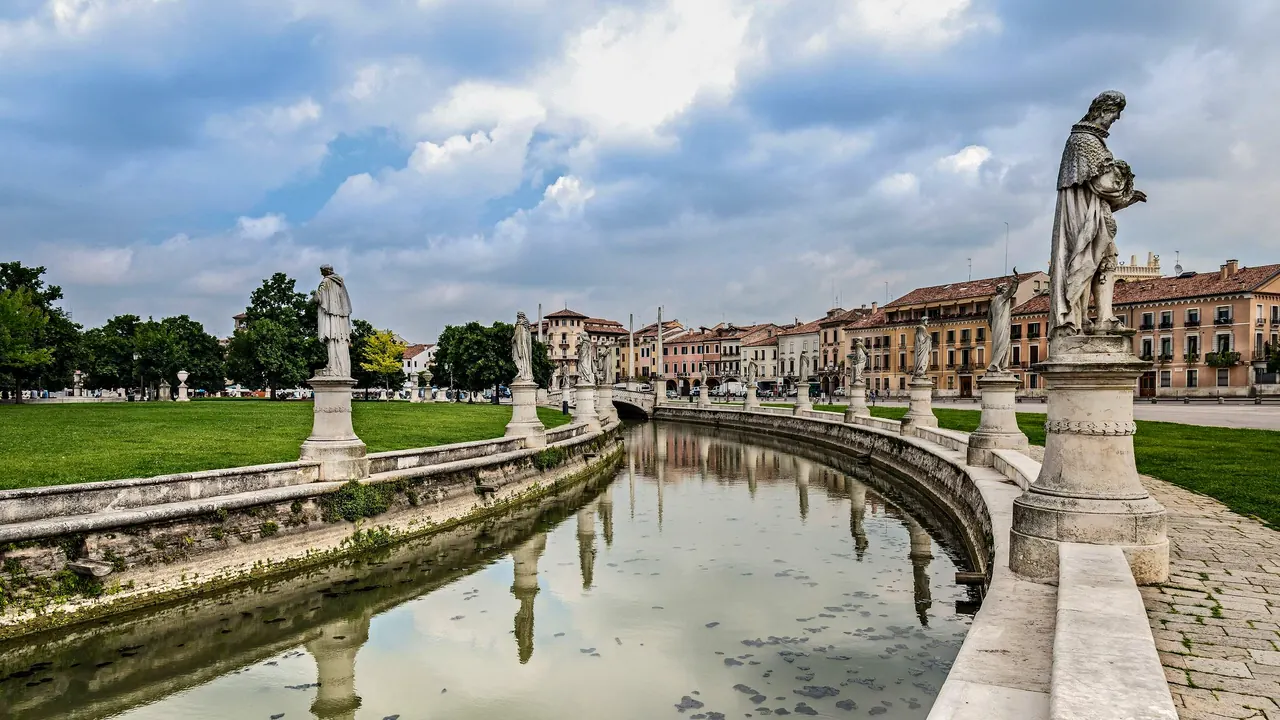
Photos: Interlaken by Roy Egloff, CC BY-SA 4.0, cropped; Padua by Didier Descouens, CC BY-SA 4.0, cropped.
Interlaken or Padua?
Our verdict in twelve categories, each scored against the same fixed benchmark cities, and the climate month by month, so you can choose for your trip.
Choose Interlaken for
- nature and the outdoors
- families
- getting around
Interlaken is for travellers whose vacation happens above the tree line. Trains and cable cars put the Jungfrau peaks, the Lauterbrunnen valley and the high ridge trails within easy reach. Families with children who love gondolas and toboggan runs will be kept busy too. The trade-off is that the town itself has little to look at, eat or do after dark, and the bill will be steep.
Choose Padua for
- culture and sights
- prices
- food and drink
Padua suits the traveller who wants frescoes, morning markets and an evening spritz in the squares, at a far gentler cost. Giotto's chapel and the Basilica of Saint Anthony anchor a rich old centre, and the thermal pools of Abano are a short ride away. Fast trains to Venice, Verona and Bologna also make it one of the best bases in northern Italy.
Scoreboard
Twelve categories on one fixed scale from 0 to 100. The shaded stretch is the gap between the two.
Your match
Pick a travel style or drag the sliders, and both match scores follow your weighting.
Wins on nature and the outdoors and families with your weighting.
Wins on culture and sights and prices with your weighting.
What matters to you?
Category by category
What the scores mean for a trip.
Beaches & swimming
Neither city is a place to plan a swimming trip around, but the water on offer is quite different. Interlaken has lake swimming on its doorstep in July and August, on grassy lidos along Lake Thun or in the colder turquoise water of Lake Brienz at Bönigen, all under snow peaks.
Padua has no water of its own, so a swim means an hour's trip to Sottomarina or the Lido of Venice. The Adriatic there is warmer, shallow and good for paddling children, but the shore is long flat rows of umbrellas rather than scenery.
Food & drink
Padua is where you will eat well. Its Venetian home cooking includes bigoli with duck sauce, baccalà and risotto with spring peas. Add the morning markets in Piazza delle Erbe and Piazza della Frutta, the standing spritz in the squares and Euganean wines from just outside town.
Interlaken feeds hikers rather than food lovers, with fondue, rösti and a run of Indian and Asian places in town. Its best meals are up in the mountains, on hut terraces above Grindelwald or with cheese from an Alpine dairy. Many visitors simply live on picnics.
Culture & sights
Here the two barely compete. Padua has Giotto's frescoes in the Scrovegni Chapel and a UNESCO-listed group of fourteenth-century fresco cycles. It also has the domed Basilica of Saint Anthony with Donatello's bronzes, and the world's oldest permanent anatomical theatre at the university. The centre is compact enough to see quickly, though the timed chapel visits are worth planning around.
Interlaken has the row of grand hotels on the Höheweg, the Kursaal and a few timber houses in Unterseen, and very little else. For museums and old architecture you take the train to Bern or Thun.
Nightlife
Padua has the livelier evenings, and they revolve around the aperitivo. Students and locals fill Piazza delle Erbe and Piazza dei Signori with spritz in hand, then move on to wine bars in the old ghetto during term. There are few clubs, and the city goes quiet in summer and during university breaks.
In Interlaken nights end early because mornings start early. A few backpacker pubs and basement clubs near the hostels, plus the casino in the Kursaal, are about all there is.
Nature & outdoors
Interlaken is one of the great mountain bases in Europe. Trains and cable cars reach the Jungfraujoch at 3,454m above the Aletsch glacier, the waterfalls of the Lauterbrunnen valley and the ridge walks on Schynige Platte. Paragliding, canyoning and rafting all start from town, and skiing takes over in winter.
Padua's outdoors is gentler and further out: trails and vineyards in the Euganean Hills, flat towpath rides along the Brenta and birdwatching on the lagoon. For real mountain walking you need a drive of about an hour and a half to the pre-Alps.
Day trips
Both make good bases, but Padua's reach is exceptional. Venice is under half an hour away by train and Vicenza a quarter of an hour. Verona, Treviso, Bologna and Ferrara are all about an hour or less away, and the Brenta villas and walled towns such as Montagnana are closer still.
Interlaken has fewer trips, but they are rewarding. Arcaded Bern is under an hour away, and paddle steamers stop at the castles of Thun, Spiez and Oberhofen. There is also the open-air museum at Ballenberg, and Lucerne is reached on the line over the Brünig Pass.
Good for families
Interlaken suits children better because getting up the mountains is half the fun. Rack railways, gondolas and steamers lead to playgrounds, cliff walks and summer toboggan runs at the summit stations, and the St Beatus caves are a reliable hit. The drawbacks are wet days and high altitudes, which can be hard on very young children.
Padua is safe and flat, and children are welcome at any trattoria, but its sights are frescoes and churches. Prato della Valle gives children room to run, and families tend to rely on Gardaland or the Adriatic for the bigger days out.
Getting around
Both are easy without a car, in different ways. Interlaken's strength is its mountain network: narrow-gauge trains, cog railways, gondolas and lake steamers timed to connect, so the whole Jungfrau region is open to you. The busiest summer trains do get crowded.
Padua is a walking city, with arcaded streets, a largely car-free core, a tram from the station and bicycles everywhere. Its main-line station also puts the rest of the Veneto and beyond within quick reach.
Shopping & style
Padua has the more varied shopping. There are Italian fashion and shoe shops along the arcades, university bookshops and the delicatessens beneath the Palazzo della Ragione, plus an antiques market on Prato della Valle one Sunday a month.
Interlaken's Höheweg sells watches, army knives, cuckoo clocks and chocolate to tour groups, along with outdoor gear. Woodcarving from Brienz is the one local craft worth buying.
Affordability
The difference in cost is wide. Padua charges normal northern Italian prices, and its hotels make a sensible base for Venice, which is a large part of their appeal. Market food, a standing spritz and a centre you can walk keep daily spending modest.
Interlaken runs at full Swiss prices, and the mountain railways, which are the point of a stay, add a lot to the bill, the Jungfraujoch most of all. Passes, hostels and picnics help, but there is no cheap way to do it.
Live music & performing arts
Neither is a city for live performance, but Padua has a modest year-round programme. Teatro Verdi stages theatre and some opera, and a chamber orchestra plays in the frescoed Sala dei Giganti and the Basilica. The Fenice in Venice and the Arena in Verona are close by for bigger nights.
Interlaken's offering is seasonal: the open-air amateur William Tell in the woods each summer, folklore evenings with alphorns and yodelling, and the odd concert at the Kursaal. For anything more you go to Bern.
Wellness & relaxation
Padua has a real advantage in Abano Terme and Montegrotto, about 12km away. There, hot mineral springs feed the pools of dozens of spa hotels that welcome day visitors, and mud treatments go back to Roman times. Long lunches and quiet hours in the botanical garden add to the slow pace in the city itself.
Interlaken has no springs of its own, so relaxing means a grand hotel spa or the town's public pool. Its calm lies away from the busy centre: early walks by the lake, steamer crossings, or a stay up in Wengen or Mürren.
When should you go?
Pick your month. The climate figures are measured averages, not a forecast.
Interlaken in July
Padua in July
Daytime high, °C
Rainfall in the month, mm
Where the figures come from
Interlaken has no rain gauge within 25 km of the centre, so its rainfall comes from a gridded climate dataset read at the city rather than from a gauge further away.
Interlaken's sunshine is measured 66 km from the centre, at Sion.
Padua's temperatures are measured 35 km from the centre, at Treviso / Istrana.
Padua has no rain gauge within 25 km of the centre, so its rainfall comes from a gridded climate dataset read at the city rather than from a gauge further away.
Padua's sunshine is measured 36 km from the centre, at Treviso / S. Angelo.
Temperature and rainfall are climate normals, averaged over the years shown. Interlaken: 2005-2020 (sunshine 1961-1990, rainfall 1991-2020) normals, Meiringen / Unterbach (19.3 km from centre). Padua: 1991-2020 normals, Treviso / Istrana (35.4 km from centre).
Interlaken is a place for summer and early autumn. July is the warmest month at about 24°C and also the sunniest, and July and August are when the lakes are warm enough to swim. May to August are the wettest months as well, at around 125mm, so showers and cloud over the peaks come with the season. September is drier and still mild enough for the high trails. From November to March daytime highs stay in single figures, and the mountains switch to skiing.
Padua is warmer all year round. July and August reach 31°C and feel humid and tiring for sightseeing, though the nearby Adriatic is at its warmest then, about 26°C, which makes a beach day worthwhile. April, May, September and October are the comfortable months for walking under the arcades. Rain falls fairly evenly through the year and peaks in November at 97mm. Winters are cool rather than cold.
Which traveller are you?
On an outdoors trip, Interlaken has few equals. Trains and cable cars reach glacier views and high trails in under an hour, paragliding and canyoning start from town, and in winter the Jungfrau ski areas are right on the doorstep.
For a culture and arts trip, Padua is the clear choice. Giotto's Scrovegni frescoes, the Basilica of Saint Anthony and the university's anatomical theatre lie a short walk apart, and Vicenza's Palladian buildings and Venice are quick train rides away.
On a tight budget, Interlaken means saving the costly mountain rides for a day or two and filling the rest with lakeside lidos and valley walks. Padua is the easier choice: from one modest base, quick trains reach Venice, Vicenza and Verona.
Before you go
| Measure | Interlaken | Padua |
|---|---|---|
| Official language | French, German, Italian, Romansh | Italian |
| Currency | Swiss Franc (CHF) | Euro (EUR) |
| Sockets | CJ230 V, 50 Hz | CFL230 V, 50 Hz |
| Driving side | Right | Right |
| Time zone | UTC+1, UTC+2 in summer | UTC+1, UTC+2 in summer |
| Emergency number | 112 | 112 |
| Elevation | 571 m | 12 m |
| Main airport | Zürich Airport (ZRH)100 km from centre226 non-stop destinations | Venice Marco Polo Airport (VCE)39 km from centre103 non-stop destinations |
| Public holidays this year | 10 days | 13 days |
By the numbers
| Measure | Interlaken | Padua |
|---|---|---|
| City population | 6,123 | 206,496 |
| People per km² | 1,424 | 2,220 |
| Museums within 10 km | 3 | 29 |
| UNESCO World Heritage sites within 50 km | 2 | 5 |
| Swim season, months above 21 °C | - | 4 months |
Where else could you go?
Every comparison below shares a destination with this one, so you can follow Interlaken or Padua somewhere new.
- Venicevs Padua
- Bernvs Interlaken
- Lucernevs Interlaken
- Veronavs Padua
- Zermattvs Interlaken
- Zurichvs Interlaken