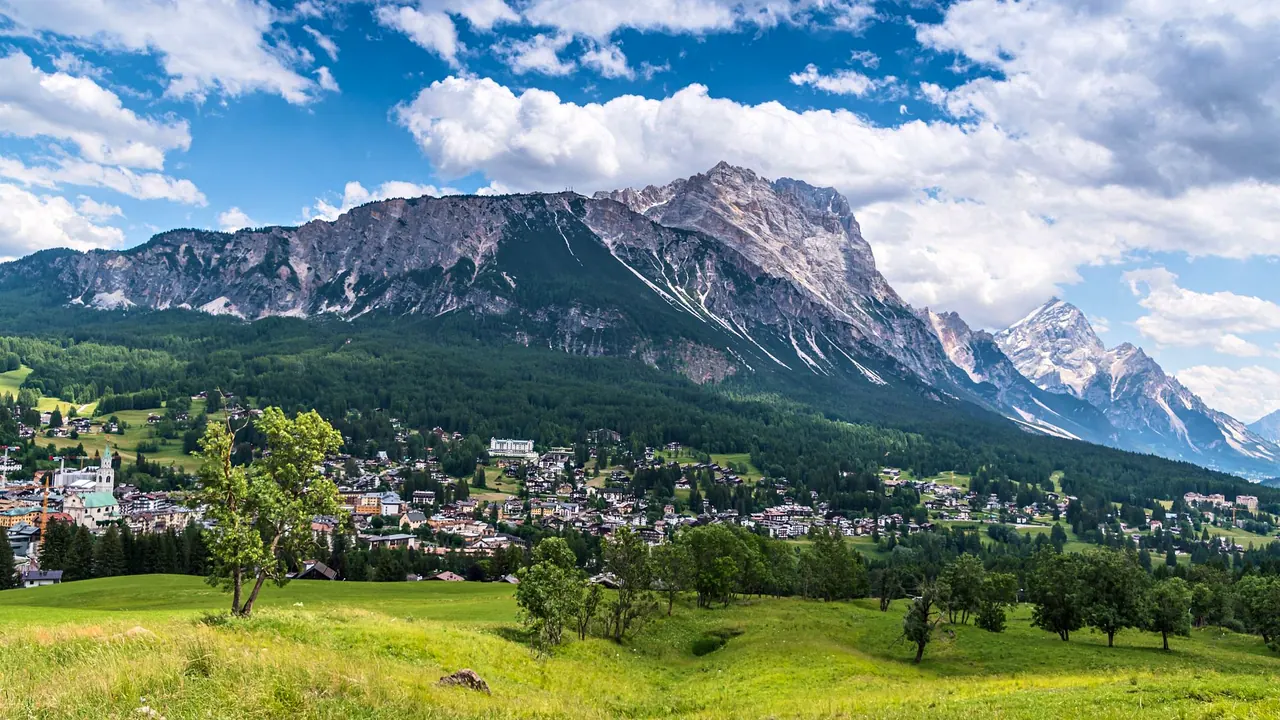
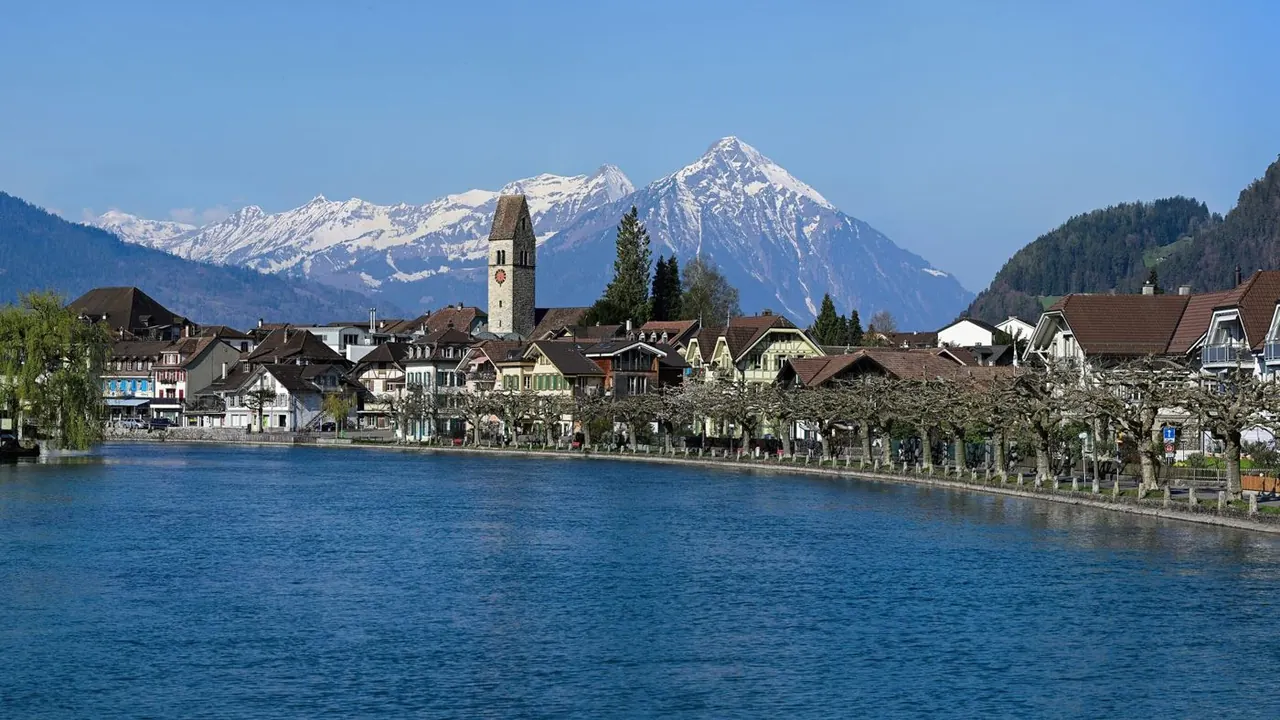
Photos: Cortina d'Ampezzo by Andreas Neubauer, Pexels License; Interlaken by Roy Egloff, CC BY-SA 4.0, cropped.
Cortina d'Ampezzo or Interlaken?
Our verdict in twelve categories, each scored against the same fixed benchmark cities, and the climate month by month, so you can choose for your trip.
Choose Cortina d'Ampezzo for
- food and drink
- shopping
- culture and sights
Cortina d'Ampezzo suits travellers who want the mountains with a polished Italian resort around them. That means long lunches at the rifugi, Ampezzan cooking, an evening passeggiata on the Corso Italia and some smart shopping. It works best with a car for ranging across the Dolomites. Choose it when eating well matters as much as the hiking or skiing.
Choose Interlaken for
- getting around
- day trips
- beaches
If you would rather leave the car at home, Interlaken is the better pick. Trains, cog railways, gondolas and lake steamers put the Jungfrau peaks, Lauterbrunnen, Bern and Thun within easy reach. That also makes it the easier base for families and for anyone who wants paragliding, rafting or a summer swim in Lake Thun. Expect plainer food, and a town you leave every morning for somewhere higher.
Scoreboard
Twelve categories on one fixed scale from 0 to 100. The shaded stretch is the gap between the two.
Your match
Pick a travel style or drag the sliders, and both match scores follow your weighting.
Wins on food and drink and shopping with your weighting.
Wins on getting around and day trips with your weighting.
What matters to you?
Category by category
What the scores mean for a trip.
Beaches & swimming
Neither is a beach destination, but Interlaken at least lets you swim. In July and August Lake Thun warms enough for a dip from the lidos and shingle shores at Neuhaus and towards Spiez. The colder turquoise Lake Brienz has a bathing area at Bönigen.
Cortina's lakes, Ghedina and Pianozes, stay cold from snowmelt all summer and are better for walking round. The Adriatic is over two hours away, so swimming there usually means the hotel pool.
Food & drink
Cortina eats noticeably better. Ampezzan cooking, with beetroot casunziei, polenta with game and barley soup, carries a Venetian accent. Lunch on a rifugio terrace is often the meal of the trip, although the choice is narrow and rarely cheap.
Interlaken's restaurants serve fondue, rösti and raclette to visitors, alongside Indian and Middle Eastern places. They are reliable but forgettable. Its best food is up in the hills, in dairy cheese and hut lunches, and many visitors get by on supermarket picnics.
Culture & sights
Neither town is a sightseeing destination, but Cortina gives you a little more. The basilica and its bell tower, the painted houses, the 1956 Olympic ice stadium and the Rimoldi collection of Italian art will fill a wet afternoon. The First World War tunnels on Lagazuoi and the Cinque Torri add real history for anyone who makes the climb.
Interlaken has the grand hotel frontage of the Höheweg, the Kursaal and a few old timber houses in Unterseen, and little else. Its culture lies a train ride away in Bern and Thun.
Nightlife
Neither town is built for late nights, so the real choice is the style of the evening. Cortina's is dressy and Italian: a drink as the lifts stop turning, a slow stroll along the Corso Italia to see and be seen, then a dinner that takes most of the evening. Only at the height of the ski season does much carry on after that, and summer evenings wind down early.
Interlaken draws a younger, more casual crowd from its hostels, so going out there means a pint, a match on a big screen or a small basement dance floor, with the Kursaal casino as the smarter option. With early trains and paragliding flights to catch, few people make a long night of it.
Nature & outdoors
Both sit in front of some of the finest mountain scenery in Europe, so the real choice is between two landscapes. Cortina is ringed by the pale, jagged towers of the Dolomites, with the Tre Cime and Lago di Misurina close by. It also has the Alta Via 1, some of the oldest via ferrata routes in the Alps and the Dolomiti Superski area.
Interlaken looks up to the Eiger, Mönch and Jungfrau, the waterfalls of Lauterbrunnen and the Aletsch glacier seen from the Jungfraujoch. Paragliding, canyoning and rafting all start from town. Its one weakness is low cloud, which can hide the peaks for days.
Day trips
Interlaken is much the better base for days away from the mountains. Bern's medieval arcades are under an hour by train, and lake steamers reach Thun and the castle towns of Spiez and Oberhofen. Lucerne, the woodcarvers of Brienz and the Ballenberg open-air museum are all easy rail trips.
From Cortina, most outings are mountain outings. Brunico and Bolzano in South Tyrol, the latter with the Iceman, are rewarding but mean a drive. Venice is a long day by coach.
Good for families
Interlaken is the stronger choice with children. The trains, gondolas and steamers are part of the fun, and the summit stations at Grindelwald First and the Harder Kulm have playgrounds and summer toboggan runs. The St Beatus caves and the farm animals at Ballenberg fill other days.
Cortina works for families who ski or hike. It has ski schools, beginner slopes at Socrepes, public skating and a forest rope park. Beyond the outdoors, though, there is little for children, and a rainy day drags.
Getting around
On transport the gap is wide. Interlaken sits on the Swiss rail network, and its mainline trains, narrow-gauge mountain lines, cog railways and lake steamers connect so well that the whole Jungfrau region works without a car.
Cortina has had no railway since 1964, so getting there means a coach from Venice or a long drive, and buses up to the passes and the Tre Cime are limited. The town itself is easy on foot, but most visitors hire a car.
Shopping & style
Cortina is the better place to shop, even though it is really one street. The Corso Italia has luxury fashion, jewellers, furriers and good mountain wear. The Cooperativa di Cortina, trading since 1893, is a pleasure to browse for local food and outdoor gear.
Interlaken's Höheweg is built around tour groups, with watch stores, army knives, cuckoo clocks and chocolate. Carved wood from Brienz is the one thing worth seeking out.
Affordability
Both are very expensive, and neither can be done cheaply. In Cortina the cost is heaviest for hotels in the winter peak and in August, with lift passes on top. Rifugio meals and the quieter weeks of June and late September ease the bill.
In Interlaken almost everything is priced at full Swiss levels, and the mountain railways cost the most, the Jungfraujoch above all. Hostels, supermarket picnics and regional transport passes soften the bill there.
Live music & performing arts
Neither offers much in the evenings, and most of what there is comes in summer. Cortina's chamber and classical festivals bring concerts to churches and sometimes out into the mountains. Interlaken has its long-running amateur open-air William Tell in the woods and folklore evenings with yodelling and alphorns, and Bern's theatre and orchestra are under an hour away.
Wellness & relaxation
Neither has thermal springs, so in both places relaxing mostly means a hotel spa. Cortina's spas are in the Alpine style, with saunas, hay baths and indoor pools, and the valley is at its calmest in June, September and the quieter winter weeks.
Interlaken's grand hotels on the Höheweg have sizeable spas, and the town has a public wellness area. The centre is busy with coach groups, though, so the most restful stays are by the lakes or up in Wengen and Mürren.
When should you go?
Pick your month. The climate figures are measured averages, not a forecast.
Cortina d'Ampezzo in July
Interlaken in July
Daytime high, °C
Rainfall in the month, mm
Where the figures come from
Interlaken has no rain gauge within 25 km of the centre, so its rainfall comes from a gridded climate dataset read at the city rather than from a gauge further away.
Interlaken's sunshine is measured 66 km from the centre, at Sion.
Temperature and rainfall are climate normals, averaged over the years shown. Cortina d'Ampezzo: 1991-2020 normals, Dobbiaco (22.5 km from centre). Interlaken: 2005-2020 (sunshine 1961-1990, rainfall 1991-2020) normals, Meiringen / Unterbach (19.3 km from centre).
Cortina has the colder, drier winter. January highs hover around 0°C and very little rain or snow falls, which suits clear, crisp days on the slopes through the cold months. Summer is mild rather than hot, around 22°C in July and August, but these are also its wettest months, with July bringing about 130mm. June is warm and quiet for the trails, though still fairly rainy. September is the steadier choice, mild and noticeably drier.
Interlaken lies lower and runs a couple of degrees warmer, reaching about 24°C in July, and its lakes are swimmable in July and August. It is wetter than Cortina for most of the year, and the gap is widest in winter, when Interlaken still gets around 75mm a month. In high summer the two are much alike for rain. In both places, late spring to early autumn is the time for walking and the high trails, and the cold months belong to skiing.
Which traveller are you?
On a family trip with children, Interlaken is the easier choice. Getting about is half the fun, the town is compact and safe, and almost every outing works without a car. Cortina suits children mainly if the whole family skis or hikes.
For a food and nightlife trip, Cortina is the better bet. Italian mountain cooking with a Venetian accent beats Interlaken's tourist menus, and in the winter season the evenings have a dressier crowd, long dinners and a few bars open late.
On a shopping trip, Cortina wins comfortably, especially for anyone with style and a generous budget in mind. Its one street does luxury and quality mountain wear well, while Interlaken's shops mostly sell souvenirs to people passing through.
Before you go
| Measure | Cortina d'Ampezzo | Interlaken |
|---|---|---|
| Official language | Italian | French, German, Italian, Romansh |
| Currency | Euro (EUR) | Swiss Franc (CHF) |
| Sockets | CFL230 V, 50 Hz | CJ230 V, 50 Hz |
| Driving side | Right | Right |
| Time zone | UTC+1, UTC+2 in summer | UTC+1, UTC+2 in summer |
| Emergency number | 112 | 112 |
| Elevation | 1,224 m | 571 m |
| Main airport | Venice Marco Polo Airport (VCE)116 km from centre103 non-stop destinations | Zürich Airport (ZRH)100 km from centre226 non-stop destinations |
| Public holidays this year | 13 days | 10 days |
By the numbers
| Measure | Cortina d'Ampezzo | Interlaken |
|---|---|---|
| City population | 5,546 | 6,123 |
| People per km² | 22 | 1,424 |
| Museums within 10 km | 3 | 3 |
| UNESCO World Heritage sites within 50 km | 1 | 2 |
Where else could you go?
Every comparison below shares a destination with this one, so you can follow Cortina d'Ampezzo or Interlaken somewhere new.
- Bernvs Interlaken
- Lucernevs Interlaken
- Zurichvs Interlaken
- Lausannevs Interlaken
- Innsbruckvs Cortina d'Ampezzo
- Baselvs Interlaken