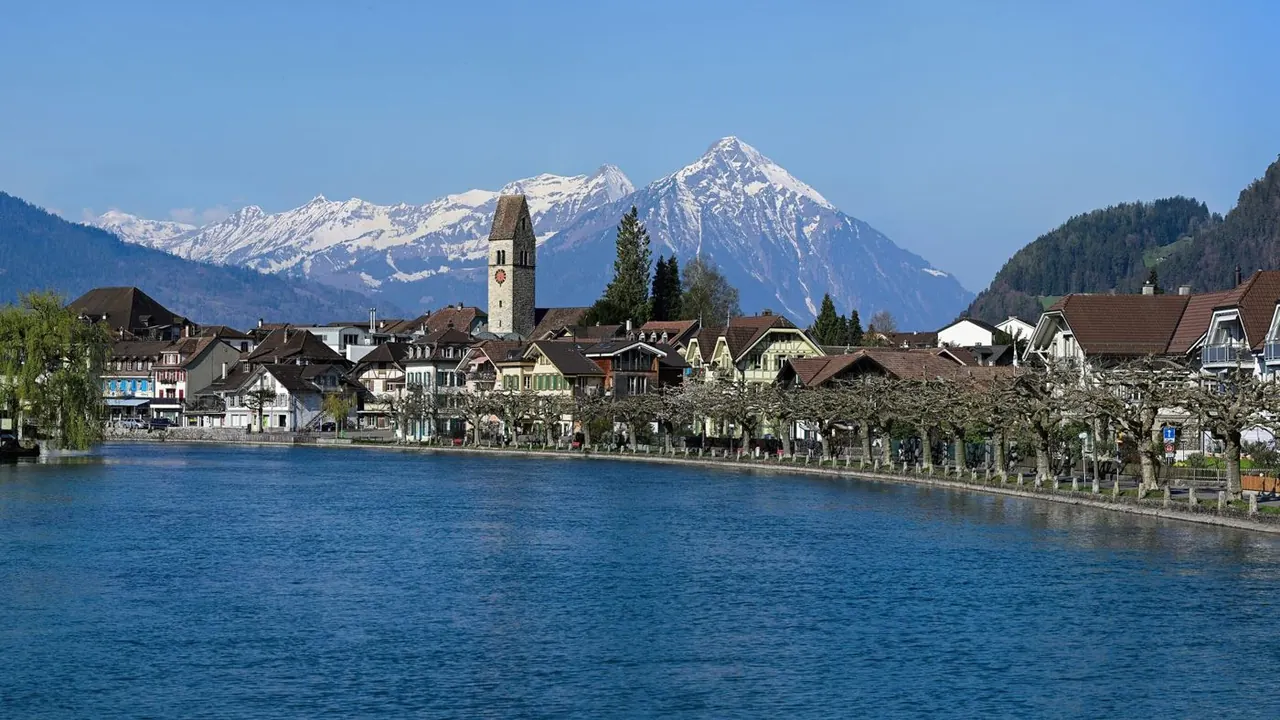
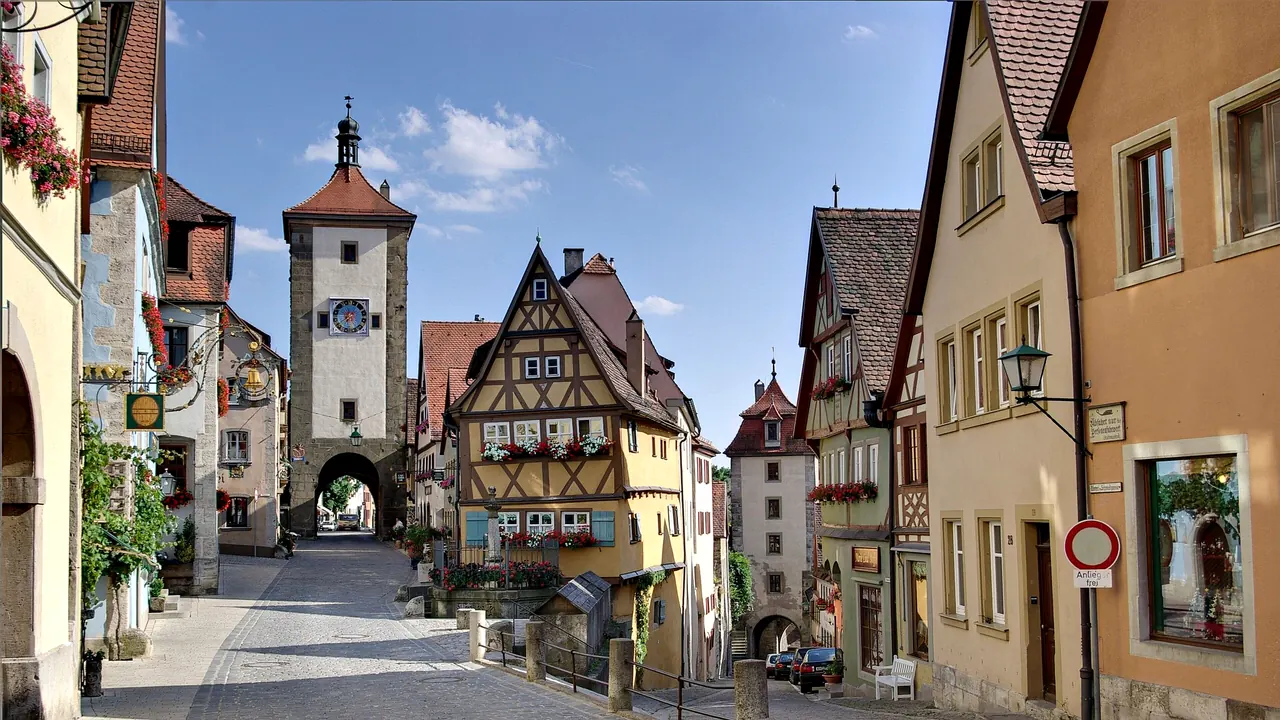
Photos: Interlaken by Roy Egloff, CC BY-SA 4.0, cropped; Rothenburg ob der Tauber by Berthold Werner, Public domain.
Interlaken or Rothenburg ob der Tauber?
Our verdict in twelve categories, each scored against the same fixed benchmark cities, and the climate month by month, so you can choose for your trip.
Choose Interlaken for
- nature and the outdoors
- families
- beaches
Choose Interlaken if the mountains are the point of the trip. It is a base rather than a destination in itself: the Jungfrau peaks, the Lauterbrunnen valley, high trails reached by cable car and a full menu of paragliding, canyoning and lake sports all start from its two stations. Families and active travellers get the most from it, as long as they accept Swiss prices and the chance that cloud hides the view for a day or two.
Choose Rothenburg ob der Tauber for
- culture and sights
- prices
- shopping
Rothenburg ob der Tauber rewards the traveller who wants to wander through history. The walled medieval town, with its ramparts, gate towers and Riemenschneider altar, is the whole attraction, and it is at its best in the quiet early mornings and evenings. It costs far less than Interlaken and pairs well with other Romantic Road towns by car, but two or three days covers it and the outdoors stays gentle.
Scoreboard
Twelve categories on one fixed scale from 0 to 100. The shaded stretch is the gap between the two.
Your match
Pick a travel style or drag the sliders, and both match scores follow your weighting.
Wins on nature and the outdoors and families with your weighting.
Wins on culture and sights and prices with your weighting.
What matters to you?
Category by category
What the scores mean for a trip.
Beaches & swimming
Neither is a beach destination, but Interlaken at least gives you water worth swimming in. In July and August the grassy lidos and shingle shores of Lake Thun reach swimmable temperatures, and Lake Brienz offers a colder glacial dip with snow peaks behind.
Rothenburg sits on a hilltop far inland. Swimming means the town pool or a drive of about an hour to the artificial lakes of the Franconian lake district.
Food & drink
Both are places to eat well enough rather than to travel for food, and the difference is mostly in kind. Interlaken mixes fondue, raclette and rösti with Indian and Asian kitchens for its international visitors, and its best meals happen higher up, on hut terraces above Grindelwald or Mürren, or with cheese bought straight from a mountain dairy.
Rothenburg sticks firmly to Franconia: Schäufele, bratwurst and dumplings in timbered inns, with Silvaner from a Bocksbeutel or a regional beer. It has a slightly stronger local identity, especially in the family guesthouses and Tauber valley wine taverns away from the Marktplatz.
Culture & sights
This is where Rothenburg pulls far ahead. The whole town inside the walls is the sight: the rampart walkway, the Plönlein between its gate towers, the view from the Rathaus tower, Riemenschneider's Holy Blood Altar in St Jakob's and the Medieval Crime Museum.
Interlaken offers a stroll past the belle époque hotels and the Kursaal on the Höheweg and a look at Unterseen's few timber houses. For real architecture you have to take the train to Bern or Thun.
Nightlife
Both towns go quiet early, but Interlaken has a bit more going on. Its backpacker pubs, sports bars and a couple of basement clubs fill up in summer and the ski season, and the Kursaal has a casino.
In Rothenburg the evening is a glass of Franconian wine in an inn and the night watchman's lantern-lit tour. Anyone wanting more has to drive to Würzburg or Nuremberg.
Nature & outdoors
Interlaken is one of the great mountain bases in Europe. Within an hour by rail are the Jungfraujoch above the Aletsch glacier, the waterfalls of the Lauterbrunnen valley and ridge trails from Schynige Platte and Grindelwald First, with paragliding, canyoning and winter skiing on top.
Rothenburg's outdoors is small in scale and gentle: paths dropping from the walls to the mills and meadows of the Tauber, a family cycle route through vineyards and the rolling Frankenhöhe. It makes a lovely afternoon but not the reason for a trip.
Day trips
Both make good bases, and Interlaken is slightly ahead because trains and paddle steamers do the work. Bern's arcaded old town, Thun's castle, the lakeside castles at Spiez and Oberhofen, Ballenberg's open-air museum and Lucerne are all reachable without a car.
Rothenburg's surroundings are just as rich in history: Dinkelsbühl, crater-ringed Nördlingen, Würzburg's Residenz and Nuremberg are all within about an hour. The catch is the branch-line railway, so you will want a car.
Good for families
Interlaken is the better family choice. Cog railways, gondolas and lake steamers are an adventure in themselves, and the summit stations add playgrounds, cliff walks and summer toboggan runs, with the St Beatus caves and Ballenberg's farm animals for variety. Wet days and high altitude with toddlers are the weak points.
Rothenburg charms children for a day or two with its ramparts, its tower climb and the night watchman, and older ones love the torture devices in the crime museum. After that it runs short of things to do, and the cobbles are tough on pushchairs.
Getting around
Both centres are small enough to walk, but beyond them the gap is wide. From Interlaken, mainline trains, Bernese Oberland railways, cable cars and steamers connect smoothly, so the whole Jungfrau region works without a car, and many hotels include a regional transport card. Only the summer crush on popular mountain trains spoils it.
In Rothenburg the old town takes about fifteen minutes to cross on foot, and cars are kept outside the gates. Leaving it is harder: rail trips usually need a change at Steinach and rural buses are sparse, so a car makes far more sense.
Shopping & style
Neither town is a place to shop, and both sell mostly to people passing through, so the difference lies in what is on the shelves. Interlaken leans on Swiss luxury and keepsakes: watches and jewellery for the coach parties, then army knives, chocolate and cuckoo clocks, with outdoor shops for a forgotten rain jacket. Woodcarving from Brienz, along the lake, is the one thing made locally that is worth taking home.
Rothenburg has the slight edge because it has a speciality. Christmas decorations are on sale all year, from glass baubles to nutcrackers and Erzgebirge smoking men, alongside teddy bears and pewter in the Herrngasse and Schmiedgasse. In December the market fills the Marktplatz inside the medieval walls. In both towns, fashion and everyday shopping barely exist.
Affordability
Rothenburg is much easier on the wallet. It has small-town German prices with a tourist premium on top, and you can save by staying outside the walls, drinking local wine and beer and walking everywhere for free.
Interlaken is expensive at every turn. Hotels and meals are at full Swiss levels, and the mountain railways that are the reason to come, the Jungfraujoch above all, cost more than most visitors expect. Picnics and passes help, but only a little.
Live music & performing arts
Both towns keep their stage life seasonal and rooted in local legend, so neither offers much. Interlaken's amateur open-air William Tell in the woods is its signature, with folklore evenings of yodelling and alphorns, and Bern's theatre and orchestra are under an hour away.
Rothenburg answers with the costumed Meistertrunk play and its processions, summer open-air theatre and organ and choral concerts in St Jakob's.
Wellness & relaxation
Interlaken keeps its spas inside its grand hotels, while Rothenburg sends you out to real thermal baths. In Interlaken, the big Höheweg hotels and the town's public pool and wellness area are where you go to be pampered. Beyond that, rest comes from the setting: an early hour on the lakeshore, a slow steamer crossing, or a room up in car-free Wengen or Mürren, away from the coach groups and backpackers in the centre.
Rothenburg's hotel spas are small, but within about an hour's drive you can float in the salt-water pool at Bad Windsheim or soak in the old spa town of Bad Mergentheim. In town, the calm comes at dawn and after the day visitors leave, when the walls and the paths down into the Tauber valley are almost empty.
When should you go?
Pick your month. The climate figures are measured averages, not a forecast.
Interlaken in July
Rothenburg ob der Tauber in July
Daytime high, °C
Rainfall in the month, mm
Where the figures come from
Interlaken has no rain gauge within 25 km of the centre, so its rainfall comes from a gridded climate dataset read at the city rather than from a gauge further away.
Interlaken's sunshine is measured 66 km from the centre, at Sion.
Rothenburg ob der Tauber's sunshine is measured 27 km from the centre, at Feuchtwangen-heilbronn.
Temperature and rainfall are climate normals, averaged over the years shown. Interlaken: 2005-2020 (sunshine 1961-1990, rainfall 1991-2020) normals, Meiringen / Unterbach (19.3 km from centre). Rothenburg ob der Tauber: 1991-2020 normals, Rothenburg ob der Tauber (0.9 km from centre).
The two share a similar curve of temperature, cold in winter at around 3°C in January and warm by midsummer, but the weather feels different. Interlaken is the wetter of the two, and its summer is its rainiest season, with about 125mm a month from June to August, though July is also its sunniest month. July and August are the only months when Lake Thun and Lake Brienz are pleasant for a swim, and June to September is the window for high trails. In winter the valley is grey and cold, and the attraction moves up to the ski slopes.
Rothenburg stays drier all year, with no month much above 65mm, and its July and August highs of about 25°C are comfortable for walking the walls and cobbled lanes. Late spring and early autumn suit sightseeing well, with orchard blossom and autumn colour in the Tauber valley. From November to February the days are short and grey, but it is cold rather than wet, which suits a December visit for the Christmas market.
Which traveller are you?
On an outdoors trip, Interlaken is the clear pick. Mountain railways lift you onto high trails below the Eiger and Jungfrau, and paragliding, rafting and lake paddling are run from town. Rothenburg's valley walks and cycle path are pleasant but mild by comparison.
For a culture and arts trip, Rothenburg wins easily. A medieval walled town, a late Gothic carved altar and a serious museum of crime and punishment all lie within a few lanes. Interlaken's history is mostly grand hotels, so for museums you have to take the train elsewhere.
On a trip on a tight budget, Rothenburg is far kinder. Rooms outside the walls, inn meals, local beer and wine and modest entry fees keep costs down. In Interlaken the mountain railways alone take a large share of any budget, before you pay Swiss hotel and restaurant prices.
Before you go
| Measure | Interlaken | Rothenburg ob der Tauber |
|---|---|---|
| Official language | French, German, Italian, Romansh | German |
| Currency | Swiss Franc (CHF) | Euro (EUR) |
| Sockets | CJ230 V, 50 Hz | CF230 V, 50 Hz |
| Driving side | Right | Right |
| Time zone | UTC+1, UTC+2 in summer | UTC+1, UTC+2 in summer |
| Emergency number | 112 | 112 |
| Elevation | 571 m | 430 m |
| Main airport | Zürich Airport (ZRH)100 km from centre226 non-stop destinations | Nuremberg Airport (NUE)66 km from centre56 non-stop destinations |
| Public holidays this year | 10 days | 12 days |
By the numbers
| Measure | Interlaken | Rothenburg ob der Tauber |
|---|---|---|
| City population | 6,123 | 11,331 |
| People per km² | 1,424 | 272 |
| Museums within 10 km | 3 | 6 |
| UNESCO World Heritage sites within 50 km | 2 | 2 |
Where else could you go?
Every comparison below shares a destination with this one, so you can follow Interlaken or Rothenburg ob der Tauber somewhere new.
- Bernvs Interlaken
- Lucernevs Interlaken
- Nurembergvs Rothenburg ob der Tauber
- Zermattvs Interlaken
- Bambergvs Rothenburg ob der Tauber
- Zurichvs Interlaken