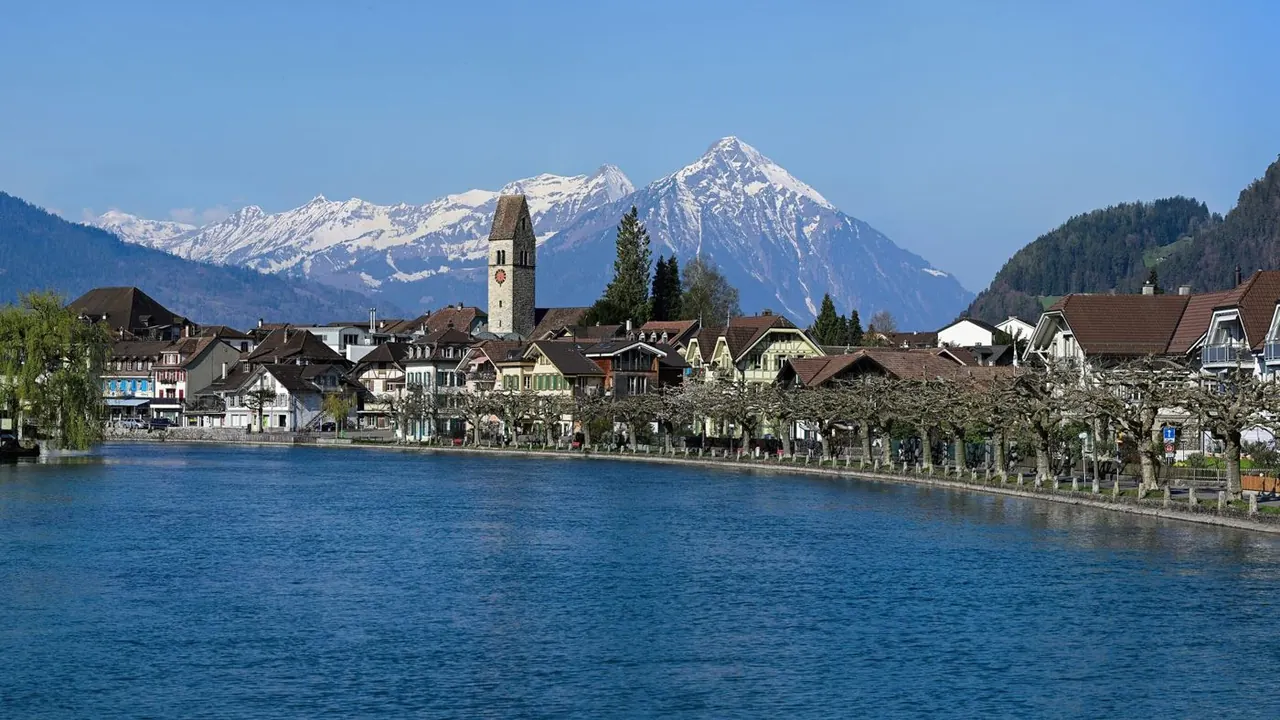
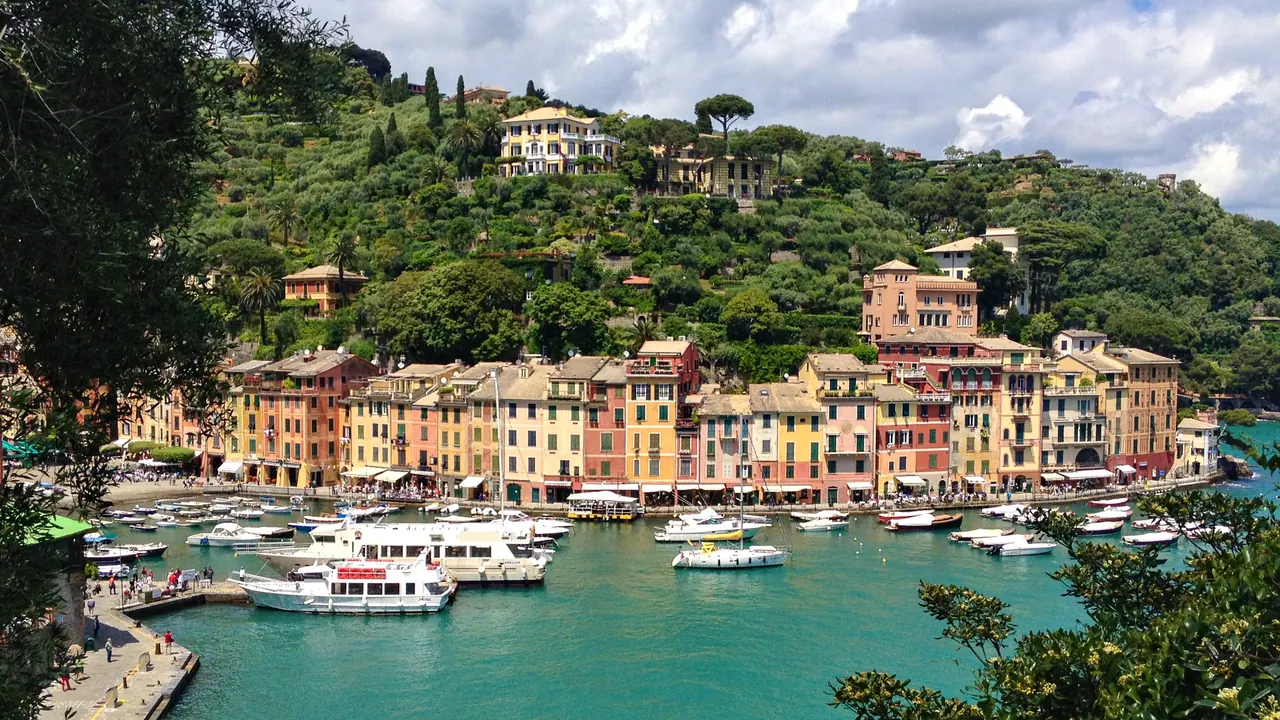
Photos: Interlaken by Roy Egloff, CC BY-SA 4.0, cropped; Portofino by Michal Osmenda, CC BY 2.0, cropped.
Interlaken or Portofino?
Our verdict in twelve categories, each scored against the same fixed benchmark cities, and the climate month by month, so you can choose for your trip.
Choose Interlaken for
- families
- getting around
- nature and the outdoors
Interlaken is the choice when the mountains are the point of the trip. It puts the Eiger, Mönch and Jungfrau, the Lauterbrunnen valley and some of the best-organised trains and cable cars in the world on your doorstep, so walkers, paragliders, skiers and families who want easy, safe adventure will get far more from it. The town itself is plain and quiet in the evenings, and most of what you do happens above it.
Choose Portofino for
- beaches
- culture and sights
- food and drink
Portofino suits a slower, more sensual kind of stay: swimming off rocks in clear water, a long lunch over the harbour, a coastal walk to an abbey you can only reach on foot or by boat. Couples and travellers who care more about setting than about a full itinerary will love it, while families and anyone hoping to pack in activities will find it small, steep and short on things to do.
Scoreboard
Twelve categories on one fixed scale from 0 to 100. The shaded stretch is the gap between the two.
Your match
Pick a travel style or drag the sliders, and both match scores follow your weighting.
Wins on families and getting around with your weighting.
Wins on beaches and culture and sights with your weighting.
What matters to you?
Category by category
What the scores mean for a trip.
Beaches & swimming
Neither place has much of a beach, but Portofino gives you the sea. Swimming off the rock platforms along the lighthouse path, in deep, clear water, is a real pleasure, and the sandy cove at Paraggi and the pebbles below San Fruttuoso are close by, though all of them are small and fill up in summer.
Interlaken offers lake swimming instead: lidos and shingle at Neuhaus on Lake Thun, or a colder plunge in turquoise Lake Brienz at Bönigen. It makes a lovely end to a mountain day in July or August, but the water rarely gets past cool and the season is brief.
Food & drink
Portofino has the edge, mainly because Ligurian cooking has a clear identity: trofie with pesto, pansoti in walnut sauce, fritto misto and the cheese-filled focaccia of Recco. The harbour restaurants charge heavily for the yachts in view, though, and the better meals are found in Camogli, Santa Margherita or the trattorie in the hills.
In Interlaken the town's tables run to fondue, rösti and international standbys aimed at visitors, so the memorable eating happens higher up, with Alpine cheese from a mountain dairy or lunch on a hut terrace above Mürren.
Culture & sights
Portofino at least is a sight in itself: the horseshoe of tall painted houses around the harbour, the church of San Giorgio, Castello Brown with its gardens, and the medieval abbey at San Fruttuoso in its roadless cove. A day covers it, but it is a beautiful day.
Interlaken offers even less, a row of nineteenth-century grand hotels on the Höheweg, the Kursaal and a few timber houses in Unterseen. For history and architecture you take the train to Bern or Thun.
Nightlife
Both go quiet early, but in different styles. Interlaken has a small, casual backpacker scene of pubs, sports bars and a couple of basement clubs near the hostels, plus the Kursaal casino, and it picks up in summer and the ski season.
Portofino is about dressing up for a long aperitivo at the elegant bars facing the yachts, followed by dinner and then very little. For anything later you head to Santa Margherita, Rapallo or Genoa.
Nature & outdoors
Interlaken is in another league. The Jungfraujoch railway climbs to 3,454m above the Aletsch glacier, waterfalls pour down the walls of the Lauterbrunnen valley, and cable cars lift you onto high trails at First, Schynige Platte and Mürren. Paragliding, canyoning, rafting and winter skiing are all run from the town.
Portofino's headland is a rewarding place on a smaller scale: a protected park with cliff paths over Monte di Portofino to San Fruttuoso and Camogli, some with chains on exposed stretches. Offshore, the marine reserve's red coral walls and the Christ of the Abyss statue draw divers, something the Alps cannot match.
Day trips
Interlaken's outings run on rails and lake steamers, Portofino's on coastal boats and the Riviera line. From Interlaken, Bern's arcaded old town is under an hour away, Thun and its castle half an hour, and Lucerne about two hours over the Brünig Pass, while steamers call at Spiez and Oberhofen and Brienz leads on to the open-air museum at Ballenberg.
From Portofino, boats and buses reach Santa Margherita, Rapallo and Camogli, and Genoa's medieval centre and Renaissance palaces are under an hour away. In summer the ferries carry on to the Cinque Terre and Portovenere, so the journey becomes part of the day, but outside that season the trains take over and outings need more planning.
Good for families
Interlaken is far easier with children. The trains, gondolas and lake steamers are adventures in themselves, the summit stations have playgrounds, cliff walks and summer toboggan runs, and the St Beatus caves and Ballenberg's farm animals rarely fail. Wet days and high altitudes with very young children are the main things to plan around.
Portofino is calm and safe but made for adults, with no playgrounds, steep stepped paths that defeat pushchairs and sand mostly given over to paid clubs. Families usually stay in Rapallo or Santa Margherita and make the trip to Genoa's aquarium.
Getting around
Interlaken is much the easier place to move around. Its flat centre links two stations on foot, and beyond it narrow-gauge trains, cog railways, gondolas and lake steamers connect so smoothly that the whole Jungfrau region works without a car, despite crowding on the busiest summer trains.
Portofino is tiny but awkward to reach. One narrow road about 5km long links it to Santa Margherita, parking is scarce and the summer buses are packed, so the spring to autumn ferries are often the pleasantest way in.
Shopping & style
Portofino comes out a little ahead, if only for browsing. Its few lanes hold a surprising number of big fashion and jewellery houses and resort-wear shops, plus Ligurian lace and ceramics, all seen in under an hour.
Interlaken's Höheweg sells watches, army knives, cuckoo clocks and chocolate to tour groups, along with outdoor gear, and the carved wood from Brienz is the one local craft worth carrying home.
Affordability
Both are among the most expensive places you could choose, so the difference lies in where the money goes. In Interlaken the mountain railways and cable cars, the Jungfraujoch above all, take a large share, though hostels, transport passes and supermarket picnics help.
In Portofino the few hotels are luxury properties, and the piazzetta, the Paraggi loungers and boat hire all add up. Sleeping in Santa Margherita, Rapallo or Camogli and coming in for the day is the usual way round it.
Live music & performing arts
Interlaken has a little more to offer, chiefly the long-running open-air William Tell performed by local amateurs in the woods each summer, along with folklore evenings of yodelling and alphorns. Bern's theatre and orchestra are under an hour away.
Portofino has only occasional summer concerts in the piazzetta or at the castle, so a real night of opera or theatre means the Teatro Carlo Felice in Genoa.
Wellness & relaxation
Neither has a bathing tradition, and in both the spas belong to the grand hotels. Interlaken adds a public pool and wellness area, but its centre is geared to activity, so rest comes from steamer crossings or the quiet of Wengen and Mürren.
Portofino's calm comes from long lunches by the water and shaded paths with only the sea for company, best early, late or outside high summer, when tour boats fill the harbour at midday.
When should you go?
Pick your month. The climate figures are measured averages, not a forecast.
Interlaken in July
Portofino in July
Daytime high, °C
Rainfall in the month, mm
Where the figures come from
Interlaken has no rain gauge within 25 km of the centre, so its rainfall comes from a gridded climate dataset read at the city rather than from a gauge further away.
Portofino's temperatures are measured 31 km from the centre, at Genova / Sestri.
Portofino has no rain gauge within 25 km of the centre, so its rainfall comes from a gridded climate dataset read at the city rather than from a gauge further away.
Temperature and rainfall are climate normals, averaged over the years shown. Interlaken: 2005-2020 (rainfall 1991-2020) normals, Meiringen / Unterbach (19.3 km from centre). Portofino: 1991-2020 normals, Genova / Sestri (31 km from centre).
Interlaken is a summer and winter destination with little in between. From June to August days reach about 24°C, warm enough for high trails and a cool dip in Lake Thun, but this is also the wettest stretch, with around 127mm of rain a month and cloud that can hide the peaks. Winters are cold, close to freezing by day, which suits skiers rather than sightseers, and spring and autumn are mild but changeable.
Portofino runs to the opposite rhythm. Summer is hot and dry, peaking at 28°C in August, and the sea is warm enough to swim from June into early October, reaching about 25°C at its height. Autumn brings the heaviest rain, with October and November the wettest months at up to 225mm, while spring is mild and dry enough for the best hiking. Winters stay gentle, far warmer than in the Alps, though too cool for swimming.
Which traveller are you?
For a beach and sun trip, Portofino is the obvious pick. The sea is warm through summer and very clear off the rocks towards the lighthouse, with Paraggi and San Fruttuoso close by, while Interlaken's lakes are cold for most of the year.
On a family trip with children, Interlaken works much better. Rack railways, gondolas and steamers thrill children, the summit stations have playgrounds and toboggan runs, and the valley floor is flat. Portofino has steep steps, paid beach clubs and nothing aimed at the young.
On an outdoors trip, Interlaken is one of the great bases anywhere, with glaciers, high trails, paragliding, canyoning and skiing all reached by train. Portofino offers fine coastal hikes and diving in its marine reserve, but on a much smaller scale.
Before you go
| Measure | Interlaken | Portofino |
|---|---|---|
| Official language | French, German, Italian, Romansh | Italian |
| Currency | Swiss Franc (CHF) | Euro (EUR) |
| Sockets | CJ230 V, 50 Hz | CFL230 V, 50 Hz |
| Driving side | Right | Right |
| Time zone | UTC+1, UTC+2 in summer | UTC+1, UTC+2 in summer |
| Emergency number | 112 | 112 |
| Elevation | 571 m | 20 m |
| Main airport | Zürich Airport (ZRH)100 km from centre226 non-stop destinations | Genoa Cristoforo Colombo Airport (GOA)32 km from centre25 non-stop destinations |
| Public holidays this year | 10 days | 13 days |
By the numbers
| Measure | Interlaken | Portofino |
|---|---|---|
| City population | 6,123 | 355 |
| People per km² | 1,424 | 142 |
| Museums within 10 km | 3 | 14 |
| UNESCO World Heritage sites within 50 km | 2 | 2 |
| Swim season, months above 21 °C | - | 4 months |
Where else could you go?
Every comparison below shares a destination with this one, so you can follow Interlaken or Portofino somewhere new.