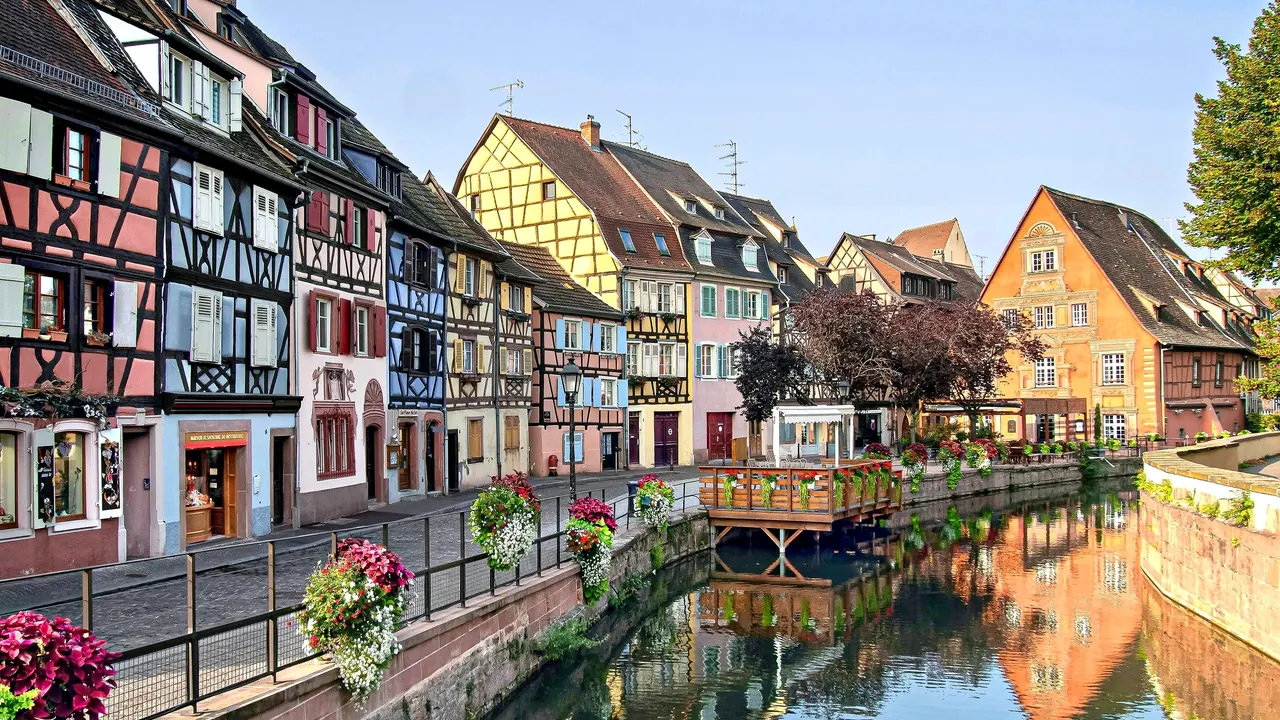
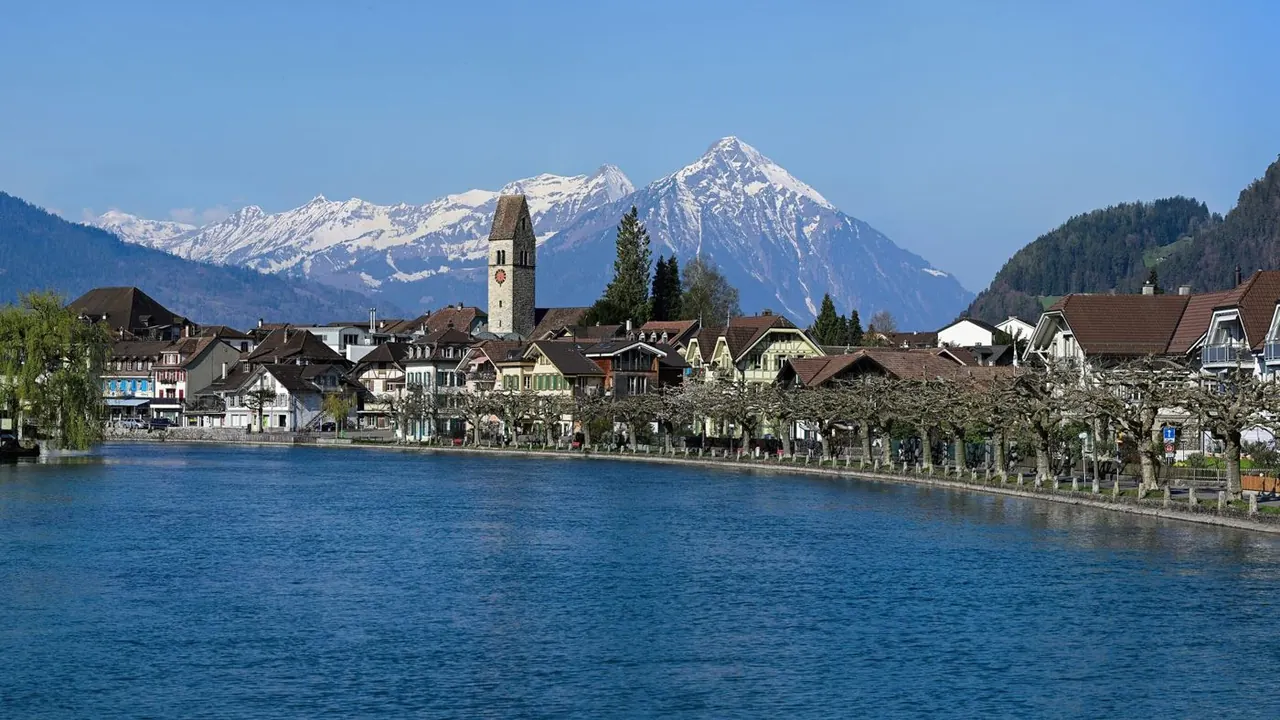
Photos: Colmar by Rolf Kranz, CC BY-SA 4.0, cropped; Interlaken by Roy Egloff, CC BY-SA 4.0, cropped.
Colmar or Interlaken?
Our verdict in twelve categories, each scored against the same fixed benchmark cities, and the climate month by month, so you can choose for your trip.
Choose Colmar for
- culture and sights
- food and drink
- prices
Colmar suits travellers who want a painted old town, one great museum and long tables of Alsace food and wine, with France, Germany and Switzerland all within a day's reach. It is the gentler and cheaper choice. It works best for a few unhurried days of eating, looking and tasting in the wine villages, ideally with a car for the countryside.
Choose Interlaken for
- nature and the outdoors
- beaches
- getting around
Pick Interlaken if the mountains are the whole point. The Jungfrau peaks, the Lauterbrunnen valley and a close-knit network of trains, gondolas and steamers make it one of Europe's best places to hike, paraglide or ski without driving, and children enjoy the ride up as much as the view. Expect to pay heavily for it, and don't expect much from the town's food or sights.
Scoreboard
Twelve categories on one fixed scale from 0 to 100. The shaded stretch is the gap between the two.
Your match
Pick a travel style or drag the sliders, and both match scores follow your weighting.
Wins on culture and sights and food and drink with your weighting.
Wins on nature and the outdoors and beaches with your weighting.
What matters to you?
Category by category
What the scores mean for a trip.
Beaches & swimming
Neither is a beach destination, but Interlaken at least has water on its doorstep. In July and August, Lake Thun warms enough for a swim from the lidos at Neuhaus or along the shore towards Spiez, and the glacial turquoise of Lake Brienz at Bönigen makes for a bracing dip. Colmar sits far inland on the Alsace plain and has only municipal pools and the odd small Vosges lake, so a swim there is an errand rather than part of the day.
Food & drink
Colmar is the place to eat. Its wood-panelled winstubs serve the Franco-German cooking of Alsace: choucroute, baeckeoffe, tarte flambée and munster cheese. The covered market on the Lauch is full of charcuterie and gingerbread, and the Riesling and Gewurztraminer come from the slopes just outside town, with cellar tastings in the villages.
In Interlaken you mostly eat to refuel. Fondue, rösti and raclette for visitors, plus Indian and Asian places for the international crowd, are dependable but forgettable. The memorable meals happen higher up, on a hut terrace above Grindelwald or with cheese from a mountain dairy, and many visitors live on supermarket picnics.
Culture & sights
A culture-minded visitor can fill two full days in Colmar without leaving town. The old town works as one late-medieval and Renaissance ensemble rather than a few showpieces, so the walk from the tanners' quarter to Petite Venise is itself part of the sightseeing. Grünewald's altarpiece in the Unterlinden is the kind of work people plan a whole trip around, and Schongauer's Madonna and Bartholdi's birthplace round out the visit.
You can see Interlaken in an hour: the grand hotels and the Kursaal along the Höheweg, then across the Aare to the timber houses of Unterseen. The town was built as a base for the mountains, and any serious art or architecture means a train ride somewhere else.
Nightlife
Both towns go quiet early, but in different ways. In Colmar the evening is a long dinner followed by a glass in a wine bar or brasserie near Petite Venise, and summer terraces are as lively as it gets. Interlaken has a small backpacker circuit of pubs, sports bars and a couple of basement clubs near the hostels, plus the Kursaal casino, though most people there are in bed early for the morning trains.
Nature & outdoors
Colmar's countryside is lovely and close. Marked paths run through the vines between wine villages, and above them rise the rounded, forested Vosges, crossed by the Route des Crêtes past the Grand Ballon. Autumn is the best season, and a car makes it all easier.
Interlaken is on another scale altogether. The Eiger, Mönch and Jungfrau, the waterfalls of Lauterbrunnen and the Aletsch glacier seen from the Jungfraujoch are all within an hour by rail, and paragliding, canyoning, rafting and serious skiing are run from town. The one catch is cloud, which can hide the peaks for days.
Day trips
Both make fine bases, but Colmar has more variety within easy reach. Strasbourg's cathedral is half an hour away by train, and the walled and winding wine villages of Riquewihr, Eguisheim and Kaysersberg lie a few kilometres apart. Basel and Freiburg put two more countries within about an hour.
From Interlaken, Bern's arcaded old town is under an hour away, lake steamers link the castles of Thun, Spiez and Oberhofen, and the Ballenberg open-air museum is near Brienz. Lucerne takes about two hours, though the scenic line over the Brünig Pass makes the journey part of the day.
Good for families
Interlaken has the edge with children because the excursions themselves are the fun. Rack railways, gondolas and steamers lead to summit stations with playgrounds, cliff walks and summer toboggan runs, and the St Beatus caves make a change. Rainy days are harder to fill, and very young children may struggle at the highest altitudes.
Colmar is flat and easy, with boat rides through Petite Venise and storks nesting on the roofs. Its best family outings, though, are outside town and need a car: the macaques at Kintzheim, the stork and otter park at Hunawihr and Europa-Park across the Rhine.
Getting around
Both towns are small and flat enough to walk. The difference lies beyond them. Interlaken connects straight into a well-timed system of mainline trains, narrow-gauge mountain lines, cog railways and lake boats, so the whole Jungfrau region works without a car, though the popular trains get crowded in summer.
Colmar has quick regional trains to Strasbourg and Mulhouse, but buses to the wine villages and the Vosges are thin. Most visitors hire a car or cycle the vineyard roads.
Shopping & style
Colmar is the better place for things that come from the region itself: wine bought from the grower, Soufflenheim pottery and kougelhopf moulds, printed Alsatian linen, and the independent boutiques around the Rue des Marchands. In December the Christmas markets spread across several squares and turn shopping into the main event.
Interlaken's Höheweg is given over to tour groups, with big watch stores, army knives, cuckoo clocks and chocolate, plus outdoor gear for anyone who came underprepared. Brienz woodcarving is the one local craft worth seeking out.
Affordability
Colmar is moderately priced for Western Europe. Set lunches are reasonable and village wine tastings are often free. Rooms are the expensive part, especially in summer and during the Christmas market weeks, and staying in a nearby village helps.
Interlaken runs at full Swiss prices, and the mountain railways that are the point of a stay add a large bill on top, the Jungfraujoch above all. Transport passes, hostels and picnics help, but a week there costs far more than a week in Alsace.
Live music & performing arts
Colmar has a small Italian-style theatre with a proper season of plays, opera and concerts, and the Opéra national du Rhin tours there. A classical music festival in July and a jazz festival in autumn are the high points of its year. Between those weeks the programme is thin.
Interlaken's best-known show is the open-air William Tell, put on in the woods each summer by local amateurs, along with folklore evenings of yodelling, alphorns and flag throwing. For orchestral music or serious theatre you go to Bern.
Wellness & relaxation
In Colmar, spas mean hotel spas, in town or out in the wine villages. The rest comes from the pace: long lunches, quiet evenings by the canals once the day-trippers have gone, and unhurried walks through the vines.
Interlaken offers more for anyone who wants pampering. Several of the grand Höheweg hotels have sizeable spas, and the town has a public pool and wellness area. The centre itself is busy and geared to activity, but early mornings by the lake, slow steamer crossings and the quiet of Wengen or Mürren are genuinely restful.
When should you go?
Pick your month. The climate figures are measured averages, not a forecast.
Colmar in July
Interlaken in July
Daytime high, °C
Rainfall in the month, mm
Where the figures come from
Interlaken has no rain gauge within 25 km of the centre, so its rainfall comes from a gridded climate dataset read at the city rather than from a gauge further away.
Interlaken's sunshine is measured 66 km from the centre, at Sion.
Temperature and rainfall are climate normals, averaged over the years shown. Colmar: 1991-2020 normals, Ihringen (21.1 km from centre). Interlaken: 2005-2020 (sunshine 1961-1990, rainfall 1991-2020) normals, Meiringen / Unterbach (19.3 km from centre).
Colmar's summer is warm and bright, with highs reaching 27°C in August and long, sunny days from May to August. It is also when most of the town's rain falls, May especially, so a wet afternoon is possible even in high summer. Spring and September to October are the most comfortable months for walking the old town and the vineyards. Winters are cold and grey, with highs around 6°C, short days and little sun.
Interlaken is cooler and much wetter all year. July peaks at about 24°C, but June to August is also its rainiest stretch, at around 125mm a month, nearly double Colmar's summer rain. Expect showery afternoons and cloud hiding the peaks. September is drier and still mild, which makes it a good hiking month. In winter the town stays close to freezing, with highs of about 3°C in January. That cold suits the ski season, but Colmar is the more pleasant place for winter strolling.
Which traveller are you?
For a culture and arts trip, Colmar wins easily. The painted old town and Petite Venise reward slow wandering, the Isenheim Altarpiece alone justifies the journey, and Strasbourg and Basel are close. Interlaken has almost nothing to see in town.
On an outdoors trip, Interlaken is in a different league. Trains and cable cars put glaciers, high ridges and the Lauterbrunnen waterfalls within an hour, and paragliding, canyoning and Jungfrau skiing all start from town. The Vosges above Colmar are pleasant but gentler.
On a tight budget, choose Colmar. Set lunches, local wine and often free village tastings keep costs moderate, and staying outside the centre brings room prices down. Interlaken's Swiss prices and costly mountain railways make even a frugal stay expensive.
Before you go
| Measure | Colmar | Interlaken |
|---|---|---|
| Official language | French | French, German, Italian, Romansh |
| Currency | Euro (EUR) | Swiss Franc (CHF) |
| Sockets | CE230 V, 50 Hz | CJ230 V, 50 Hz |
| Driving side | Right | Right |
| Time zone | UTC+1, UTC+2 in summer | UTC+1, UTC+2 in summer |
| Emergency number | 112 | 112 |
| Elevation | 185 m | 571 m |
| Main airport | EuroAirport Basel–Mulhouse–Freiburg (BSL)55 km from centre112 non-stop destinations | Zürich Airport (ZRH)100 km from centre226 non-stop destinations |
| Public holidays this year | 11 days | 10 days |
By the numbers
| Measure | Colmar | Interlaken |
|---|---|---|
| City population | 66,970 | 6,123 |
| People per km² | 1,006 | 1,424 |
| Museums within 10 km | 9 | 3 |
| UNESCO World Heritage sites within 50 km | 3 | 2 |
Where else could you go?
Every comparison below shares a destination with this one, so you can follow Colmar or Interlaken somewhere new.
- Bernvs Interlaken
- Lucernevs Interlaken
- Baselvs Colmar
- Strasbourgvs Colmar
- Zurichvs Interlaken
- Lausannevs Interlaken