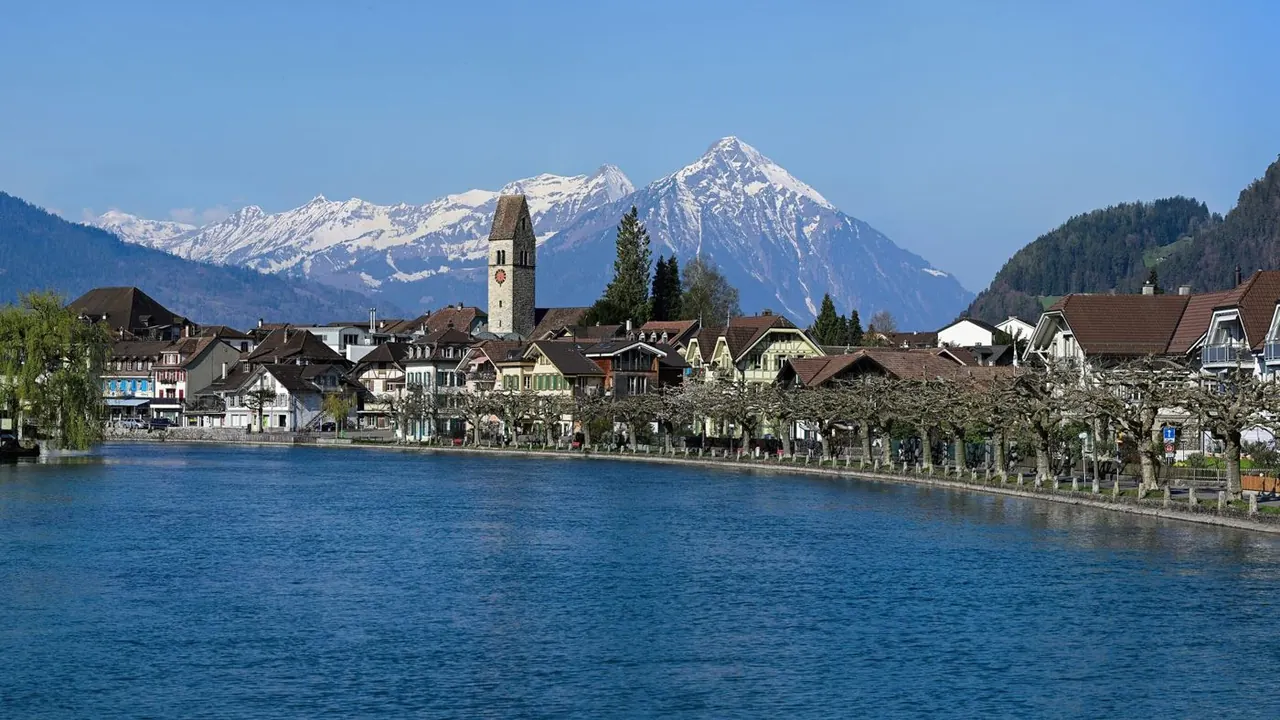
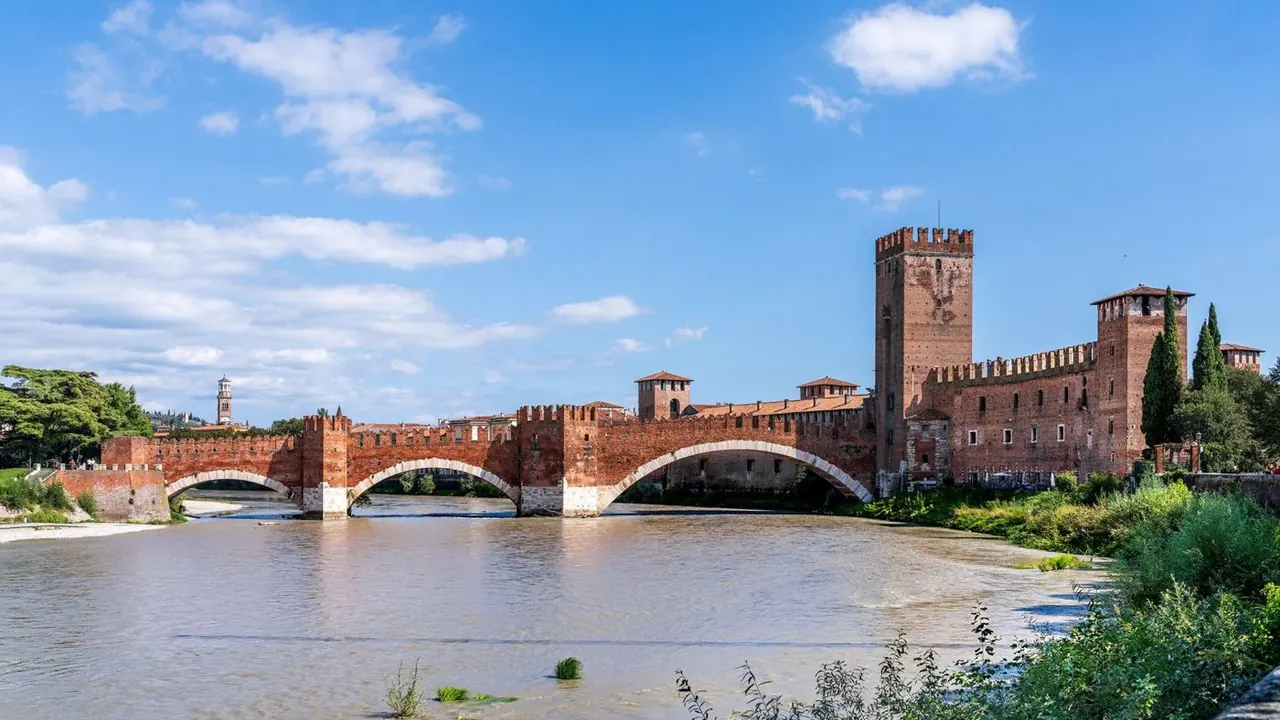
Photos: Interlaken by Roy Egloff, CC BY-SA 4.0, cropped; Verona by NorbertNagel, CC BY-SA 4.0, cropped.
Interlaken or Verona?
Our verdict in twelve categories, each scored against the same fixed benchmark cities, and the climate month by month, so you can choose for your trip.
Choose Interlaken for
- nature and the outdoors
- getting around
- families
Interlaken suits travellers who plan their days around summits, trails and cable cars. The peaks, waterfalls and glaciers of the Jungfrau region are within an hour by rail, and the trains, gondolas and steamers fit together so well that you never need a car. Children tend to love the mountain railways as much as the views. The trade-off is that the town itself has little to see, the food is plain, evenings end early and the whole stay is expensive.
Choose Verona for
- culture and sights
- live music and the arts
- food and drink
Pick Verona if you want a city to explore on foot, with Roman stones, Romanesque churches and opera under the open sky of the Arena. It eats and drinks far better, with the wines of Valpolicella and Soave grown on its doorstep, and it costs a good deal less. Venice, Padua, Vicenza and Lake Garda all make easy days out, though the countryside around it is gentle vineyard hills and lakeshore, not high mountains.
Scoreboard
Twelve categories on one fixed scale from 0 to 100. The shaded stretch is the gap between the two.
Your match
Pick a travel style or drag the sliders, and both match scores follow your weighting.
Wins on nature and the outdoors and getting around with your weighting.
Wins on culture and sights and live music and the arts with your weighting.
What matters to you?
Category by category
What the scores mean for a trip.
Beaches & swimming
Neither city has a coast, so in both a swim means a lake. In Interlaken you can use the grassy lidos on Lake Thun at Neuhaus or bathe in the cold glacial turquoise of Lake Brienz at Bönigen. It is a lovely, bracing end to a mountain day, but only in high summer.
Verona does a little better because Lake Garda is warmer and has more to offer. It is about half an hour away, with lidos and sunbeds, lawns running down to the water and the flat limestone shelves at Sirmione, and the season runs from June to September. Even so, it is a day out and not a reason to stay in the city.
Food & drink
Interlaken feeds you without much excitement. Tourist restaurants serve fondue, raclette and rösti alongside a run of Indian and Asian places, and many visitors live on supermarket picnics. The best meals are found higher up, at hut terraces and mountain dairies.
Verona has a real regional kitchen: Amarone risotto, bigoli with duck, and bollito misto with peppery pearà, served in plain osterie around Piazza delle Erbe and in Veronetta. The vineyards of Valpolicella, Soave and Bardolino are a short drive away, so the wine on the table is far better than anything grown near Interlaken.
Culture & sights
This is where the two cities differ most. Interlaken's sights come down to the grand nineteenth-century hotels and the Kursaal on the Höheweg, plus a few old timber houses in Unterseen. The town was built as a base for the mountains, not as a place to see.
Verona's UNESCO-listed centre layers Roman, medieval and Renaissance city on top of one another. You have the Arena on Piazza Bra, the Roman theatre below Castel San Pietro, the della Scala tombs, the bronze doors of San Zeno and Castelvecchio in its Scarpa setting, enough for two or three unhurried days on foot.
Nightlife
Neither city is made for late nights, but in Verona an evening goes further. Going out in Interlaken means a few backpacker pubs and basement clubs near the hostels, the casino in the Kursaal and an early night before the morning train. Verona has its aperitivo hour in Piazza delle Erbe and along Corso Porta Borsari, cheaper student wine bars in Veronetta, and in summer the opera crowd spilling out of the Arena near midnight.
Nature & outdoors
Interlaken is one of the great bases in the Alps. The Jungfraujoch at 3,454m looks over the Aletsch glacier, the Lauterbrunnen valley has its waterfalls and Trümmelbach thunders inside the rock, and trails lead out from Grindelwald First, Schynige Platte and Mürren. Add paragliding, canyoning and winter skiing, and only low cloud gets in the way.
Verona's outdoors are softer and further off. There are vineyard walks in Valpolicella and the cycle route up the Adige, and Monte Baldo and the sailing winds of northern Garda are about an hour away. It is pleasant country, but nothing like the high mountains.
Day trips
Both are good bases with strong rail links, but Verona offers more variety. From Interlaken the outings stay mostly within one region: Bern's arcaded old town in under an hour, paddle steamers to castle towns such as Spiez and Oberhofen, woodcarving at Brienz with Ballenberg nearby, and Lucerne over the Brünig Pass for a longer day.
From Verona, Venice, Palladio's Vicenza, Giotto's chapel in Padua and lake-ringed Mantua are all about an hour or less by train. The Garda towns and the cellars of Valpolicella and Soave are closer still, so you can mix art cities, lake harbours and wine tastings in one week.
Good for families
Both work well with children, in different ways. Interlaken has a slight edge because the fun is part of every outing: rack railways, gondolas and steamers, playgrounds and summer toboggan runs at the summits, the St Beatus caves and the farm animals at Ballenberg, all reachable without a car. Its weak points are wet days and the high altitudes, which can be hard on very young children.
Verona's big attractions, Gardaland, the water parks on Garda's southern shore and the safari at Parco Natura Viva, all lie outside town and mostly need a car. The flat, largely pedestrian centre is easy with a pushchair, but hot afternoons and sights aimed at adults make the city itself less of a draw.
Getting around
In Interlaken the town is small and flat, but the real advantage is the network beyond it. Mainline trains, narrow-gauge mountain lines, cog railways, gondolas and lake steamers connect neatly, so you can cover the whole Jungfrau region without a car, though the busiest mountain trains get crowded in summer.
Verona is a walking city where everything inside the Adige loop is a short stroll apart, and its trains to Venice, Milan and the lake are excellent. Away from those lines, the Valpolicella villages, the Lessinia and some Garda attractions are much easier with a car.
Shopping & style
Interlaken's Höheweg sells watches, army knives, cuckoo clocks and chocolate to tour groups, with outdoor gear for anyone who arrived underprepared. Woodcarving from Brienz is the only local craft worth seeking out. Verona has a proper shopping street in marble-paved Via Mazzini, with smaller boutiques and jewellers along Corso Porta Borsari, and edible souvenirs worth the suitcase space: Amarone, Garda olive oil and the star-shaped pandoro.
Affordability
Interlaken is a very expensive place to stay. Rooms, meals and drinks cost full Swiss rates, and the mountain railways that fill every day, the Jungfraujoch above all, add a great deal more. Hostels, passes and picnics only help so much.
Verona is much easier on the budget, though not cheap. Central hotels are dear, especially on opera nights, but the osterie in Veronetta, snacks with a glass at wine counters and a centre you can walk keep everyday spending moderate.
Live music & performing arts
In Interlaken live performance means the summer open-air William Tell, played by local amateurs in the woods, folklore evenings with yodelling and alphorns, and the odd concert at the Kursaal. For a proper theatre or orchestra you go to Bern.
Verona has something worth building a trip around: grand opera in the Roman Arena on most summer evenings. On top of that come Shakespeare, dance and jazz in the Roman theatre and a cooler-season programme at the Teatro Filarmonico.
Wellness & relaxation
Interlaken has no bathing culture of its own and relies on hotel spas along the Höheweg and the town's public wellness area. The calm comes from lakeshore mornings, slow steamer crossings and the mountain villages above, because the centre itself is busy and geared to activity.
Verona has no baths of its own either, but warm springs lie close by: the thermal pools at Sirmione facing Lake Garda, the spring-fed lake near Lazise and the springs at Caldiero, used since Roman times. Long lunches and an evening passeggiata by the river slow the pace further.
When should you go?
Pick your month. The climate figures are measured averages, not a forecast.
Interlaken in July
Verona in July
Daytime high, °C
Rainfall in the month, mm
Where the figures come from
Interlaken has no rain gauge within 25 km of the centre, so its rainfall comes from a gridded climate dataset read at the city rather than from a gauge further away.
Temperature and rainfall are climate normals, averaged over the years shown. Interlaken: 2005-2020 (rainfall 1991-2020) normals, Meiringen / Unterbach (19.3 km from centre). Verona: 1991-2020 normals, Verona / Villafranca (11.6 km from centre).
Interlaken is at its best in summer and again in winter. From June to September the days are mild, peaking around 24°C in July, which is ideal for high walking, but the lakes are only warm enough for a comfortable swim in July and August. Rain falls fairly evenly through the year, with summer showers common. In midwinter highs near 3°C mean snow on the ski slopes above Grindelwald and Wengen, and the town is too cold for pleasant strolling.
Verona is several degrees warmer in every month. July and August reach around 30°C and have the most sunshine of the year. That is good for Lake Garda swimming and evening opera, but tiring for afternoon sightseeing, so May, June and September are better for walking the centre. September to November is the wettest stretch, with up to 85mm a month, and winters are cool and often grey, though milder than in the Alps.
Which traveller are you?
On an outdoors trip, Interlaken is the obvious choice. The Eiger, Mönch and Jungfrau, the Lauterbrunnen valley and the ridge trails are a short train ride away, and paragliding, canyoning and rafting all start in town. Verona's vineyard walks are pleasant but far gentler.
For a culture and arts trip, Verona wins easily. The Arena, San Zeno, the Scaliger tombs and Castelvecchio fill two or three days, there is opera on the ancient stone tiers in summer, and Vicenza, Padua and Venice are close by train. Interlaken's sights barely fill a morning.
On a food and nightlife trip, Verona is far more rewarding. You get Amarone risotto and bigoli with duck, an aperitivo in Piazza delle Erbe, then the later wine bars of Veronetta. In Interlaken the fondue and backpacker pubs do the job, and the streets go quiet early.
Before you go
| Measure | Interlaken | Verona |
|---|---|---|
| Official language | French, German, Italian, Romansh | Italian |
| Currency | Swiss Franc (CHF) | Euro (EUR) |
| Sockets | CJ230 V, 50 Hz | CFL230 V, 50 Hz |
| Driving side | Right | Right |
| Time zone | UTC+1, UTC+2 in summer | UTC+1, UTC+2 in summer |
| Emergency number | 112 | 112 |
| Elevation | 571 m | 59 m |
| Main airport | Zürich Airport (ZRH)100 km from centre226 non-stop destinations | Verona Villafranca Valerio Catullo Airport (VRN)10 km from centre96 non-stop destinations |
| Public holidays this year | 10 days | 13 days |
By the numbers
| Measure | Interlaken | Verona |
|---|---|---|
| City population | 6,123 | 255,588 |
| People per km² | 1,424 | 1,285 |
| Museums within 10 km | 3 | 18 |
| UNESCO World Heritage sites within 50 km | 2 | 5 |
Where else could you go?
Every comparison below shares a destination with this one, so you can follow Interlaken or Verona somewhere new.