Photos: Hallstatt by C.Stadler/Bwag, CC BY-SA 4.0, cropped; Interlaken by Roy Egloff, CC BY-SA 4.0, cropped.
Hallstatt or Interlaken?
Our verdict in twelve categories, each scored against the same fixed benchmark cities, and the climate month by month, so you can choose for your trip.
Choose Hallstatt for
- culture and sights
- prices
- wellness
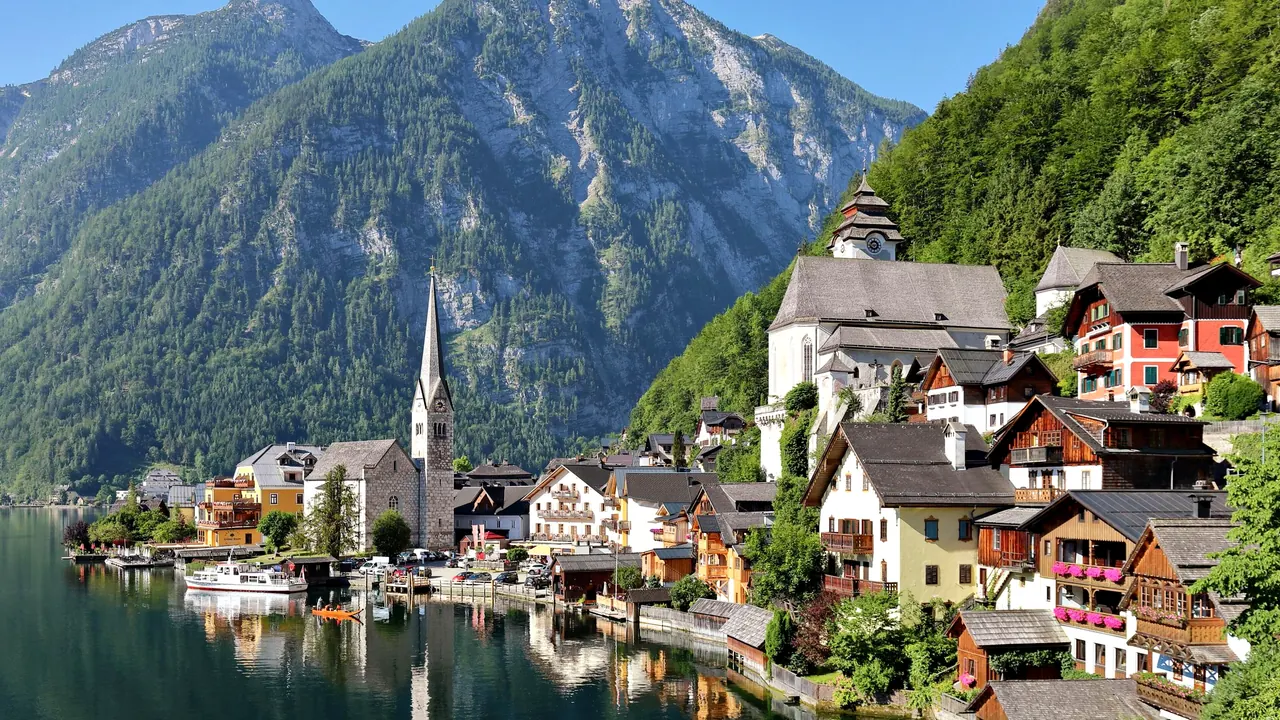
Hallstatt suits travellers who want one deeply atmospheric place rather than a busy programme. The village itself is the attraction, with seven thousand years of salt mining, the painted skulls of the Beinhaus and a UNESCO lake landscape, and the Dachstein rises straight behind it. It works best for couples and slow travellers who will stay overnight to have the lake to themselves once the day visitors leave, and who are happy to use a car for the wider Salzkammergut.
Choose Interlaken for
- families
- getting around
- day trips
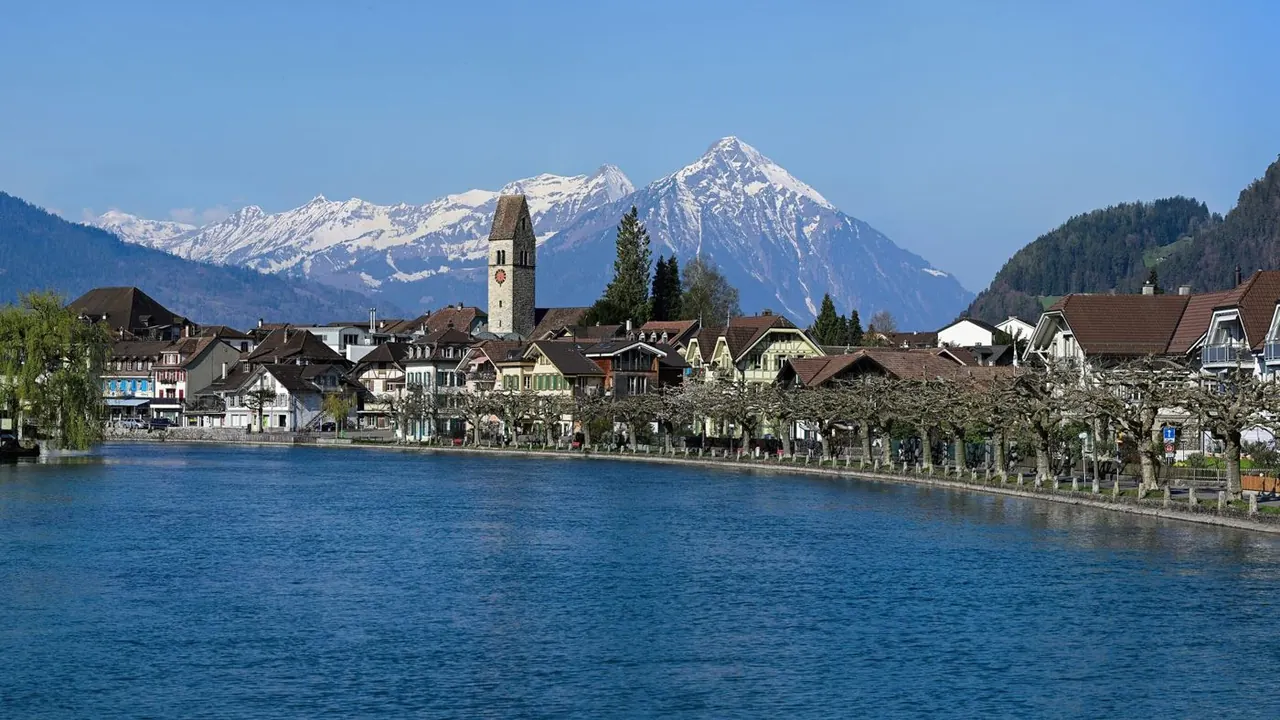
Interlaken is the better choice for anyone who wants to be out in the high mountains every day with the least effort. Trains, cog railways and gondolas carry you from a flat, easy town to the Jungfraujoch, Lauterbrunnen and Grindelwald without a car, and the adventure sports, family excursions and rail links to Bern and Lucerne give a week far more range. The town has little to look at and it costs more, but as a base it is hard to beat.
Scoreboard
Twelve categories on one fixed scale from 0 to 100. The shaded stretch is the gap between the two.
Your match
Pick a travel style or drag the sliders, and both match scores follow your weighting.
Wins on culture and sights and prices with your weighting.
Wins on families and getting around with your weighting.
What matters to you?
Category by category
What the scores mean for a trip.
Beaches & swimming
Swimming is a short summer extra in both, and neither is a reason to choose. Hallstatt has one deep, dark-green lake with a small lawn and jetty in the village and a larger lido at Obertraun, bracing rather than balmy.
Interlaken has the advantage of two lakes. Lake Thun is a little warmer, with grassy lidos and shingle at Neuhaus, while the glacial turquoise of Lake Brienz looks spectacular but stays colder.
Food & drink
Neither is a place to travel for food, but they disappoint in different ways. Hallstatt's few dining rooms serve schnitzel and goulash, with smoked or pan-fried lake char as the one local touch, and kitchens close early.
Interlaken has a little more range, with fondue, raclette and rösti alongside Indian and Asian places for its international visitors. Its best eating is up the mountain, on hut terraces or with cheese bought from a dairy.
Culture & sights
Here Hallstatt is well ahead. The village is a UNESCO landscape in its own right, and the salt mine, the museum telling the story of the Iron Age Hallstatt culture and the painted skulls of the Beinhaus fill a rich day.
Interlaken was built as a base for the mountains and has little beyond the row of grand hotels on the Höheweg and a few timber houses in Unterseen. For museums you take the train to Bern or Thun.
Nightlife
Interlaken at least has an evening scene, with backpacker pubs, sports bars, a couple of basement clubs near the hostels and the casino in the Kursaal, though it is quiet well before midnight. Hallstatt has nothing of the kind: after the day visitors go, the night is dinner, a glass of wine by the water and a dark lakeside walk, which is exactly why some people stay.
Nature & outdoors
Both are superb mountain bases, with Interlaken a step ahead for sheer scale and ease of access. Hallstatt has the Dachstein right behind the village: the Five Fingers platform on the Krippenstein, the ice caves, the Echerntal waterfalls and the walk to the Gosausee.
Interlaken puts the Eiger, Mönch and Jungfrau within an hour by rail, with the Jungfraujoch over the Aletsch glacier, the Lauterbrunnen valley and endless high trails reached by cable car. It is also the place for paragliding, canyoning and rafting, which Hallstatt does not offer on the same level.
Day trips
Interlaken has the stronger spread of outings, helped by fast trains. Bern's medieval arcades are under an hour away, Thun and the lake castles at Spiez and Oberhofen are close by steamer, and Lucerne makes a scenic longer day.
Hallstatt's outings are gentler lake towns of the Salzkammergut: imperial Bad Ischl, St Wolfgang and Gmunden, with Salzburg as the big day. They are lovely, but slower to reach without a car.
Good for families
Interlaken is the easier place with children. The trains, gondolas and steamers are fun in themselves, summit stations have playgrounds and toboggan runs, and the St Beatus caves and Ballenberg's farm animals are reliable on most days.
Hallstatt has a few highlights, above all the salt mine's miners' slides and underground lake, but the village is a steep, narrow lane crowded at midday. Families usually stay in Obertraun and visit for a few hours.
Getting around
Both centres are small and walkable, but Interlaken is flat and Hallstatt is all steps and slopes. The bigger gap is beyond town: Interlaken's trains, cog railways, gondolas and steamers fit together so well that a car is unnecessary.
From Hallstatt, the station is across the lake and reached by boat, and the regional buses thin out outside summer, so many visitors find a car worth having.
Shopping & style
Neither is a shopping destination, though Interlaken offers a little more. Its Höheweg has large watch and jewellery stores, chocolate, army knives and outdoor gear, with Brienz woodcarving the craft to look for. Hallstatt is a half-hour stroll past souvenir shops, and its one distinctive buy is salt from the mine above the village.
Affordability
Both are expensive, but Hallstatt is the more manageable. Rooms in the village are scarce and pricey, yet staying in Obertraun, Bad Goisern or Bad Ischl brings costs down noticeably.
Interlaken runs at full Swiss prices for everything, and the mountain railways and cable cars at the heart of any stay are a heavy extra. Passes and supermarket picnics help, but there is no cheap way to see the Jungfrau region.
Live music & performing arts
Interlaken has slightly more to plan an evening around: the open-air William Tell play staged by locals each summer, folklore evenings with alphorns and yodelling, and Bern's theatre and orchestra under an hour away. Hallstatt has only its brass band at feast days and the odd church concert, though Bad Ischl's summer operetta and Salzburg's classical season are within reach.
Wellness & relaxation
Neither has a spa culture of its own, so the difference lies in where you find it. From Hallstatt, the historic brine baths of Bad Ischl, Bad Aussee and Bad Goisern are close, a real spa tradition dating back to the nineteenth century.
Interlaken relies on the large spas in its grand Höheweg hotels and a public wellness area. In both, the calm comes from the edges of the day and from staying outside the busiest streets.
When should you go?
Pick your month. The climate figures are measured averages, not a forecast.
Hallstatt in July
Interlaken in July
Daytime high, °C
Rainfall in the month, mm
Where the figures come from
Hallstatt's temperatures are measured 56 km from the centre, at Salzburg.
Hallstatt has no rain gauge within 25 km of the centre, so its rainfall comes from a gridded climate dataset read at the city rather than from a gauge further away.
Interlaken has no rain gauge within 25 km of the centre, so its rainfall comes from a gridded climate dataset read at the city rather than from a gauge further away.
Interlaken's sunshine is measured 66 km from the centre, at Sion.
Temperature and rainfall are climate normals, averaged over the years shown. Hallstatt: 1991-2020 normals, Salzburg (55.5 km from centre). Interlaken: 2005-2020 (sunshine 1961-1990, rainfall 1991-2020) normals, Meiringen / Unterbach (19.3 km from centre).
The two follow almost the same temperature curve, so the good months are the same: June to September, when days reach the low to mid twenties and both lakes are warm enough for a brief swim in July and August. Winter in both is cold, around 3°C in January, and suits snow sports more than sightseeing; spring and autumn are cool but fine for walking, with October still pleasant.
The real difference is rain. Hallstatt is noticeably wetter, especially in high summer, when July brings about 178mm against roughly 126mm in Interlaken, so mist and showers over the lake are part of any summer stay. Hallstatt's sunniest months are July and August, while early winter is short on sun. In Interlaken the drier spell from September into October is a good bet for clear mountain views with fewer showers.
Which traveller are you?
On a culture and arts trip, Hallstatt goes much deeper. Salt has been mined above the village for millennia, and finds from its burial ground gave their name to an Iron Age culture of early Europe. Interlaken was built for the view.
On a family trip with children, Hallstatt offers one memorable morning in the salt mine and not much more. Interlaken fills a whole week, since every ride up a mountain is an outing in itself and the valley floor is flat and safe.
For a trip on a tight budget, Hallstatt is the gentler of two costly choices. Cheaper beds wait a short ride away in Obertraun or Bad Goisern, and the lake and valley walks cost nothing. In Interlaken nearly every highlight starts with a mountain ticket.
Before you go
| Measure | Hallstatt | Interlaken |
|---|---|---|
| Official language | German, Austrian Sign Language | French, German, Italian, Romansh |
| Currency | Euro (EUR) | Swiss Franc (CHF) |
| Sockets | CF230 V, 50 Hz | CJ230 V, 50 Hz |
| Driving side | Right | Right |
| Time zone | UTC+1, UTC+2 in summer | UTC+1, UTC+2 in summer |
| Emergency number | 112 | 112 |
| Elevation | 511 m | 571 m |
| Main airport | Salzburg Airport (SZG)55 km from centre64 non-stop destinations | Zürich Airport (ZRH)100 km from centre226 non-stop destinations |
| Public holidays this year | 16 days | 10 days |
By the numbers
| Measure | Hallstatt | Interlaken |
|---|---|---|
| City population | 741 | 6,123 |
| People per km² | 12 | 1,424 |
| Museums within 10 km | 3 | 3 |
| UNESCO World Heritage sites within 50 km | 2 | 2 |
Where else could you go?
Every comparison below shares a destination with this one, so you can follow Hallstatt or Interlaken somewhere new.
- Bernvs Interlaken
- Salzburgvs Hallstatt
- Lucernevs Interlaken
- Zurichvs Interlaken
- Lausannevs Interlaken
- Baselvs Interlaken