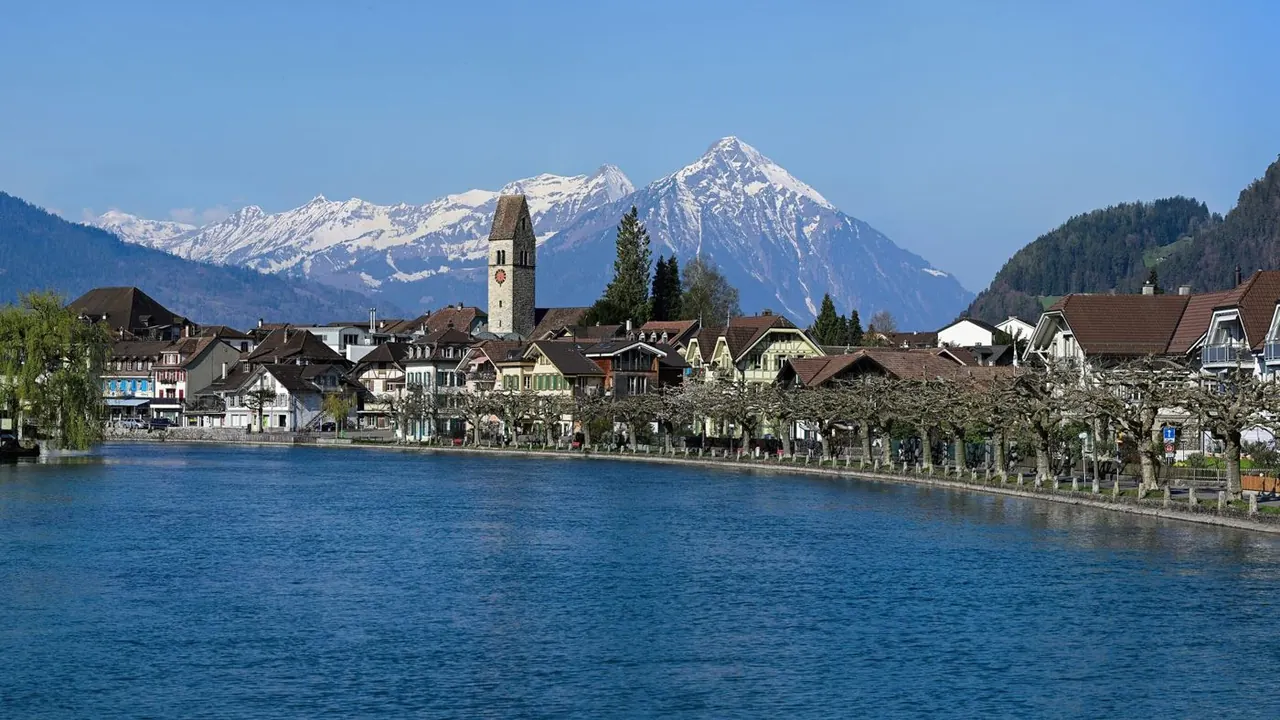
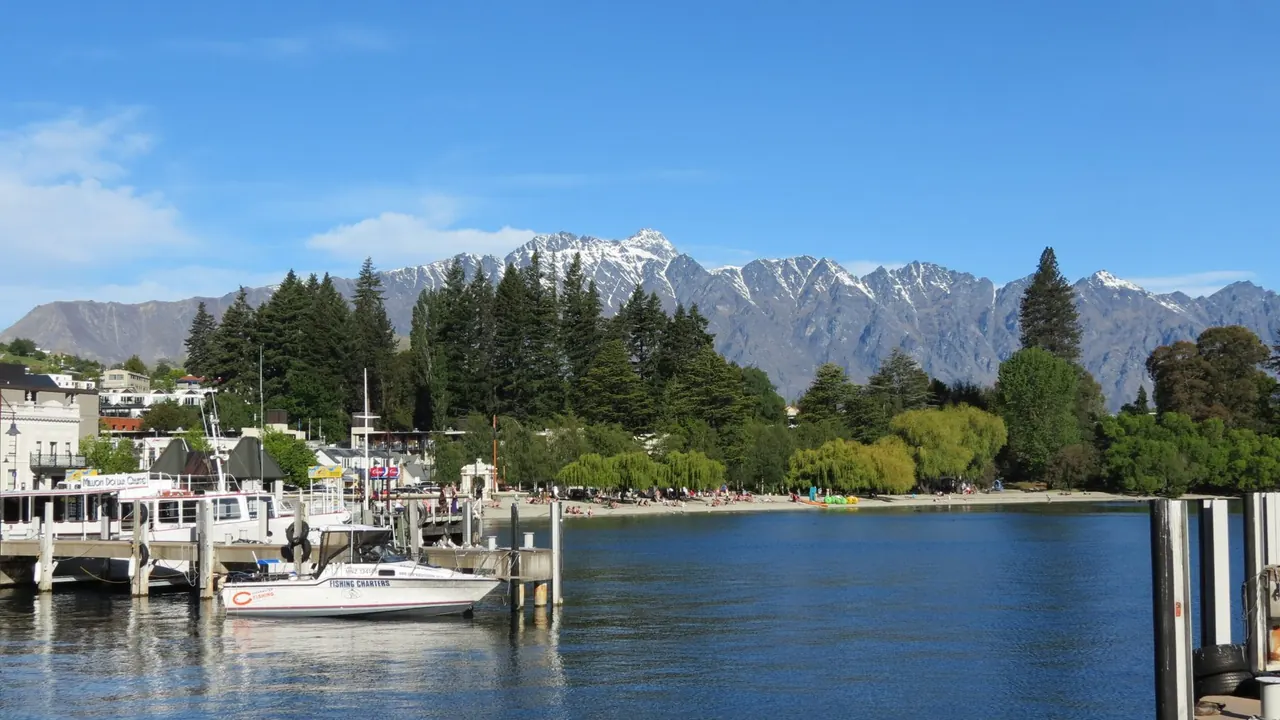
Photos: Interlaken by Roy Egloff, CC BY-SA 4.0, cropped; Queenstown by Robert Linsdell, CC BY 2.0, cropped.
Interlaken or Queenstown?
Our verdict in twelve categories, each scored against the same fixed benchmark cities, and the climate month by month, so you can choose for your trip.
Choose Interlaken for
- getting around
- day trips
- families
Interlaken is the choice for travellers who want the high Alps delivered by train. Rack railways, cable cars and lake steamers carry you from the town to glaciers, ridge walks, the castle at Thun and Bern's arcaded old town without a hire car, which also makes it the easier base with children. The trade-off is quiet evenings, plain food and full Swiss prices.
Choose Queenstown for
- nightlife
- food and drink
- prices
Pick Queenstown for a livelier mountain trip with more going on after dark. Its bars stay busy late, its restaurants and the Gibbston Valley wineries give you reasons to linger over dinner, and riders can take bikes up the gondola to steep downhill tracks or follow the cycle trails through the Kawarau gorge. Plan on a hire car, though, and once you have seen Arrowtown and Wanaka there are few towns left to visit.
Scoreboard
Twelve categories on one fixed scale from 0 to 100. The shaded stretch is the gap between the two.
Your match
Pick a travel style or drag the sliders, and both match scores follow your weighting.
Too close to call, 1 point apart
Wins on getting around and day trips with your weighting.
Wins on nightlife and food and drink with your weighting.
What matters to you?
Category by category
What the scores mean for a trip.
Beaches & swimming
Neither is a beach destination, but Interlaken's lakes are kinder to swimmers. In a good summer Lake Thun warms to about 21°C, with grassy lidos at Neuhaus and shingle shores towards Spiez, and Bönigen gives you a colder dip in turquoise Lake Brienz.
Lake Wakatipu stays near 12°C even in late summer, so in Queenstown a swim usually means a quick plunge from the bay or a jump off the town jetty. Lake Hayes and Moke Lake are the warmer choice in January and February.
Food & drink
Queenstown eats noticeably better. A year-round visitor trade supports smart restaurants serving lamb, venison and South Island seafood, alongside ramen bars and pie shops. Its best card is Gibbston Valley, where a long lunch among the pinot noir vines is a short drive up the Kawarau Gorge.
In Interlaken the menus run to fondue, rösti and raclette, done reliably but without much flair. The best meals happen up the mountain, with cheese from an Alpine dairy, lunch on a hut terrace above Mürren or a glass of Lake Thun white. Many visitors simply live on supermarket picnics.
Culture & sights
Neither town is worth choosing for its sights, because both were built as bases for the landscape around them. Interlaken has its row of grand nineteenth-century hotels and the Kursaal facing the Höhematte, plus a few old timber houses in Unterseen. Queenstown's best piece of history still moves: the coal-fired TSS Earnslaw, which has crossed the lake since 1912.
The real difference lies beyond town. Interlaken can draw on the historic Swiss towns along its rail lines, while Queenstown's gold-rush past is best seen in Arrowtown.
Nightlife
Queenstown is far the better place for a night out. Seasonal workers, skiers and backpackers fill the bars around Shotover, Camp and Searle streets, which stay loud past midnight on a winter Saturday, and in summer the evenings move out onto lakefront terraces. It is mostly drinking and DJ bars, and two nights will cover it.
Interlaken goes to bed early because its visitors are up for the first mountain train. A few backpacker pubs, a couple of basement clubs and the Kursaal casino are about all there is.
Nature & outdoors
Both are among the world's great mountain bases, but you meet the scenery in different ways. In Interlaken, trains and lifts do the climbing. The cog railway runs up to the Jungfraujoch above the Aletsch glacier, gondolas rise to Grindelwald First, a cable car goes to the Schilthorn above Mürren and a historic cog railway from Wilderswil climbs to the Schynige Platte ridge. Below them, Lauterbrunnen's waterfalls drop into the valley under the Eiger.
In Queenstown, the outdoors starts on foot or by road. You can climb Ben Lomond straight from town, walk the Routeburn Track beyond Glenorchy or ride a jet boat through the Shotover canyons. Commercial bungy jumping began here, and the ski fields are a drive away rather than a train ride.
Day trips
Interlaken wins clearly, because Swiss rail puts real towns within easy reach. Bern's arcaded old town is under an hour away, Thun's castle is half an hour along the lake, paddle steamers call at Spiez and Oberhofen, and Lucerne is a scenic ride over the Brünig Pass. Ballenberg's open-air museum and the woodcarvers of Brienz add variety.
Queenstown has one excellent short outing in Arrowtown and a good second in Wanaka, over the Crown Range. After that the choice comes down to wine country and scenery, and Milford Sound takes three to four hours each way.
Good for families
Both are safe, but Interlaken is the easier base with children because getting up the mountain is half the fun. Summit stations have playgrounds, cliff walks and summer toboggan runs, and the St Beatus caves and the farm animals at Ballenberg rarely fail. The main caution is altitude at the highest stops for very young children.
Queenstown's best family day is the gondola and luge on Bob's Peak, with kiwi to see at the wildlife park by the gondola base. Many of the thrills it is known for are closed to younger children, though, and long drives tire small passengers.
Getting around
This is where the two differ most in practice. In Interlaken, mainline trains, narrow-gauge railways, cog railways, gondolas and steamers connect into one network, often covered by a guest transport card, so the whole Jungfrau region works without a car. The only nuisance is crowded mountain trains in summer.
Queenstown's tiny centre is easy to walk, and buses run to Frankton and Arrowtown. The wineries, Glenorchy, Wanaka and the trailheads really call for a hire car, though, and the single road into town backs up at busy times.
Shopping & style
Nobody travels to either for shopping, though Queenstown's offer feels a little more local. It has merino and possum-wool knitwear, greenstone jewellery, galleries of landscape painting and a summer craft market by the wharf, along with serious ski and bike shops.
Interlaken's Höheweg mostly sells watches, jewellery, army knives, cuckoo clocks and chocolate to tour groups, and carved wood from Brienz is the one purchase with real local roots.
Affordability
Both are expensive, but Interlaken is harder on the wallet. Full Swiss prices for rooms and meals come on top of mountain railway fares, the Jungfraujoch above all, and there is no cheap way to see the region properly.
Queenstown is pricey for New Zealand, and bungy jumps, jet boats and lift passes add up quickly. Even so, self-catering apartments, the Frankton supermarkets and free walking trails make a budget go a little further than it would in the Bernese Oberland.
Live music & performing arts
Interlaken's one real stage tradition is the open-air William Tell, which local amateurs have performed in the woods each summer since the early twentieth century. Folklore evenings with yodelling and alphorns fill out the season, and Bern's orchestra and theatre are within an hour by train.
Queenstown has no tradition of that kind. Live music mostly means covers bands and acoustic sets in pubs and après-ski bars, and the winter festival adds a few days of street performances and concerts.
Wellness & relaxation
In Interlaken, rest comes in a grand-hotel style. Several of the old hotels on the Höheweg have large spas, a steamer crossing on either lake is slow and calm, and a few nights in car-free Wengen or Mürren take you away from the coach groups in the centre.
Queenstown's version is more rustic. You can soak in a private cedar hot tub on a hillside above the Shotover River, book a massage at a lodge spa out towards Arrowtown or spend a quiet day in Glenorchy at the head of the lake. Neither town has thermal springs, and in both the centre is busier than the edges.
When should you go?
Pick your month. The climate figures are measured averages, not a forecast.
Interlaken in July
Queenstown in July
Daytime high, °C
Rainfall in the month, mm
Where the figures come from
Interlaken has no rain gauge within 25 km of the centre, so its rainfall comes from a gridded climate dataset read at the city rather than from a gauge further away.
Queenstown has no weather station within reach, so its figures come from a gridded climate model rather than a measured record, and read a broad area rather than the city itself.
Temperature and rainfall are climate normals, averaged over the years shown. Interlaken: 2005-2020 (rainfall 1991-2020) normals, Meiringen / Unterbach (19.3 km from centre). Queenstown: 1991-2020 normals, TerraClimate 4 km grid at the town, no weather station within 90 km.
The two sit in opposite hemispheres, so their seasons run in reverse. Interlaken is at its best from June to September, when July highs around 24°C suit long walks and make the lakes warm enough for a swim. May to August brings the most rain, so pack for showers, while September is drier and still mild, a good month for the trails. From December to February the days are only a few degrees above freezing, and the valley belongs to skiers rather than to people who want to stroll the streets.
Queenstown is warmest from December to March, with highs near 20°C, and smaller lakes such as Lake Hayes warm up most in January and February. June to August is cold and suits the ski fields rather than walking. Rain falls in every season, peaking in spring with about 200mm in September, and March is often wet too. February is the driest month at about 89mm and the most reliable for long days on foot.
Which traveller are you?
On a food and nightlife trip, Queenstown is the clear pick. The lanes off the Mall hold far more good kitchens than Interlaken, Gibbston Valley pinot noir is a short drive away, and the bars around Shotover Street keep going long after Interlaken has gone quiet.
On a family trip with children, Interlaken has the edge. The rack railways, gondolas and steamers are a treat in themselves, and the summit stations have playgrounds and toboggan runs. Many of Queenstown's signature thrills have age and weight limits, and its big sights involve long drives.
For a short city break, Interlaken makes better use of a few days despite being so small. Without a car you can reach the Jungfraujoch, walk Bern's arcades and cross Lake Thun by steamer. Queenstown's best sights are spread out along winding roads.
Before you go
| Measure | Interlaken | Queenstown |
|---|---|---|
| Official language | French, German, Italian, Romansh | English, New Zealand Sign Language, Māori |
| Currency | Swiss Franc (CHF) | New Zealand Dollar (NZD) |
| Sockets | CJ230 V, 50 Hz | I230 V, 50 Hz |
| Driving side | Right | Left |
| Time zone | UTC+1, UTC+2 in summer | UTC+12, UTC+13 in summer |
| Emergency number | 112 | 111 |
| Elevation | 571 m | 324 m |
| Main airport | Zürich Airport (ZRH)100 km from centre226 non-stop destinations | Queenstown Airport (ZQN)7 km from centre7 non-stop destinations |
| Public holidays this year | 10 days | 12 days |
By the numbers
| Measure | Interlaken | Queenstown |
|---|---|---|
| City population | 6,123 | 29,000 |
| People per km² | 1,424 | - |
| Museums within 10 km | 3 | 0 |
| UNESCO World Heritage sites within 50 km | 2 | 0 |
Where else could you go?
Every comparison below shares a destination with this one, so you can follow Interlaken or Queenstown somewhere new.