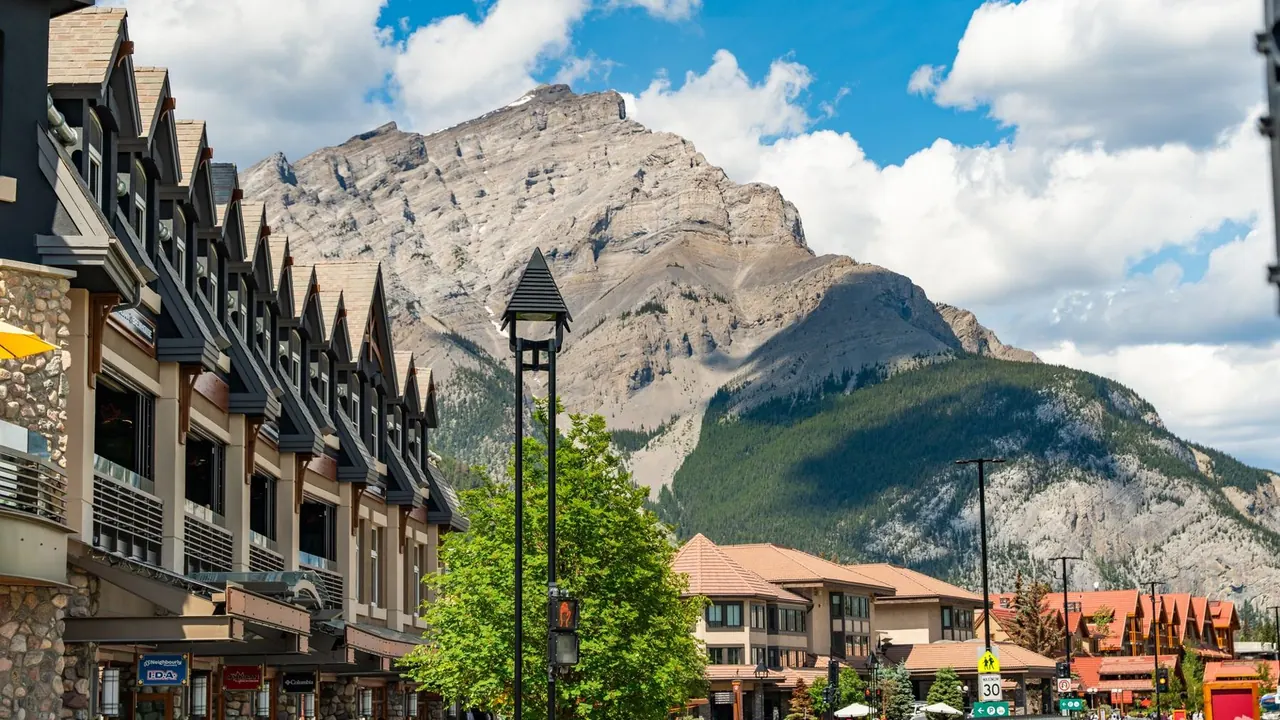
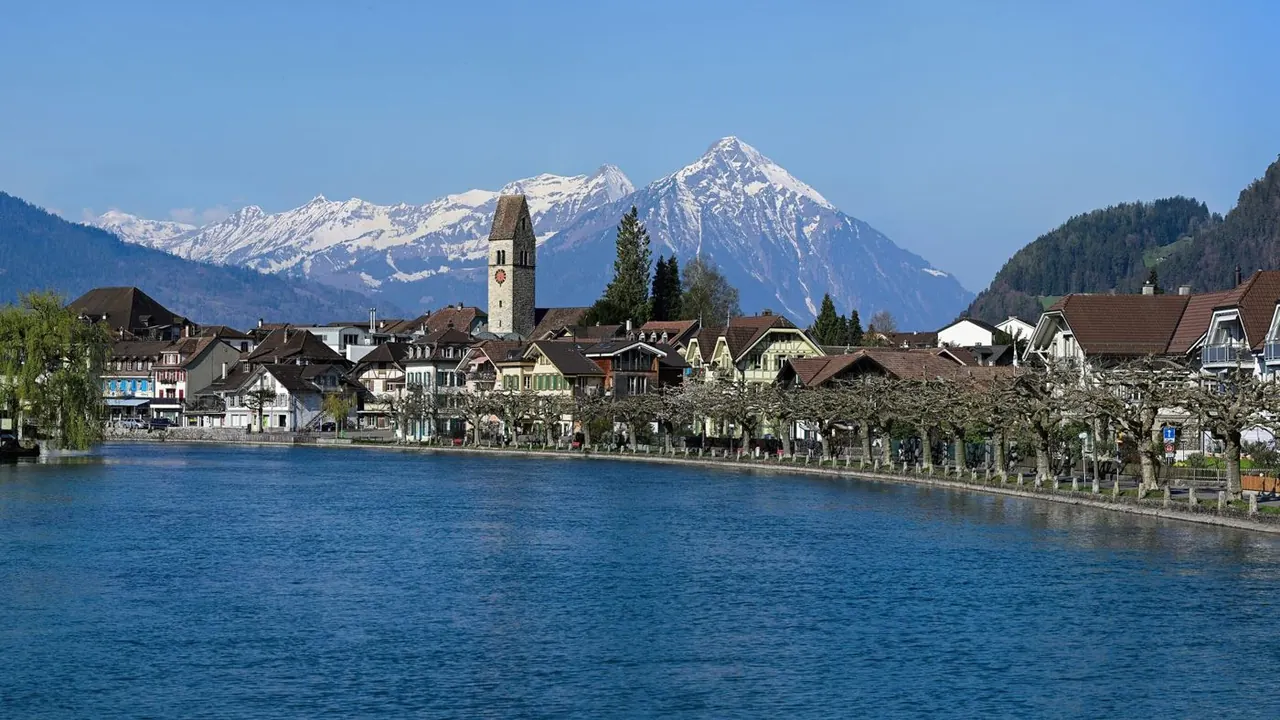
Photos: Banff by bryan pascual, Pexels License; Interlaken by Roy Egloff, CC BY-SA 4.0, cropped.
Banff or Interlaken?
Our verdict in twelve categories, each scored against the same fixed benchmark cities, and the climate month by month, so you can choose for your trip.
Choose Banff for
- live music and the arts
- nightlife
- culture and sights
Banff suits travellers who want real wilderness on the doorstep and a town with a bit of life after dark. Elk on the lawns and bears along the roads, the Icefields Parkway, a soak in the Upper Hot Springs after skiing, the Banff Centre's stages and a cheerful pub scene make it the better pick for couples and friends who will hire a car and want their evenings to count. It is also, for all its resort prices, the gentler of the two on the wallet.
Choose Interlaken for
- day trips
- getting around
- beaches
If you would rather leave the car behind and let trains, cog railways and lake steamers do the work, Interlaken is the place. The Jungfrau peaks, Lauterbrunnen and the Jungfraujoch are all an easy rail ride away, and so are Bern, Thun and Lucerne, so a week here offers far more variety of towns than the Rockies can. Families do especially well, and the lakes are warm enough for a summer swim. Expect quiet evenings and a very large bill.
Scoreboard
Twelve categories on one fixed scale from 0 to 100. The shaded stretch is the gap between the two.
Your match
Pick a travel style or drag the sliders, and both match scores follow your weighting.
Too close to call, 2 points apart
Wins on live music and the arts and nightlife with your weighting.
Wins on day trips and getting around with your weighting.
What matters to you?
Category by category
What the scores mean for a trip.
Beaches & swimming
Neither is a beach destination, but Interlaken at least gives you a proper summer swim. Lake Thun warms enough in July and August for the grassy lidos at Neuhaus and along the shore towards Spiez, and Bönigen on the colder Lake Brienz has its own bathing area.
Banff's glacier-fed lakes are for paddling on and admiring, and only shallow Johnson Lake is comfortable on a hot August afternoon. Here the warm water is in the hot springs instead.
Food & drink
Banff eats a little better. Alberta beef, bison and elk, a few ambitious hotel and independent dining rooms using mountain and prairie produce, and decent craft beer and coffee give it more character than Interlaken's run of fondue, raclette and international places for the backpacker crowd.
Interlaken's best meals happen outside town: Alpine cheese from mountain dairies, lunch on a hut terrace above Grindelwald or Mürren, a glass of Lake Thun white. In both places food is fuel for the day outdoors rather than a reason to book.
Culture & sights
Banff has more to see in town, and its sights tell a coherent story: the Cave and Basin where Canada's national parks began, the castle-like Banff Springs Hotel, the Whyte Museum's mountain art and the Buffalo Nations Luxton Museum on the peoples of the plains. Together they make a satisfying rainy day.
Interlaken itself offers a stroll past the grand hotels and the Kursaal on the Höheweg and the old timber houses of Unterseen, and little more. Its history and architecture lie in Bern and Thun, which belong to a day out rather than to the town.
Nightlife
Banff goes out harder. Seasonal workers and the ski crowd keep a few pubs and dance bars around Banff Avenue loud late into the night, with après-ski from early evening and hotel lounges for a quieter drink.
Interlaken's visitors go to bed early for trains, hikes and paragliding. Beyond a few backpacker pubs, basement clubs near the hostels and the casino in the Kursaal, the streets are quiet well before midnight.
Nature & outdoors
Both are among the world's great mountain bases, and the difference is in kind. Banff is wilderness: a town inside a national park, with bears, elk and mountain goats along the roads, the turquoise water of Lake Louise and Moraine Lake, and the Icefields Parkway running past glaciers, best explored on foot, by canoe and by car.
Interlaken's Alps are opened up by engineering, with railways and cable cars lifting you to the Jungfraujoch, Lauterbrunnen's waterfalls and Grindelwald First without effort, and paragliding, canyoning and rafting run straight from town. Come to Banff for wildlife and wide open country, to Interlaken for easy high-altitude access and organised thrills, keeping in mind that low cloud can hide its peaks for days.
Day trips
Interlaken is by far the better base for seeing towns. Bern's arcaded medieval centre is under an hour by train, Thun and the lakeside castles of Spiez and Oberhofen are a steamer ride away, Brienz and Ballenberg show off woodcarving and rural building, and Lucerne is a scenic run over the Brünig Pass.
From Banff nearly every outing is into the mountains. Canmore down the valley, a big-city day in Calgary and small stops at Field and Golden are about the extent of it.
Good for families
Both are safe, easy towns where the landscape keeps children busy, and neither has a zoo, aquarium or science museum to hand. In Banff the day's sights lie far apart, so wildlife spotting, Johnston Canyon and the lakes mean long stretches in the car, and children need warm layers in every season. Anything built for children means the drive to Calgary, an hour and a half away.
Interlaken comes out ahead because a family day there is a string of short hops by train and boat rather than a long drive, though it has its own catches. Pushchairs cope best on the valley floor and the gentler panoramic paths, the altitude of the highest excursions can trouble very young children, and a run of wet days is hard to fill.
Getting around
Both centres are flat and take about twenty minutes to cross on foot, so the difference lies beyond them. Interlaken plugs into the Swiss rail network, with mainline trains, narrow-gauge lines, cog railways, gondolas and lake steamers timed to connect, so the whole Jungfrau region works without a car.
Banff has Roam buses to the gondola, Lake Minnewanka, Canmore and Lake Louise, plus summer shuttles to the busiest lakes, but no passenger railway. The Icefields Parkway, Yoho and the quieter trailheads really call for a car or a tour.
Shopping & style
Neither suits a shopping trip, though Banff has slightly more worth browsing. Alongside the outfitters, fudge shops and moose-and-maple souvenirs, its galleries of Indigenous art and Rocky Mountain landscape painting offer something genuinely local to take home.
Interlaken's Höheweg is given over to watch and jewellery stores for tour groups, army knives, cuckoo clocks and chocolate, with Brienz woodcarving the one craft worth seeking out.
Affordability
Both are expensive, but Interlaken is the harder on the wallet. Full Swiss rates for rooms, meals and drinks come with mountain railway and cable car fares, the Jungfraujoch above all, that surprise almost everyone, and there is no cheap way to see the region properly.
Banff's resort prices, gondola, tours and lift passes add up too, yet its trails, lakes and viewpoints cost nothing beyond the park pass. Staying in Canmore or camping, and coming in spring or late autumn, cuts the bill further.
Live music & performing arts
Banff has the stronger stage, thanks to the Banff Centre for Arts and Creativity on Tunnel Mountain, whose theatres host concerts and dance with the fullest programme in summer. Each autumn its Banff Mountain Film and Book Festival draws adventurers and filmmakers from around the world.
Interlaken offers the open-air William Tell, staged by local amateurs in the woods each summer, occasional Kursaal concerts and folklore evenings of yodelling and alphorns. For an orchestra or proper theatre you head to Bern.
Wellness & relaxation
Banff has the edge because bathing is part of its history. The Upper Hot Springs on Sulphur Mountain, an open-air mineral pool looking across the valley, is a fine end to a ski day, and the grand mountain hotels have big spas with mineral pools, even if the public pool gets crowded.
Interlaken has no thermal water, so it relies on hotel spas along the Höheweg and the town's public wellness area. Its calm comes from steamer crossings and the lakeside or mountain villages, since the centre itself is busy with coach groups and backpackers.
When should you go?
Pick your month. The climate figures are measured averages, not a forecast.
Banff in July
Interlaken in July
Daytime high, °C
Rainfall in the month, mm
Where the figures come from
Interlaken has no rain gauge within 25 km of the centre, so its rainfall comes from a gridded climate dataset read at the city rather than from a gauge further away.
Temperature and rainfall are climate normals, averaged over the years shown. Banff: 1991-2020 normals, Banff (2 km from centre). Interlaken: 2005-2020 (rainfall 1991-2020) normals, Meiringen / Unterbach (19.3 km from centre).
Banff has the harsher winter, with daytime highs below freezing from December to February and around -4°C in December, though the air stays dry. Summer is short: July and August reach about 23°C, the season for trails, canoes and a brief swim at Johnson Lake, and even June, the wettest month, brings only 66mm. After September it cools quickly, and by November the town is turning towards the ski season.
Interlaken is milder at both ends, staying a few degrees above freezing in the valley through winter and reaching about 24°C in July, when Lake Thun is warm enough for a swim. It is much wetter, with rain spread through the year and peaking at 127mm in June, so summer days often bring showers and cloud over the peaks. May and September are good walking months in both, and September tends to be the drier choice in Interlaken.
Which traveller are you?
On a family trip with children, Interlaken is the easier choice. Rack railways, gondolas and lake steamers thrill in themselves, the summit stations have playgrounds and summer toboggan runs, and the St Beatus caves and Ballenberg fill valley days without long drives.
For a relaxing and wellness trip, Banff does it better. The town was founded on its hot springs, and an evening in the open-air pool on Sulphur Mountain plus the large spas of the grand hotels offer more than Interlaken's hotel spas.
On a food and nightlife trip, neither is a destination, but Banff has the edge. Its steakhouses and hotel dining rooms make good use of Rocky Mountain produce, and seasonal workers keep Banff Avenue's pubs going long after Interlaken has gone quiet.
Before you go
| Measure | Banff | Interlaken |
|---|---|---|
| Official language | French, English | French, German, Italian, Romansh |
| Currency | Canadian Dollar (CAD) | Swiss Franc (CHF) |
| Sockets | AB120 V, 60 Hz | CJ230 V, 50 Hz |
| Driving side | Right | Right |
| Time zone | UTC-7, UTC-6 in summer | UTC+1, UTC+2 in summer |
| Emergency number | 911 | 112 |
| Elevation | 1,400 m | 571 m |
| Main airport | Calgary International Airport (YYC)109 km from centre103 non-stop destinations | Zürich Airport (ZRH)100 km from centre226 non-stop destinations |
| Public holidays this year | 13 days | 10 days |
By the numbers
| Measure | Banff | Interlaken |
|---|---|---|
| City population | 8,305 | 6,123 |
| People per km² | 1,730 | 1,424 |
| Museums within 10 km | 4 | 3 |
| UNESCO World Heritage sites within 50 km | 0 | 2 |
Where else could you go?
Every comparison below shares a destination with this one, so you can follow Banff or Interlaken somewhere new.