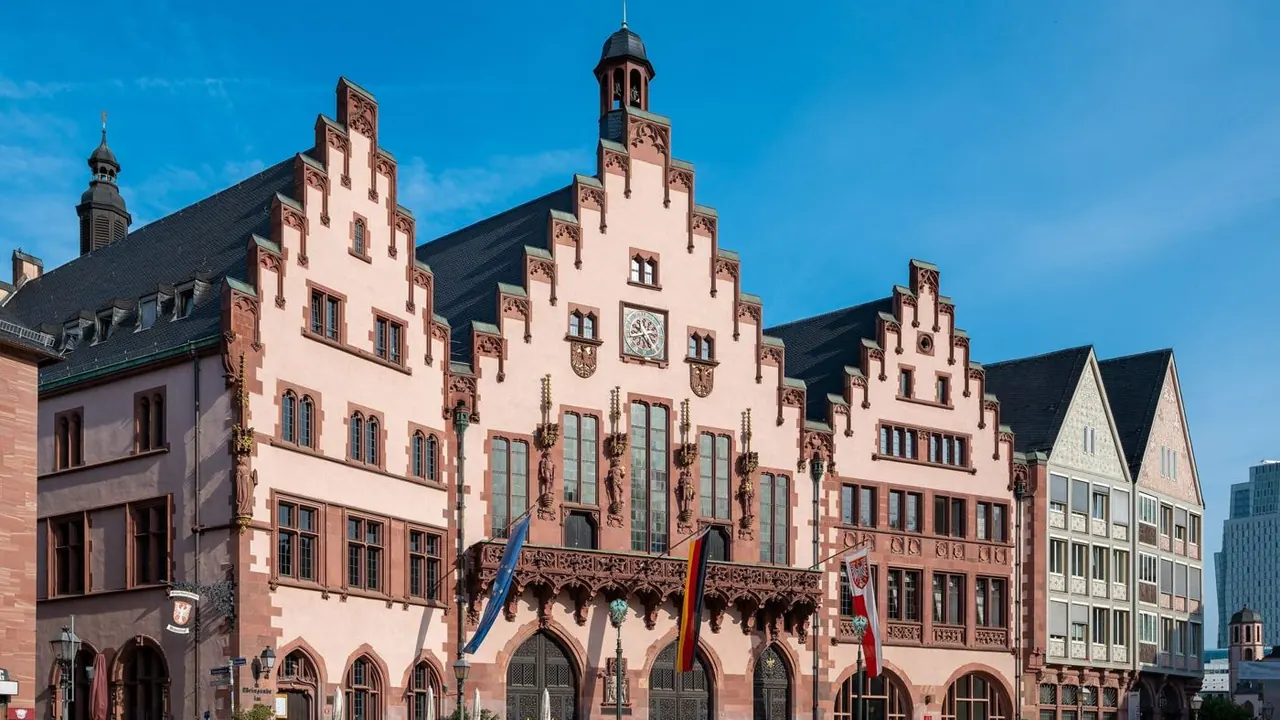
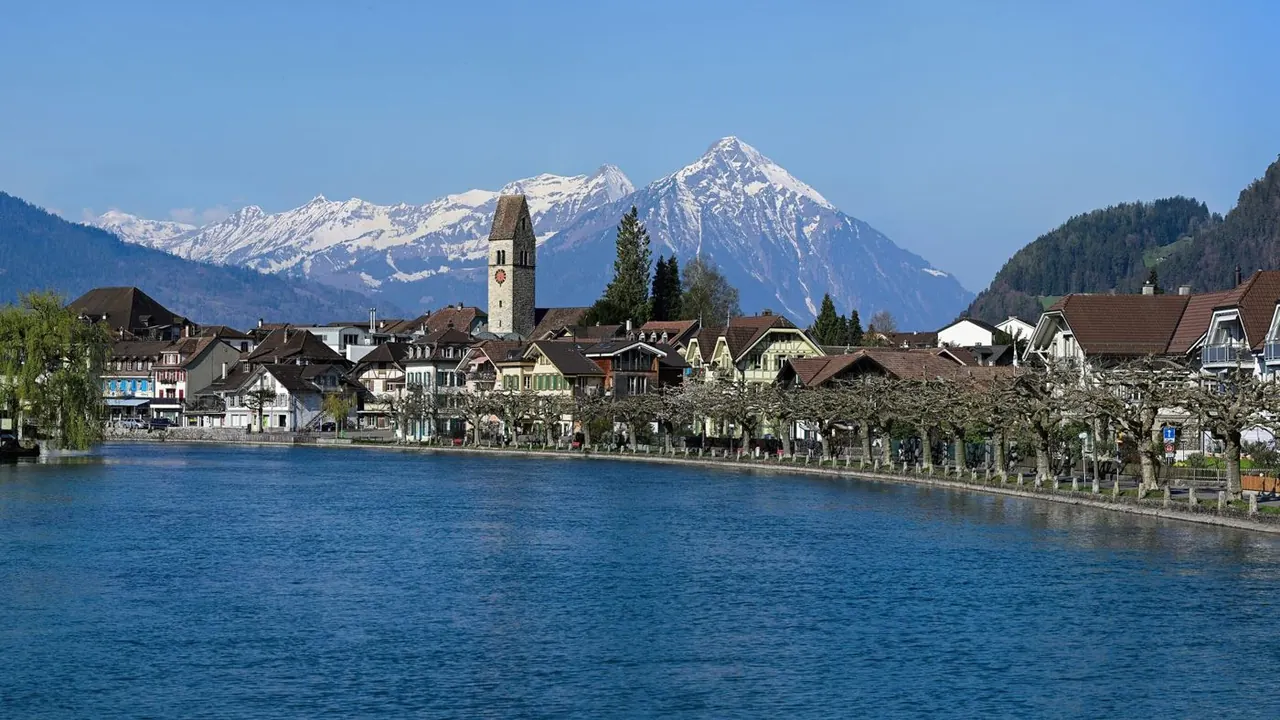
Photos: Frankfurt by Thomas Wolf, CC BY-SA 3.0 DE, cropped; Interlaken by Roy Egloff, CC BY-SA 4.0, cropped.
Frankfurt or Interlaken?
Our verdict in twelve categories, each scored against the same fixed benchmark cities, and the climate month by month, so you can choose for your trip.
Choose Frankfurt for
- live music and the arts
- culture and sights
- nightlife
Frankfurt is the choice for a city trip with substance. It has the Museumsufer and the Städel, an opera company of real standing, apple-wine taverns in Sachsenhausen and a club scene with roots in techno. Fast trains also put Heidelberg, Cologne and the Rhine Gorge within easy reach. It suits travellers who want museums, evenings out and a base for touring Germany by rail, and it costs less to stay, as long as you avoid the trade fairs.
Choose Interlaken for
- nature and the outdoors
- beaches
- families
Interlaken is for people who came for the mountains and will happily give up the city to be near them. The Eiger, the Lauterbrunnen valley and the Jungfraujoch are all a short train ride from your door, and paragliding, canyoning and lake paddling start in town. It also works better with children who love trains and gondolas. Expect early nights, plain food and some of the highest prices in Europe.
Scoreboard
Twelve categories on one fixed scale from 0 to 100. The shaded stretch is the gap between the two.
Your match
Pick a travel style or drag the sliders, and both match scores follow your weighting.
Wins on live music and the arts and culture and sights with your weighting.
Wins on nature and the outdoors and beaches with your weighting.
What matters to you?
Category by category
What the scores mean for a trip.
Beaches & swimming
Neither city is a beach destination, but Interlaken at least has swimmable water close by. Frankfurt has no sea anywhere near, so locals cool off in outdoor pools and gravel-pit lakes such as the Langener Waldsee in the southern forest. The Main is for sitting beside, not swimming in.
In Interlaken, Lake Thun warms up enough in high summer for the lidos and small shingle beaches at Neuhaus and towards Spiez, with snow peaks behind. Turquoise Lake Brienz is colder. It makes a good swim after a hike, but only for a few weeks of the year.
Food & drink
Frankfurt has real local food culture, which Interlaken lacks. Long shared tables in the Sachsenhausen apple-wine taverns, Grüne Soße and Handkäs mit Musik, and the stalls of the Kleinmarkthalle give a trip some regional flavour. The Bahnhofsviertel's cheap global kitchens add range.
Interlaken's restaurants mostly serve fondue, rösti and international dishes to visitors. The food is reliable but forgettable. Its better meals happen higher up: cheese from a mountain dairy or lunch on a hut terrace above Grindelwald.
Culture & sights
Here the gap is wide. Frankfurt has the Museumsufer, where the Städel's old masters sit alongside museums of film, architecture and Jewish history. It also has the rebuilt Römer and old-town lanes, the Paulskirche and Goethe's birthplace, all within a short walk, under Germany's only real skyline.
Interlaken offers a row of grand hotels on the Höheweg, a few old timber houses across the Aare in Unterseen and a small local museum. Anyone who wants museums or historic streets will need to take the train to Bern or Thun.
Nightlife
Frankfurt has far more going on after dark, though mostly at weekends. Its techno and house tradition, shared with Offenbach, lives on in a small club scene. The Bahnhofsviertel has cocktail bars and late kiosks, and Berger Straße has relaxed neighbourhood bars.
Interlaken goes to bed early because its visitors are catching dawn trains. A few backpacker pubs, basement clubs near the hostels and the Kursaal casino are about all there is, and the streets are quiet before midnight.
Nature & outdoors
This is where Interlaken is in a different league. The Eiger, Mönch and Jungfrau, the waterfalls of the Lauterbrunnen valley and the Aletsch glacier seen from the Jungfraujoch are all within an hour. Paragliding, canyoning, rafting on the Lütschine and winter skiing around Wengen and Mürren start from town. The one risk is low cloud hiding the peaks.
Frankfurt's outdoors is green and gentle. The Taunus beech woods and the Großer Feldberg are a short ride away, and the city has the Stadtwald and long, flat cycle paths along the Main. It suits walkers and cyclists, not anyone looking for drama.
Day trips
Both are good bases, but Frankfurt reaches more places, and more varied ones. High-speed trains bring Cologne cathedral and Würzburg's Residenz into easy range, and Heidelberg and the castle-lined Rhine Gorge are about an hour away. Closer still are Mainz with its Gutenberg Museum, the spa town of Wiesbaden and Darmstadt's Art Nouveau colony.
Interlaken's trips are smaller in scale but very attractive. You have Bern's arcaded old town, Thun's castle, steamer stops at Spiez and Oberhofen, the Ballenberg open-air museum and the line over the Brünig Pass to Lucerne.
Good for families
Interlaken makes the more memorable family trip, because getting around is half the fun. Rack railways, gondolas and steamers, summer toboggan runs and cliff walks at the summit stations, the St Beatus caves and the animals at Ballenberg all go down well. Wet days and high altitudes are the weak points.
Frankfurt covers exactly those weak points. The Senckenberg's dinosaur hall, the central zoo and the Palmengarten glasshouses fill a rainy day, and trams take pushchairs easily. There is just less to excite children.
Getting around
Both are easy without a car, in different ways. Frankfurt has a full urban network of U-Bahn, S-Bahn and trams, which takes some learning across its zones, with the airport about a quarter of an hour from the centre and high-speed trains from the main station.
Interlaken is a small, flat town you can walk end to end. What matters is the mountain network beyond it: narrow-gauge lines, cog railways, gondolas and lake steamers that connect neatly, though they get crowded in summer.
Shopping & style
Frankfurt is a proper shopping city. It has department stores and malls on the Zeil, luxury houses around Goethestraße, and independent boutiques and delis on Berger Straße and Schweizer Straße.
Interlaken's Höheweg sells watches, army knives, cuckoo clocks and chocolate to tour groups, plus outdoor gear. The one craft worth buying is woodcarving from Brienz.
Affordability
Neither is cheap, but Frankfurt is much easier on the wallet. Hotels are the expensive part, and they become scarce during trade fairs. Weekends and summer bring rates down, and eating in taverns and Turkish grills costs little.
Interlaken charges full Swiss prices for everything. On top of that come the mountain railways and cable cars, the Jungfraujoch above all, and adventure sports. Hostels, picnics and transport passes help, but there is no budget way to see the region properly.
Live music & performing arts
Frankfurt has a full cultural season. Its opera company is known for adventurous productions, the Alte Oper hosts the radio symphony orchestra, and there is serious drama at the Schauspiel, dance at the Mousonturm and jazz in old cellar clubs. Most of it runs from autumn to early summer.
Interlaken's live performance mostly happens in summer: the amateur open-air William Tell in the woods, yodelling and alphorn evenings, and a lake-stage musical in Thun. For anything more, you go to Bern.
Wellness & relaxation
Frankfurt itself is not restful, but it puts you near real spa towns. Wiesbaden's Art Nouveau Kaiser-Friedrich-Therme and the thermal baths of Bad Homburg are both easy trips, and in town the Palmengarten is the calmest place.
Interlaken has no springs of its own. Rest there means hotel spas on the Höheweg, early mornings by the lake and slow steamer crossings. The busy centre is not restful, so people who want quiet stay up in Wengen or Mürren.
When should you go?
Pick your month. The climate figures are measured averages, not a forecast.
Frankfurt in July
Interlaken in July
Daytime high, °C
Rainfall in the month, mm
Where the figures come from
Interlaken has no rain gauge within 25 km of the centre, so its rainfall comes from a gridded climate dataset read at the city rather than from a gauge further away.
Temperature and rainfall are climate normals, averaged over the years shown. Frankfurt: 1991-2020 normals, Frankfurt Westend (2 km from centre). Interlaken: 2005-2020 (rainfall 1991-2020) normals, Meiringen / Unterbach (19.3 km from centre).
Frankfurt is the warmer of the two through the summer, with highs of about 26°C in July and August. June and July bring the most sunshine, so long evenings on the Main riverbanks are at their best then. Winter is cold and grey for walking the streets, and December and January see very little sun. Rain falls fairly evenly all year, a little heavier in summer and December. For sightseeing on foot, May, June and September are the most comfortable months.
Interlaken stays a couple of degrees cooler, at about 24°C in July, and the lakes are only warm enough for a swim in July and August. Midsummer is also one of its wetter stretches, beaten only by December with 88mm. September is drier and still mild, which often makes it the best month for the high trails. From December to February, highs of only about 4°C bring the ski season and close the high trails, while March starts to soften but is still cool.
Which traveller are you?
For a culture and arts trip, Frankfurt is the obvious pick. You get the Städel and a dozen other museums along the Main, a respected opera house and the Alte Oper's concerts. Interlaken has little to see itself and sends you to Bern for culture.
On an outdoors trip, Interlaken has few equals. Trains and cable cars take you up to the Jungfraujoch, the Schynige Platte and the Mürren trails, and paragliding, canyoning and rafting all run from town. Frankfurt's Taunus and riverside cycle paths are pleasant but gentle.
On a tight budget, Frankfurt is far easier. Cider taverns, Turkish grills and the Museumsufer pass keep costs down, and weekends away from the trade fairs bring cheaper rooms. In Interlaken the mountain railways alone take a big share of any budget.
Before you go
| Measure | Frankfurt | Interlaken |
|---|---|---|
| Official language | German | French, German, Italian, Romansh |
| Currency | Euro (EUR) | Swiss Franc (CHF) |
| Sockets | CF230 V, 50 Hz | CJ230 V, 50 Hz |
| Driving side | Right | Right |
| Time zone | UTC+1, UTC+2 in summer | UTC+1, UTC+2 in summer |
| Emergency number | 112 | 112 |
| Elevation | 101 m | 571 m |
| Main airport | Frankfurt Main Airport (FRA)13 km from centre281 non-stop destinations | Zürich Airport (ZRH)100 km from centre226 non-stop destinations |
| Public holidays this year | 10 days | 10 days |
By the numbers
| Measure | Frankfurt | Interlaken |
|---|---|---|
| City population | 760,656 | 6,123 |
| People per km² | 3,063 | 1,424 |
| Museums within 10 km | 53 | 3 |
| UNESCO World Heritage sites within 50 km | 4 | 2 |
Where else could you go?
Every comparison below shares a destination with this one, so you can follow Frankfurt or Interlaken somewhere new.