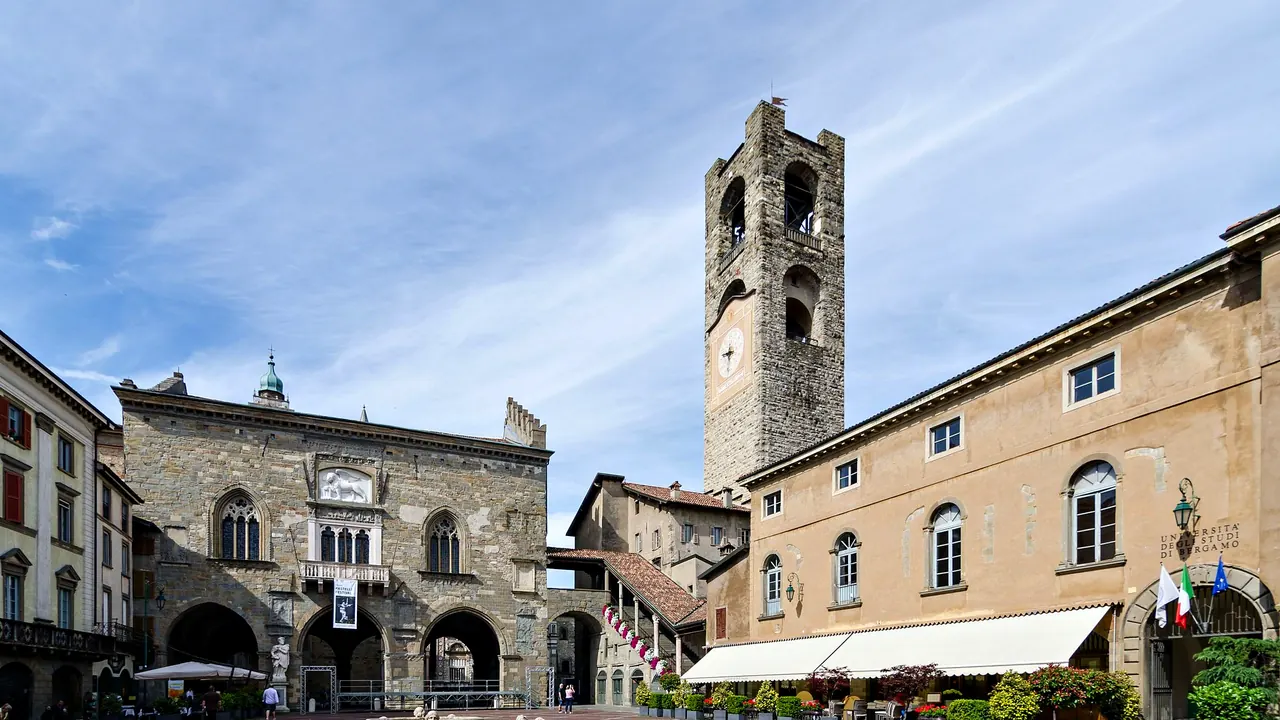
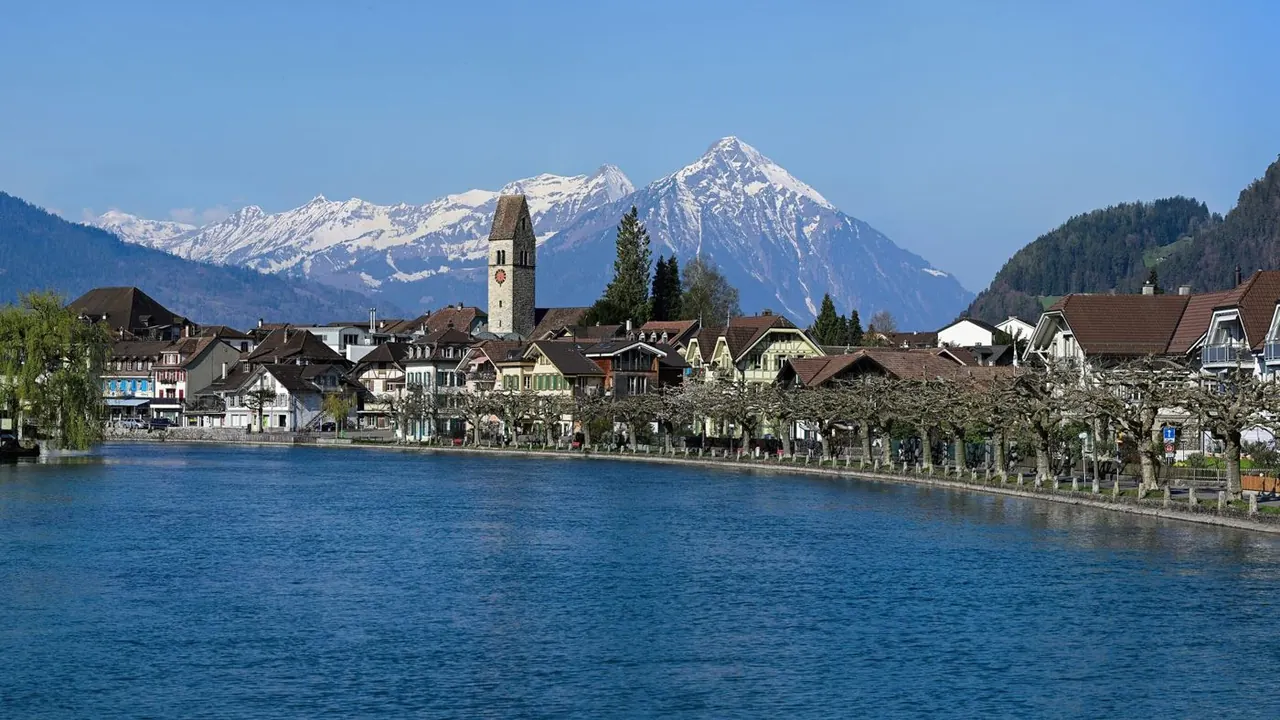
Photos: Bergamo by Steffen Schmitz, CC BY-SA 4.0, cropped; Interlaken by Roy Egloff, CC BY-SA 4.0, cropped.
Bergamo or Interlaken?
Our verdict in twelve categories, each scored against the same fixed benchmark cities, and the climate month by month, so you can choose for your trip.
Choose Bergamo for
- culture and sights
- prices
- food and drink
Bergamo is the choice for a trip built around a historic town, good Lombard cooking and easy train travel. The walled Città Alta, the Accademia Carrara and an opera house named after Donizetti give it a cultural weight that Interlaken lacks entirely. It is also far easier on the budget, and Milan, the lakes and Verona are all within reach. The Orobie Alps are close enough for a few hiking days, but here they come second to the town.
Choose Interlaken for
- nature and the outdoors
- families
- getting around
Interlaken is for travellers who come for the mountains and are happy to spend heavily to get up them. The Jungfrau peaks, the Lauterbrunnen valley and an unbroken chain of trains, cable cars and lake steamers make it one of the easiest places in the Alps to reach high ground without a car. Families and anyone into hiking, paragliding or skiing will be well looked after. The town itself has little to see or eat, so the days are spent outdoors.
Scoreboard
Twelve categories on one fixed scale from 0 to 100. The shaded stretch is the gap between the two.
Your match
Pick a travel style or drag the sliders, and both match scores follow your weighting.
Wins on culture and sights and prices with your weighting.
Wins on nature and the outdoors and families with your weighting.
What matters to you?
Category by category
What the scores mean for a trip.
Beaches & swimming
Neither town has a beach, and both offer lake swimming in summer, mostly from grassy lidos and pebbly shores rather than sand. The difference is in distance and temperature. Bergamo's lakes, Iseo and the Lecco arm of Como, make a day out and warm to about 23°C. Interlaken sits right between its two lakes. Lake Thun reaches around 21°C, Lake Brienz stays colder, and you swim with snow peaks overhead.
Food & drink
Bergamo eats far better. It has a real regional kitchen: casoncelli with butter and sage, polenta with braised meats and game, and cheeses such as Taleggio and Strachitunt from the surrounding valleys, with Valcalepio and Franciacorta to drink. The Città Alta's trattorias and cheese counters are worth visiting in their own right.
Interlaken's restaurants mostly serve fondue, rösti and international dishes to visitors. They are reliable but rarely memorable. The better meals are up the mountain, at a hut terrace or a dairy selling Alpine cheese, and many visitors get by on supermarket picnics.
Culture & sights
This is where the two differ most. Bergamo's upper town is a near-complete walled hilltop town inside UNESCO-listed Venetian fortifications. Piazza Vecchia, Santa Maria Maggiore and the marble Cappella Colleoni are all close together, and the Accademia Carrara below holds Mantegna, Lotto and Raphael.
Interlaken was built as a base for the mountains and has almost nothing to see. There is the row of nineteenth-century hotels on the Höheweg, a few timber houses in Unterseen and a small museum. For historic architecture you take the train to Bern or Thun.
Nightlife
Neither is a place for a big night out, but Bergamo keeps going for longer. An evening there starts with a long aperitivo and moves on to the wine bars around Borgo Santa Caterina, or in summer to drinks on the city walls. Milan is close enough for clubbing.
Interlaken goes to bed early because people have trains and hikes to catch. Its scene is a handful of backpacker pubs, sports bars and basement clubs, plus the casino in the Kursaal.
Nature & outdoors
Bergamo has real mountain country close by. The Colli di Bergamo park climbs straight from the walls of the upper town to San Vigilio, and Val Brembana and Val Seriana lead deep into the Orobie Alps, with rifugi, high lakes and serious summer hiking. Most of it is far easier to reach by car, though, and the winter skiing is limited to small areas such as Foppolo.
Interlaken is on another scale altogether. The Eiger, Mönch and Jungfrau and the waterfalls of the Lauterbrunnen valley are within an hour by rail. The cog railway to the Jungfraujoch at 3,454m takes about two hours and ends with a view over the Aletsch glacier. Cable cars take you up to high trails without a car, paragliders land in the middle of town, and in winter the Jungfrau ski areas take over. Low cloud that hides the peaks is the only real drawback.
Day trips
Both make good bases, but Bergamo reaches a richer spread of places. Milan's Duomo and Last Supper are under an hour away, Lake Como and Lake Iseo are closer still, and Brescia, Cremona, Verona and Mantua all make a day out. Crespi d'Adda and the Franciacorta vineyards are nearer again.
Interlaken's trips are fewer and more often scenic. Bern's arcaded old town is under an hour away, the lake steamers stop at the castle towns of Thun, Spiez and Oberhofen, and Lucerne is a two-hour ride over the Brünig Pass.
Good for families
Interlaken works better with children, mainly because getting up the mountain is half the fun. Rack railways, gondolas, summer toboggan runs, the St Beatus caves and the farm animals at Ballenberg keep most ages busy. The weak points are rainy days and the high altitude for very young children.
Bergamo is calm and safe, and the funiculars and walks along the walls go down well. The best family outings, though, are outside the city at the Leolandia theme park and the Le Cornelle wildlife park, and the cobbled upper town is hard going with a buggy.
Getting around
Interlaken has the better network. Mainline trains, narrow-gauge mountain railways, cog railways, gondolas and lake steamers all connect, so the whole Jungfrau region works without a car, and the town itself is flat and easy to walk. The catch is the crowded trains at the height of summer.
Bergamo is easy within its two towns, which are linked by funicular, and it has direct trains to Milan and Brescia and a short bus ride to the airport. For the upper valleys and the lake shores, a car saves a lot of time.
Shopping & style
Bergamo is the better place to shop, mainly for food. The upper town's main lane is lined with cheese shops, delicatessens and wine sellers, and the arcades of Via XX Settembre cover mid-range fashion. Milan is close for anything grander.
Interlaken's Höheweg caters to tour groups, with watch and jewellery stores, army knives, cuckoo clocks and chocolate. Carved woodwork from nearby Brienz is the one local craft worth taking home.
Affordability
The gap here is wide. Bergamo is moderately priced by northern Italian standards: lower-town hotels and trattorias are fair, and the funicular and buses cost little, though rooms in the Città Alta cost more.
Interlaken charges full Swiss prices for beds, meals and drinks. The mountain railways and cable cars, which are the reason most people come, add a lot to the bill, especially the Jungfraujoch. Transport passes and picnics help, but only so far.
Live music & performing arts
Bergamo has a real opera tradition as Donizetti's birthplace. The Teatro Donizetti runs a season of opera and concerts, and its autumn festival of his works draws serious fans. Add the Teatro Sociale, the long-running Bergamo Jazz in spring and La Scala within reach for an evening.
Interlaken's highlight is the amateur open-air William Tell, performed in the woods each summer. Beyond that there are occasional Kursaal concerts and folklore evenings with alphorns and yodelling.
Wellness & relaxation
Bergamo has proper spa towns nearby. San Pellegrino Terme, a Belle Époque resort up Val Brembana, and the sulphur springs of Trescore Balneario both make an easy outing, and the quiet early mornings in the Città Alta help you slow down.
Interlaken has no springs of its own, so relaxing means hotel spas on the Höheweg and the town's public wellness area. The real calm is found on slow steamer crossings or by staying up in Wengen or Mürren, away from the busy centre.
When should you go?
Pick your month. The climate figures are measured averages, not a forecast.
Bergamo in July
Interlaken in July
Daytime high, °C
Rainfall in the month, mm
Where the figures come from
Bergamo has no rain gauge within 25 km of the centre, so its rainfall comes from a gridded climate dataset read at the city rather than from a gauge further away.
Bergamo's sunshine is measured 64 km from the centre, at Lugano.
Interlaken has no rain gauge within 25 km of the centre, so its rainfall comes from a gridded climate dataset read at the city rather than from a gauge further away.
Interlaken's sunshine is measured 66 km from the centre, at Sion.
Temperature and rainfall are climate normals, averaged over the years shown. Bergamo: 1991-2020 normals, Bergamo / Orio Al Serio (3.9 km from centre). Interlaken: 2005-2020 (sunshine 1961-1990, rainfall 1991-2020) normals, Meiringen / Unterbach (19.3 km from centre).
Bergamo is warmer at every point in the year. Summer highs reach about 29°C in July and August, which is good for lake swimming but makes the steep climb to the Città Alta hard work in the afternoon. May, June and September are the most comfortable months for walking the old town. Rain is heaviest in autumn, when September to November each bring well over 100mm. Winters are mild but grey, with short, dull days.
Interlaken stays cooler, peaking at around 24°C in July. That suits hiking, but the lakes are only really swimmable in July and August. Its rain comes in summer, with June to August the wettest months, often as showers that can hide the peaks. The upside is that these months are also the sunniest. The best mountain weather tends to be in early autumn, when September is drier and still bright. Winter highs of around 3°C and very little sun suit skiers, not sightseers.
Which traveller are you?
On a culture and arts trip, Bergamo is the clear choice. It has the Venetian-walled Città Alta, the Cappella Colleoni, Raphael and Bellini at the Accademia Carrara, and opera at the Teatro Donizetti. Interlaken offers grand hotels and little else, so its culture means a train to Bern.
For an outdoors trip, Interlaken has a strong lead. Trains and cable cars go up to the Jungfraujoch, Schynige Platte and Mürren, and paragliding, canyoning and rafting all start from town. Bergamo's Orobie valleys are good for hiking, but you need a car and the mountains are on a smaller scale.
On a trip with a tight budget, choose Bergamo. Lower-town hotels, trattorias and aperitivo bars are moderately priced, and trains to Milan or the lakes are inexpensive. In Interlaken, the Swiss prices for rooms and meals, and above all for mountain railways, make even a frugal stay expensive.
Before you go
| Measure | Bergamo | Interlaken |
|---|---|---|
| Official language | Italian | French, German, Italian, Romansh |
| Currency | Euro (EUR) | Swiss Franc (CHF) |
| Sockets | CFL230 V, 50 Hz | CJ230 V, 50 Hz |
| Driving side | Right | Right |
| Time zone | UTC+1, UTC+2 in summer | UTC+1, UTC+2 in summer |
| Emergency number | 112 | 112 |
| Elevation | 249 m | 571 m |
| Main airport | Il Caravaggio International Airport (BGY)4 km from centre146 non-stop destinations | Zürich Airport (ZRH)100 km from centre226 non-stop destinations |
| Public holidays this year | 13 days | 10 days |
By the numbers
| Measure | Bergamo | Interlaken |
|---|---|---|
| City population | 119,534 | 6,123 |
| People per km² | 2,973 | 1,424 |
| Museums within 10 km | 21 | 3 |
| UNESCO World Heritage sites within 50 km | 6 | 2 |
Where else could you go?
Every comparison below shares a destination with this one, so you can follow Bergamo or Interlaken somewhere new.
- Bernvs Interlaken
- Milanvs Bergamo
- Comovs Bergamo
- Lucernevs Interlaken
- Luganovs Bergamo
- Zermattvs Interlaken