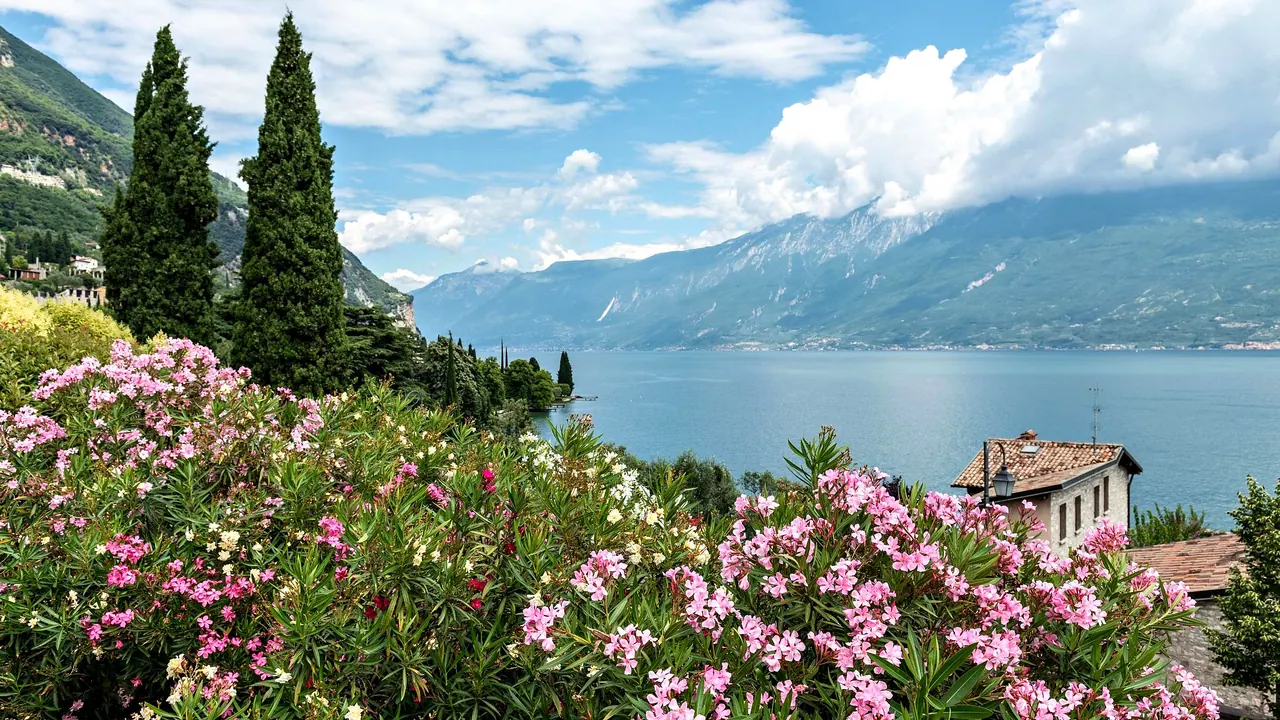
Photos: Lake Garda by Wolfgang Weiser, Pexels License.
Lake Garda or Swiss Alps?
Our verdict in twelve categories, each scored against the same fixed benchmark cities, and the climate month by month, so you can choose for your trip.
Choose Lake Garda for
- prices
- beaches
- day trips
Lake Garda is the better choice for a warm summer trip that mixes lake swimming, wine and easy outings. Its southern shore sits on the Milan to Venice railway, so Verona, Venice and Mantua are within reach, and the south-east shore is built for families, with theme parks, campsites and shallow pebble lidos. It costs a good deal less than the Swiss Alps, and the windy north around Riva and Torbole still gives keen walkers, climbers and windsurfers plenty to do.
Choose Swiss Alps for
- getting around
- wellness
- nature and the outdoors
The Swiss Alps suit travellers who put the mountains themselves first and will pay for them. The Jungfrau, the Matterhorn, the Aletsch glacier and the Engadine, and in winter some of the world's best ski areas, are all reached by trains and cable cars that run to connected timetables, with no need for a car. Add the thermal baths of Leukerbad and Vals and the quiet of the car-free villages, and the region is hard to beat for a restorative mountain stay. You have to accept the very high cost and cooler, wetter summers.
Scoreboard
Twelve categories on one fixed scale from 0 to 100. The shaded stretch is the gap between the two.
Your match
Pick a travel style or drag the sliders, and both match scores follow your weighting.
Too close to call, 2 points apart
Wins on prices and beaches with your weighting.
Wins on getting around and wellness with your weighting.
What matters to you?
Category by category
What the scores mean for a trip.
Beaches & swimming
Lake Garda is a real summer swimming destination. The water is warm in July and August, and the south and east shores have long grassy lidos, pebble coves and the rock shelves below Sirmione, so a lake vacation can be built around swimming. Expect jetties and shingle rather than sand.
In the Swiss Alps, swimming is a pleasant extra. Lake Thun, Lake Brienz and the central lakes are very clean but stay cool. Mountain lakes such as the Caumasee are beautiful places for a dip. Only Ticino's lakes come close to Garda's warmth, and they have a shorter season.
Food & drink
Lake Garda offers more variety. It has lake fish with risotto, bigoli, its own olive oil, and wines that cover Bardolino, Chiaretto, Lugana and Amarone from the nearby hills, all close together. The best meals are in hill agriturismi rather than on the harbour fronts.
The Swiss Alps focus on cheese and cured meat: fondue, raclette, rösti and Graubünden air-dried beef, best eaten on a hut terrace. The terraced vineyards of Valais are a real find, and the smart resorts offer expensive fine dining. Outside those resorts, most villages offer little more than a few hotel dining rooms and stuben.
Culture & sights
Neither destination is a museum trip, and the two are much alike for sightseeing. The difference is in kind. Lake Garda's sights are lakeside towns and a few standout places: Sirmione's moated castle and Roman villa ruins, d'Annunzio's eccentric Vittoriale estate, and castles above Malcesine and Riva.
The Swiss Alps' heritage lies along the valleys rather than in the towns: sgraffito houses in the Engadine, the World Heritage Albula and Bernina railway lines, the twin castles of Sion and Müstair's Carolingian frescoes. On both, sightseeing fills half-days rather than whole trips.
Nightlife
The Swiss Alps have the stronger nightlife, but only in winter. Après-ski in Verbier and Zermatt fills slope-side terraces and bars, and a few clubs stay open well past midnight. St Moritz and Gstaad offer a glossier night out in hotel bars.
Lake Garda's evenings are about aperitivo, dinner and a walk along the promenade, with Desenzano's lakefront bars and nearby summer clubs as the exception. Outside their peak seasons, both go quiet early.
Nature & outdoors
Lake Garda's narrow northern end is a serious outdoor base. The cable car from Malcesine climbs Monte Baldo for ridge walks and paragliding, Arco's limestone walls draw climbers all year, and the steady afternoon wind makes Torbole a classic for windsurfing and kitesurfing. The southern basin of vineyards and moraine hills is much gentler country.
The Swiss Alps are on a far larger scale. The Eiger and Jungfrau above the Lauterbrunnen valley, the Matterhorn, the Aletsch glacier and the ibex of the Swiss National Park are high, glaciated country that Garda's mountains never reach, and thousands of kilometres of trails start straight from the lifts. In winter, Monte Baldo's small ski area is modest next to the big ski areas of Zermatt, Verbier, St Moritz and Davos.
Day trips
Lake Garda has the stronger list of day trips, because the railway at Peschiera and Desenzano puts some of Italy's great cities close by. Verona's arena is under an hour away, Venice about an hour and a half, and Padua, Vicenza, Mantua and Bergamo are all easy days out.
The Swiss Alps offer pleasant rather than famous outings. Bern's arcades and Lucerne's wooden bridges are an easy train ride from the Bernese Oberland, and Gruyères, the Lavaux terraces and Chillon lie to the west. The trains make each of them simple.
Good for families
Lake Garda's south-east shore is set up for children. Gardaland and its aquarium, water parks, the Parco Natura Viva safari park and large camping villages with pools sit beside shallow pebble shores. The main drawbacks are summer heat and traffic.
The Swiss Alps work well with children in a quieter way. Ski schools in Wengen, Grindelwald and Saas-Fee, summer toboggan runs and cogwheel trains keep them busy, and car-free villages let them roam safely. There is no big theme park or zoo, and altitude needs some care with toddlers.
Getting around
The Swiss Alps are much easier to get around without a car. Trains, postbuses, lake steamers and cable cars run on connected timetables to almost every village, and resorts like Zermatt and Wengen ban cars altogether. Long transfers between regions are the only real slog.
At Lake Garda, the towns are walkable and ferries link them, but the railway serves only the south. Many visitors drive, and they face narrow, congested shore roads and scarce parking in summer.
Shopping & style
Neither is a shopping destination, but the Swiss Alps have a little more. St Moritz and Gstaad have streets of luxury fashion and jewellery, and Zermatt and Interlaken have watch shops and serious mountain gear.
Lake Garda's shopping is the weekly market on the lakefronts of Desenzano, Lazise and Bardolino, plus olive oil, Lugana wine and Limone's lemon products to take home. On both, real retail means a trip to a city.
Affordability
Lake Garda costs far less. Lakefront hotels in Sirmione or Limone are expensive in high summer, but campsites, hill agriturismi and the Valtenesi villages bring costs down, and spring and autumn are cheaper.
In the Swiss Alps the same kind of trip costs a great deal more, and even the cheaper options, such as hostels around Interlaken or an apartment in Goms or on the Ticino side, are still well above Garda's campsites. Lunch at a mountain restaurant is expensive, and a few days of cable cars and mountain railways can rival the hotel bill. Picnics and travel passes help, but the gap with Garda never closes.
Live music & performing arts
Both come alive only in summer, but the Swiss Alps have slightly more of their own. The Verbier Festival and the Menuhin Festival around Gstaad bring top soloists and orchestras to resort halls and village churches for weeks at a time.
Lake Garda's own offer is concerts at the Vittoriale's open-air amphitheatre and band evenings in the town squares. Its trump card is close by, though: the opera season in Verona's Roman arena, under an hour from the southern shore.
Wellness & relaxation
Lake Garda has one strong anchor: Sirmione's sulphurous springs feed thermal pools overlooking the lake, and there are open-air thermal pools in a historic villa park near Lazise. The resort hotel spas at Gardone and Salò add to them, but the southern towns get crowded in August.
The Swiss Alps offer a deeper tradition and more calm. Leukerbad is a whole village of hot pools under the cliffs, Vals has its stone bath and Bad Ragaz and Scuol have centuries of bathing behind them. The clean air and car-free quiet do the rest.
When should you go?
Pick your month. The climate figures are measured averages, not a forecast.
Lake Garda in July
Swiss Alps in July
Daytime high, °C
Rainfall in the month, mm
Where the figures come from
Lake Garda's sunshine is measured 28 km from the centre, at Verona / Villafranca.
Swiss Alps has no rain gauge within 25 km of the centre, so its rainfall comes from a gridded climate dataset read at the destination rather than from a gauge further away.
Swiss Alps's sunshine is measured 66 km from the centre, at Sion.
Temperature and rainfall are climate normals, averaged over the years shown. Lake Garda: 2005-2025 (sunshine 1991-2020, rainfall 1991-2020) normals, Verona / Rivoltella (1.6 km from centre). Swiss Alps: 2005-2020 (sunshine 1961-1990, rainfall 1991-2020) normals, Meiringen / Unterbach (19.5 km from centre).
Lake Garda is the warmer of the two through the whole year. Around the lake, summer days reach about 29°C in July, the lake is warm enough for swimming from June into September, and July is very sunny. That heat can make midday sightseeing in the towns tiring, so May, June and September are the easiest months for walking and hiking. Rain comes all through the year, but autumn is the wettest stretch and November is the dampest month at around 121mm. Winter is cool and grey.
The Swiss Alps figures are measured in a valley, and the high country is colder still. Even there, summer highs only reach the low twenties, and June to August is the wettest part of the year, at well over 120mm a month, often as afternoon showers. Late June to September is the season for hiking and the high passes. Winter days hover just above freezing, which is cold for wandering a village but exactly right for the ski season.
Which traveller are you?
On a beach and sun trip, Lake Garda is clearly the one to choose. Its water reaches the mid-twenties in high summer, and the lidos of Lazise, Bardolino and Sirmione's rock shelves make swimming the centre of the day. The cooler Alpine lakes only allow a quick dip between hikes.
On a trip with a tight budget, choose Lake Garda. It is not cheap in high summer, but campsites, hill agriturismi and spring or autumn stays keep costs reasonable. In the Swiss Alps, even with picnics and travel passes, hotels, meals and cable cars stay far above European norms.
For a relaxing and wellness trip, the Swiss Alps go further. Leukerbad's hot pools under the cliffs, the stone baths at Vals and Bad Ragaz's old springs add up to a real tradition of taking the waters, and the car-free villages are quiet. Sirmione's springs are lovely but more limited.
Before you go
| Measure | Lake Garda | Swiss Alps |
|---|---|---|
| Official language | Italian | French, German, Italian, Romansh |
| Currency | Euro (EUR) | Swiss Franc (CHF) |
| Sockets | CFL230 V, 50 Hz | CJ230 V, 50 Hz |
| Driving side | Right | Right |
| Time zone | UTC+1, UTC+2 in summer | UTC+1, UTC+2 in summer |
| Emergency number | 112 | 112 |
| Main airport | Verona Villafranca Valerio Catullo Airport (VRN)96 non-stop destinations | Zürich Airport (ZRH)226 non-stop destinations |
| Public holidays this year | 13 days | 10 days |
Where else could you go?
Every comparison below shares a destination with this one, so you can follow Lake Garda or Swiss Alps somewhere new.
- French Alpsvs Swiss Alps
- Lake Comovs Lake Garda
- Lake Comovs Swiss Alps
- Black Forestvs Swiss Alps
- Cinque Terrevs Lake Garda
- Dolomitesvs Lake Garda