Switzerland
Zermatt
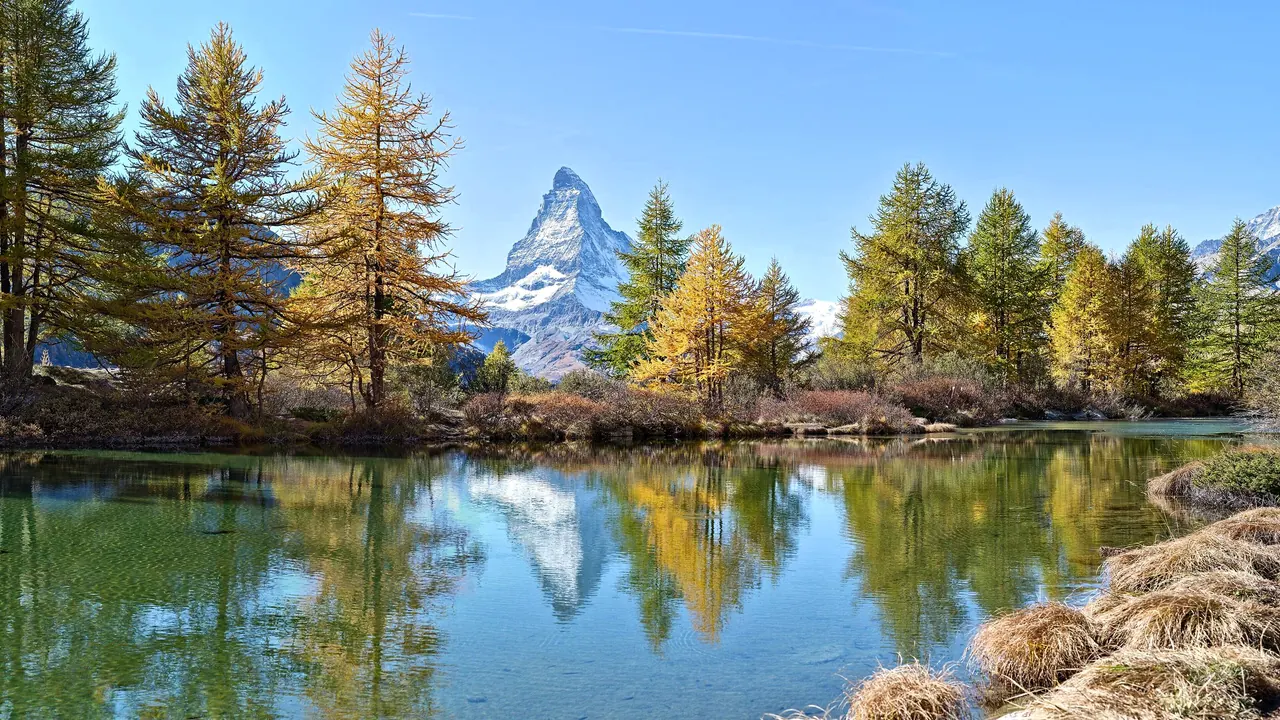
The Matterhorn reflected in the Grindjisee
- Nature & outdoors97
- Getting around78
- Families50
Photo: Roy Egloff, CC BY-SA 4.0, cropped
Match
37
Every category weighted equally
- Beach & sun35
- Culture & arts36
- Food & nightlife34
- Family trip40
- Outdoors44
- Relax & unwind39
- Shopping & style37
- On a budget34
Zermatt in twelve categories
Our verdict on each, scored 0 to 100 against the same fixed benchmark cities, so a score means the same thing on every page.
Beaches & swimming. Scores 3 out of 100.
Food & drink. Scores 40 out of 100.
Culture & sights. Scores 18 out of 100.
Nightlife. Scores 30 out of 100.
Nature & outdoors. Scores 97 out of 100.
Day trips. Scores 33 out of 100.
Good for families. Scores 50 out of 100.
Getting around. Scores 78 out of 100.
Shopping & style. Scores 28 out of 100.
Affordability. Scores 3 out of 100.
Live music & performing arts. Scores 18 out of 100.
Wellness & relaxation. Scores 50 out of 100.
Zermatt category by category
Beaches & swimming
3Zermatt is a high Alpine village at the head of a narrow valley, far from any sea and without a bathing lake. The mountain tarns above the village are for looking at, with the Matterhorn reflected in them, and their meltwater stays far too cold for a proper swim even in August. Swimming here means a hotel pool. A visitor who wants a beach should plan it for another part of the trip.
Food & drink
40Eating in Zermatt is better than a village of its size suggests, because it caters to an international, well-off ski crowd. The real character is on the mountain. Wooden chalets in the hamlets around Findeln, Furi and Zum See serve long lunches on sunny terraces with the Matterhorn in view, and reaching them on skis or on foot is part of the pleasure. In the village there are a few ambitious fine-dining kitchens and plenty of hotel restaurants.
The local cooking is Valais Alpine food: raclette, fondue, air-dried beef, rye bread and apricot desserts, with good Valais wines such as Fendant, Petite Arvine and Cornalin. Range is narrow, cheap eating is scarce, and outside the ski and hiking seasons many places close.
Culture & sights
18Zermatt has a small, focused heritage centred on mountaineering. The Matterhorn Museum, built as an underground reconstruction of the old village, tells the story of the first ascent of 1865 and the disaster on the descent. The mountaineers' cemetery beside the parish church holds the graves of climbers who died on the surrounding peaks. In the Hinterdorf, dark larch-wood barns and granaries stand on stone slabs that kept the mice out, a reminder of the farming village that was here before the hotels. Together they fill a morning. The Gornergrat cog railway, running since 1898, is a historic sight in its own right, but visitors come for the mountains, not for monuments.
Nightlife
30Going out in Zermatt means winter après-ski. From late afternoon the slope-side bars on the runs back into the village fill with ski boots and loud music, and later a few bars and small clubs along the main street keep going past midnight on busy weekends. It is fun, cheerful and expensive rather than deep. In summer the crowd is made up of hikers and climbers, many with an early start ahead, and evenings end after dinner. Between seasons much of the village is shut.
Nature & outdoors
97Few places put a visitor this close to the high Alps. The Matterhorn rises straight above the village, and the surrounding ring holds dozens of four-thousand-metre peaks, the Gorner Glacier and some of the highest lift-served terrain in Europe. Cog railway, gondolas and cable cars climb to the Gornergrat, the Rothorn and the Matterhorn Glacier Paradise at over 3,800m. The skiing links across the border into Italy, and the glacier keeps some pistes open in summer.
In summer the same lifts open up hundreds of kilometres of marked trails. The Five Lakes walk, the Hörnli hut path, the suspension bridge on the Europaweg and larch forests full of marmots and ibex are all within reach. Guides lead first ascents of four-thousanders, and the valley is the end of the Haute Route.
Day trips
33Zermatt sits at the end of a long valley, so every day out starts with the narrow-gauge train down to the Rhône. Brig, a bit over an hour away, has the Stockalper Palace and a pleasant old centre. Sion, about an hour and a half, is the most rewarding outing, with two castle hills, the Valère basilica and an old town, set among the steep Valais vineyards. Visp is the gateway to the high vineyards of Visperterminen, and Saas-Fee in the neighbouring valley is reachable by bus. Bern comes just inside a long day. Most visitors spend their spare days in the mountains rather than going to other towns.
Good for families
50The car-free streets make Zermatt relaxed with children: no traffic to worry about, short walks between hotel, ski school and lifts, and a calm, safe village. In winter there are children's ski schools and gentle nursery slopes up on the Sunnegga side. In summer there are easy lakeside walks, marmots to spot, a small playground lake and the novelty of cog railways and glacier gondolas.
There is little else made for children, though: no zoo, aquarium or theme park, and rainy days are hard to fill. The highest viewpoints are above 3,000m, where the thin air and cold can be too much for small children. Families who ski or hike together get the most out of it.
Getting around
78Zermatt is closed to ordinary cars, so visitors arrive by train, usually changing from the car park and shuttle at Täsch. After that everything is on foot. The village is a compact strip along the river, and small electric taxis and ski buses cover the outlying lift stations. The mountains are reached by the Gornergrat cog railway, the underground funicular to Sunnegga and a chain of gondolas and cable cars, all within walking distance of the centre. Hotels on the slopes at the edges mean a steep walk with luggage. Leaving the valley takes over an hour by train, but the connections into the Swiss rail network are smooth.
Shopping & style
28Shopping runs along one main street from the station towards the church. It is lined with Swiss watch and jewellery boutiques aimed at wealthy skiers, well-stocked ski and mountaineering outfitters, and souvenir shops selling cowbells, chocolate and Matterhorn-shaped everything. The outdoor gear is genuinely good if you need equipment. Beyond that there is little to browse: no market, no design scene and few independent shops.
Affordability
3Zermatt is one of the most expensive places in the Alps, and that says a lot. Rooms in season are steep even in plain hotels, and a sit-down meal or a drink on a mountain terrace costs well above what most of Europe charges. The lifts and cog railways that every visitor uses are expensive too. Self-catering apartments and supermarket picnics make the biggest difference, and staying down the valley in Täsch saves on beds, but nobody comes here on a tight budget.
Live music & performing arts
18Zermatt has no theatre or concert hall, and for most of the year live music means a band in an après-ski bar. Two festivals give the calendar some weight. Zermatt Unplugged brings acoustic sets by well-known singers to tents and mountain stages in spring, and a chamber music festival in late summer puts serious classical musicians in the village church and other small venues. If your visit falls outside those weeks, plan your evenings around dinner.
Wellness & relaxation
50Zermatt has no thermal springs and no public bathing tradition. What it has is a very high concentration of excellent hotel spas, with indoor pools, saunas, steam rooms and treatment rooms, many with mountain views. A few of them sell day access to non-residents. Car-free streets, clear air and the absence of traffic noise give the village a restful feel, especially in early summer and on quiet winter evenings after skiing. Peak weeks are busy, though, and the mood is active rather than slow. For proper thermal bathing, Valais has spa towns further down the valley.
When should you go?
Pick a month to see what it is like. The climate figures are measured averages, not a forecast.
Zermatt in July
Daytime high, °C
Rainfall in the month, mm
The whole year
Shaded against this city’s own year: the deepest cell is its best month for that figure and the palest its weakest.
Where the figures come from
Zermatt has no weather station within reach, so its figures come from a gridded climate model rather than a measured record, and read a broad area rather than the city itself.
Temperature and rainfall are climate normals, averaged over the years shown. Zermatt: 1991-2020 normals, TerraClimate 4 km grid at the town, no weather station within 90 km.
Before you go
| Measure | Zermatt |
|---|---|
| Official language | French, German, Italian, Romansh |
| Currency | Swiss Franc (CHF) |
| Sockets | CJ230 V, 50 Hz |
| Driving side | Right |
| Time zone | UTC+1, UTC+2 in summer |
| Emergency number | 112 |
| Elevation | 1,624 m |
| Main airport | Geneva International Airport (GVA)128 km from centre150 non-stop destinations |
| Public holidays this year | 9 days |
By the numbers
| Measure | Zermatt |
|---|---|
| City population | 6,023 |
| People per km² | 25 |
| Museums within 10 km | 2 |
| UNESCO World Heritage sites within 50 km | 2 |
Compare Zermatt with
Every comparison with a written verdict behind it.
- Aix-en-Provence
- Annecy
- Antibes
- Avignon
- Baden-Baden
- Basel
- Bergamo
- Bern
- Bled
- Bologna
- Cannes
- Chamonix
- Colmar
- Como
- Cortina d'Ampezzo
- Dijon
- Florence
- Frankfurt
- Freiburg
- Geneva
- Genoa
- Hallstatt
- Heidelberg
- Innsbruck
- Interlaken
- La Spezia
- Lausanne
- Lucca
- Lucerne
- Lugano
- Luxembourg
- Lyon
- Marseille
- Milan
- Monaco
- Montpellier
- Munich
- Nice
- Nuremberg
- Padua
- Piran
- Pisa
- Portofino
- Pula
- Rovinj
- Saint-Tropez
- Salzburg
- Siena
- Strasbourg
- Stuttgart
- Trieste
- Turin
- Venice
- Verona
- Zurich