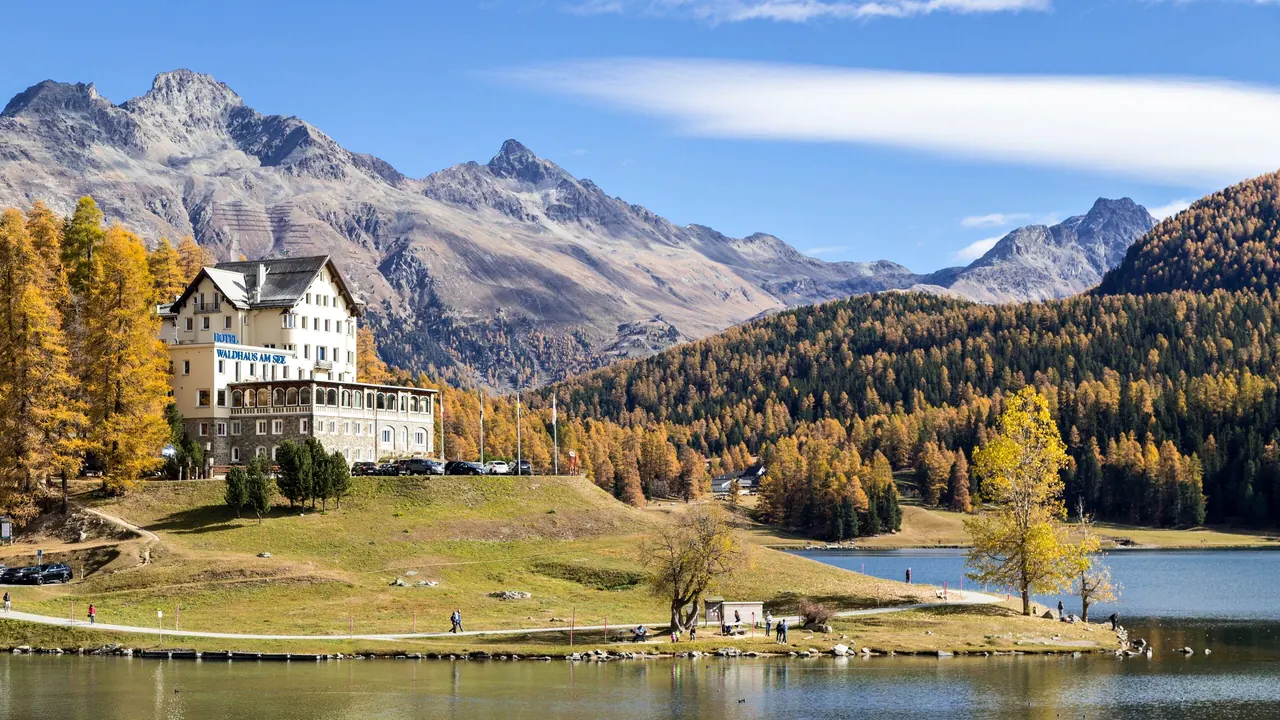
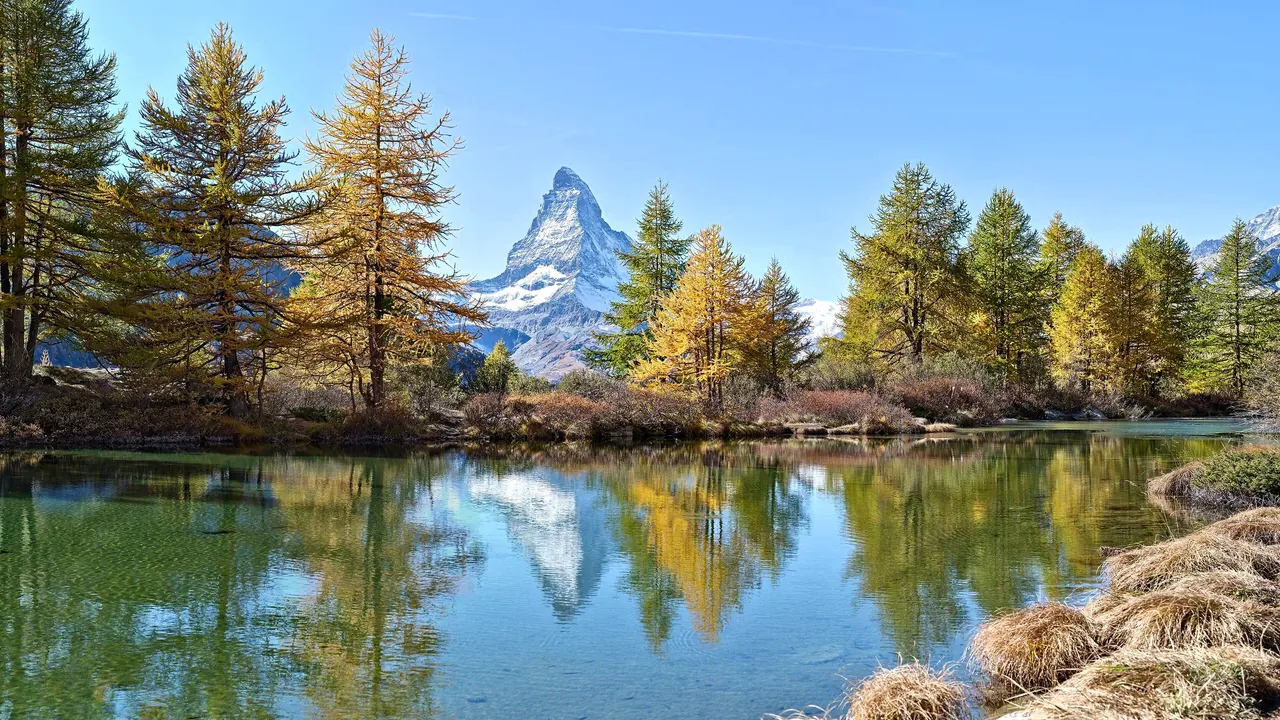
Photos: St. Moritz by JoachimKohler-HB, CC BY-SA 4.0, cropped; Zermatt by Roy Egloff, CC BY-SA 4.0, cropped.
St. Moritz or Zermatt?
Our verdict in twelve categories, each scored against the same fixed benchmark cities, and the climate month by month, so you can choose for your trip.
Choose St. Moritz for
- shopping
- day trips
- wellness
St. Moritz suits travellers who want the Alps with polish. Its strengths are the grand hotel spas and the old mineral-spring baths, a street of luxury boutiques, and a wide, sunny lake valley where cross-country trails, kitesurfing and gentle walks sit alongside the big skiing. The Bernina railway also puts Italian villages within a day's reach. Summers are noticeably warmer than in Zermatt, which makes it the easier choice for an unhurried mountain stay outside the ski season.
Choose Zermatt for
- nightlife
- nature and the outdoors
- families
Zermatt is for people who come mainly for the mountain itself. The Matterhorn stands right over the village, the lifts climb higher, glacier skiing runs into summer, and guides take climbers up four-thousanders. The car-free streets give the place a calm, walkable feel, and the après-ski is livelier and more casual than in St. Moritz. If high peaks, long trails and a ski area that crosses into Italy matter more to you than shopping and spa culture, choose Zermatt.
Scoreboard
Twelve categories on one fixed scale from 0 to 100. The shaded stretch is the gap between the two.
Your match
Pick a travel style or drag the sliders, and both match scores follow your weighting.
Wins on shopping and day trips with your weighting.
Wins on nightlife and nature and the outdoors with your weighting.
What matters to you?
Category by category
What the scores mean for a trip.
Beaches & swimming
Neither is a place to swim, but St. Moritz at least offers a little. Lej da Staz, a forest lake within walking distance of town, has a lawn and a small bathing area for a few warm weeks of summer. Lake St. Moritz itself is for windsurfers in wetsuits.
Zermatt has no bathing lake at all. Its mountain tarns are for photographing the Matterhorn's reflection, not for getting in. In both places, most swimming happens in a hotel or indoor pool.
Food & drink
Both eat better than their size suggests, and in both the choice thins quickly below the expensive tier. St. Moritz is the place for a formal evening, with serious kitchens in its grand hotels and Engadine dishes such as capuns, pizzoccheri and the dense nut tart from the old village confectioners.
Zermatt's best meals are up the mountain, at wooden chalets in Findeln, Furi and Zum See, where you arrive on skis or on foot for raclette and a long lunch facing the Matterhorn. The Valais wines are the other reason to eat there.
Culture & sights
You can see the sights in either place in a morning or an afternoon. What differs is the subject. St. Moritz offers art and resort history: Segantini's Alpine triptych in its domed museum, painted farmhouse rooms in the Engadin Museum, and the legacy of two Winter Olympics, with the Cresta Run still in use.
Zermatt's heritage is about climbing. The underground Matterhorn Museum tells the story of the 1865 first ascent and its fatal descent, climbers lie buried in the mountaineers' cemetery, and the old larch barns of the Hinterdorf stand on their stone slabs.
Nightlife
Neither has much of a nightlife, and both go quiet outside winter. They differ in mood. St. Moritz is dressy: champagne in grand hotel bars and a couple of exclusive clubs that need the right introduction. Zermatt is louder and more relaxed, with ski boots on the floor of slope-side bars from late afternoon and a few places on the main street still open past midnight on busy weekends.
Nature & outdoors
Both are first-rate Alpine bases, but they offer different landscapes. The Upper Engadine around St. Moritz is broad, open and sunny, with a chain of lakes. That gives it excellent cross-country skiing, polo and racing on the frozen lakes, the steady afternoon wind on Lake Silvaplana for kitesurfers, and the Swiss National Park within an hour.
Zermatt feels steeper and more enclosed. The Matterhorn rises straight above the streets, lifts reach glacier terrain above 3,800m, the pistes link into Italy, and some slopes stay open through summer. Mountaineers come for guided ascents of four-thousanders and to finish the Haute Route.
Day trips
St. Moritz has more to offer away from the slopes. The Bernina railway climbs over the pass and down to Poschiavo and Tirano in Italy. Over the Maloja, Soglio and Chiavenna are within easy reach, and Sils Maria and the sgraffito-decorated villages of the Lower Engadine are closer still.
From Zermatt, every outing starts with a train ride of over an hour down the valley. Sion, with its two castle hills and its vineyards, is the best reward, and Brig and Saas-Fee are easier trips. Most visitors would rather spend a spare day back in the mountains.
Good for families
Families do roughly as well in either place, for different reasons. In Zermatt the main advantage is the absence of cars: children can walk safely between the hotel, ski school and lifts, and the cog railways and the marmots are an easy win. Bear in mind that the highest viewpoints can be too cold and thin-aired for small children.
St. Moritz offers ski schools on Corviglia, sledging and skating on natural ice, but the town is built around adult luxury. Many families with young children stay in the quieter villages nearby instead.
Getting around
You won't need a car in either place. In St. Moritz, regional trains and buses run the length of the valley from Maloja to Zuoz, which makes it easy to explore beyond the town. The village itself is split between hilly Dorf and flat Bad, with escalators and a lift helping on the climb.
Zermatt bans ordinary cars, so you leave yours at Täsch and come in by shuttle train. The village is a compact strip, and the cog railway, funicular and gondolas all start within walking distance. The trade-off is that leaving the valley takes over an hour.
Shopping & style
St. Moritz has far more to browse. A cluster of fashion, watch and jewellery houses around Via Serlas, along with furriers and high-end ski wear, is unusual for a town this small. Look for Engadine linen and woodwork as souvenirs.
Zermatt's shopping is limited to its main street. Beyond the watch boutiques and the cowbell-and-chocolate souvenir shops, its real strength is serious mountaineering and ski equipment.
Affordability
Both are among the most expensive places in the Alps, and there is no cheap version of either. The ways to soften the cost differ. In St. Moritz, many hotels include local lifts and public transport in the room, summer is easier on the wallet, and budget travellers sleep in guesthouses elsewhere in the valley.
In Zermatt, the biggest savings come from self-catering apartments, supermarket picnics and beds down the valley in Täsch.
Live music & performing arts
Neither has a theatre or concert hall, so in both it comes down to timing a visit around a festival. St. Moritz has a summer jazz festival in small rooms, the Engadin Festival's chamber concerts in churches across the valley, and a winter classical series.
Zermatt has Zermatt Unplugged's acoustic sets on mountain stages in spring and a late-summer chamber music festival in the village church. Outside festival dates, expect a hotel pianist in St. Moritz and an après-ski band in Zermatt.
Wellness & relaxation
St. Moritz began as a spa town, and that history still shows. Guests at the medical bath in Bad are treated with iron-rich spring water and peat, the hotel spas are among the most elaborate in the Alps, a public pool with saunas is open to everyone, and the thermal baths at Scuol are a rail trip away.
Zermatt has no springs and no public bathing tradition. It does have many very good hotel spas, a few with day passes, and the quiet of car-free streets. The mood there is more active than restful.
When should you go?
Pick your month. The climate figures are measured averages, not a forecast.
St. Moritz in July
Zermatt in July
Daytime high, °C
Rainfall in the month, mm
Where the figures come from
St. Moritz has no rain gauge within 25 km of the centre, so its rainfall comes from a gridded climate dataset read at the destination rather than from a gauge further away.
Zermatt has no weather station within reach, so its figures come from a gridded climate model rather than a measured record, and read a broad area rather than one spot.
Temperature and rainfall are climate normals, averaged over the years shown. St. Moritz: 2015-2025 (rainfall 1991-2020) normals, Samedan (5.5 km from centre). Zermatt: 1991-2020 normals, TerraClimate 4 km grid at the town, no weather station within 90 km.
Both towns are in deep winter from December to March, with daytime highs around freezing and icy pavements. That is the ski season in each. St. Moritz warms sooner and further: by July it reaches about 20°C, mild enough for long hikes and a quick swim in a forest lake. Zermatt's summer is much cooler, peaking near 14°C in July and August, so even midsummer walks call for a warm layer, and its spring stays wintry well into April.
The wet months fall differently. St. Moritz gets most of its rain in summer, peaking at around 111mm in August, while late winter is its driest stretch. Zermatt's rain and snow are spread fairly evenly through the year until November, its wettest month at about 130mm and a poor time to visit. For warm walking weather, St. Moritz has the edge from June to September. Zermatt is better saved for winter or for a cool summer of high-altitude hiking.
Which traveller are you?
On a relaxing and wellness trip, St. Moritz allows the slower pace. In the quiet weeks of late summer and autumn, days can drift between spa afternoons and lakeside strolls in dry mountain air. In Zermatt, rest tends to come between hikes or ski days, and the mood stays active.
For a shopping trip, St. Moritz is the clear choice, but go in winter, when its boutiques are aimed at the high-season crowd and all of them are open. In Zermatt, shopping is practical rather than leisurely: an hour spent buying gear before a climb.
On an outdoors trip built around high mountains, choose Zermatt. The Matterhorn, a ring of four-thousanders, lifts climbing above 3,800m and summer glacier skiing make it the more dramatic base. St. Moritz is better for lake sports and cross-country trails.
Before you go
| Measure | St. Moritz | Zermatt |
|---|---|---|
| Official language | French, German, Italian, Romansh | French, German, Italian, Romansh |
| Currency | Swiss Franc (CHF) | Swiss Franc (CHF) |
| Sockets | CJ230 V, 50 Hz | CJ230 V, 50 Hz |
| Driving side | Right | Right |
| Time zone | UTC+1, UTC+2 in summer | UTC+1, UTC+2 in summer |
| Emergency number | 112 | 112 |
| Elevation | 1,822 m | 1,624 m |
| Main airport | Zürich Airport (ZRH)145 km from centre226 non-stop destinations | Geneva International Airport (GVA)128 km from centre150 non-stop destinations |
| Public holidays this year | 9 days | 9 days |
By the numbers
| Measure | St. Moritz | Zermatt |
|---|---|---|
| Population | 5,027 | 6,023 |
| People per km² | 175 | 25 |
| Museums within 10 km | 7 | 2 |
| UNESCO World Heritage sites within 50 km | 2 | 2 |
Where else could you go?
Every comparison below shares a destination with this one, so you can follow St. Moritz or Zermatt somewhere new.
- Saas-Feevs Zermatt
- Lenzerheidevs St. Moritz
- Arosavs St. Moritz
- Davosvs St. Moritz
- Crans-Montanavs Zermatt
- Verbiervs Zermatt