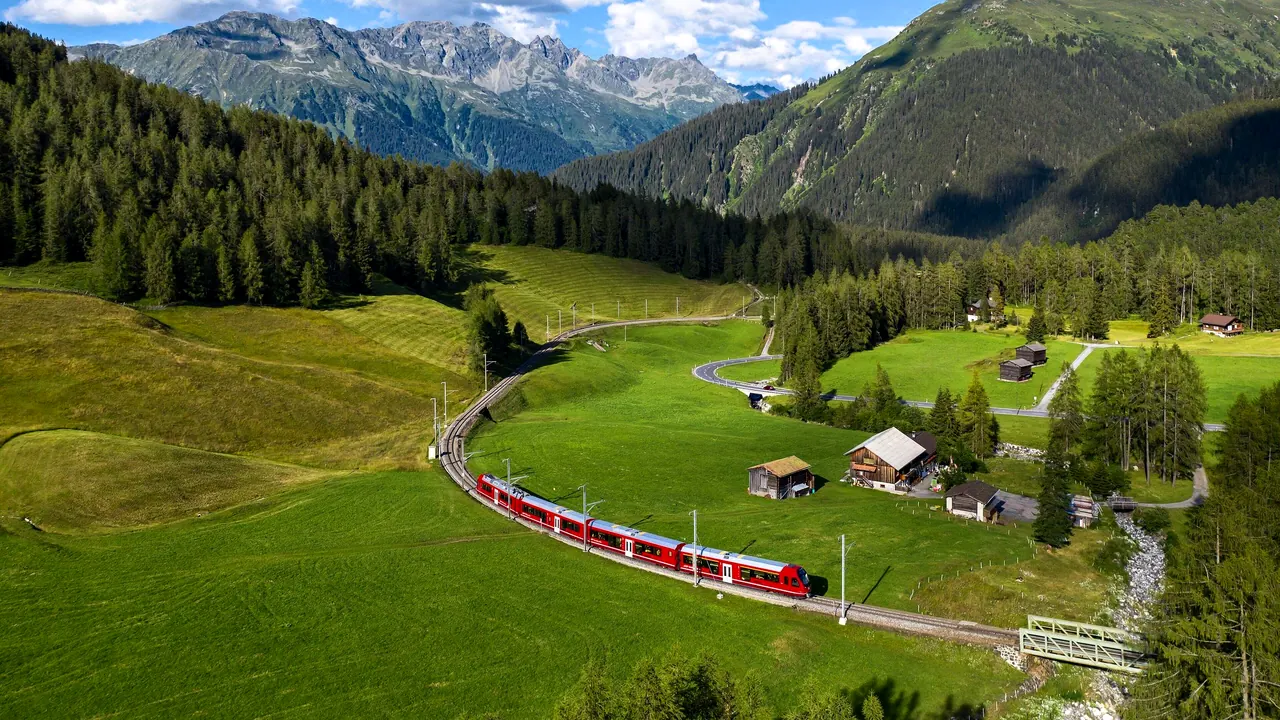
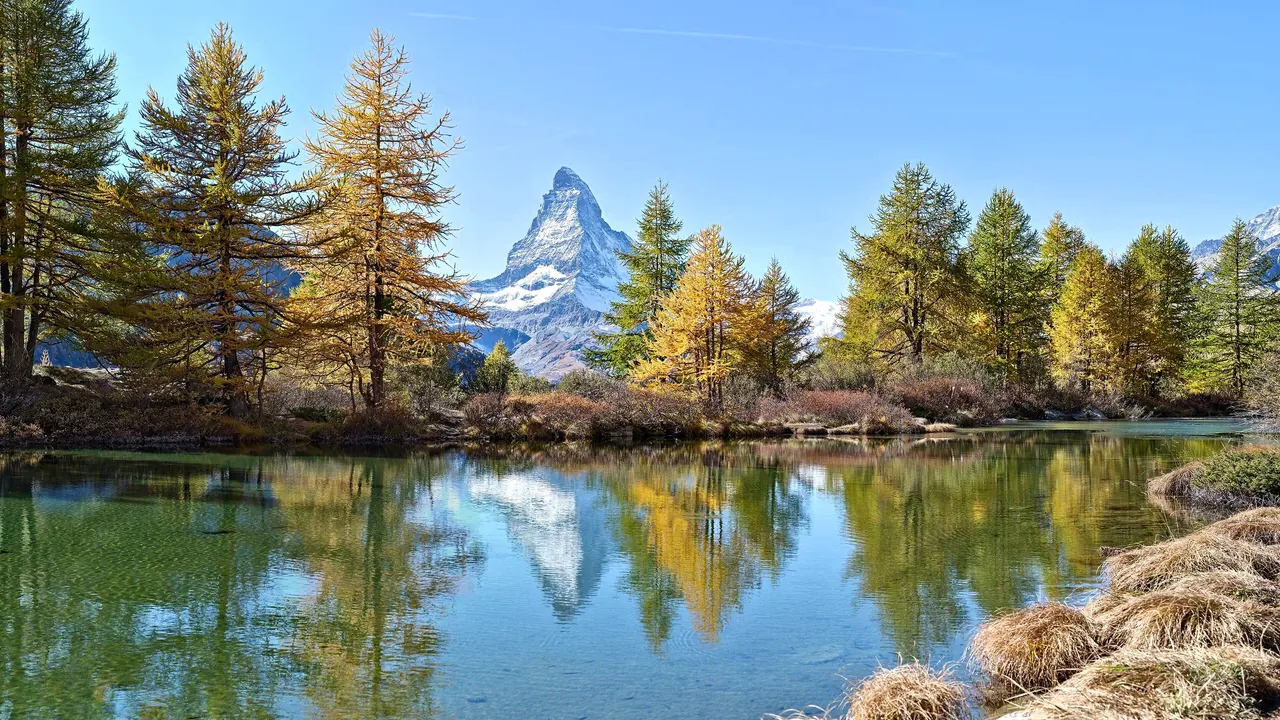
Photos: Davos by Kabelleger / David Gubler, CC BY-SA 4.0, cropped; Zermatt by Roy Egloff, CC BY-SA 4.0, cropped.
Davos or Zermatt?
Our verdict in twelve categories, each scored against the same fixed benchmark cities, and the climate month by month, so you can choose for your trip.
Choose Davos for
- day trips
- families
- beaches
Davos suits travellers who want an Alpine base with room to vary the days. It is a proper town rather than a village, with free buses, an indoor leisure pool and a lido, which makes it the easier pick for families. The Rhaetian Railway turns spare days into outings over the Albula line to St Moritz or down to Chur. Cross-country skiers, mountain bikers and anyone curious about the sanatorium era and Kirchner's paintings will feel at home here.
Choose Zermatt for
- food and drink
- nightlife
- shopping
Choose Zermatt if the mountains themselves are the whole point. The Matterhorn stands over the car-free village, the lifts climb higher, and the glacier keeps snow into summer. Long lunches on chalet terraces with Valais wine and livelier après-ski give the days a little more polish. It costs as much as Davos, which means a great deal, and there is less to do once the weather closes in.
Scoreboard
Twelve categories on one fixed scale from 0 to 100. The shaded stretch is the gap between the two.
Your match
Pick a travel style or drag the sliders, and both match scores follow your weighting.
Too close to call, 1 point apart
Wins on day trips and families with your weighting.
Wins on food and drink and nightlife with your weighting.
What matters to you?
Category by category
What the scores mean for a trip.
Beaches & swimming
Neither town is a swimming destination, but Davos at least has somewhere to swim outdoors. The lido on the Davosersee, with its lawns and jetty, makes a pleasant July afternoon if you don't mind cool water. Zermatt has no bathing lake at all. Its tarns are meltwater for photographing the Matterhorn, so swimming there means a hotel pool.
Food & drink
Zermatt eats better. The draw is its mountain chalets in hamlets such as Findeln, Furi and Zum See, where a long lunch comes with a view of the Matterhorn. Glasses of Petite Arvine or Cornalin from the Valais vineyards come with it, and the village has a few more serious kitchens catering to its international clientele.
Davos has the more distinctive regional dishes, such as capuns, pizokel and Engadiner Nusstorte, but they are best found in the huts and side valleys. The town itself leans on pizza, fondue and hotel dining. In both places cheap meals are hard to find and many kitchens close between seasons.
Culture & sights
Davos's past is medical and literary. The sanatorium era that inspired The Magic Mountain still shows in the Schatzalp and its sun balconies, and the Kirchner Museum holds the Expressionist's paintings of this valley. Together they make a day or two of sightseeing.
Zermatt's story is about climbing. The Matterhorn Museum covers the 1865 first ascent and the disaster on the way down, the mountaineers' cemetery lies beside the church, and the larch barns of the Hinterdorf recall the farming village. That fills a morning, and a ride on the Gornergrat railway adds a piece of history to it.
Nightlife
Zermatt has the livelier winter evenings. Its slope-side bars on the runs into the village fill with ski boots from late afternoon, and a few bars and small clubs on the main street carry on past midnight at weekends.
Davos follows the same pattern on a smaller scale, starting at the foot of the Jakobshorn and Parsenn and moving to hotel bars and pubs on the Promenade. In summer both settle into dinner and a drink, Zermatt the earlier of the two because so many guests have a dawn start on the mountain.
Nature & outdoors
Both are first-rate mountain destinations, and the difference lies in the terrain. Zermatt is the more dramatic. The Matterhorn rises over the village, dozens of four-thousand-metre peaks surround it, lifts reach the Matterhorn Glacier Paradise above 3,800m, and you can ski across to Italy or on the glacier in summer.
Davos is broader and gentler. It has five ski areas, over 100km of cross-country trails along the valley floor, and dense singletrack for mountain bikers. The quiet Sertig and Dischma valleys end below glaciers, and the Swiss National Park is within a day's reach.
Day trips
Davos sits on the Rhaetian Railway, and that gives it far more to do on a day off. The Albula line crosses the Landwasser Viaduct on its way to St Moritz, medieval Chur is close, and the Vereina tunnel leads to the painted houses of Guarda and the baths at Scuol.
From Zermatt every outing begins with the long train ride down the valley. Sion, with its castle hills and vineyards, is the best of them. Brig is closer, and Saas-Fee in the neighbouring valley can be reached by bus, but most visitors spend their spare days on the mountain instead.
Good for families
Davos gives children more to do. The long toboggan run from the Schatzalp, the natural ice rink, the lido and an indoor pool with slides mean a wet day is not wasted, and playgrounds wait at the top stations.
Zermatt's car-free streets are a real comfort with small children, and the Sunnegga nursery slopes and cog railways delight them. Rainy days are hard to fill, though, and the highest viewpoints can be too cold and thin-aired for the youngest.
Getting around
Neither needs a car, but they work differently. Davos is a long 4km strip with a station at each end, and free buses run along it and out to the side valleys. Zermatt is compact and closed to ordinary cars, so you leave the car at Täsch and walk everywhere, with electric taxis for luggage and lift stations within a stroll of the centre.
Shopping & style
Zermatt has the better main street. Its watch and jewellery boutiques serve wealthy skiers, and its mountaineering outfitters are well worth a visit if you need serious gear. Davos's Promenade covers ski and outdoor needs, and its delicatessens are good for Bündnerfleisch and Nusstorte to take home. Neither has a market or anything worth planning a trip around.
Affordability
Both rank among the most expensive vacations in the Alps, and neither offers real relief. In Davos the guest card's free buses, rental apartments and the quieter early summer help a little. January, when the World Economic Forum fills the town, is the dearest time. In Zermatt the lifts and cog railways add to every day's spending, and sleeping down the valley in Täsch and self-catering are the main ways to save.
Live music & performing arts
Live music is thin in both, so it comes down to which festival you can catch. Davos has its summer classical festival, with young musicians playing in churches and hotels around the valley. For theatre or a proper concert season, you would have to go to Zurich.
Zermatt has two dates in the calendar: the acoustic Zermatt Unplugged in spring and a late-summer chamber music festival in the village church. Outside those weeks, an evening of music there means a band in an après-ski bar.
Wellness & relaxation
Davos is easier if you are not staying at a spa hotel. Its public leisure pool has a sauna area open to day visitors, the mineral baths at Scuol are about an hour away, and the town was built around recovery in the first place.
Zermatt's strength is its hotel spas, many of them excellent and with mountain views, though only some sell day access. The car-free streets make it quiet in the evenings, but the village mood stays active rather than slow.
When should you go?
Pick your month. The climate figures are measured averages, not a forecast.
Davos in July
Zermatt in July
Daytime high, °C
Rainfall in the month, mm
Where the figures come from
Davos's temperatures are measured 53 km from the centre, at S. Valentino Alla Muta.
Davos has no rain gauge within 25 km of the centre, so its rainfall comes from a gridded climate dataset read at the destination rather than from a gauge further away.
Zermatt has no weather station within reach, so its figures come from a gridded climate model rather than a measured record, and read a broad area rather than one spot.
Temperature and rainfall are climate normals, averaged over the years shown. Davos: 1991-2020 normals, S. Valentino Alla Muta (53.4 km from centre). Zermatt: 1991-2020 normals, TerraClimate 4 km grid at the town, no weather station within 90 km.
Davos is the milder of the two by a clear margin. In July and August daytime highs reach about 20°C, which is warm enough for the Davosersee lido and comfortable for long hikes. Those are also its wettest months, with around 140mm in August, so summer days often end in showers. Zermatt's summer peaks at about 14°C. That is fine for walking but cool in the shade, and its summer is noticeably drier than Davos's.
In winter both sit around freezing. Davos stays a degree or two above zero by day, while Zermatt stays below freezing from December to February, with highs near -2°C, which keeps the snow reliable. Zermatt's wettest month is November, at about 130mm, so late autumn is its weakest time. In Davos, late spring and November are muddy and quiet.
Which traveller are you?
On a family trip with children, Davos is the safer bet. It is a real town rather than a village, so a wet or tiring day is easier to fill, and the free buses carry children door to door. Zermatt rewards families who already ski or hike together.
For a food and nightlife trip, Zermatt is the better of the two, though neither is a place to travel for either. Its kitchens cook for a wealthier international crowd and its winter evenings run later. Davos suits those who want to taste regional Graubünden cooking more than go out.
On an outdoors trip, the choice depends on what kind of mountains you want. Zermatt is for high-altitude walkers, skiers after big vertical and anyone hiring a guide for a summit. Davos gives more variety from one base and gentler terrain for mixed abilities.
Before you go
| Measure | Davos | Zermatt |
|---|---|---|
| Official language | French, German, Italian, Romansh | French, German, Italian, Romansh |
| Currency | Swiss Franc (CHF) | Swiss Franc (CHF) |
| Sockets | CJ230 V, 50 Hz | CJ230 V, 50 Hz |
| Driving side | Right | Right |
| Time zone | UTC+1, UTC+2 in summer | UTC+1, UTC+2 in summer |
| Emergency number | 112 | 112 |
| Elevation | 1,559 m | 1,624 m |
| Main airport | Zürich Airport (ZRH)122 km from centre226 non-stop destinations | Geneva International Airport (GVA)128 km from centre150 non-stop destinations |
| Public holidays this year | 9 days | 9 days |
By the numbers
| Measure | Davos | Zermatt |
|---|---|---|
| Population | 10,738 | 6,023 |
| People per km² | 38 | 25 |
| Museums within 10 km | 3 | 2 |
| UNESCO World Heritage sites within 50 km | 2 | 2 |
Where else could you go?
Every comparison below shares a destination with this one, so you can follow Davos or Zermatt somewhere new.
- Klostersvs Davos
- Arosavs Davos
- Saas-Feevs Zermatt
- Lenzerheidevs Davos
- St. Moritzvs Davos
- Crans-Montanavs Zermatt