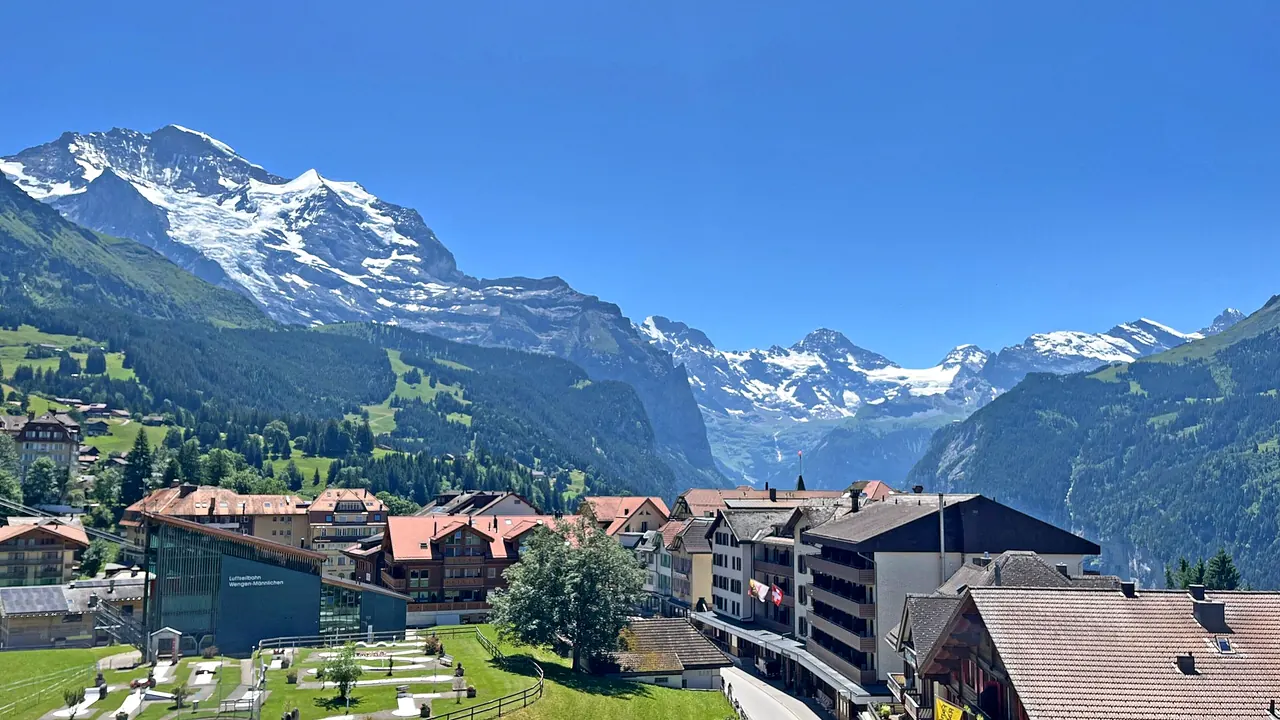
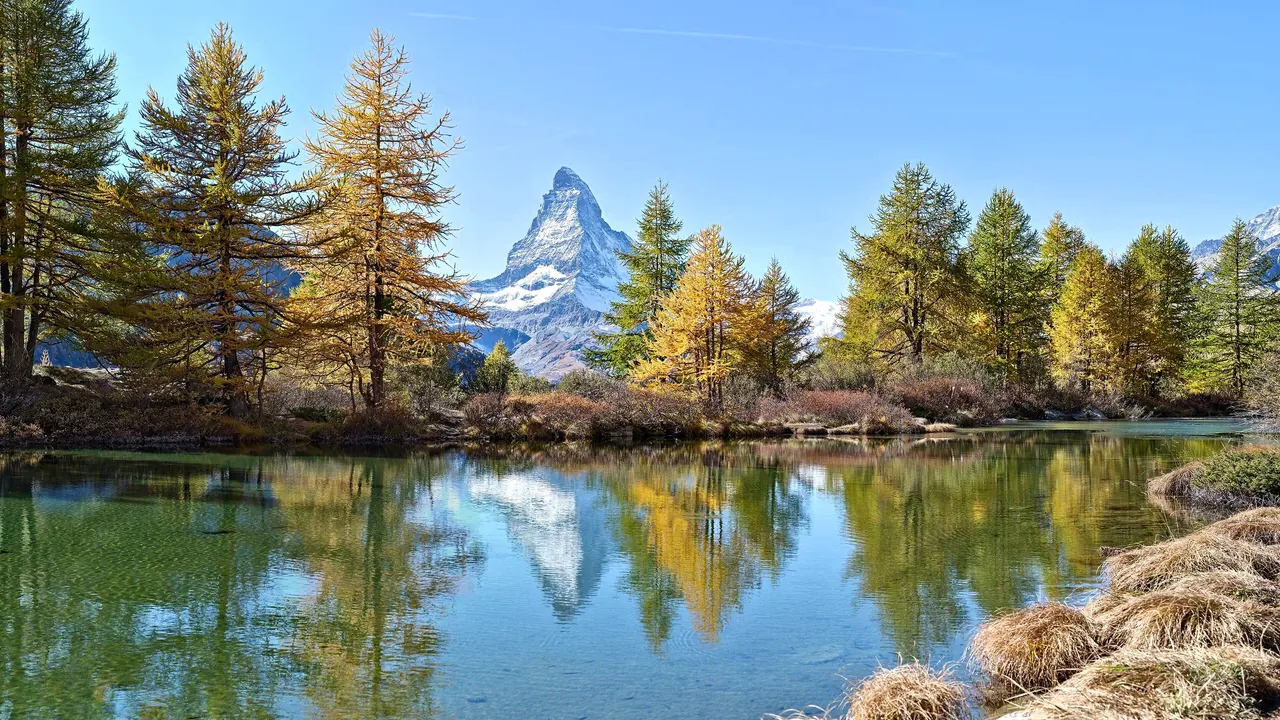
Photos: Wengen by Charles J. Sharp, CC BY-SA 4.0, cropped; Zermatt by Roy Egloff, CC BY-SA 4.0, cropped.
Wengen or Zermatt?
Our verdict in twelve categories, each scored against the same fixed benchmark cities, and the climate month by month, so you can choose for your trip.
Choose Wengen for
- day trips
- beaches
- families
Wengen suits walkers and families who want a slower Alpine stay. It is quiet, and the balcony view looks across the waterfall-lined Lauterbrunnen valley to the Jungfrau. It also makes the better base for seeing more of Switzerland, because the lakes, castles and old towns around Interlaken and Bern are within a day's reach. Choose it if calm evenings and gentle outings matter more than dining out.
Choose Zermatt for
- food and drink
- shopping
- nightlife
Zermatt is for travellers who want the high mountains at their biggest and a livelier village to come back to. The lifts reach glacier terrain, the skiing crosses into Italy, and guides lead climbs on four-thousand-metre peaks. Back in the village you get better food, Valais wine, real après-ski and a choice of hotel spas, along with a little mountaineering history to fill a spare morning.
Scoreboard
Twelve categories on one fixed scale from 0 to 100. The shaded stretch is the gap between the two.
Your match
Pick a travel style or drag the sliders, and both match scores follow your weighting.
Wins on day trips and beaches with your weighting.
Wins on food and drink and shopping with your weighting.
What matters to you?
Category by category
What the scores mean for a trip.
Beaches & swimming
Neither village is a place to swim, but Wengen at least has lakes within reach. About an hour down the line, the lidos on Lake Thun warm up enough for a summer afternoon in the water, while Lake Brienz stays cooler.
Zermatt has no bathing lake at all. The tarns above the village are cold meltwater, good only for photographing the Matterhorn's reflection, so swimming means a hotel pool.
Food & drink
Zermatt eats noticeably better. The best of it is on the mountain, in the wooden chalets of Findeln, Furi and Zum See, where reaching lunch on skis or on foot is part of the outing. The village adds a handful of serious fine-dining kitchens, and the Valais air-dried beef, apricot desserts and wines such as Petite Arvine and Cornalin give the food a regional identity.
Wengen's food is mostly what the hotel dining room serves, often on half-board. That means rösti, fondue and veal in cream sauce, and for variety you have to go down to Interlaken.
Culture & sights
Zermatt has a small but real story to tell. The underground Matterhorn Museum covers the first ascent of 1865 and the deaths on the way down, and the mountaineers' cemetery and the old larch barns of the Hinterdorf turn that history into a short walk. Together they fill a morning.
Wengen has nothing comparable to visit. Its Belle Époque hotels and chalets recall its beginnings as an English resort, but the interest lies in the view rather than in any one building.
Nightlife
Zermatt has the stronger après-ski scene. Bars on the runs into the village are loud by late afternoon, and a few small clubs along the main street keep going past midnight on busy winter weekends.
Wengen is much quieter. A few bars and a hotel bar or two make up the evening, and the village only really lets go on the weekend of the Lauberhorn downhill race in January. In summer both villages go to bed early.
Nature & outdoors
Both are among the great Alpine settings, and the choice comes down to the kind of mountain landscape you want. Wengen looks across a deep glacial valley lined with waterfalls to the Jungfrau, Eiger and Mönch. Its walks run along the Männlichen ridge to Kleine Scheidegg and down through meadows, and its skiing links with Grindelwald.
Zermatt is higher and icier. The Matterhorn stands over the village, lifts climb above 3,800m to the glacier, which keeps some pistes open in summer, and the ski area crosses into Italy. Climbers come for four-thousand-metre peaks and the end of the Haute Route.
Day trips
Wengen has much more within a day's reach. Once you are down in Interlaken, a steamer on Lake Thun calls at the lakeside castles of Oberhofen and Spiez, and Thun itself has its castle above the old town. On Lake Brienz you can visit the woodcarving village of Brienz and the old farmhouses of the Ballenberg open-air museum, and Bern's arcaded old town makes a full day.
From Zermatt, the long train ride down the valley limits the choice. Sion, with its two castle hills set among vineyards, is the best outing, and Brig's Stockalper Palace and Saas-Fee are reasonable alternatives.
Good for families
Both villages are car-free, so children can walk around safely in either, and neither has a zoo, aquarium or theme park for a wet day. Wengen keeps its nursery slopes and sledging runs close to the hotels, and its summer outings stay at gentler heights, though the steep lanes are hard work with a buggy.
In Zermatt, the beginners' area is up on the Sunnegga side, and summer brings marmots, a small playground lake and easy lakeside walks. The thin air at its top viewpoints rules some of those out for the youngest children.
Getting around
Both are reached by train with the car left below, at Lauterbrunnen for Wengen and at Täsch for Zermatt. Once you arrive, both are easy on foot. Wengen is so small that you can cross it in minutes, and its rack railway and the Männlichen cable car take you straight into the mountains.
Zermatt spreads out further along its river, so electric taxis and ski buses link the outer lift stations, while the underground funicular and the Gornergrat railway leave from near the centre. Zermatt is the slower village to leave, with a ride of over an hour down the valley before you reach the main line, though the connections from there are smooth. From Wengen the lowlands are closer, but each trip starts with the slow rack descent and usually a change at Interlaken.
Shopping & style
Zermatt has more to browse. Its main street is lined with Swiss watch and jewellery boutiques, and its mountaineering outfitters are genuinely good if you need proper equipment.
Wengen's short main street covers ski hire, groceries and a few chocolate counters. Anyone who wants to shop as an activity has to go down to Interlaken.
Affordability
Expect Swiss resort prices for rooms, meals and drinks in either village. In Wengen, the mountain railways and cable cars are what push the cost up most, above all the train to the Jungfraujoch, so a regional rail pass and a self-catering chalet make the biggest difference.
In Zermatt, the usual savings are to sleep down the valley in Täsch and to picnic from the supermarket rather than eat on the mountain terraces.
Live music & performing arts
Zermatt has two festivals worth timing a trip around. In spring, Zermatt Unplugged brings acoustic sets to tents and mountain stages, and in late summer a chamber music festival fills the parish church.
Wengen's live music is limited to the odd alphorn or yodelling evening and the village brass band. For a real concert, you have to go to Interlaken or Bern.
Wellness & relaxation
Zermatt is the better choice for a spa stay. It has a large number of excellent hotel spas with pools, steam rooms and mountain views, a few of which sell day passes to non-residents, and thermal spa towns further down the Valais. The trade-off is a busier, more active mood in peak weeks.
Wengen offers stillness rather than treatments. Its pools are in the larger hotels, and the main pleasure is a slow afternoon on a balcony with only cowbells and the distant waterfalls to hear.
When should you go?
Pick your month. The climate figures are measured averages, not a forecast.
Wengen in July
Zermatt in July
Daytime high, °C
Rainfall in the month, mm
Where the figures come from
Wengen has no weather station within reach, so its figures come from a gridded climate model rather than a measured record, and read a broad area rather than one spot.
Zermatt has no weather station within reach, so its figures come from a gridded climate model rather than a measured record, and read a broad area rather than one spot.
Temperature and rainfall are climate normals, averaged over the years shown. Wengen: 1991-2020 normals, TerraClimate 4 km grid at the town, no weather station within 90 km. Zermatt: 1991-2020 normals, TerraClimate 4 km grid at the town, no weather station within 90 km.
Neither village ever gets warm enough for beach weather. Wengen is the milder of the two by a couple of degrees all year, with summer highs around 16°C. Zermatt peaks closer to 14°C in July and August, and it sits below freezing through the depths of winter, which suits skiers but makes strolling the lanes a brisk business. In both places, the months from June to September are the time for hiking and the high trails.
The rain falls differently through the year. Wengen is at its wettest in early summer, with over 110mm a month from May to August, so expect some lost days on the trails. Zermatt is drier in high summer and gets its heaviest rain in November, at around 130mm, when the between-seasons quiet sets in. That makes Zermatt the safer bet for a July or August walking trip. Early autumn is clear and pleasant in both.
Which traveller are you?
For a food and nightlife trip, Zermatt is clearly the better choice. You can have long lunches at the chalets around Findeln and Furi, drink Valais wine and eat in a few ambitious kitchens. Its slope-side bars and small clubs keep going after midnight, while Wengen's evenings mostly end over dinner.
On a family trip with young children, Wengen is slightly easier. The nursery slopes are close to the hotels, the views can be reached without very high altitude, and the lakes and Ballenberg's farmhouses are within reach around Interlaken. Zermatt's highest viewpoints, above 3,000m, can be too much for small children.
On an outdoors trip, both villages are superb, but they suit different people. Wengen is for walkers who want waterfalls, meadows and the panorama route beneath the Eiger. Zermatt is for those who want glaciers, summer skiing and guided ascents of four-thousanders.
Before you go
| Measure | Wengen | Zermatt |
|---|---|---|
| Official language | French, German, Italian, Romansh | French, German, Italian, Romansh |
| Currency | Swiss Franc (CHF) | Swiss Franc (CHF) |
| Sockets | CJ230 V, 50 Hz | CJ230 V, 50 Hz |
| Driving side | Right | Right |
| Time zone | UTC+1, UTC+2 in summer | UTC+1, UTC+2 in summer |
| Emergency number | 112 | 112 |
| Elevation | 1,274 m | 1,624 m |
| Main airport | Zürich Airport (ZRH)106 km from centre226 non-stop destinations | Geneva International Airport (GVA)128 km from centre150 non-stop destinations |
| Public holidays this year | 10 days | 9 days |
By the numbers
| Measure | Wengen | Zermatt |
|---|---|---|
| Population | 1,116 | 6,023 |
| People per km² | 31 | 25 |
| Museums within 10 km | 2 | 2 |
| UNESCO World Heritage sites within 50 km | 1 | 2 |
Where else could you go?
Every comparison below shares a destination with this one, so you can follow Wengen or Zermatt somewhere new.
- Mürrenvs Wengen
- Grindelwaldvs Wengen
- Saas-Feevs Zermatt
- Adelbodenvs Wengen
- Leukerbadvs Wengen
- Crans-Montanavs Zermatt