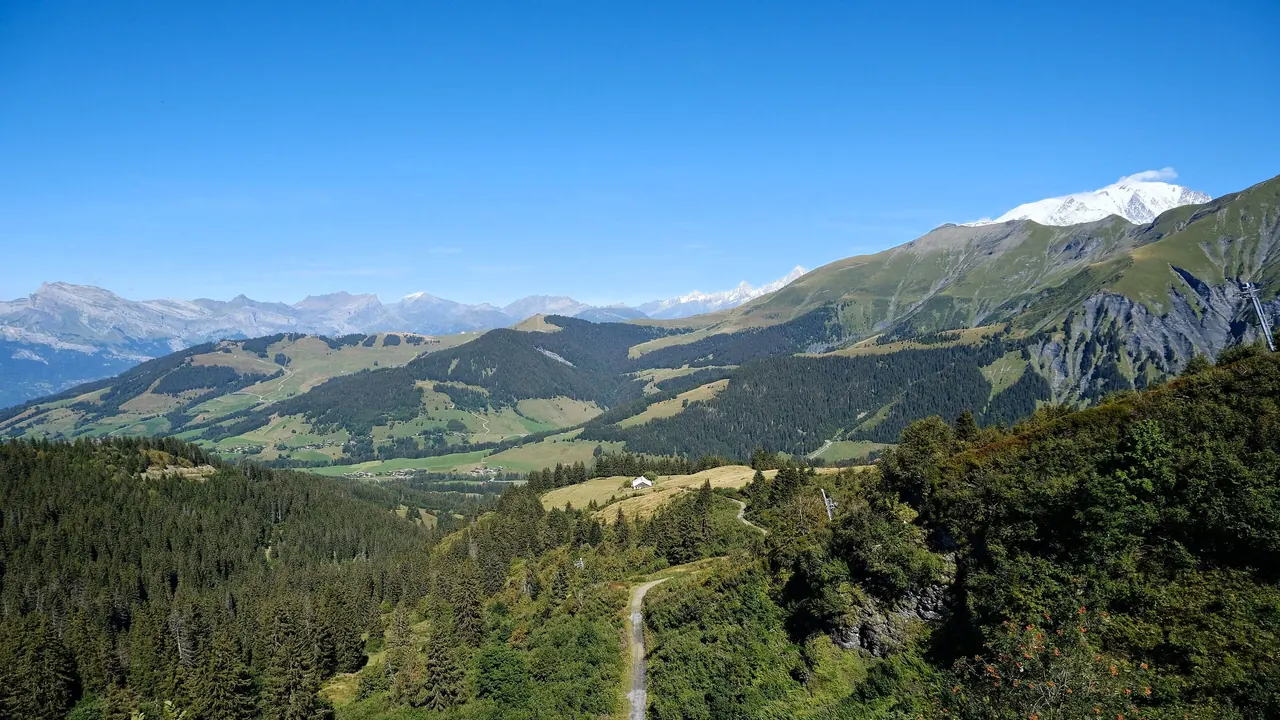
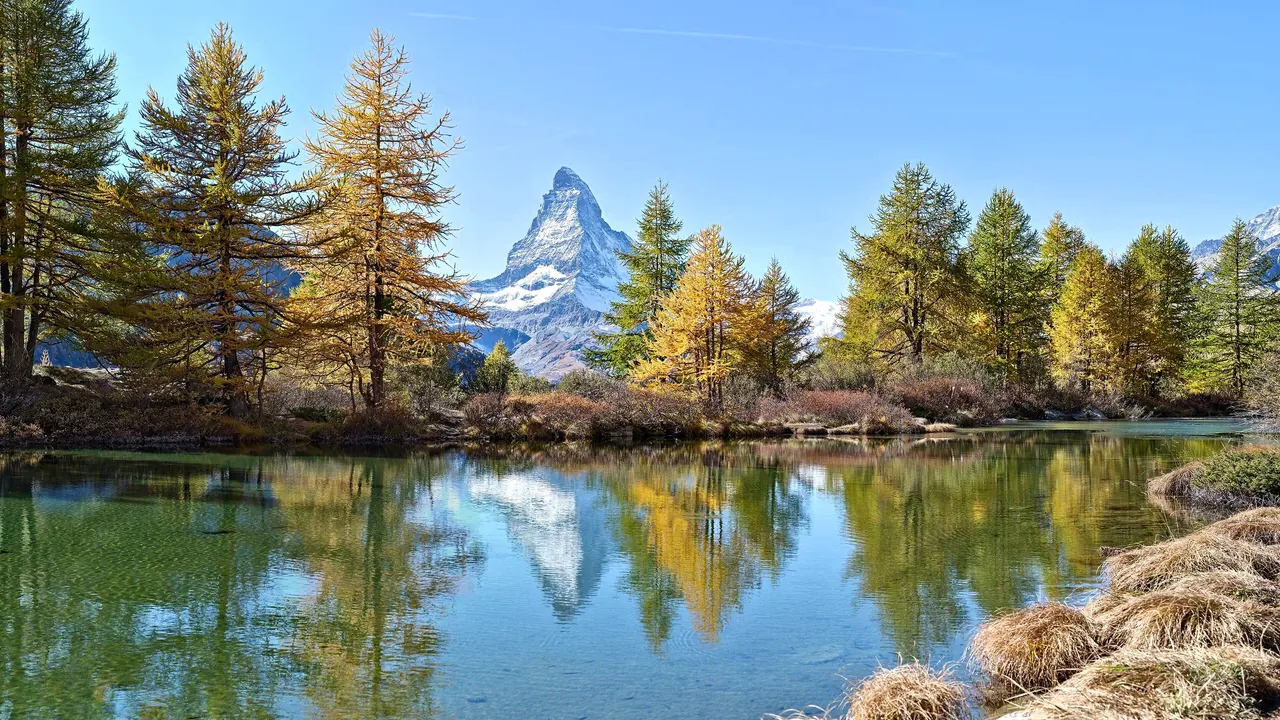
Photos: Megève by Guilhem Vellut, CC BY 2.0, cropped; Zermatt by Roy Egloff, CC BY-SA 4.0, cropped.
Megève or Zermatt?
Our verdict in twelve categories, each scored against the same fixed benchmark cities, and the climate month by month, so you can choose for your trip.
Choose Megève for
- day trips
- beaches
- shopping
Megève is the softer, more rounded mountain stay. It suits travellers who want gentle wooded pistes or summer meadows, then a long lunch, a spa afternoon and a smart dinner in a cobbled village. It is also the better base for seeing the wider region: Annecy, Geneva, Chamonix and the Aosta valley are all within a drive, and the village has more to offer between outings, with better food, more boutiques and a calmer pace.
Choose Zermatt for
- getting around
- nature and the outdoors
- live music and the arts
Zermatt is for people who come mainly for the high mountains. The Matterhorn stands over the village, and lifts reach glacier terrain close to 4,000m, where Megève offers mid-altitude cruising. The skiing, hiking and climbing go higher and further than anything around Megève, and the car-free village with its railways and gondolas makes it easy to get up there each morning. Choose it if the mountains are the whole point and you are happy to spend your evenings in a ski bar.
Scoreboard
Twelve categories on one fixed scale from 0 to 100. The shaded stretch is the gap between the two.
Your match
Pick a travel style or drag the sliders, and both match scores follow your weighting.
Wins on day trips and beaches with your weighting.
Wins on getting around and nature and the outdoors with your weighting.
What matters to you?
Category by category
What the scores mean for a trip.
Beaches & swimming
Neither village is a swimming destination, but Megève at least has some summer swimming. In July and August there are natural bathing ponds and small lakes in the nearby valleys, there are outdoor pools at the Palais, and Lake Annecy is about an hour away and properly warm.
Zermatt has none of that. Its mountain tarns are for photographing the Matterhorn, not for swimming, and the water stays icy all summer. A hotel pool is the only place to swim.
Food & drink
Megève eats better and more grandly. Alongside Savoyard fondue, tartiflette, diots and Reblochon, it has several Michelin-starred kitchens in the village and up on Mont d'Arbois, which makes it a real destination for fine dining. In summer the farmhouse auberges in the side valleys add a simpler, rustic option.
Zermatt's best meals are up on the mountain, in the chalet restaurants of Findeln, Furi and Zum See with the Matterhorn in view. The cooking is Valais rather than Savoyard: air-dried beef, rye bread and apricot desserts, with Petite Arvine or Cornalin to drink. Both villages have little cheap food and a narrow range.
Culture & sights
There is little to choose between them here, and in both places a morning covers the sights. Megève's history is in its buildings: the medieval layout around Saint-Jean-Baptiste, the chapels of the Calvaire, and Henry Jacques Le Même's elegant interwar chalets.
Zermatt's heritage is about climbing. The Matterhorn Museum tells the story of 1865, the mountaineers' cemetery holds those who died on the peaks, and the old larch barns stand in the Hinterdorf. Megève has one advantage: the baroque churches of the neighbouring villages are close by if you want more.
Nightlife
The two have about the same amount going on after dark, but the mood is very different. Megève's evenings are polished and grown-up: fireside hotel bars, piano and wine bars in the cobbled centre, and long dinners that end the night.
Zermatt is louder and younger in winter. Slope-side après-ski bars fill with ski boots and music, and a few bars and small clubs on the main street stay open past midnight. In both places the nightlife fades in summer and stops between seasons.
Nature & outdoors
Megève's mountain setting is lovely: a sunny saddle facing Mont Blanc, wide wooded pistes in the Évasion Mont-Blanc area that suit intermediates, and summer hikes on Mont Joly, paragliding and golf. Its slopes are fairly low, though, and the big glaciers are a drive away.
Zermatt is in another league. The Matterhorn rises straight above the streets, and lifts climb to over 3,800m at the Matterhorn Glacier Paradise. The skiing crosses into Italy and carries on into summer on the glacier, and guides take climbers up four-thousanders right from the village.
Day trips
For days away, Megève is far better placed. Within about an hour or so by car are Chamonix, the canals and lake of Annecy, the museums of Geneva, and through the Mont Blanc tunnel Courmayeur and Roman Aosta, so two countries are within easy reach. You will need a car for most of them.
Zermatt's position at the end of its valley makes every outing begin with an hour on the train down. Sion's castle hills and vineyards are the best reward, and Brig and the high vines of Visperterminen are pleasant, but most people staying in Zermatt spend their spare days in the mountains.
Good for families
Both villages are safe, with car-free streets and children's ski schools, but Megève has more to keep children busy. It has an ice rink, sledging, sleigh rides, and pools and a climbing wall at the Palais for wet days. In summer there are pony rides, warm-water swimming and easy walks to farms.
Zermatt's appeal for children is the cog railways, gondolas and marmots, and the Sunnegga nursery slopes are gentle. The highest viewpoints are cold and short of oxygen for small children, though, and a rainy day there is hard to fill.
Getting around
Zermatt is the simpler place to stay without a car. You arrive by train, the village is a compact strip you can walk, and the Gornergrat railway, the Sunnegga funicular and the gondolas all start within walking distance of the centre. The Swiss rail network connects smoothly, even if leaving the valley takes over an hour.
Megève's small pedestrian centre is just as easy, and free shuttles run in winter. But it has no railway station, many chalets sit up steep hillside roads, and most people who want to explore rent a car.
Shopping & style
Megève is the better place to browse. Its cobbled lanes have designer ski-wear, cashmere and fur, jewellers and galleries of Alpine interior design, and the Allard ski-wear house has been in the village since the 1920s. There are also good cheese shops and a weekly market, though it all fits into a few streets.
Zermatt's single main street is mostly Swiss watches, jewellery and Matterhorn souvenirs. Its real strength is serious mountaineering and ski equipment.
Affordability
Both are among the most expensive places in the Alps, and neither works on a tight budget. Megève's prices drop a little in summer and in the quiet weeks of January and March, and staying in the valley towns below and driving up is the usual way to save.
In Zermatt the costs are harder to avoid, because almost everyone pays for the lifts and cog railways. Self-catering, supermarket picnics and a bed in Täsch help the most.
Live music & performing arts
Neither village has a theatre or a regular concert season, so the difference is in the occasional events. Megève's links to jazz show in a cellar or piano bar with live sets in season, plus a few open-air and church concerts in summer.
Zermatt's calendar centres on two festivals: Zermatt Unplugged, with acoustic sets on mountain stages in spring, and a chamber music festival in the village church in late summer. Both are worth planning a trip around.
Wellness & relaxation
Megève is the more restful choice. It has grand hotel spas, a public wellness area at the Palais open to anyone, and a slow pace of sleigh rides and snowy evenings. The historic thermal baths at Saint-Gervais are about twenty minutes away.
Zermatt has plenty of fine hotel spas with mountain views, and its car-free quiet is restful. But the mood there is active rather than slow, peak weeks are busy, and the nearest thermal water is far down the valley.
When should you go?
Pick your month. The climate figures are measured averages, not a forecast.
Megève in July
Zermatt in July
Daytime high, °C
Rainfall in the month, mm
Where the figures come from
Megève's temperatures are measured 29 km from the centre, at Bourg-St-Maurice.
Megève's station stands 162 m below the city centre, so the centre is likely a little cooler than the figures say.
Megève has no rain gauge within 25 km of the centre, so its rainfall comes from a gridded climate dataset read at the destination rather than from a gauge further away.
Zermatt has no weather station within reach, so its figures come from a gridded climate model rather than a measured record, and read a broad area rather than one spot.
Temperature and rainfall are climate normals, averaged over the years shown. Megève: 1999-2020 (rainfall 1991-2020) normals, Bourg-St-Maurice (29.1 km from centre). Zermatt: 1991-2020 normals, TerraClimate 4 km grid at the town, no weather station within 90 km.
The two villages have very different summers. Megève, lower down, warms properly from June to August with afternoon highs of around 25°C to 27°C, warm enough for the bathing ponds, lake days and long terrace lunches. September is still pleasant for walking. Zermatt sits much higher and stays cool even in July and August, with highs around 14°C, so summer there means hiking in layers, not lying on the grass. Late spring and early autumn are mild in Megève and brisk in Zermatt.
In winter Zermatt is the colder of the two by a wide margin, with daytime highs below freezing from December to March. That cold helps keep its snow reliable. Megève stays a few degrees above freezing in the village, which is why snow on its lower slopes varies from year to year. Megève is also the wetter place, with rain or snow fairly steady all year and peaking in December at around 140mm. Zermatt is drier for most of the year, apart from a wet November.
Which traveller are you?
On an outdoors trip, Zermatt is the clear choice. It has glacier skiing, four-thousand-metre peaks with guides, the Five Lakes walk and the Europaweg, all reached by lifts that climb far higher than anything around Megève's wooded slopes.
On a family trip with children, Megève has the edge. It has gentle nursery slopes and ski kindergartens, sledging and an ice rink, and the Palais pools for bad weather. In summer there are warm lake afternoons, and nobody has to deal with the thin, cold air at Zermatt's highest viewpoints.
On a relaxing and wellness trip, Megève suits better. Its spa hotels and the public wellness area at the Palais come with a slow rhythm of long lunches and sleigh rides, and the old thermal baths at Saint-Gervais are a short drive away.
Before you go
| Measure | Megève | Zermatt |
|---|---|---|
| Official language | French | French, German, Italian, Romansh |
| Currency | Euro (EUR) | Swiss Franc (CHF) |
| Sockets | CE230 V, 50 Hz | CJ230 V, 50 Hz |
| Driving side | Right | Right |
| Time zone | UTC+1, UTC+2 in summer | UTC+1, UTC+2 in summer |
| Emergency number | 112 | 112 |
| Elevation | 1,027 m | 1,624 m |
| Main airport | Geneva International Airport (GVA)58 km from centre150 non-stop destinations | Geneva International Airport (GVA)128 km from centre150 non-stop destinations |
| Public holidays this year | 11 days | 9 days |
By the numbers
| Measure | Megève | Zermatt |
|---|---|---|
| Population | 2,893 | 6,023 |
| People per km² | 66 | 25 |
| Museums within 10 km | 2 | 2 |
| UNESCO World Heritage sites within 50 km | 1 | 2 |
Where else could you go?
Every comparison below shares a destination with this one, so you can follow Megève or Zermatt somewhere new.
- Saint-Gervais-les-Bainsvs Megève
- La Clusazvs Megève
- Saas-Feevs Zermatt
- Le Grand-Bornandvs Megève
- Flainevs Megève
- Chamonixvs Megève