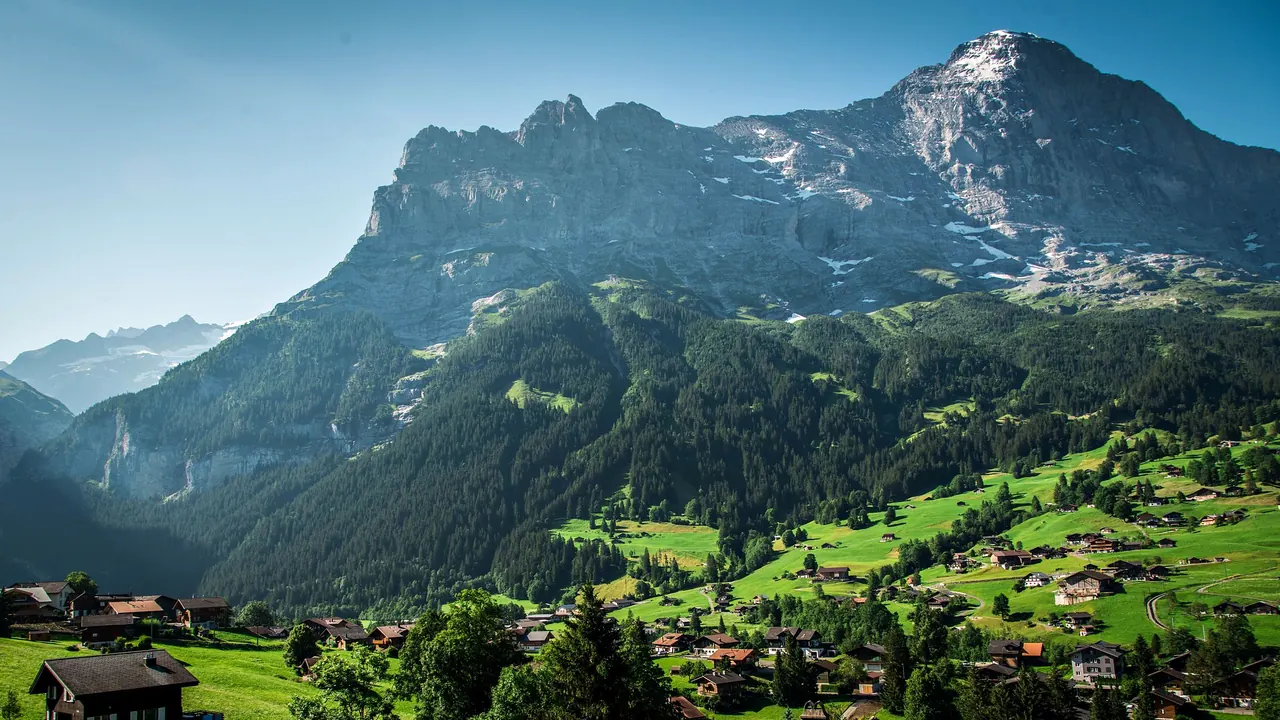
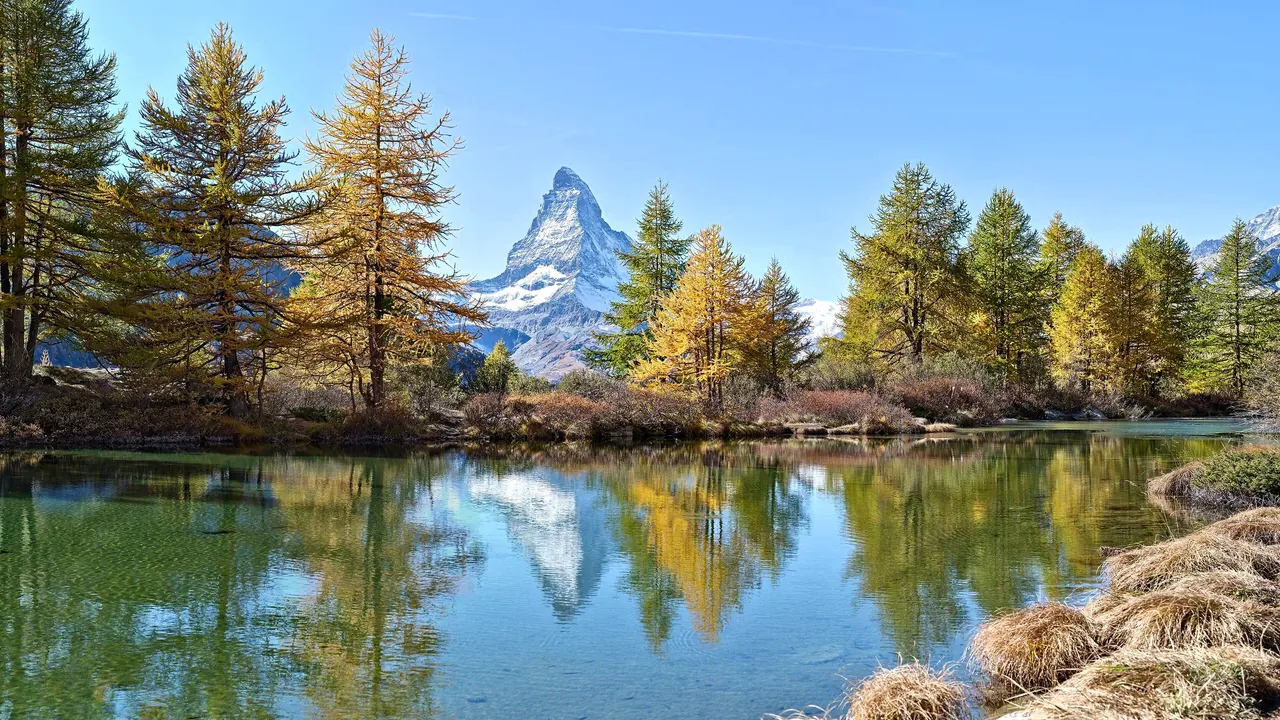
Photos: Grindelwald by Christopher Becke, Pexels License; Zermatt by Roy Egloff, CC BY-SA 4.0, cropped.
Grindelwald or Zermatt?
Our verdict in twelve categories, each scored against the same fixed benchmark cities, and the climate month by month, so you can choose for your trip.
Choose Grindelwald for
- day trips
- families
- beaches
Grindelwald suits travellers who want the high Alps as a base for a wider trip. The Eiger and Jungfrau are on the doorstep, and the train down to Interlaken also opens up the lakes, the cliff villages above Lauterbrunnen and a day in Bern. Families do especially well here, with gondola-top playgrounds, mountain carts and a summer toboggan run that make the mountains easy for children.
Choose Zermatt for
- nightlife
- food and drink
- shopping
Zermatt is the stronger pick for a more polished stay in one place. It is car-free, you walk everywhere, and it is built around a single famous peak. The terrace lunches and Valais wines are better than Grindelwald's, après-ski carries on later, and the lifts reach higher, with glacier skiing in summer and runs over into Italy. Couples and keen skiers who plan to stay in the valley will get the most from it.
Scoreboard
Twelve categories on one fixed scale from 0 to 100. The shaded stretch is the gap between the two.
Your match
Pick a travel style or drag the sliders, and both match scores follow your weighting.
Too close to call, 1 point apart
Wins on day trips and families with your weighting.
Wins on nightlife and food and drink with your weighting.
What matters to you?
Category by category
What the scores mean for a trip.
Beaches & swimming
Neither village is a swimming destination, but Grindelwald at least has lakes within reach. Lake Thun warms to around 20°C in a good summer and has lawns and lido-style bathing spots, about half an hour to an hour away by train and bus. Lake Brienz is a striking glacial turquoise, though the water stays cold.
Zermatt has nothing like this. There is no bathing lake in the valley, the tarns stay icy even in August, and swimming means a hotel pool.
Food & drink
Zermatt eats better. It caters to a wealthy international ski crowd, so the mountain hamlets of Findeln, Furi and Zum See are full of chalet restaurants with terraces facing the Matterhorn. The village adds a few ambitious fine-dining kitchens, and Valais wines such as Fendant and Cornalin go with the raclette and air-dried beef.
Grindelwald's food is plainer: fondue, rösti and Älplermagronen, mostly in hotel dining rooms. Its best meals depend on the setting, such as a terrace facing the Eiger or cheese bought straight from a summer dairy. Neither place offers much range or cheap eating.
Culture & sights
Grindelwald has very little to see beyond the mountain wall: a small local museum on farming, early tourism and the Eiger climbers, a whitewashed church and carved chalets scattered across the slopes. For anything more you have to leave the valley.
Zermatt can at least fill a morning. The Matterhorn Museum, built underground, tells the story of the 1865 first ascent and its fatal descent. The climbers' graves by the parish church and the old larch-wood granaries of the Hinterdorf complete the picture, and the Gornergrat cog railway, running since 1898, is a historic sight in itself.
Nightlife
Zermatt has the livelier evenings, though only in winter. Slope-side bars fill with ski boots and loud music from late afternoon, and on busy weekends a few bars and small clubs on the main street stay open past midnight. Grindelwald's après-ski is a few bars near the slopes and some hotel bars, and the village is dark by late evening. In summer both are hiking villages where people go to bed early.
Nature & outdoors
Both put you right beneath some of the greatest scenery in the Alps, and the difference is in the mountains themselves. Grindelwald faces a wall of peaks: the Eiger north face, the Wetterhorn and the Panoramaweg under the Eiger, Mönch and Jungfrau. The rack railway climbs to the Jungfraujoch at 3,454m, above the Aletsch Glacier. Paragliding, via ferratas and the walk-in Glacier Canyon add variety.
Zermatt is built around one peak, the Matterhorn, ringed by dozens of four-thousanders and lifts that reach over 3,800m. That height gives it summer glacier skiing, pistes that run into Italy, guided ascents and marmots and ibex in the larch woods.
Day trips
Grindelwald is much the better base for excursions, because Interlaken is just down the line. From there you can reach the car-free villages of Wengen and Mürren, lake steamers to the castles of Thun and Spiez, Brienz with the Ballenberg open-air museum, and Bern's arcaded old town in about an hour and a half.
From Zermatt, every outing starts with a long train ride down the valley. Sion, with its two castle hills set among vineyards, is worth the journey, and Brig and Saas-Fee are within reach. Most visitors still spend their spare days on the mountain.
Good for families
Grindelwald has more laid on for children. The First gondola leads to a cliff walk, scooter-bikes, mountain carts for the ride down and playgrounds at the mid-stations. There is a summer toboggan run below Pfingstegg, themed walks short enough for small legs, and farm animals everywhere.
Zermatt's strength is its car-free streets, so children can walk safely between hotel, ski school and lifts. Beyond the nursery slopes at Sunnegga, marmot-spotting and the cog railways, there is little built for them. In both villages a rainy day is hard to fill.
Getting around
Grindelwald's trains stop in the middle of the village, and the gondolas to First and Männlichen are a short walk or bus ride away, on timetables linked to the trains. The village is long and spread over a slope, though, so local buses fill the gaps and some walks back to your hotel are steep. The line down to Interlaken also gets you to the rest of Switzerland more quickly.
Zermatt keeps out ordinary cars, so you park at Täsch and take the shuttle train in. After that the village is a compact strip along the river that you cover on foot, with small electric taxis for the outer edges and the Gornergrat railway and Sunnegga funicular close to the centre. Leaving the valley takes over an hour by train.
Shopping & style
Zermatt has a bit more to browse. Its main street has Swiss watch and jewellery boutiques aimed at wealthy skiers, and genuinely good mountaineering outfitters. Grindelwald's main street sells gear, rental kit, army knives, chocolate and cowbells, which is fine for walking poles or a souvenir. Neither has markets or independent shops.
Affordability
Both are among the most expensive places you could go, and neither works as a budget trip. In Grindelwald the biggest cost is getting around, above all the railway to the Jungfraujoch, and regional travel passes reduce it.
In Zermatt the rooms and terrace meals are what hurt most. Staying down the valley in Täsch saves on beds. In both villages, a self-catering apartment and supermarket picnics make the biggest difference.
Live music & performing arts
Zermatt has two dates worth planning around. In spring, Zermatt Unplugged brings acoustic sets by well-known singers to tents and mountain stages. In late summer, a chamber music festival fills the village church with serious classical musicians. Grindelwald has yodelling choirs, alphorn players and brass bands in summer, which are pleasant to come across, and for theatre you go down the valley.
Wellness & relaxation
Zermatt is the better place to be pampered. It has a dense cluster of excellent hotel spas, some selling day passes to non-residents, and the car-free streets keep the village quiet, though peak weeks feel more active than restful.
Grindelwald relies on a few larger hotel spas, some with windows facing the Eiger, plus a public sports centre pool and sauna open to all. What it offers is a slow pace: cowbells and quiet evenings on a balcony. Neither village has thermal baths.
When should you go?
Pick your month. The climate figures are measured averages, not a forecast.
Grindelwald in July
Zermatt in July
Daytime high, °C
Rainfall in the month, mm
Where the figures come from
Grindelwald has no weather station within reach, so its figures come from a gridded climate model rather than a measured record, and read a broad area rather than one spot.
Zermatt has no weather station within reach, so its figures come from a gridded climate model rather than a measured record, and read a broad area rather than one spot.
Temperature and rainfall are climate normals, averaged over the years shown. Grindelwald: 1991-2020 normals, TerraClimate 4 km grid at the town, no weather station within 90 km. Zermatt: 1991-2020 normals, TerraClimate 4 km grid at the town, no weather station within 90 km.
Both villages are at their best in two seasons: summer for walking and winter for snow. Neither is ever warm enough for a beach day. Grindelwald is the milder of the two, reaching about 17°C in July against Zermatt's 14°C, so summer evenings on a balcony are more comfortable there. It is also noticeably wetter in summer, with June and July each bringing around 119mm, so cloud and showers can hide the Eiger for days. The high trails only clear of snow from about June. For the occasional lake swim from Grindelwald, July and August are the months.
Zermatt's summers are cooler but drier, with about 78mm in July, which makes July to September a steadier time for long hikes. Late autumn is its weak spot: November is the wettest month at 130mm, just as much of the village closes between seasons. In winter Zermatt's daytime highs stay below freezing from December to February, while Grindelwald hovers around zero. That gives Zermatt the colder, more reliable snow, and makes Grindelwald slightly gentler for winter walks and sledging.
Which traveller are you?
On a family trip with young children, Grindelwald is the better choice. Its lift stations are set up for children to do things rather than only look at the view, so the mountains keep them busy. Zermatt suits families who already ski or hike together.
For a food and nightlife trip, choose Zermatt, ideally in the ski season. Its kitchens and bars cater to a wealthy international crowd, so meals are more ambitious, the local wine is better and evenings go on longer. Grindelwald's food is plainer and its evenings end early.
On a culture and arts trip that stays in the mountains, Zermatt gives you more. Its mountaineering history is all within walking distance, and if you time it right a music festival fills your evenings. In Grindelwald, culture mostly means a train out of the valley.
Before you go
| Measure | Grindelwald | Zermatt |
|---|---|---|
| Official language | French, German, Italian, Romansh | French, German, Italian, Romansh |
| Currency | Swiss Franc (CHF) | Swiss Franc (CHF) |
| Sockets | CJ230 V, 50 Hz | CJ230 V, 50 Hz |
| Driving side | Right | Right |
| Time zone | UTC+1, UTC+2 in summer | UTC+1, UTC+2 in summer |
| Emergency number | 112 | 112 |
| Elevation | 1,034 m | 1,624 m |
| Main airport | Zürich Airport (ZRH)100 km from centre226 non-stop destinations | Geneva International Airport (GVA)128 km from centre150 non-stop destinations |
| Public holidays this year | 10 days | 9 days |
By the numbers
| Measure | Grindelwald | Zermatt |
|---|---|---|
| Population | 3,942 | 6,023 |
| People per km² | 23 | 25 |
| Museums within 10 km | 0 | 2 |
| UNESCO World Heritage sites within 50 km | 2 | 2 |
Where else could you go?
Every comparison below shares a destination with this one, so you can follow Grindelwald or Zermatt somewhere new.
- Wengenvs Grindelwald
- Mürrenvs Grindelwald
- Interlakenvs Grindelwald
- Saas-Feevs Zermatt
- Engelbergvs Grindelwald
- Crans-Montanavs Zermatt