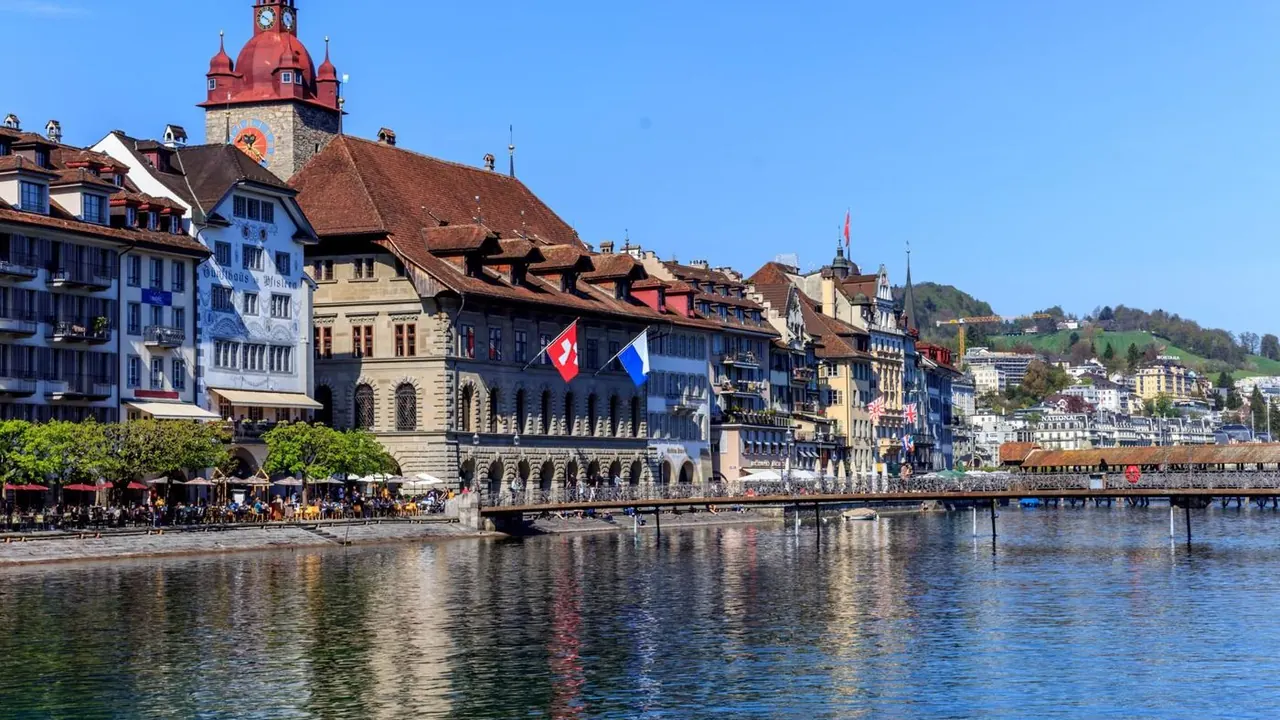
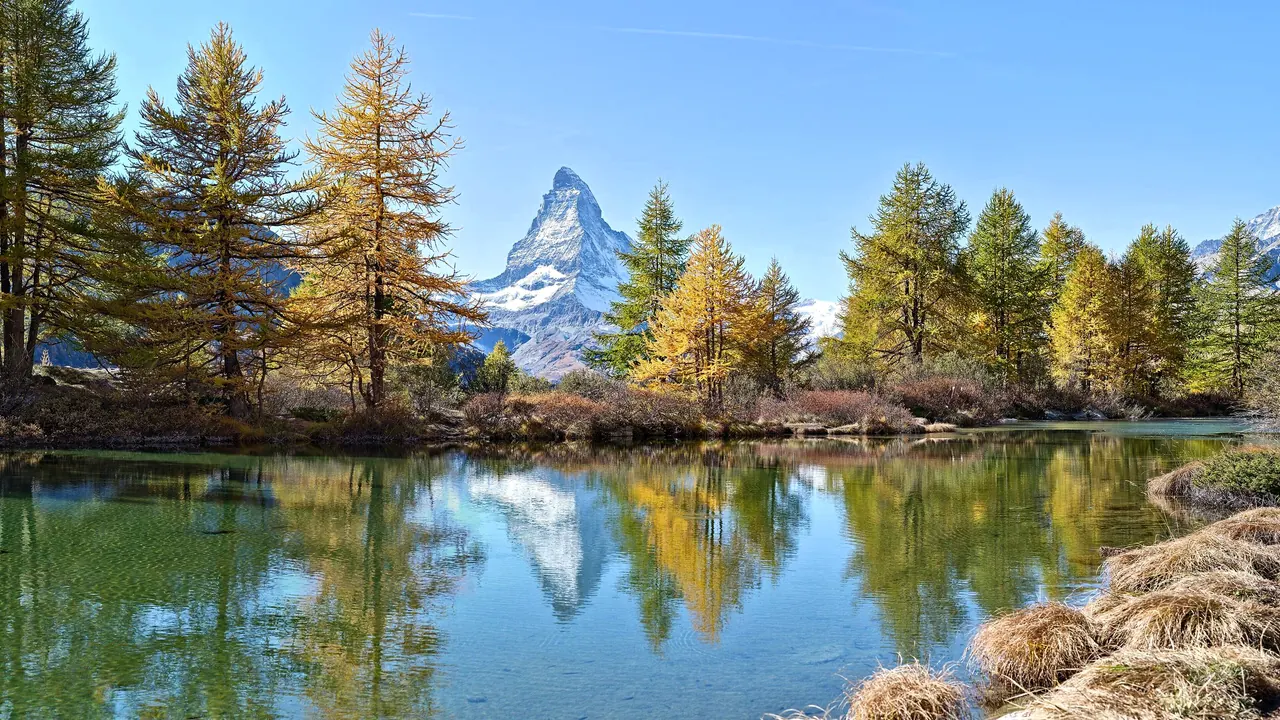
Photos: Lucerne by ILOVESwitzerland, Pexels License; Zermatt by Roy Egloff, CC BY-SA 4.0, cropped.
Lucerne or Zermatt?
Our verdict in twelve categories, each scored against the same fixed benchmark cities, and the climate month by month, so you can choose for your trip.
Choose Lucerne for
- live music and the arts
- day trips
- culture and sights
Lucerne is the better base for a varied Swiss trip. It gives you a medieval Old Town, a lake to swim in during summer, a world-class concert hall and fast trains to Bern, Basel and Zurich, with Pilatus and Rigi close by. It suits couples, families and first-time visitors who want sights, mountains and easy outings in one place, all reached without a car.
Choose Zermatt for
- food and drink
- nature and the outdoors
- wellness
Choose Zermatt if the mountains are the whole point. The Matterhorn stands over the village, the lifts go far higher than anything near Lucerne, and the skiing, glacier walks and four-thousand-metre summits are the reason to stay. In return you give up nearly everything else: museums, music, shopping and easy trips to other towns are all thin, and it costs even more than Lucerne.
Scoreboard
Twelve categories on one fixed scale from 0 to 100. The shaded stretch is the gap between the two.
Your match
Pick a travel style or drag the sliders, and both match scores follow your weighting.
Wins on live music and the arts and day trips with your weighting.
Wins on food and drink and nature and the outdoors with your weighting.
What matters to you?
Category by category
What the scores mean for a trip.
Beaches & swimming
Lucerne has a real bathing culture in summer. People swim from the Lido, the old wooden lake baths and the lawns at Ufschötti, and the clean lake water is pleasant in July and August. You swim from grass and jetties rather than sand, and a swim fits easily between excursions.
Zermatt has nothing like it. Its mountain tarns are meltwater, lovely for Matterhorn reflections but far too cold to swim in, so swimming there means a hotel pool.
Food & drink
Neither town is a reason to travel for food, and the cooking in both is hearty and Swiss. What differs is where you eat. Lucerne's meals are in town: Chügelipastete and lake perch in Old Town guild houses, coffee on the terraces along the Reuss and the Saturday riverside market.
In Zermatt the best meal is lunch on the mountain, in chalets around Findeln, Furi and Zum See, with Valais wines and a Matterhorn view. The village adds a few ambitious kitchens, but many places close between seasons.
Culture & sights
Lucerne has far more to see. The covered Chapel Bridge, the climbable towers of the Musegg Wall, the Lion Monument and the Rosengart Collection fill a day or two, and the Jesuit Church and Wagner's villa at Tribschen add depth.
Zermatt's heritage is about mountaineering. The Matterhorn Museum, the climbers' cemetery and the old larch-wood barns of the Hinterdorf take a morning, and after that the mountains take over.
Nightlife
Both are quiet places at night, but they come alive at different times. In Lucerne evenings mean wine bars by the river and a few cocktail bars in the Neustadt, steady all year, with Fasnacht turning the Old Town into an all-night carnival once a year.
Zermatt's nights depend on the season. In winter, après-ski bars on the runs into the village fill from late afternoon and a few clubs on the main street stay open past midnight. In summer hikers turn in after dinner, and between seasons the village shuts.
Nature & outdoors
Both are superb for the outdoors, and the difference is the kind of landscape. Lucerne mixes lake and mountain: you can take a paddle steamer to Vitznau, ride the rack railway up Rigi and walk the ridge, or climb Pilatus by the world's steepest cogwheel line, all in gentle, easy stages.
Zermatt is the high Alps proper. Lifts reach over 3,800m among glaciers and dozens of four-thousand-metre peaks, the Five Lakes walk and the Europaweg suspension bridge lie close to the village, and guided climbs and summer glacier skiing are on offer. Lucerne has no equivalent at that height.
Day trips
Lucerne is one of Switzerland's best bases for day trips. Bern, Basel and Zurich are each under an hour by train, Zug and Einsiedeln are closer still, and the lake steamer to the Rütli meadow makes a day out in itself.
From Zermatt every outing starts with a long train ride down the valley. Sion, with its castle hills and vineyards, is worth the trip, and Brig and Saas-Fee are easy enough, but most visitors spend their spare days on the mountain.
Good for families
Lucerne gives children more to do. The Swiss Museum of Transport is a full day of trains, planes and a planetarium, the Glacier Garden and the Goldau wildlife park add more, and the flat riverside centre and lakeside lawns are easy with a pushchair.
Zermatt's appeal is its car-free calm, with ski schools and gentle nursery slopes at Sunnegga and marmots to spot in summer. Rainy days are hard to fill, though, and the thin air at the top viewpoints can be too much for small children.
Getting around
Lucerne is a little easier. The station, the boat piers and the Old Town all sit together on the lakefront, the walks are short and flat, and lake steamers, trains and cable cars into the mountains all run on one integrated ticket system.
Zermatt is car-free, so you walk everywhere, with electric taxis and ski buses for the outlying lifts. Trains run straight up the valley into the village. Only visitors who come by car have to leave it at Täsch and take the shuttle. Hotels on the slopes mean a steep climb with luggage, and leaving the valley takes over an hour by train.
Shopping & style
Both towns sell Swiss watches, chocolate and souvenirs to visitors, but Lucerne has a little more range. Alongside the watch houses on Schwanenplatz there are Old Town boutiques and the Saturday riverside market.
Zermatt's shops line one main street. Their real strength is ski and mountaineering gear, which is worth a look if you need equipment, but there is no market and little else to browse.
Affordability
Neither is a place to save money: rooms, meals and above all the mountain railways cost a lot in both. Lucerne has a few more ways to cut costs, with Swiss travel passes covering the lake boats and supermarket picnics on the lakeshore.
Zermatt is steeper still in season, especially for drinks on a mountain terrace. Self-catering apartments and beds down the valley in Täsch are the main ways to save.
Live music & performing arts
Lucerne is far stronger. The Lucerne Festival brings leading orchestras to Jean Nouvel's lakefront concert hall, which also has a year-round programme, and the city theatre stages opera, drama and dance.
Zermatt has no theatre or concert hall. Outside Zermatt Unplugged in spring and the late-summer chamber music festival in the village church, live music means a band in an après-ski bar.
Wellness & relaxation
Neither has a thermal bathing tradition, so in both you rely on hotel spas, and the calm feels different in each. Lucerne's restful side is a slow afternoon on a steamer or along the promenades, with the Botta-designed mineral bath on the Rigi for a soak with a mountain view.
Zermatt has more fine hotel spas, some open to day guests, and the car-free streets keep traffic noise away. The mood is active rather than idle, and proper thermal baths are further down the Valais valley.
When should you go?
Pick your month. The climate figures are measured averages, not a forecast.
Lucerne in July
Zermatt in July
Daytime high, °C
Rainfall in the month, mm
Where the figures come from
Lucerne has no rain gauge within 25 km of the centre, so its rainfall comes from a gridded climate dataset read at the city rather than from a gauge further away.
Lucerne's sunshine is measured 42 km from the centre, at Zurich Town / Ville..
Zermatt has no weather station within reach, so its figures come from a gridded climate model rather than a measured record, and read a broad area rather than the city itself.
Temperature and rainfall are climate normals, averaged over the years shown. Lucerne: 2005-2025 (sunshine 1991-2020, rainfall 1991-2020) normals, Emmen (4.2 km from centre). Zermatt: 1991-2020 normals, TerraClimate 4 km grid at the town, no weather station within 90 km.
Lucerne is at its best from June to September, when afternoons reach about 24°C at the peak. That is warm enough for lake swims in July and August and for long days out on the steamers. These are the sunniest months and also the wettest, with around 141mm of rain in July and August, so expect showers and low cloud that can hide the peaks for a day or two. May and late September into October are pleasant for walking the Old Town. Winter is cold and grey, with little sunshine.
Zermatt runs on a different calendar. From December to March daytime highs stay at or below freezing, around -2°C, which is what a snow vacation needs. Spring comes late. April is still wintry, and May is only cool, with snow lying on the higher trails. July and August peak at about 14°C, comfortable for hiking but never warm enough to swim. November is the wettest month at about 130mm, so late autumn is the weakest time to go. Neither place ever gets too hot for walking.
Which traveller are you?
For a culture and arts trip, Lucerne is the clear choice. The Chapel Bridge, the Lion Monument and the Rosengart's Picasso and Klee are all a short walk apart, and the lakefront concert hall gives the evenings serious music. Zermatt's history fills a morning.
On a family trip with young children, Lucerne has more to offer. The Transport Museum easily fills a day, the lakeside lawns suit picnics and steamers make outings simple. Zermatt's car-free lanes are calm, but rainy days drag there.
For a ski trip, Zermatt is the place to go. Lifts run from the village up to glacier pistes that stay open even in summer, the runs link across into Italy, and the slope-side bars fill on the way down. From Lucerne, skiing means a day out to Titlis.
Before you go
| Measure | Lucerne | Zermatt |
|---|---|---|
| Official language | French, German, Italian, Romansh | French, German, Italian, Romansh |
| Currency | Swiss Franc (CHF) | Swiss Franc (CHF) |
| Sockets | CJ230 V, 50 Hz | CJ230 V, 50 Hz |
| Driving side | Right | Right |
| Time zone | UTC+1, UTC+2 in summer | UTC+1, UTC+2 in summer |
| Emergency number | 112 | 112 |
| Elevation | 436 m | 1,624 m |
| Main airport | Zürich Airport (ZRH)49 km from centre226 non-stop destinations | Geneva International Airport (GVA)128 km from centre150 non-stop destinations |
| Public holidays this year | 12 days | 9 days |
By the numbers
| Measure | Lucerne | Zermatt |
|---|---|---|
| City population | 86,234 | 6,023 |
| People per km² | 2,963 | 25 |
| Museums within 10 km | 14 | 2 |
| UNESCO World Heritage sites within 50 km | 1 | 2 |
Where else could you go?
Every comparison below shares a destination with this one, so you can follow Lucerne or Zermatt somewhere new.
- Zurichvs Lucerne
- Interlakenvs Lucerne
- Bernvs Lucerne
- Chamonixvs Zermatt
- Interlakenvs Zermatt
- Baselvs Lucerne