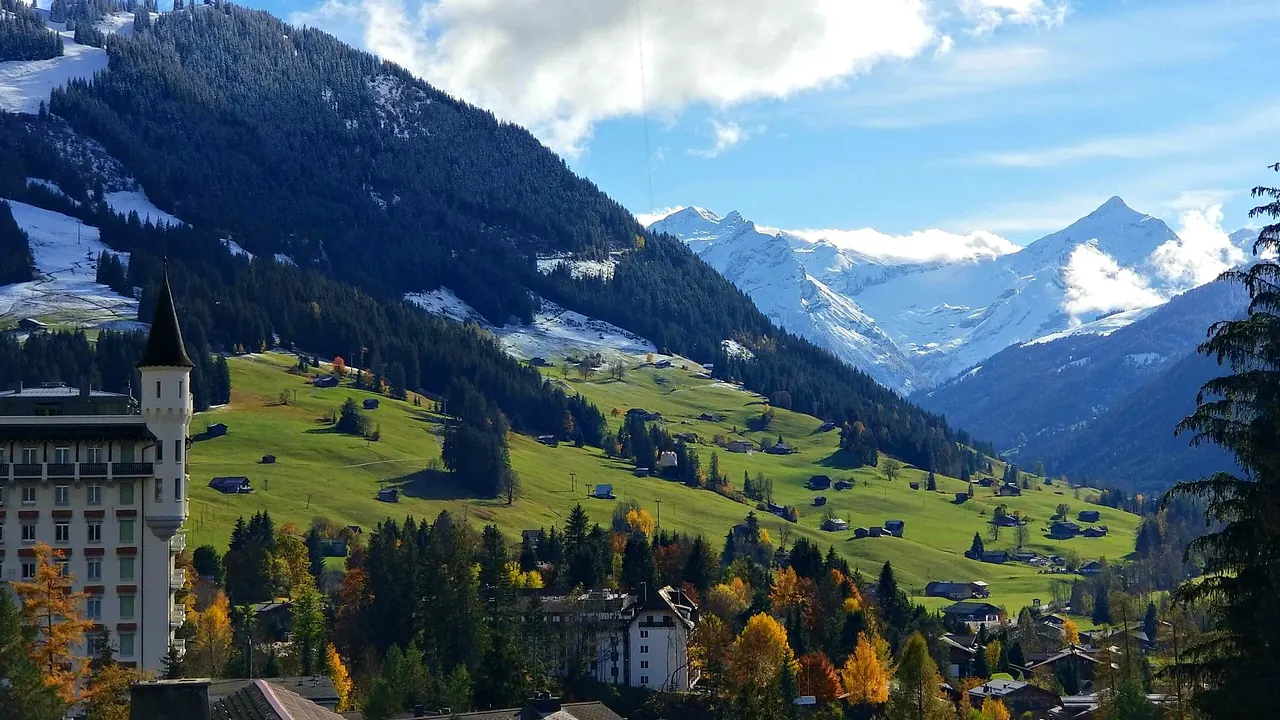
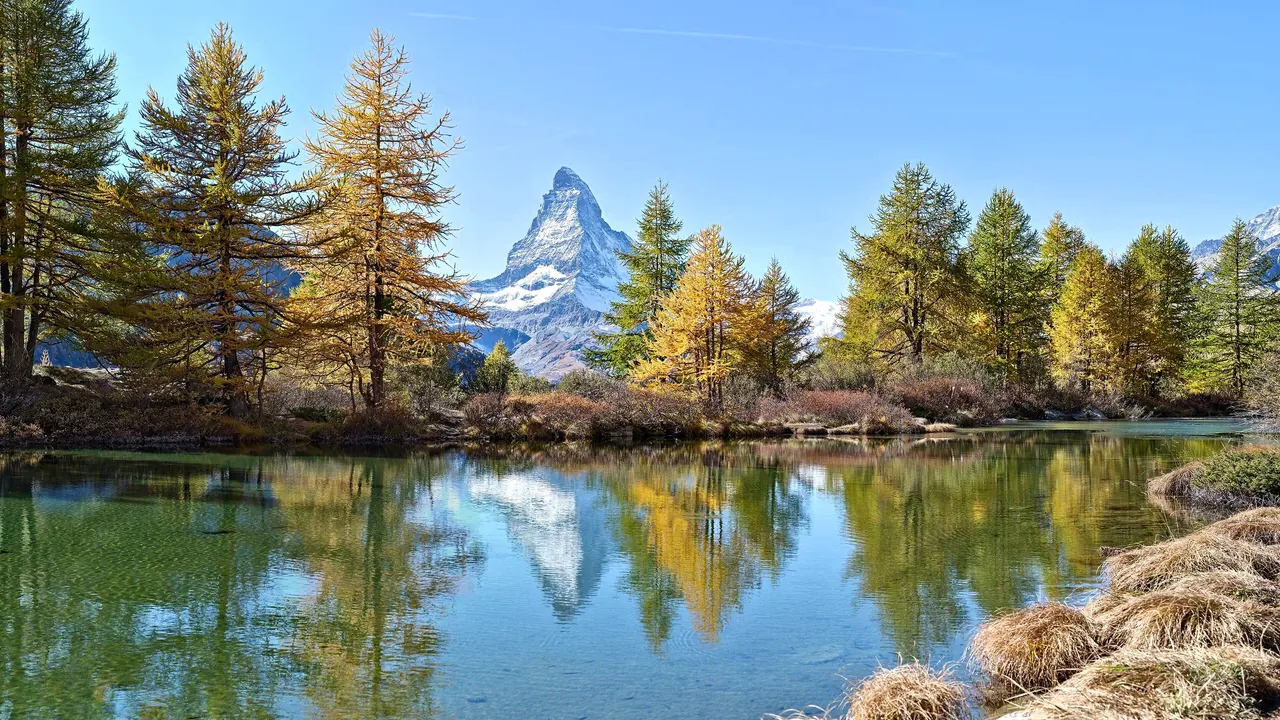
Photos: Gstaad by Samuel Barlow, CC BY-SA 4.0, cropped; Zermatt by Roy Egloff, CC BY-SA 4.0, cropped.
Gstaad or Zermatt?
Our verdict in twelve categories, each scored against the same fixed benchmark cities, and the climate month by month, so you can choose for your trip.
Choose Gstaad for
- day trips
- live music and the arts
- shopping
Gstaad suits travellers who want the Alps as a gentle, well-padded backdrop rather than the main event. Its green valleys and low, rounded slopes make for easy walking and relaxed skiing. The Menuhin Festival gives summer a real musical programme, and the GoldenPass line puts Lake Geneva, Gruyères and Bern within reach for days off the mountain. Couples who like a polished village, a short luxury shopping street and a good hotel spa will feel at home.
Choose Zermatt for
- nature and the outdoors
- nightlife
- culture and sights
Zermatt is the choice when the mountains themselves are the reason to go. The Matterhorn stands over a car-free village, the lifts climb to glacier terrain above 3,800m, and serious hikers, climbers and skiers get high-Alpine country that Gstaad cannot match. Après-ski is livelier too. The trade-off is a dead-end valley, so outings to other towns take real effort, and evenings outside the festival weeks come down to dinner.
Scoreboard
Twelve categories on one fixed scale from 0 to 100. The shaded stretch is the gap between the two.
Your match
Pick a travel style or drag the sliders, and both match scores follow your weighting.
Wins on day trips and live music and the arts with your weighting.
Wins on nature and the outdoors and nightlife with your weighting.
What matters to you?
Category by category
What the scores mean for a trip.
Beaches & swimming
Neither is a place to swim, but Gstaad at least lets you get wet outdoors. On hot summer afternoons people take a brief, cold dip from the grassy shores at Lauenen and Arnensee, and there is a heated outdoor pool in the valley.
Zermatt has no bathing lake at all. Its tarns are glacial mirrors for the Matterhorn, far too cold to swim in, so in practice the hotel pool is the only option.
Food & drink
The two eat about as well as each other, and in a similar way: a few ambitious hotel kitchens below and wooden huts with sunny terraces on the slopes. The difference is in what is on the table. Gstaad is cheese country, with long-aged Saanen Hobelkäse shaved into curls and L'Etivaz from wood-fired summer dairies, sold straight from the valley's cellars.
Zermatt leans on the Valais larder and its vineyards: air-dried beef, rye bread, apricot desserts and glasses of Petite Arvine or Cornalin. Its best meals also take some effort, since the hamlets of Findeln, Furi and Zum See are reached on skis or on foot.
Culture & sights
Sightseeing is thin in both, with Zermatt offering slightly more to do. The Matterhorn Museum tells the story of the 1865 first ascent and its fatal descent, the mountaineers' cemetery adds a sombre footnote, and the old larch barns of the Hinterdorf show the farming village beneath the resort. That fills a morning.
Gstaad has no museum to speak of. Its heritage lies in the carved and painted Saanenland chalets and in the medieval wall paintings of the church at Saanen, pleasant stops on a walk rather than a reason to come.
Nightlife
Zermatt is the livelier of the two after skiing. From late afternoon the bars on the runs back into the village fill with ski boots and loud music, and on busy weekends a few bars and small clubs on the main street carry on past midnight.
Gstaad's winter nights are smaller and dressier, centred on hotel bars, a couple of exclusive cellar clubs and private chalet parties. In summer both villages go quiet after dinner.
Nature & outdoors
Both are superb mountain bases, but Zermatt is the more spectacular. The Matterhorn rises straight above the village, dozens of four-thousand-metre peaks and the Gorner Glacier surround it, and lifts climb above 3,800m to skiing that crosses into Italy and stays open on the glacier in summer. Hikers, climbers and those finishing the Haute Route come for terrain Gstaad simply does not have.
Gstaad's landscape is pastoral: green valleys, low linked ski areas from Wispile to Rinderberg, and easy walks to Lauenensee and the Geltental waterfalls. For high snow it relies on Glacier 3000, about half an hour away. In summer it adds paragliding and rafting on the Saane.
Day trips
Gstaad is far better placed for days away. The GoldenPass railway runs down to Montreux, the Castle of Chillon and the Lavaux terraces on Lake Geneva, Gruyères and its cheese dairies are under an hour west, and Lake Thun and Bern lie the other way.
Zermatt sits at the end of a long valley, so every outing starts with the train down to the Rhône. Sion's castle hills and Brig's Stockalper Palace are worthwhile, but most visitors use spare days on the mountain instead.
Good for families
Both are safe and calm with children and both lack zoos, aquariums or rainy-day attractions, so the choice is about style. Gstaad is gentler: low beginner slopes, sledge runs, horse-drawn sleigh rides and summer walks among cows and goats, all at a comfortable altitude.
Zermatt has the car-free streets, nursery slopes at Sunnegga, marmot spotting and the thrill of cog railways and glacier gondolas. The highest viewpoints above 3,000m can be too cold and thin-aired for small children.
Getting around
Gstaad's centre is a short car-free promenade where everything is a few minutes apart, but the resort spreads along several valleys. GoldenPass trains stop at Saanen, Schönried and Saanenmöser, and yellow PostBuses climb to Lauenen, Gsteig and the Glacier 3000 cable car. Services thin out in the quiet months, though, and many visitors end up relying on a car or hotel shuttles.
Zermatt is the simpler of the two once you arrive. Trains from Visp and Brig run straight up the valley into the village, and only visitors who come by car need to park at Täsch and take the shuttle train. From then on you walk along the compact strip by the river to the Gornergrat railway, the Sunnegga funicular and the gondolas, with small electric taxis for luggage and the outlying lift stations.
Shopping & style
Gstaad's Promenade carries a remarkable cluster of luxury houses for such a small place: watchmakers, jewellers, fashion labels, cashmere, furs and interior design. Alongside them are shops selling carved wood and the papercut art of the Pays-d'Enhaut.
Zermatt's main street is narrower in scope: watch boutiques, souvenirs and, its real strength, well-stocked ski and mountaineering outfitters for anyone who needs gear.
Affordability
There is nothing to choose between them on cost. Both rank among the most expensive places in the Alps, with lift passes, meals and rooms all at the top of Swiss prices.
The ways to save differ slightly. In Gstaad, summer and the shoulder seasons ease the bill and Saanen or Zweisimmen offer cheaper beds. In Zermatt, self-catering, supermarket picnics and staying down the valley in Täsch help most.
Live music & performing arts
Gstaad has a real place on the classical calendar. For several weeks each summer the Menuhin Festival brings leading soloists and orchestras to a large tent and to the intimate churches of Saanen, Rougemont and Lauenen, and winter adds chamber music and New Year concerts.
Zermatt's offer is lighter: Zermatt Unplugged's acoustic sets in spring and a chamber festival in late summer. Outside those weeks, music means a band in an après-ski bar.
Wellness & relaxation
Neither has thermal springs or a bathing culture, and both rely on large hotel spas with mountain views, a few of them open to day visitors. Where they differ is in mood. Gstaad's rhythm is slower, a walk, a long lunch and a sauna in a quiet village with still, dark nights.
Zermatt's car-free streets and clear air are restful, but in peak weeks the village feels active and busy. For proper thermal bathing it can send you to the Valais spa towns down the valley.
When should you go?
Pick your month. The climate figures are measured averages, not a forecast.
Gstaad in July
Zermatt in July
Daytime high, °C
Rainfall in the month, mm
Where the figures come from
Gstaad's temperatures are measured 78 km from the centre, at Les Eplatures.
Gstaad has no rain gauge within 25 km of the centre, so its rainfall comes from a gridded climate dataset read at the destination rather than from a gauge further away.
Zermatt has no weather station within reach, so its figures come from a gridded climate model rather than a measured record, and read a broad area rather than one spot.
Temperature and rainfall are climate normals, averaged over the years shown. Gstaad: 2010-2020 (rainfall 1991-2020) normals, Les Eplatures (77.5 km from centre). Zermatt: 1991-2020 normals, TerraClimate 4 km grid at the town, no weather station within 90 km.
Neither village is a beach destination, so the question is snow or trails. Gstaad sits much lower and is clearly milder. Summer afternoons reach about 21°C, warm enough for a quick dip in Lauenensee and for long walks in shirtsleeves, but June to August is also its wettest stretch, with regular showers. Its winters hover just above freezing, which is why snow on the low home slopes can be thin early on, and December is the wettest month of the year.
Zermatt stays cold for much longer. Daytime highs sit below freezing from December to February, which keeps the snow reliable, and even July and August only reach about 14°C in the village, colder still at the top of the lifts. It is drier than Gstaad through the summer hiking months. November is its wettest month at around 130mm, and late autumn is a poor time for either place. For walking, Gstaad's season runs from late May to September, while Zermatt's is shorter and best from late June to early September.
Which traveller are you?
For an outdoors trip, Zermatt is the stronger pick. Lifts reach glacier terrain, hundreds of kilometres of marked trails lead past the Five Lakes and to the Hörnli hut, and guides take climbers up four-thousanders. Gstaad's pastures and gentle ridges are lovely but much tamer.
On a culture and arts trip, Gstaad gives more. The Menuhin Festival fills its tent and village churches with leading orchestras every summer, and day trips by rail reach the Castle of Chillon, Gruyères and Bern's arcades. Zermatt offers a mountaineering museum and little else.
For a food and nightlife trip, Zermatt has the edge after dark. Its slope-side bars and main-street clubs keep après-ski going late, and lunches in the hamlets of Findeln and Zum See come with Valais wine. Gstaad's nights are quieter, dressier and often private.
Before you go
| Measure | Gstaad | Zermatt |
|---|---|---|
| Official language | French, German, Italian, Romansh | French, German, Italian, Romansh |
| Currency | Swiss Franc (CHF) | Swiss Franc (CHF) |
| Sockets | CJ230 V, 50 Hz | CJ230 V, 50 Hz |
| Driving side | Right | Right |
| Time zone | UTC+1, UTC+2 in summer | UTC+1, UTC+2 in summer |
| Emergency number | 112 | 112 |
| Elevation | 1,050 m | 1,624 m |
| Main airport | Geneva International Airport (GVA)94 km from centre150 non-stop destinations | Geneva International Airport (GVA)128 km from centre150 non-stop destinations |
| Public holidays this year | 10 days | 9 days |
By the numbers
| Measure | Gstaad | Zermatt |
|---|---|---|
| Population | 2,960 | 6,023 |
| People per km² | - | 25 |
| Museums within 10 km | 0 | 2 |
| UNESCO World Heritage sites within 50 km | 4 | 2 |
Where else could you go?
Every comparison below shares a destination with this one, so you can follow Gstaad or Zermatt somewhere new.
- Saas-Feevs Zermatt
- Adelbodenvs Gstaad
- Crans-Montanavs Gstaad
- Leukerbadvs Gstaad
- Crans-Montanavs Zermatt
- Verbiervs Zermatt