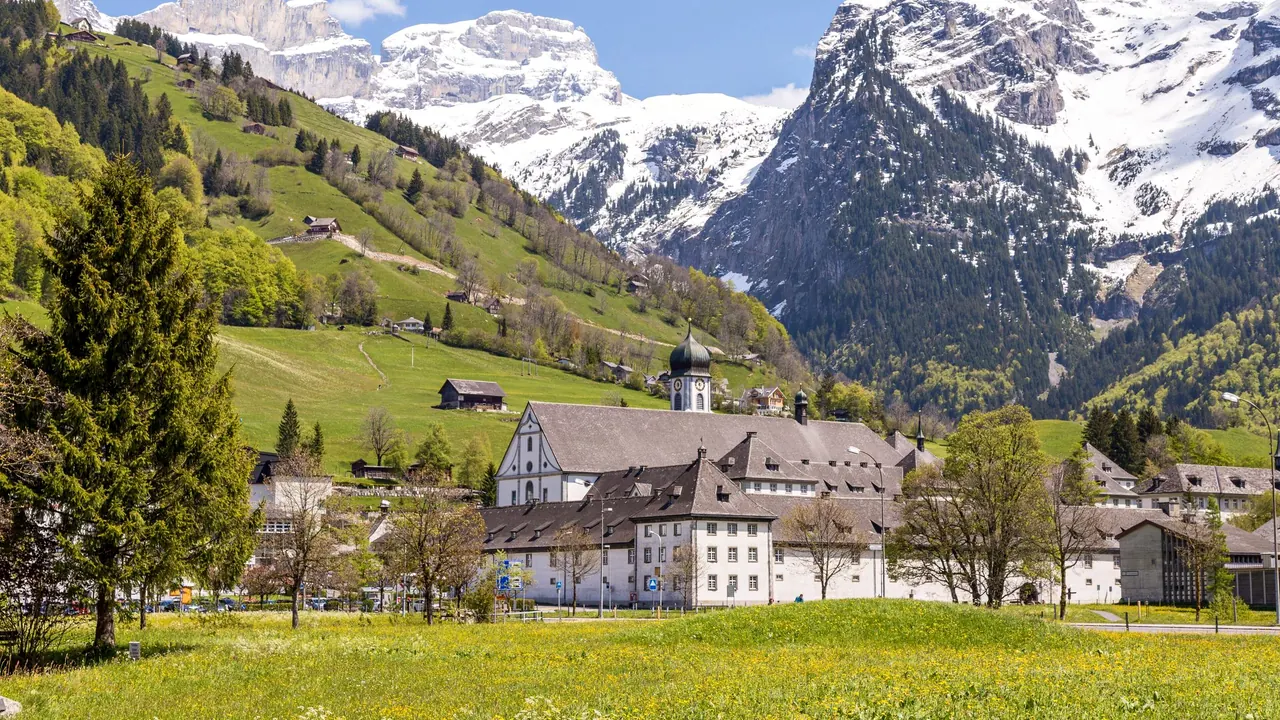
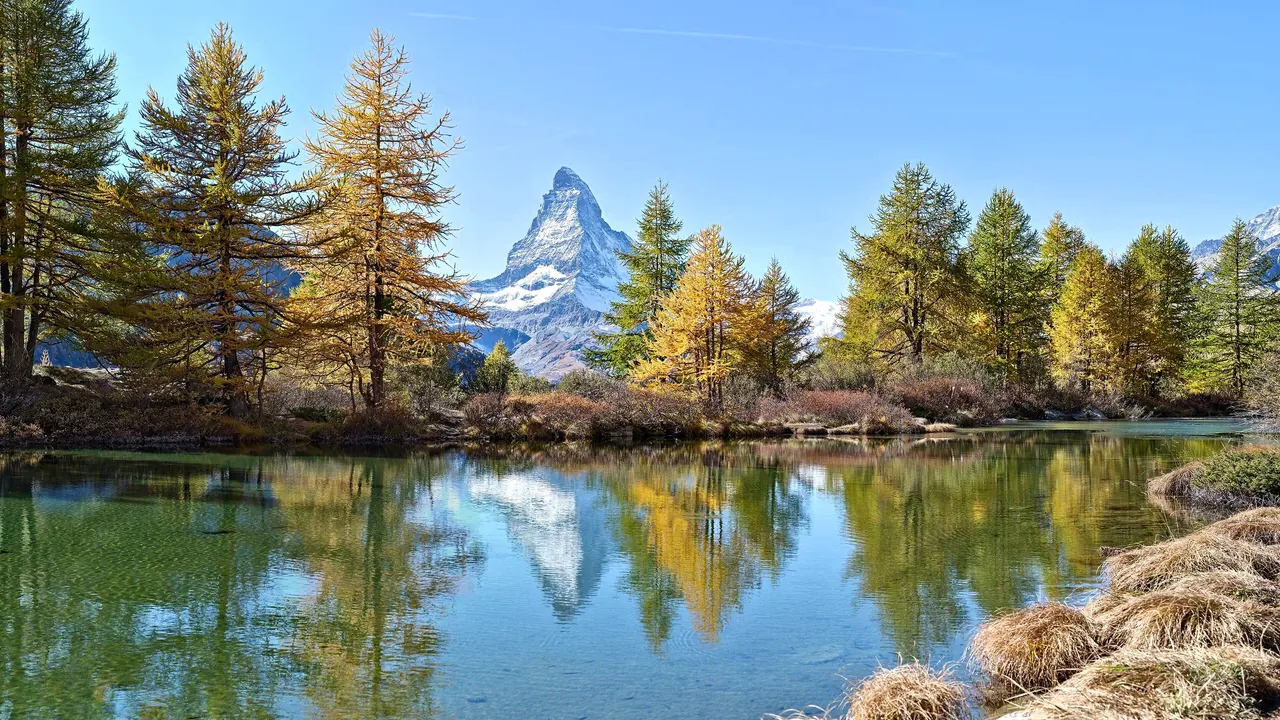
Photos: Engelberg by JoachimKohler-HB, CC BY-SA 4.0, cropped; Zermatt by Roy Egloff, CC BY-SA 4.0, cropped.
Engelberg or Zermatt?
Our verdict in twelve categories, each scored against the same fixed benchmark cities, and the climate month by month, so you can choose for your trip.
Choose Engelberg for
- day trips
- families
- beaches
Engelberg suits families and travellers who want serious mountains without giving up an easy link to a real town. Lucerne and its lake are under an hour down the valley by train. The Brunni and Trübsee areas are laid out for children, and the warmer, greener summers make it a gentler base for walking, lake trips and a first look at a glacier on Titlis.
Choose Zermatt for
- food and drink
- shopping
- nightlife
For the high Alps at their most dramatic, Zermatt is the stronger choice. The Matterhorn stands over the car-free village, and the lifts climb higher, reach more terrain and link into Italy for skiing. The terrace lunches with Valais wine are better, après-ski is livelier and the hotel spas are excellent. It rewards keen skiers, hikers and climbers more than anyone looking for outings to other towns.
Scoreboard
Twelve categories on one fixed scale from 0 to 100. The shaded stretch is the gap between the two.
Your match
Pick a travel style or drag the sliders, and both match scores follow your weighting.
Too close to call, level with your weighting
Wins on day trips and families with your weighting.
Wins on food and drink and shopping with your weighting.
What matters to you?
Category by category
What the scores mean for a trip.
Beaches & swimming
Neither village is a swimming destination, but Engelberg has the better answer. In midsummer the train takes you down to Lake Lucerne in about an hour, where lidos and lakeside meadows offer water of around 20°C. On a rainy day there is also the indoor pool at the village sports centre.
Zermatt has no such escape. Its tarns are meltwater that stays icy even in August, the nearest bathing lake is a long way off, and swimming means a hotel pool.
Food & drink
Zermatt eats noticeably better. Its real strength is up the mountain, where chalets in the hamlets of Findeln, Furi and Zum See serve long terrace lunches facing the Matterhorn. Back in the village there are a few ambitious fine-dining kitchens, and the Valais wines, such as Petite Arvine and Cornalin, give meals a local character.
Engelberg's cooking is hearty and repetitive: fondue, rösti and Älplermagronen in hotel dining rooms and huts. Its one distinctive stop is the show cheese dairy inside the monastery. Both places are expensive and narrow in range, but Zermatt gives a food-minded visitor more to look forward to.
Culture & sights
Both villages have only modest sights, and they differ in subject. Engelberg's heritage is religious and early tourist: the Benedictine abbey, founded in 1120, with its bright baroque church and huge organ, plus a handful of Belle Époque hotels from the grand-resort era. An hour covers it.
Zermatt tells the story of mountaineering. The underground Matterhorn Museum recounts the 1865 first ascent and its disaster, and the climbers' cemetery and the old larch barns of the Hinterdorf take up a morning, with a ride on the historic Gornergrat railway to follow.
Nightlife
Both villages only go out in winter, but Zermatt does it on a bigger scale. Slope-side bars fill with skiers coming down the runs into the village, and later a few bars and small clubs along the main street run past midnight on busy weekends.
Engelberg's après-ski is livelier than its size suggests, kept going by young freeriders and seasonal workers. Still, it comes down to a couple of late bars and one small club at high-season weekends. In both places, summer evenings end after dinner.
Nature & outdoors
Engelberg makes a fine mountain base, but Zermatt's high Alps are grander. Engelberg's valley is lower and greener, under the glaciated Titlis, where the rotating gondola, the suspension bridge and the ice cave bring permanent snow within easy reach. Across the valley, Brunni has meadows and a via ferrata, summer walkers take the Four Lakes route over the Jochpass, and in winter freeriders come for the steep north faces of Titlis.
At Zermatt the Matterhorn rises straight above the village, inside a ring of four-thousand-metre peaks around the Gorner Glacier. Hundreds of kilometres of marked trails run through larch forests where you can see marmots and ibex, and the glacier keeps some pistes open through the summer. Guides lead climbs of the four-thousanders, and the Haute Route ends in the village.
Day trips
Engelberg is far better placed for days away. Lucerne's covered bridges and old town are under an hour down the valley, and paddle steamers on the lake run to Weggis and Vitznau. Stans, Schwyz with its Confederation charters, and Einsiedeln's baroque abbey are also within easy reach, and Zurich makes a full day.
From Zermatt, every outing begins with a long train ride down to the Rhône. Sion's castle hills and vineyards are the best reward, at about an hour and a half away, and most visitors end up spending spare days in the mountains instead.
Good for families
Engelberg is set up more deliberately for children. The Härzlisee at Brunni has stepping stones, rafts and adventure trails, and the Trübsee has a playground and boats. When the weather turns, Lucerne's transport museum is an easy trip.
Zermatt's big advantage is having no cars, which makes the village calm, and its nursery slopes at Sunnegga and its marmots please small children. Beyond skiing and walking, though, there is little aimed at children, and wet days are hard to fill. In both places the glacier stations above 3,000m can be too much for toddlers.
Getting around
Both work well without a car, in slightly different ways. Engelberg is small and flat, a free shuttle runs in the ski season, and the cog railway from Lucerne brings you straight into the village.
In Zermatt, cars stay behind at Täsch. Electric taxis, ski buses and an underground funicular serve the long, narrow village, though hotels on the slopes at its edges mean a steep walk with luggage. Each sits at the end of a valley, but Zermatt's ride out to the main rail network is the longer one.
Shopping & style
Zermatt has more to browse along its single main street. There are watch and jewellery boutiques aimed at wealthy skiers, and the mountaineering outfitters are among the best stocked in the Alps.
Engelberg's shops are mostly for renting and buying ski gear, with a few watch counters for tour groups. The best things to take home from it are edible, especially cheese from the monastery dairy.
Affordability
Both are among the most expensive mountain resorts in Europe, and neither can be done cheaply. Engelberg's biggest single cost is the Titlis cable car. A Swiss travel pass covers the train and takes something off some of the lifts.
In Zermatt, rooms in season and drinks on the mountain terraces are steep, and the cog railways add up. The best saving is to sleep down the valley in Täsch. In both villages, self-catering and supermarket picnics make the biggest difference.
Live music & performing arts
Zermatt has more to plan around, thanks to two festivals. Zermatt Unplugged brings acoustic sets by well-known singers to tents and mountain stages in spring, and a chamber music festival in late summer fills the village church.
Engelberg's highlight is an organ recital or concert in the abbey church, alongside a small summer festival of classical music. For anything bigger, Lucerne's concert halls are less than an hour away.
Wellness & relaxation
Zermatt is the better place for a spa vacation. It has an unusual number of excellent hotel spas, many with Matterhorn views and some open to non-residents, and the lack of traffic noise helps. Thermal baths are also within reach further down the Valais valley.
Engelberg first became known as a health resort, and its quiet valley still suits slow days in early summer. In practice, though, wellness there means hotel saunas and the village sports-centre pool.
When should you go?
Pick your month. The climate figures are measured averages, not a forecast.
Engelberg in July
Zermatt in July
Daytime high, °C
Rainfall in the month, mm
Where the figures come from
Engelberg has no weather station within reach, so its figures come from a gridded climate model rather than a measured record, and read a broad area rather than one spot.
Zermatt has no weather station within reach, so its figures come from a gridded climate model rather than a measured record, and read a broad area rather than one spot.
Temperature and rainfall are climate normals, averaged over the years shown. Engelberg: 2001-2020 normals, NASA POWER reanalysis grid, no weather station within 90 km. Zermatt: 1991-2020 normals, TerraClimate 4 km grid at the town, no weather station within 90 km.
Engelberg sits much lower and is the milder of the two. From June to August daytime highs reach about 21°C, which is comfortable for walking and warm enough for swimming trips down to Lake Lucerne. These are also its wettest months, with around 150mm of rain in each, so expect showers and changeable weather in the valley. December to February stay close to freezing, which is snow season, and late autumn is grey between seasons.
Zermatt is cold all year. Even July and August only reach about 14°C during the day, so summer here means hiking weather in a fleece rather than lake weather, and highs stay below freezing from December into March. Its rain is spread more evenly, so summer is drier than in Engelberg. November is the wettest month at around 130mm, which makes it the least appealing time to visit.
Which traveller are you?
On a family trip with children, Engelberg is the easier choice. It lies lower and is milder, so summer days are warm enough for small children to play outdoors. Everything is a short walk apart, and a city and lake are close when the peaks are in cloud.
For a food and nightlife trip, Zermatt is clearly the better pick. Its kitchens cook for an international, well-off crowd, so meals range from mountain huts to fine dining, and its winter evenings run later and on a bigger scale than Engelberg's.
On an outdoors trip, Zermatt has the edge. Its higher lifts and much larger terrain give a week of skiing or walking without repeating a route, and serious mountaineers come specifically for it. Engelberg suits those who want lower trails and warmer summer days.
Before you go
| Measure | Engelberg | Zermatt |
|---|---|---|
| Official language | French, German, Italian, Romansh | French, German, Italian, Romansh |
| Currency | Swiss Franc (CHF) | Swiss Franc (CHF) |
| Sockets | CJ230 V, 50 Hz | CJ230 V, 50 Hz |
| Driving side | Right | Right |
| Time zone | UTC+1, UTC+2 in summer | UTC+1, UTC+2 in summer |
| Emergency number | 112 | 112 |
| Elevation | 1,015 m | 1,624 m |
| Main airport | Zürich Airport (ZRH)72 km from centre226 non-stop destinations | Geneva International Airport (GVA)128 km from centre150 non-stop destinations |
| Public holidays this year | 13 days | 9 days |
By the numbers
| Measure | Engelberg | Zermatt |
|---|---|---|
| Population | 4,181 | 6,023 |
| People per km² | 56 | 25 |
| Museums within 10 km | 0 | 2 |
| UNESCO World Heritage sites within 50 km | 2 | 2 |
Where else could you go?
Every comparison below shares a destination with this one, so you can follow Engelberg or Zermatt somewhere new.
- Saas-Feevs Zermatt
- Andermattvs Engelberg
- Grindelwaldvs Engelberg
- Crans-Montanavs Zermatt
- Verbiervs Zermatt
- Leukerbadvs Zermatt