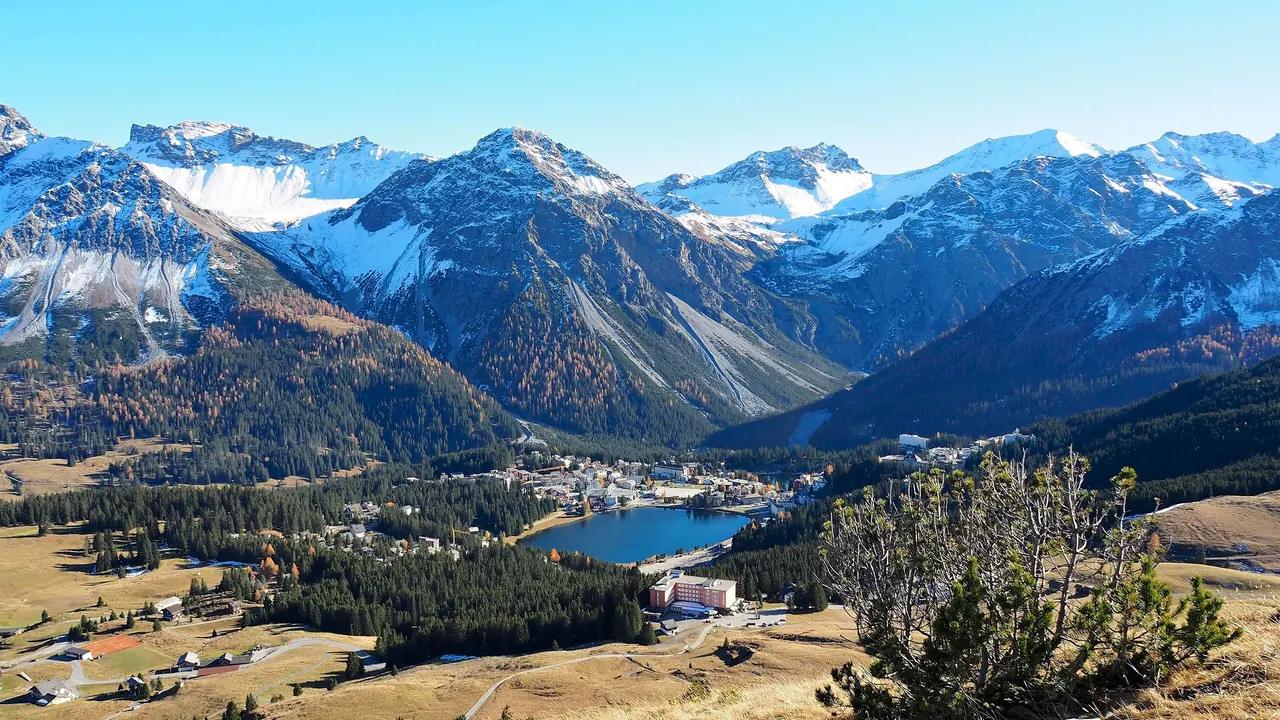
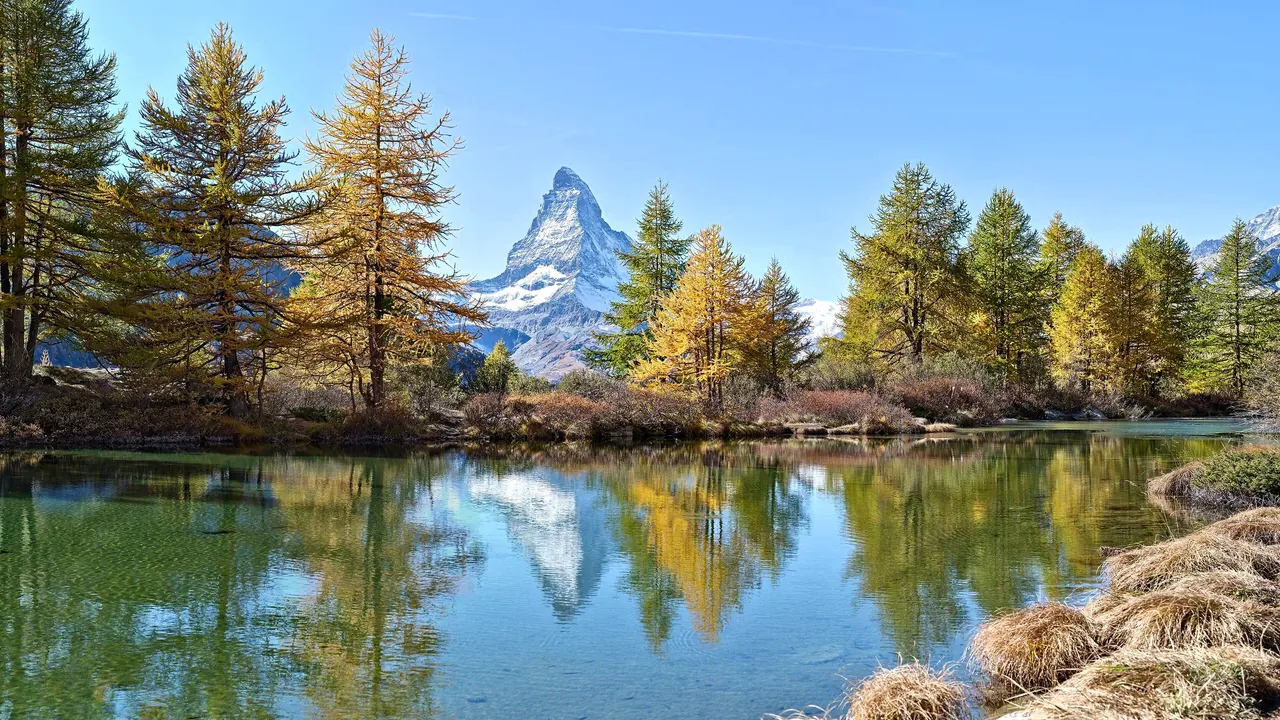
Photos: Arosa by Andres Passwirth, CC BY-SA 4.0, cropped; Zermatt by Roy Egloff, CC BY-SA 4.0, cropped.
Arosa or Zermatt?
Our verdict in twelve categories, each scored against the same fixed benchmark cities, and the climate month by month, so you can choose for your trip.
Choose Arosa for
- beaches
- families
- day trips
Arosa suits families and travellers who want a gentler, quieter mountain stay. Its sunny basin of larches and small lakes is easy to explore with children, the bear sanctuary and sledging runs fill the days, and in summer the Untersee lido gives you a cool swim after a walk. Evenings are calm, and the lift link to Lenzerheide gives skiers plenty of terrain without the drama of glaciers and thin air.
Choose Zermatt for
- shopping
- food and drink
- nightlife
Zermatt is the choice for anyone who comes for the high Alps themselves. The Matterhorn stands above the village, glaciers and four-thousand-metre peaks are a lift ride away, and serious hikers, climbers and skiers will find more to do here than almost anywhere else. It also has the livelier après-ski, the better terrace lunches and the wider range of shops, all in a car-free village you can cross on foot.
Scoreboard
Twelve categories on one fixed scale from 0 to 100. The shaded stretch is the gap between the two.
Your match
Pick a travel style or drag the sliders, and both match scores follow your weighting.
Too close to call, 1 point apart
Wins on beaches and families with your weighting.
Wins on shopping and food and drink with your weighting.
What matters to you?
Category by category
What the scores mean for a trip.
Beaches & swimming
Neither village is a place for a swimming vacation, but Arosa at least has water you can get into. The lido on the Untersee has a lawn and a jetty, and the higher Obersee and Schwellisee draw hardy swimmers for a few weeks in July and August.
Zermatt has no bathing lake at all. Its mountain tarns are there to reflect the Matterhorn, and the meltwater stays too cold for a proper swim even in late summer, so the only swimming is in a hotel pool.
Food & drink
Both villages do their best eating on the mountain, but Zermatt has more depth. Its chalet restaurants in the hamlets of Findeln, Furi and Zum See make lunch the main event of a ski or hiking day. The village adds a few ambitious fine-dining kitchens, and Valais wines such as Petite Arvine and Cornalin go with the raclette and air-dried beef.
Arosa's huts serve good Graubünden cooking, including capuns, barley soup and dried meat on terraces above the valley, and its luxury hotels offer a small fine-dining tier. Away from the slopes the choice comes down to fondue and raclette. In both places many kitchens close between seasons.
Culture & sights
Arosa's heritage fits into an afternoon. The shingled Bergkirchli has stood alone on its meadow above Innerarosa for some five centuries. The Schanfigg museum tells of valley farmers and of the years when sanatoriums treated tuberculosis in the dry air, and a few grand hotels survive from that era.
Zermatt has a little more to show, and its story has more drama. The underground Matterhorn Museum covers the first ascent of 1865 and the deaths on the way down, and the mountaineers' cemetery by the parish church holds climbers lost on the surrounding peaks. The dark larch-wood granaries of the Hinterdorf recall the farming village that stood here before the hotels. The Gornergrat cog railway, running for well over a century, is a piece of history you can ride.
Nightlife
Neither village is a place to plan a trip around late nights, and both go quiet once the ski season ends. Arosa keeps its winter evenings polished and low-key. After a drink on the slopes, most guests move on to a hotel bar, and the small clubs only come into their own on the fullest weekends.
Zermatt's scene is bigger, louder and more of a party. Its après-ski spills out of the bars on the runs back into the village, still in ski boots, and the main street gives you more choice for carrying on past midnight. You pay for it, though, and the fun is cheerful rather than sophisticated.
Nature & outdoors
The difference here is one of scale. Arosa sits in an open basin of larches, lakes and bare summits beneath the Weisshorn, and its lift link to Lenzerheide makes a large ski area with dependable snow. In summer, lake circuits and routes over the passes toward Davos suit hikers and mountain bikers who want wide views without glacier terrain.
Zermatt puts you among the high Alps proper. The Matterhorn rises straight above the village, with the Gorner Glacier and a ring of four-thousanders around it. The Gornergrat cog railway climbs to a viewpoint facing the glacier, and the cable cars go on to the Matterhorn Glacier Paradise at over 3,800m. Walkers have the Five Lakes trail, the suspension bridge on the Europaweg and larch forests where marmots and ibex are easy to spot.
Day trips
Both villages sit at the end of a line, so every outing begins with about an hour on the train, and the difference lies in where you end up. From Arosa almost everything goes through Chur, an old town with a Romanesque cathedral that makes an easy day out. Beyond it lie Maienfeld's vineyards and Vaduz in Liechtenstein.
Zermatt's train runs down to the Rhône and opens up more of Valais. There is Brig's Stockalper Palace and Sion's two castle hills among the vineyards, with Saas-Fee in the next valley. These are longer days out, and most visitors spend their spare days in the mountains instead.
Good for families
Arosa gives families more to fall back on. Its ski schools have gentle children's areas, the cable cars carry small legs up to high viewpoints, and on a wet day the indoor pool and the ice rink give children somewhere to go. Traffic is light, and the free buses make getting around the hillside village easy.
What Zermatt offers children is the absence of cars. Hotel, ski school and lifts are a short, safe walk apart, and the nursery slopes on the Sunnegga side and a small playground lake cover the basics. Beyond that it has little built for children, and rain leaves few options. In both villages, eating out as a family gets expensive quickly.
Getting around
Neither village needs a car, and Zermatt does without one entirely. Its compact strip along the river is walkable from end to end, with the Gornergrat railway, the Sunnegga funicular and the gondolas all close to the centre. Small electric taxis cover the outlying hotels.
Arosa spreads up a hillside from Ausserarosa to Innerarosa, so the free buses matter more, especially with ski gear, and the walks involve plenty of stairs. Its single railway down to Chur is scenic but slow. Zermatt's line connects more smoothly to the rest of the Swiss network.
Shopping & style
Zermatt gives you more to browse along its main street. There are Swiss watch and jewellery boutiques aimed at wealthy skiers and well-stocked mountaineering outfitters, alongside the cowbells and Matterhorn-shaped souvenirs. Arosa covers the basics, with ski rental, outdoor gear, a few boutiques and chocolate, and anyone wanting more takes the train down to Chur's old town.
Affordability
Both are among the costliest places to stay in the Alps, and in both, lift passes, ski rental and terrace meals add up fast. The savings work differently. In Arosa a summer stay is noticeably cheaper than the ski season, and the guest card brings some perks. In Zermatt you can sleep down the valley in Täsch and ride the shuttle up. In both, self-catering makes the biggest difference.
Live music & performing arts
Neither has a theatre season, and each relies on a few festival weeks that differ in character. Arosa's long-running December comedy festival puts stand-up and cabaret on stages around the village, some of them outdoors in the snow, and its summer chamber concerts fill the churches, the old Bergkirchli among them.
Zermatt's highlight is Zermatt Unplugged in spring, with acoustic sets by well-known singers on tent and mountain stages, plus a late-summer chamber music festival in the village church.
Wellness & relaxation
Arosa was founded for convalescence, and the rest it offers is still about pace: lakeside walks, sun terraces and early nights outside the busiest ski weeks. The larger hotels have extensive spa areas, and there is a public indoor pool in the village.
Zermatt is better for the spas themselves. Its excellent hotel spas are packed close together, a few sell day access to non-residents, and the car-free streets keep traffic noise away. The mood is more active, though, and for real thermal bathing you head down the valley into Valais, since neither village has springs.
When should you go?
Pick your month. The climate figures are measured averages, not a forecast.
Arosa in July
Zermatt in July
Daytime high, °C
Rainfall in the month, mm
Where the figures come from
Arosa's temperatures are measured 31 km from the centre, at Samedan.
Arosa has no rain gauge within 25 km of the centre, so its rainfall comes from a gridded climate dataset read at the destination rather than from a gauge further away.
Zermatt has no weather station within reach, so its figures come from a gridded climate model rather than a measured record, and read a broad area rather than one spot.
Temperature and rainfall are climate normals, averaged over the years shown. Arosa: 2015-2025 (rainfall 1991-2020) normals, Samedan (31.2 km from centre). Zermatt: 1991-2020 normals, TerraClimate 4 km grid at the town, no weather station within 90 km.
Arosa has the warmer summer of the two, with daytime highs around 20°C in July. That makes July and August the weeks for its lake swims and long hikes, but June to August is also its wettest stretch, at about 150mm a month, so plan for afternoon showers. Zermatt is higher and noticeably cooler, reaching only about 14°C in high summer. It is drier then, though, at around 80mm a month, which makes July to September steady weather for trails and glacier views.
In winter both villages sit around freezing at midday, so snow is dependable from December to February. Zermatt stays wintry for longer and is still near 0°C in March, while Arosa is already thawing by April. Late autumn is the time to avoid Zermatt: November is its wettest month by far, at about 130mm.
Which traveller are you?
On a family trip with young children, Arosa is the easier choice. Sledging runs, lake playgrounds, short walks to farm restaurants and the bear sanctuary all lie at a comfortable altitude, while Zermatt's best viewpoints are high enough to tire small children.
For an outdoors trip, Zermatt wins clearly. Its glaciers, four-thousand-metre peaks, guided ascents, summer skiing and the end of the Haute Route offer a scale of mountain experience that Arosa's friendlier larch-and-lake basin cannot match.
On a food and nightlife trip, Zermatt gives you more. Its hamlet chalets serve long Matterhorn-view lunches with Valais wines, its après-ski is louder, and the main-street bars stay open later. Arosa's evenings are smarter and quieter, apart from its January gay ski week.
Before you go
| Measure | Arosa | Zermatt |
|---|---|---|
| Official language | French, German, Italian, Romansh | French, German, Italian, Romansh |
| Currency | Swiss Franc (CHF) | Swiss Franc (CHF) |
| Sockets | CJ230 V, 50 Hz | CJ230 V, 50 Hz |
| Driving side | Right | Right |
| Time zone | UTC+1, UTC+2 in summer | UTC+1, UTC+2 in summer |
| Emergency number | 112 | 112 |
| Elevation | 1,775 m | 1,624 m |
| Main airport | Zürich Airport (ZRH)114 km from centre226 non-stop destinations | Geneva International Airport (GVA)128 km from centre150 non-stop destinations |
| Public holidays this year | 9 days | 9 days |
By the numbers
| Measure | Arosa | Zermatt |
|---|---|---|
| Population | 3,185 | 6,023 |
| People per km² | 21 | 25 |
| Museums within 10 km | 1 | 2 |
| UNESCO World Heritage sites within 50 km | 2 | 2 |
Where else could you go?
Every comparison below shares a destination with this one, so you can follow Arosa or Zermatt somewhere new.