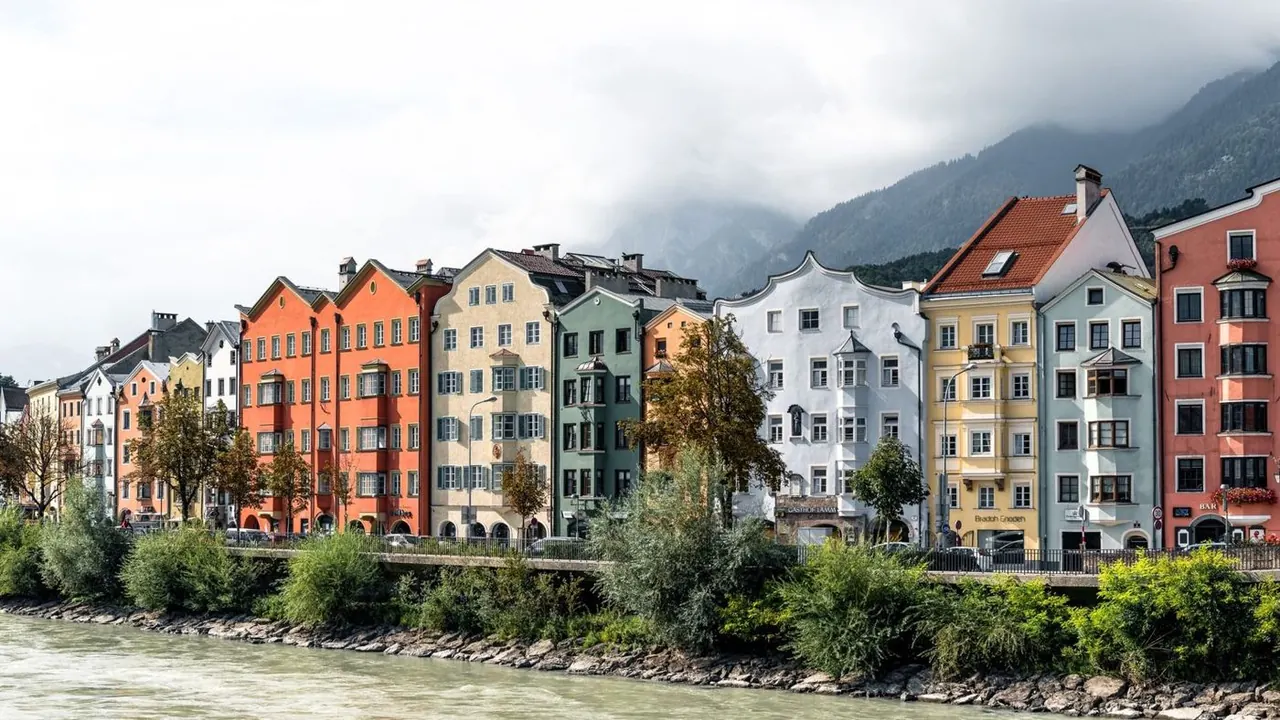
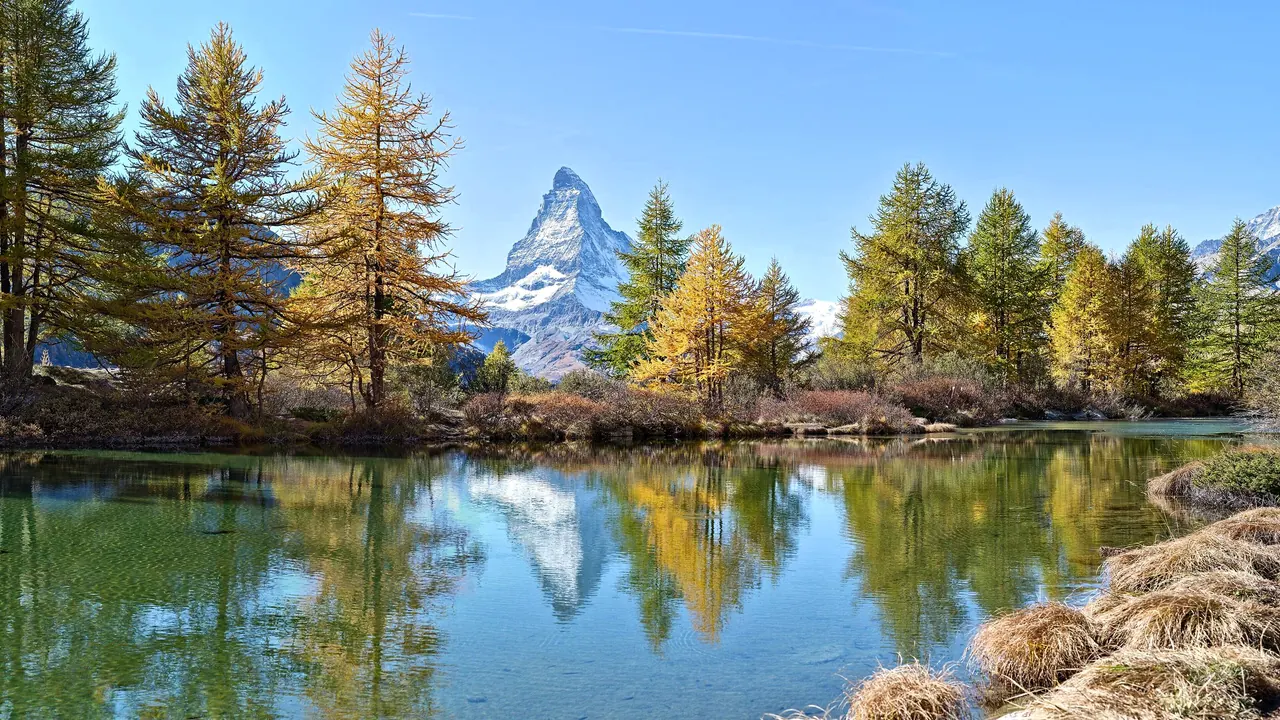
Photos: Innsbruck by Wolfgang Weiser, Pexels License; Zermatt by Roy Egloff, CC BY-SA 4.0, cropped.
Innsbruck or Zermatt?
Our verdict in twelve categories, each scored against the same fixed benchmark cities, and the climate month by month, so you can choose for your trip.
Choose Innsbruck for
- culture and sights
- day trips
- prices
Innsbruck suits travellers who want the mountains and a proper city on the same trip. A funicular and cable cars from the edge of the old town take you up to the Nordkette ridge. Back down in the city, the Hofkirche and the Golden Roof stand in the old town itself, Ambras Castle is on the edge of town, and the bars under the railway viaduct keep the evenings going. Trains reach Munich, Salzburg and South Tyrol, costs are far easier to manage, and in high summer you can swim in a plateau lake.
Choose Zermatt for
- wellness
- nature and the outdoors
Zermatt is for people who want to be in the high Alps and want little else. The Matterhorn fills the view from the car-free village, the lifts climb to glacier terrain, and guides lead climbs on the four-thousand-metre peaks. It is best for skiers, hikers and climbers who will spend every day on the mountain and can afford some of the highest costs in the Alps.
Scoreboard
Twelve categories on one fixed scale from 0 to 100. The shaded stretch is the gap between the two.
Your match
Pick a travel style or drag the sliders, and both match scores follow your weighting.
Wins on culture and sights and day trips with your weighting.
Wins on wellness and nature and the outdoors with your weighting.
What matters to you?
Category by category
What the scores mean for a trip.
Beaches & swimming
Neither place is for a beach trip, but Innsbruck at least has a summer swim. The shallow Lanser See and Natterer See on the plateaus above town warm up in July and August, and the Achensee further out is beautiful but chilly.
Zermatt has no bathing lake at all. Its tarns are for photographing the Matterhorn, the meltwater is too cold to swim in, and the only place to swim is a hotel pool.
Food & drink
In both places the best meals are on the mountain: in Innsbruck at huts above the Inn valley reached by cable car, in Zermatt on the chalet terraces at Findeln, Furi and Zum See, with the Matterhorn in view. Innsbruck cooks Tyrolean dishes such as Gröstl, Kaspressknödel and Kaiserschmarrn, adds Viennese-style coffee houses and cheaper student places, and brings in most of its wine from elsewhere.
Zermatt serves Valais raclette, fondue and air-dried beef with the valley's own Petite Arvine and Cornalin, and it has a few ambitious fine-dining kitchens for the wealthy ski crowd. Cheap meals are much harder to find, and out of season many places close.
Culture & sights
Innsbruck is far ahead here. As a Habsburg seat it gained a compact old town with the Golden Roof, the Hofburg and the Hofkirche, where the tomb of Maximilian I is ringed by bronze figures. Add Ambras Castle and two solid museums, and you have two or three days of sightseeing.
Zermatt's heritage is the story of mountaineering: the Matterhorn Museum and its account of the 1865 first ascent, the climbers' cemetery and the old larch barns of the Hinterdorf. It is moving, but it fills only a morning.
Nightlife
Innsbruck has more going on at night, thanks to its university. Bars and small clubs in the brick arches under the railway viaduct stay open late at weekends all year, and there are pubs and wine bars around the old town.
In Zermatt, nights out depend on the season. Winter brings loud, expensive après-ski on the runs back into the village and a few late bars on the main street. In summer the hikers go to bed after dinner, and between seasons much of the village is shut.
Nature & outdoors
Both put you about as close to the Alps as a visitor can get, but the mountains are of a different kind. In Innsbruck, the Nordkette ridge is under half an hour from the old town, with the huge Karwendel park behind it. The Stubai Glacier, rafting, paragliding and mountain biking are all close by.
Zermatt is higher and wilder. The Matterhorn stands over the village among dozens of four-thousand-metre peaks, the lifts reach glacier terrain where some pistes stay open in summer, and the skiing crosses into Italy. With guided climbs and the end of the Haute Route, it is the place for serious mountaineering.
Day trips
Innsbruck is on the main rail lines through the Alps, so Munich, Salzburg, Bolzano and Merano all make day trips. Hall in Tirol is ten minutes away, and the Bavarian castles around Füssen are within a drive.
From Zermatt, every day out begins with the long train ride down the valley. Sion's castle hills and Brig's Stockalper Palace are worth the trip, and Saas-Fee is close by bus, but most visitors simply go back up the mountain.
Good for families
Innsbruck is the easier base for families. The Alpenzoo, with its ibex, bears and wolves, is a funicular stop above town, the plateau lakes are good for a summer swim, and the Swarovski Crystal Worlds have a large play tower, though rainy days still take planning.
In Zermatt, the car-free lanes are a real comfort with small children, and nursery slopes, marmots and cog railways keep them busy. Beyond that, little is made for children, wet days are hard to fill, and at the highest viewpoints the thin air and cold can be too much for young children.
Getting around
Both are easy to walk, and both have the lifts within walking distance of the centre. Innsbruck also has trams and buses out to Igls and the Stubai valley and a central station with trains along the valley, so you only need a car for the remote lakes.
Zermatt works differently. Ordinary cars are not allowed, so you leave yours at Täsch and take the shuttle train up, then get around on foot or by electric taxi and ski bus. Hotels on the slopes mean a steep walk with luggage.
Shopping & style
Innsbruck has more to buy. Maria-Theresien-Strasse has the high-street chains, and the old-town arcades sell loden jackets, dirndls, woodcarvings, Speck and schnapps. The outdoor and ski shops are excellent.
Zermatt's one main street is mostly Swiss watches and jewellery for wealthy skiers, mountain outfitters and Matterhorn souvenirs. The gear is good, but there is little else to browse.
Affordability
Neither is cheap, but the gap is wide. Innsbruck has Western European prices with an Alpine premium, it gets cheaper in spring and autumn, and its guest card bundles transport with lifts and sights.
Zermatt is one of the most expensive places in the Alps, from plain hotel rooms to lunch on a terrace and every lift ticket. Self-catering and a bed down the valley in Täsch help, but a budget trip is hard to make work.
Live music & performing arts
Innsbruck has a programme through the season: opera, drama and dance at the Tiroler Landestheater, concerts by the Tyrolean Symphony Orchestra, and in summer the Festival of Early Music, in settings such as the Spanish Hall at Ambras Castle.
Zermatt has no theatre or concert hall. Its music comes in two short spells, Zermatt Unplugged in spring and a chamber music festival in late summer. The rest of the year, live music means a band at après-ski.
Wellness & relaxation
Neither has thermal springs, so in both places wellness means hotel spas and mountain air. Innsbruck's best spas are up in Igls and the plateau villages, and the big thermal complexes in the Ötztal and the Zillertal are about an hour away.
Zermatt has an unusual number of excellent hotel spas in one village, and a few sell day access. With no traffic it feels quieter, though in peak weeks the mood is more active than restful.
When should you go?
Pick your month. The climate figures are measured averages, not a forecast.
Innsbruck in July
Zermatt in July
Daytime high, °C
Rainfall in the month, mm
Where the figures come from
Zermatt has no weather station within reach, so its figures come from a gridded climate model rather than a measured record, and read a broad area rather than the city itself.
Temperature and rainfall are climate normals, averaged over the years shown. Innsbruck: 1991-2020 normals, Innsbruck-Flughafen (3.3 km from centre). Zermatt: 1991-2020 normals, TerraClimate 4 km grid at the town, no weather station within 90 km.
The two places sit at very different heights, and you notice it all year. In Innsbruck, summer daytime highs reach about 26°C in July, warm enough for the plateau lakes. June to August are also the wettest months, with about 144mm of rain in August. May and September are mild and good for walking the old town or hiking. Winter days stay just above freezing, which suits a ski trip. July has the most sunshine, and December the least.
Zermatt is much colder. Even in July and August, daytime highs only reach about 14°C, and from December to February they stay below freezing, so winter is purely for snow. The hiking season runs roughly from June to September. Rain is spread fairly evenly through the year, and November is the wettest month at about 130mm.
Which traveller are you?
For a culture and arts trip, Innsbruck is the clear choice. The Hofkirche, the Hofburg and Ambras Castle fill two or three days, and the Landestheater stages opera. Zermatt's mountaineering museum and climbers' cemetery take only a morning.
On a tight budget, Innsbruck is the only realistic option of the two. It is not cheap, but prices drop in spring and autumn and the student cafés help. Zermatt charges heavily for beds, meals and every lift.
For a relaxing and wellness trip, Zermatt has a slight edge. With no traffic, clear air and a cluster of excellent hotel spas, quiet evenings come easily. Innsbruck's spa hotels up in Igls are close behind.
Before you go
| Measure | Innsbruck | Zermatt |
|---|---|---|
| Official language | German, Austrian Sign Language | French, German, Italian, Romansh |
| Currency | Euro (EUR) | Swiss Franc (CHF) |
| Sockets | CF230 V, 50 Hz | CJ230 V, 50 Hz |
| Driving side | Right | Right |
| Time zone | UTC+1, UTC+2 in summer | UTC+1, UTC+2 in summer |
| Emergency number | 112 | 112 |
| Elevation | 574 m | 1,624 m |
| Main airport | Innsbruck Airport (INN)4 km from centre40 non-stop destinations | Geneva International Airport (GVA)128 km from centre150 non-stop destinations |
| Public holidays this year | 16 days | 9 days |
By the numbers
| Measure | Innsbruck | Zermatt |
|---|---|---|
| City population | 132,499 | 6,023 |
| People per km² | 1,263 | 25 |
| Museums within 10 km | 28 | 2 |
| UNESCO World Heritage sites within 50 km | 1 | 2 |
Where else could you go?
Every comparison below shares a destination with this one, so you can follow Innsbruck or Zermatt somewhere new.
- Chamonixvs Zermatt
- Interlakenvs Zermatt
- Luganovs Zermatt
- Munichvs Innsbruck
- Cortina d'Ampezzovs Innsbruck
- Lausannevs Zermatt