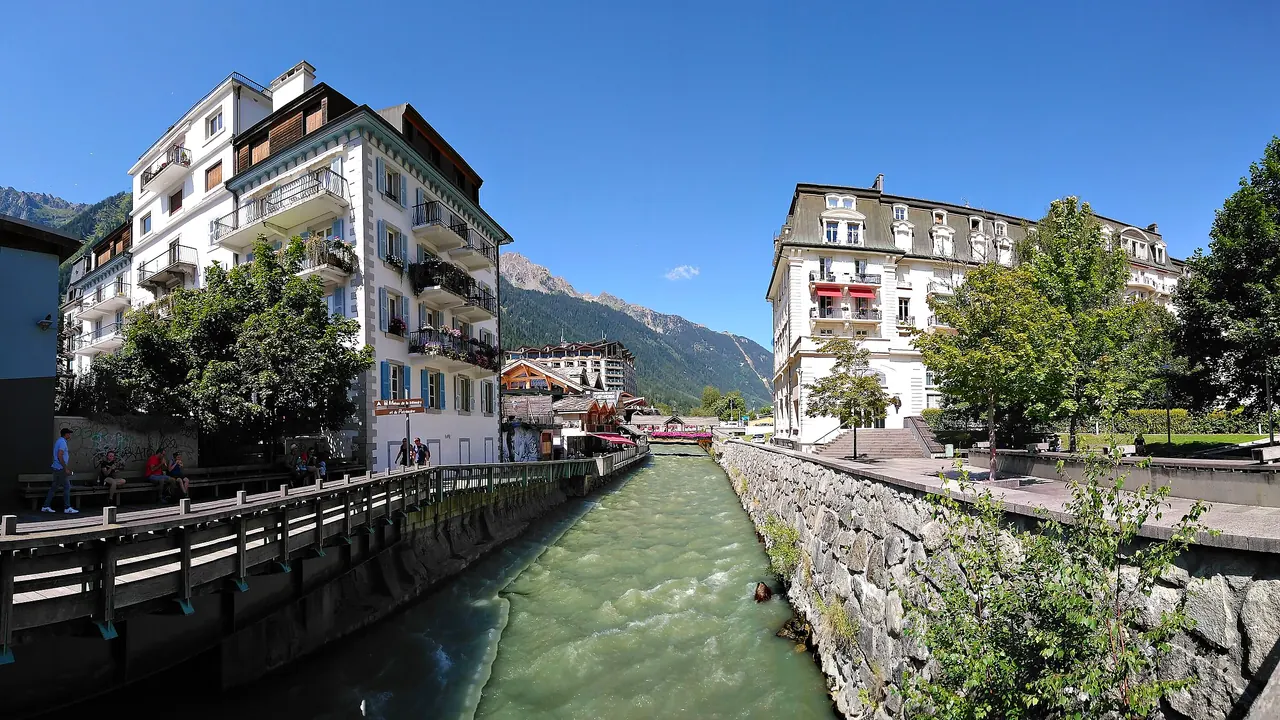
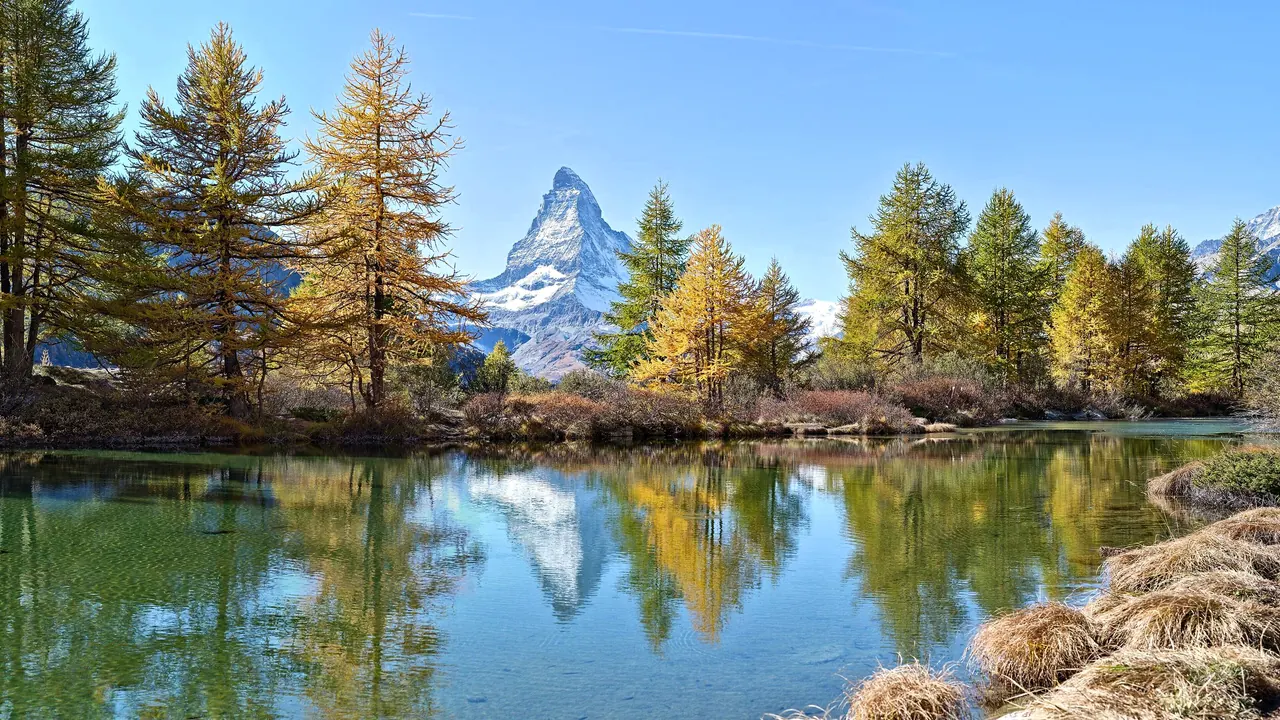
Photos: Chamonix by Tiia Monto, CC BY-SA 3.0, cropped; Zermatt by Roy Egloff, CC BY-SA 4.0, cropped.
Chamonix or Zermatt?
Our verdict in twelve categories, each scored against the same fixed benchmark cities, and the climate month by month, so you can choose for your trip.
Choose Chamonix for
- day trips
- prices
- beaches
Chamonix suits the traveller who wants the high mountains plus something more. It is a real town with a livelier evening scene, more to keep children busy, and three countries within reach, so a wet day can turn into Annecy, Geneva or the Roman streets of Aosta. It is expensive, but less punishing than its Swiss rival, and the free valley transport and trails from the valley floor make it easier to keep costs down.
Choose Zermatt for
- getting around
- live music and the arts
Zermatt is the better pick for those who want one perfect mountain and a quiet, polished base beneath it. With no cars, every railway and gondola is a short walk away, and the Matterhorn stands over the village from every street. Choose it if the budget can stretch to one of the dearest resorts in the Alps and you plan to spend each day up high rather than travelling to other towns.
Scoreboard
Twelve categories on one fixed scale from 0 to 100. The shaded stretch is the gap between the two.
Your match
Pick a travel style or drag the sliders, and both match scores follow your weighting.
Wins on day trips and prices with your weighting.
Wins on getting around and live music and the arts with your weighting.
What matters to you?
Category by category
What the scores mean for a trip.
Beaches & swimming
Chamonix at least gives you somewhere to swim. Lac de Passy, lower down the Arve valley, has a grassy shore and a sandy strip facing Mont Blanc, and Lake Annecy is close enough for a warm summer day out.
Zermatt has nothing like it. The tarns above the village are meltwater and stay too cold for a proper swim even in high summer, so swimming means a hotel pool.
Food & drink
The food is equally good in both, but the regional cooking differs. Chamonix serves Savoyard dishes such as tartiflette and croziflette with Reblochon and Beaufort and Savoie whites, and its large international crowd keeps plenty of bistros, burger places and pizzerias in business alongside the cheese shops and charcuteries.
Zermatt cooks Valais food, with air-dried beef, rye bread and apricot desserts, and pours Petite Arvine and Cornalin. Its best meals are long lunches in old chalets in hamlets such as Findeln, Furi and Zum See, reached on skis or on foot. In both places many restaurants close between seasons.
Culture & sights
Both have small heritage sights about mountaineering, which take a morning or so. Chamonix tells the bigger story: the birthplace of alpinism after the first ascent of Mont Blanc in 1786, and host of the first Winter Olympics, with the Musée Alpin housed in a Belle Époque palace hotel.
Zermatt's story is the Matterhorn's first ascent in 1865 and the disaster on the way down, told in a museum built as an underground reconstruction of the old village. The larch-wood barns of the Hinterdorf, raised on stone slabs, give it an old farming corner that Chamonix lacks.
Nightlife
Chamonix has the livelier nights. After après-ski the crowd moves to a narrow old-town lane of pubs and bars, where guides, seasonal workers and visitors stay out late, and two or three small clubs keep going after that.
Zermatt's evenings are cheerful but costly, mostly slope-side bars and a few places on the main street on winter weekends. In summer both towns go quiet, and Zermatt more so, since most of its hikers turn in after dinner.
Nature & outdoors
For the mountains themselves you can hardly separate them. Chamonix offers more different ways in, from the Aiguille du Midi at 3,842m and the Vallée Blanche glacier run to the start of the Tour du Mont Blanc, rock climbing, via ferrata and paragliding down to the meadows.
Zermatt has the single most famous peak, with dozens of other four-thousanders around it. It also has skiing that crosses into Italy and glacier pistes that stay open in summer. Its trails take in the Five Lakes walk and the suspension bridge on the Europaweg, and the valley is where the Haute Route ends.
Day trips
For days away from the mountains, Chamonix is far better placed. Through the Mont Blanc Tunnel, Courmayeur and the Roman walls and theatre of Aosta are close, and Annecy and Geneva are each a little over an hour away. The Mont Blanc Express also runs over to Martigny in Switzerland.
From Zermatt every outing starts with the long train ride down the valley. Sion, with its two castle hills set among the vineyards, is the best of them, and Brig and Saas-Fee are within reach. Most visitors simply stay up in the mountains instead.
Good for families
Chamonix has more for children to do: the Merlet animal park, a summer luge, treetop adventure courses and the little red train to the Mer de Glace, all in a small town that is easy to walk.
Zermatt's car-free streets mean you never have to watch for traffic, and the Sunnegga side has gentle nursery slopes. Beyond that there is little for children apart from marmots and a playground lake, and wet days are hard to fill. In both places the highest viewpoints are too high for small children.
Getting around
Zermatt is the easier place to get around. With no ordinary cars, you walk everywhere, and the Gornergrat railway, the underground funicular to Sunnegga and the gondolas all leave from near the centre. The catches are steep walks with luggage to hotels on the edges, and over an hour by train to leave the valley.
Chamonix's centre is just as walkable, and the guest card makes buses and the valley train free. Its ski areas are spread along the valley, though, so winter days mean crowded ski buses, and a car helps for trips over the border.
Shopping & style
Both towns are best for mountain gear. In Chamonix there are outdoor shops that go back generations, plus génépi and rock crystals from the massif. Zermatt's main street adds Swiss watch and jewellery boutiques for wealthy skiers, along with cowbells and chocolate. For fashion, Chamonix visitors go to Geneva or Annecy, which are much closer than anything comparable from Zermatt.
Affordability
Neither is cheap, but Chamonix is the easier one to manage. The free valley transport, trails that start without a lift, and quieter months in late spring and autumn all help keep costs under control.
Zermatt is among the most expensive places in the Alps. Even plain rooms, a terrace drink or a ride on the cog railway cost a lot. Self-catering helps, and staying down the valley in Täsch saves on beds.
Live music & performing arts
Zermatt has the stronger festivals, though neither place has a regular season. Zermatt Unplugged brings well-known singers to acoustic stages in spring, and a late-summer chamber music festival puts serious classical players in the village church.
Chamonix's main event is a summer jazz festival with some sets played high in the mountains. For the rest of the year there are occasional church concerts and mountain film evenings, and for opera you go to Geneva.
Wellness & relaxation
They are equally good for unwinding, but in different ways. Chamonix has real bathing: a large day spa with hot outdoor pools looking up at the glaciers, and the old thermal springs of Saint-Gervais in a wooded gorge down the valley.
Zermatt has no springs. Instead it has many excellent hotel spas, a few of which sell day passes, and a car-free village whose quiet makes evenings calmer than in Chamonix's busier streets.
When should you go?
Pick your month. The climate figures are measured averages, not a forecast.
Chamonix in July
Zermatt in July
Daytime high, °C
Rainfall in the month, mm
Where the figures come from
Chamonix's temperatures are measured 35 km from the centre, at Bourg-St-Maurice.
Chamonix has no rain gauge within 25 km of the centre, so its rainfall comes from a gridded climate dataset read at the city rather than from a gauge further away.
Zermatt has no weather station within reach, so its figures come from a gridded climate model rather than a measured record, and read a broad area rather than the city itself.
Temperature and rainfall are climate normals, averaged over the years shown. Chamonix: 1999-2020 (rainfall 1991-2020) normals, Bourg-St-Maurice (34.9 km from centre). Zermatt: 1991-2020 normals, TerraClimate 4 km grid at the town, no weather station within 90 km.
The two climates feel quite different. Down in the Chamonix valley summer is properly warm, with afternoons reaching about 27°C in July, warm enough for a swim in Lac de Passy in July and August and comfortable for walking from June to September. Zermatt's figures are much colder. Daytime highs stay below freezing from December to February and only reach about 14°C at the height of summer, so even in July you need a warm layer for walking.
Chamonix is also the wetter of the two, with heavy rain or snow all year and the most in late autumn and early winter, up to around 169mm in December. Zermatt is drier and steadier, with November the only very wet month at about 130mm. In both places December to March is the snow season, July to September is the time for hiking, and the spring and autumn months in between are the weakest time to go.
Which traveller are you?
On a family trip with children, Chamonix copes better with mixed ages and mixed weather. Its warm summer valley lets children swim in a lake, and on a grey day Annecy's canals are an easy drive. Zermatt is best for families who already ski or hike together.
For a trip on a tight budget, neither is cheap, but Chamonix is the less costly of the two. Pizza places and bistros feed you for less, and the bakeries stock a picnic. In Zermatt cheap meals are hard to find, and the lifts that every day depends on are dear.
On a food and nightlife trip, Chamonix gives you more evenings out. Its young, international crowd keeps casual places busy long after dinner, so one night can follow another. Zermatt's best moments come earlier in the day, with a long lunch on a chalet terrace and one fine dinner.
Before you go
| Measure | Chamonix | Zermatt |
|---|---|---|
| Official language | French | French, German, Italian, Romansh |
| Currency | Euro (EUR) | Swiss Franc (CHF) |
| Sockets | CE230 V, 50 Hz | CJ230 V, 50 Hz |
| Driving side | Right | Right |
| Time zone | UTC+1, UTC+2 in summer | UTC+1, UTC+2 in summer |
| Emergency number | 112 | 112 |
| Elevation | 995 m | 1,624 m |
| Main airport | Geneva International Airport (GVA)68 km from centre150 non-stop destinations | Geneva International Airport (GVA)128 km from centre150 non-stop destinations |
| Public holidays this year | 11 days | 9 days |
By the numbers
| Measure | Chamonix | Zermatt |
|---|---|---|
| City population | 8,705 | 6,023 |
| People per km² | 75 | 25 |
| Museums within 10 km | 3 | 2 |
| UNESCO World Heritage sites within 50 km | 0 | 2 |
Where else could you go?
Every comparison below shares a destination with this one, so you can follow Chamonix or Zermatt somewhere new.
- Annecyvs Chamonix
- Genevavs Chamonix
- Lausannevs Chamonix
- Interlakenvs Zermatt
- Luganovs Zermatt
- Lausannevs Zermatt