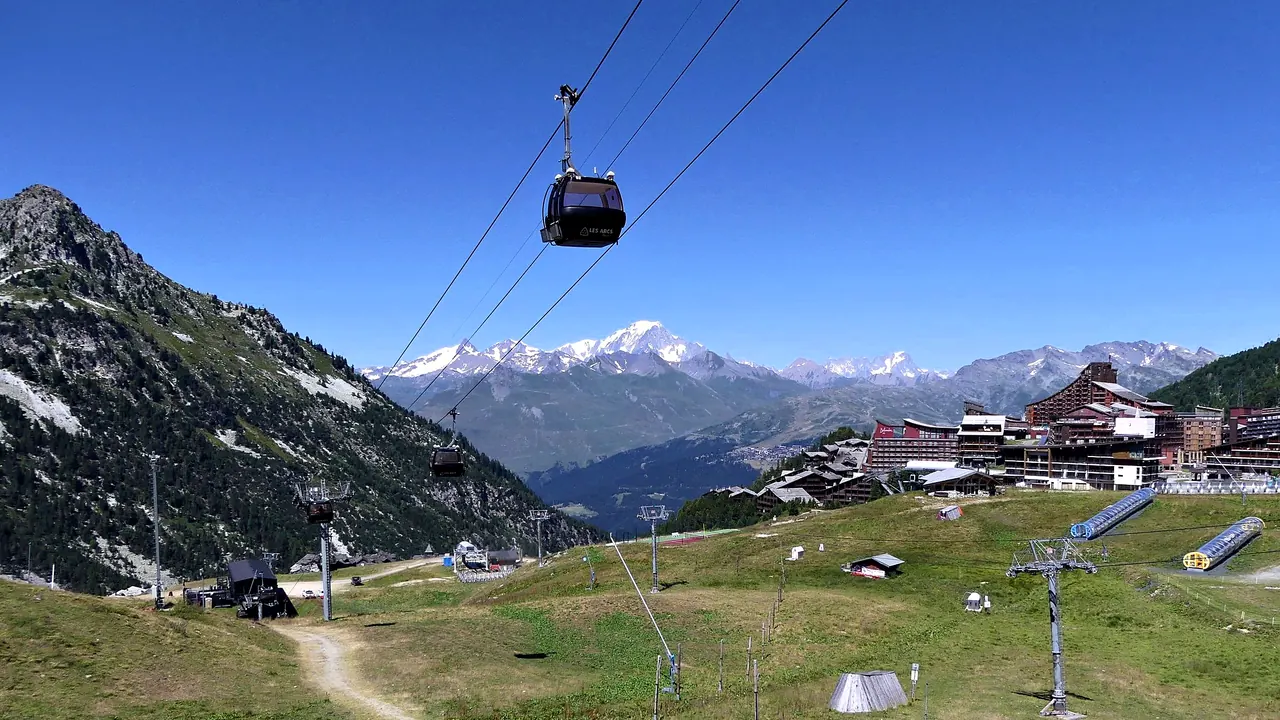
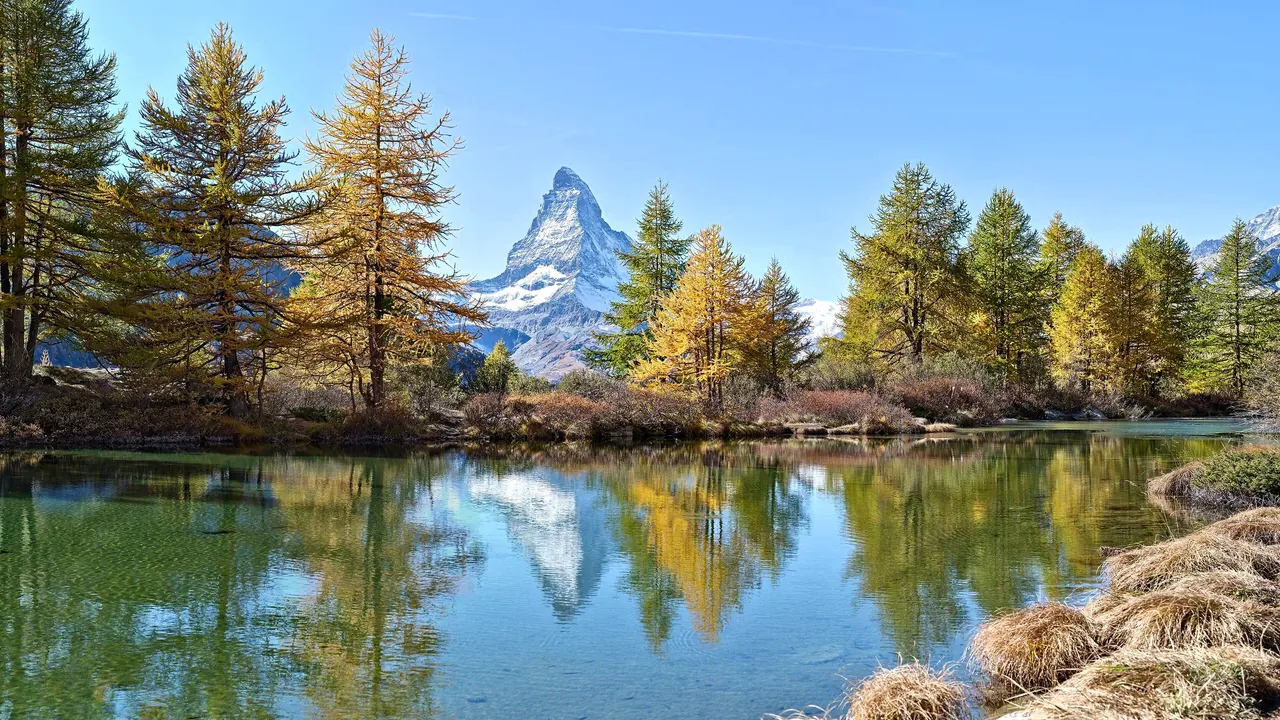
Photos: Les Arcs by Florian Pépellin, CC BY-SA 4.0, cropped; Zermatt by Roy Egloff, CC BY-SA 4.0, cropped.
Les Arcs or Zermatt?
Our verdict in twelve categories, each scored against the same fixed benchmark cities, and the climate month by month, so you can choose for your trip.
Choose Les Arcs for
- families
- prices
- day trips
Les Arcs is the better pick for a family ski week and for anyone who wants big mountains without the very highest bills. Its villages were planned around children, with apartments opening onto the snow and ski schools that take the youngest. Self-catering keeps costs in check, and the vast Paradiski area gives keen skiers plenty of ground. Design lovers get Charlotte Perriand's architecture as a bonus, and in summer the road over into Italy adds variety.
Choose Zermatt for
- wellness
- getting around
- shopping
Zermatt suits travellers who want the Matterhorn above their window and can pay for it. The high glacier terrain, the summer skiing and the guided climbs are hard to match anywhere in the Alps. The car-free village is easy to walk, the terrace lunches and hotel spas are a step up, and après-ski goes on later. Couples and groups of adults who ski or hike hard by day will get the most from it.
Scoreboard
Twelve categories on one fixed scale from 0 to 100. The shaded stretch is the gap between the two.
Your match
Pick a travel style or drag the sliders, and both match scores follow your weighting.
Too close to call, 1 point apart
Wins on families and prices with your weighting.
Wins on wellness and getting around with your weighting.
What matters to you?
Category by category
What the scores mean for a trip.
Beaches & swimming
Neither has anywhere to swim outdoors in any real sense. Les Arcs does a little better in summer: residences have heated outdoor pools, there are small leisure lakes in the valley, and Lake Annecy is a drive of about two hours. In Zermatt, the tarns are too cold even in August, so swimming means a hotel pool.
Food & drink
Zermatt eats better. The real draw is lunch at the wooden chalets in Findeln, Furi and Zum See, which you reach on skis or on foot and eat with the Matterhorn in view. The village adds a few serious fine-dining kitchens, and Valais wines such as Petite Arvine and Cornalin go well with the raclette and air-dried beef.
Les Arcs offers honest Savoyard cooking, with Beaufort in everything and long terrace lunches in converted farm huts. Down in the villages, though, the choice quickly narrows to pizzerias and crêperies, and many guests cook in their apartments.
Culture & sights
Both are thin on culture, but in different ways. In Les Arcs the attraction is the resort itself: Charlotte Perriand's stepped blocks at Arc 1600 and 1800 are a pilgrimage for fans of modern design. Zermatt has mountaineering history instead, with the Matterhorn Museum, the climbers' graves by the church and the old larch barns of the Hinterdorf. Either fills a morning at most.
Nightlife
Zermatt has more going on after dark. In winter the bars on the runs back into the village fill from late afternoon, and a few bars and small clubs on the main street stay open past midnight on busy weekends.
Les Arcs has lively après-ski too, with DJs and table-dancing in Arc 1800 and Arc 2000. Because so many guests are families in apartments, though, most nights end early. Outside winter, both go quiet soon after dinner.
Nature & outdoors
Both are outstanding mountain bases, and the difference lies in character more than quality. Les Arcs offers sheer size: Paradiski links it to La Plagne by double-decker cable car, and runs drop from the Aiguille Rouge to the valley floor. In summer the Vanoise National Park, rafting on the Isère and paragliding make it a good all-round adventure base.
Zermatt offers height and drama. Lifts climb above 3,800m to the Matterhorn Glacier Paradise, some pistes stay open in summer and the skiing crosses into Italy. Guides take climbers up four-thousand-metre peaks, and the village is where the Haute Route ends.
Day trips
Les Arcs has more to offer beyond the slopes, especially in summer. Then the Little St Bernard Pass opens a road to Aosta's Roman remains and Courmayeur. Chambéry and Annecy are each about two hours away, and the cheese villages of the Beaufortain are close.
From Zermatt, every outing starts with a long train ride down the valley. Sion, with its castle hills and vineyards, makes the best day out, and Brig and Saas-Fee are easy. Most visitors stay in the mountains instead.
Good for families
Les Arcs is the more child-friendly resort by design. Apartments open straight onto the snow, ski schools take the very young, and kindergartens, themed fun slopes, sledging, skating and pools fill the afternoons. In summer there are lakeside play areas and mountain-bike lessons.
Zermatt is safe and calm thanks to its car-free streets, and it has nursery slopes on the Sunnegga side. Beyond that, little is made for children: rainy days drag, and the high viewpoints can be too cold and thin-aired for small ones.
Getting around
Zermatt is simpler to get around. Everything lies in one compact strip along the river, the cog railway, the funicular and the gondolas all start within walking distance, and the train links into the Swiss rail network are smooth.
Les Arcs can also be reached without a car, by funicular from the station at Bourg-Saint-Maurice. Its four villages lie far apart along a winding road, however, so you depend on shuttles that slow down in snow, and trips into the valley are easier by car.
Shopping & style
Zermatt has more to browse. Its main street runs from the station to the church and is lined with Swiss watch and jewellery boutiques and well-stocked mountaineering outfitters. Les Arcs is limited to rental shops and supermarkets. Its best buys, Beaufort cheese and génépi, are easier to find down in Bourg-Saint-Maurice.
Affordability
Les Arcs is the cheaper of the two, though a winter week there is still expensive. Self-catering apartments, quieter weeks in January or late March and summer stays all bring costs down a good deal.
Zermatt is among the most expensive places in the Alps, from plain hotel rooms to a drink on a terrace. Its lifts and cog railways add to the cost too. Picnics and a bed down the valley in Täsch help, but only so far.
Live music & performing arts
Both have festivals rather than a cultural calendar that runs all year, and the difference is the timing. Les Arcs has its classical music festival and academy in July, with chamber concerts in halls and chapels. Zermatt has two: Zermatt Unplugged brings acoustic sets in spring, and a chamber music festival fills the village church in late summer. Outside those weeks, both offer little beyond après-ski bands.
Wellness & relaxation
Zermatt is better for unwinding. It has a large number of excellent hotel spas, many with mountain views and some selling day passes, and the car-free streets keep the village quiet.
Les Arcs relies on the pool and sauna in your residence, plus a few hotel spas. For a proper thermal soak, Brides-les-Bains and Salins-les-Thermes are about an hour down the valley. Summer is the calmest time in both resorts.
When should you go?
Pick your month. The climate figures are measured averages, not a forecast.
Les Arcs in July
Zermatt in July
Daytime high, °C
Rainfall in the month, mm
Where the figures come from
Les Arcs's temperatures are measured 43 km from the centre, at Grand St. Bernard / Grand Saint Bernard.
Les Arcs's station stands 199 m above the city centre, so the centre is likely a little warmer than the figures say.
Les Arcs has no rain gauge within 25 km of the centre, so its rainfall comes from a gridded climate dataset read at the destination rather than from a gauge further away.
Zermatt has no weather station within reach, so its figures come from a gridded climate model rather than a measured record, and read a broad area rather than one spot.
Temperature and rainfall are climate normals, averaged over the years shown. Les Arcs: 1991-2020 normals, Grand St. Bernard / Grand Saint Bernard (43.4 km from centre). Zermatt: 1991-2020 normals, TerraClimate 4 km grid at the town, no weather station within 90 km.
Neither place is ever warm, so there is no beach month here. The real choice is between the snow season and the hiking season. In Les Arcs, daytime highs stay below freezing from November to March, and December is very dark. July and August are the best months for walking, with highs around 12°C and around 200 hours of sunshine. Rain or snow falls all year and is heaviest in November, at about 193mm.
Zermatt is a little milder and noticeably drier. Summer highs reach about 14°C, and most months see less than 90mm of rain, so it is the safer bet for a summer walking trip. Winters are still cold enough to keep snow on the ground. Both have the same slack months in late autumn: it is the wettest time in each, the snow is not yet reliable and the walking weather is over.
Which traveller are you?
On a family trip with children, Les Arcs is the better choice. It was built for ski weeks with kids, with car-free villages, kindergartens, themed fun slopes and sledging. Zermatt has calm streets but little made for children, and its thin-air viewpoints are hard on toddlers.
For a trip on a tight budget, Les Arcs is the only realistic option of the two. Neither is cheap, but its self-catering apartments, quieter January weeks and cheaper summers make a stay manageable. Zermatt is among the dearest places in the Alps, even in plain hotels.
On a relaxing and wellness trip, Zermatt pulls ahead. It has a dense cluster of excellent hotel spas with mountain views, some open to day visitors, and car-free streets without traffic noise. In Les Arcs, wellness mostly means the pool and sauna in your residence.
Before you go
| Measure | Les Arcs | Zermatt |
|---|---|---|
| Official language | French | French, German, Italian, Romansh |
| Currency | Euro (EUR) | Swiss Franc (CHF) |
| Sockets | CE230 V, 50 Hz | CJ230 V, 50 Hz |
| Driving side | Right | Right |
| Time zone | UTC+1, UTC+2 in summer | UTC+1, UTC+2 in summer |
| Emergency number | 112 | 112 |
| Elevation | 2,273 m | 1,624 m |
| Main airport | Geneva International Airport (GVA)92 km from centre150 non-stop destinations | Geneva International Airport (GVA)128 km from centre150 non-stop destinations |
| Public holidays this year | 11 days | 9 days |
By the numbers
| Measure | Les Arcs | Zermatt |
|---|---|---|
| Population | - | 6,023 |
| People per km² | - | 25 |
| Museums within 10 km | 0 | 2 |
| UNESCO World Heritage sites within 50 km | 0 | 2 |
Where else could you go?
Every comparison below shares a destination with this one, so you can follow Les Arcs or Zermatt somewhere new.
- La Rosièrevs Les Arcs
- La Plagnevs Les Arcs
- Tignesvs Les Arcs
- Saas-Feevs Zermatt
- Val d'Isèrevs Les Arcs
- Courchevelvs Les Arcs