France
Chamonix
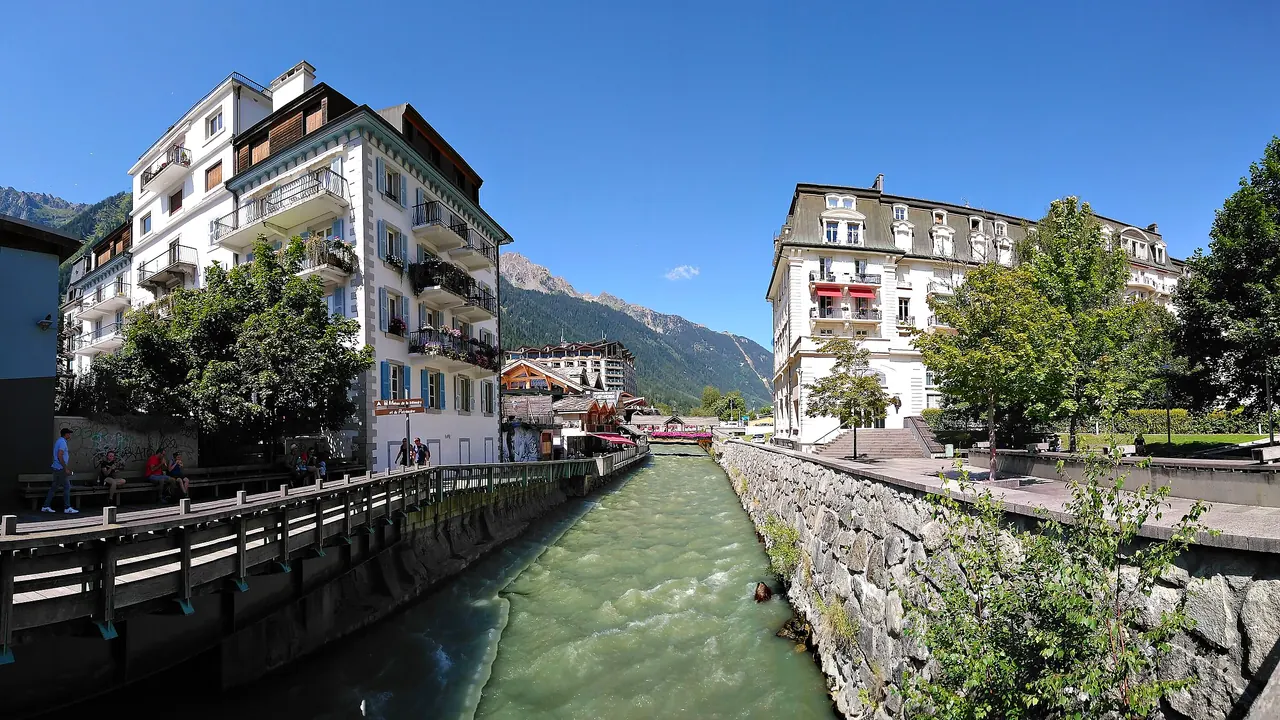
The River Arve through Chamonix between Belle Époque hotels
- Nature & outdoors98
- Getting around70
- Families60
Photo: Tiia Monto, CC BY-SA 3.0, cropped
Match
42
Every category weighted equally
- Beach & sun42
- Culture & arts39
- Food & nightlife37
- Family trip46
- Outdoors51
- Relax & unwind44
- Shopping & style40
- On a budget40
Chamonix in twelve categories
Our verdict on each, scored 0 to 100 against the same fixed benchmark cities, so a score means the same thing on every page.
Beaches & swimming. Scores 14 out of 100.
Food & drink. Scores 40 out of 100.
Culture & sights. Scores 18 out of 100.
Nightlife. Scores 38 out of 100.
Nature & outdoors. Scores 98 out of 100.
Day trips. Scores 58 out of 100.
Good for families. Scores 60 out of 100.
Getting around. Scores 70 out of 100.
Shopping & style. Scores 30 out of 100.
Affordability. Scores 18 out of 100.
Live music & performing arts. Scores 12 out of 100.
Wellness & relaxation. Scores 52 out of 100.
Chamonix category by category
Beaches & swimming
14This is a high Alpine valley, so swimming barely features. The nearest proper place to bathe is Lac de Passy, a small mountain lake lower down the Arve valley with a grassy shore, a sandy strip and the Mont Blanc massif straight ahead. It warms up enough to swim in July and August. Lake Annecy, one of the warmest and clearest lakes in the Alps, is a little over an hour by car and makes a good summer day out.
In town, swimming means the municipal pool, which has an outdoor basin in summer. Visitors who want water in their vacation treat it as an occasional afternoon off, never as the reason for coming.
Food & drink
40Eating in Chamonix means Savoyard mountain food: fondue, raclette, tartiflette and croziflette, made with Reblochon, Beaufort and Abondance from the surrounding alpages, with diots sausages and Savoie white wines alongside. Mountain restaurants and refuges on the ski slopes and hiking trails serve hearty plates on terraces facing the glaciers. Back in town, the cheese shops, charcuteries and bakeries are good for putting together a picnic before a day in the hills.
The international crowd also supports a run of bistros, burger and pizza places and a handful of ambitious kitchens, some in the grand old hotels. The range is still that of a resort, though. Menus look alike, high season gets crowded, and outside winter and summer a fair number of places close.
Culture & sights
18Chamonix's heritage is the story of mountaineering. The town is where alpinism began, with the first ascent of Mont Blanc in 1786, and it hosted the first Winter Olympics in 1924. The Musée Alpin, in a former Belle Époque palace hotel, tells that history. The Espace Tairraz covers glaciers and the crystals of the massif. Statues of the pioneers of the first ascent stand in the centre, and the old guides' quarter, the church of Saint-Michel and the climbers' cemetery fill in the picture.
The grand hotels of the early twentieth century make a pleasant walk, but that is about all there is. A visitor looking for museums and historic architecture will see it all in half a day. What people come to look at here is mountains.
Nightlife
38For a mountain town, Chamonix goes out more than you would expect. In winter, après-ski starts in the late afternoon in bars at the foot of the slopes and in the centre. Later in the evening it moves to a short run of pubs and bars along a narrow lane in the old town, where seasonal workers, guides and visitors mix until late. Two or three small clubs keep going into the early hours on busy nights.
The scene is loud and sociable but small, and the crowd skews young and English-speaking. Summer nights are quieter, with terrace drinking after long days on the hills, and in the shoulder seasons a lot of places shut. Anyone after a real city night out will not find it here.
Nature & outdoors
98Chamonix is a world reference for mountains. The valley floor sits at about 1,000m, with the Mont Blanc massif rising almost 4km above it: hanging glaciers, granite needles and the summit of Western Europe. Cable cars lift visitors straight into high-mountain terrain. The Aiguille du Midi climbs to 3,842m, the rack railway runs to the Mer de Glace, and lifts on the sunny side of the valley give views across to the glaciers. The Grand Balcon trails, Lac Blanc and the Tour du Mont Blanc start from town.
In winter there are steep ski areas spread along the valley, ski touring and the Vallée Blanche glacier descent. In summer people come for mountaineering with the oldest guiding company in the world, rock climbing, via ferrata, trail running, mountain biking and paragliding down to the meadows. Weather in the high mountains can turn fast, and the valley can sit under cloud while the peaks are in sun.
Day trips
58Chamonix is close to three countries, and that is what makes its day trips. Through the Mont Blanc Tunnel, Courmayeur is minutes away on the Italian side, and the Aosta valley beyond has a Roman town with walls, a theatre and an arch, plus castles strung along the valley. Annecy, with its canals, old prison island and lakeside, is a little over an hour by car, as is Geneva and its lakefront and old town.
The Mont Blanc Express railway climbs over into Switzerland to Martigny, which has Roman remains and a well-known art foundation. Nearer home, Megève and Saint-Gervais are pretty mountain villages worth an afternoon. Once you have done these, though, most places within reach are other resorts, and mountain roads stretch journey times.
Good for families
60Chamonix works well for families who enjoy being outdoors. In winter there are ski schools with gentle nursery slopes, and sledging. In summer there are easy trails to mountain lakes, a summer luge, treetop adventure courses, and the Merlet animal park in Les Houches, where ibex, chamois and marmots roam a hillside facing Mont Blanc. The little red train to the Mer de Glace goes down well with children of every age, and the town is small, safe and easy to walk.
The drawbacks are cost and altitude. The highest cable cars climb too high and too fast for small children, and the glacier terrain and steep hiking suit teenagers better than toddlers. On wet days there is little to fall back on beyond the pool and the museums.
Getting around
70The centre of Chamonix is small, flat and easy to walk, and the Aiguille du Midi and Montenvers stations are in town. Along the valley, local buses and the Mont Blanc Express train link the hamlets and ski areas from Les Houches to Argentière and on to Vallorcine. Visitors staying in local accommodation travel on them free with a guest card. Most people arrive by shuttle from Geneva airport.
The ski areas are spread along the valley, so in winter you spend a lot of time on packed ski buses, and the evening services thin out. A car makes day trips over the border easier, but around the valley itself parking is tight, and you can manage perfectly well without one.
Shopping & style
30Shopping in Chamonix is about mountain gear. The pedestrian streets of the centre are lined with climbing, ski and outdoor shops. Some go back generations, and they carry technical equipment and specialist knowledge few towns can match. Climbers and skiers often save their big gear purchases for a visit here.
Beyond that, there are Savoyard cheeses, cured meats and génépi liqueur in the food shops, rock crystals from the massif, and a few clothing boutiques with mountain chic labels. Everything else is souvenirs. For fashion, design or department stores, the nearest real choice is in Geneva or Annecy.
Affordability
18Chamonix is an expensive place to stay. Rooms and chalets fill up at high prices in the February school vacations, at Christmas and in July and August. Lift passes and the big cable cars add up quickly, and hiring a mountain guide or doing a paragliding flight is a serious expense. Restaurant meals cost what you would expect in a famous resort.
There are ways to cut costs. Valley transport is free with the guest card, apartments and supermarkets make self-catering easy, picnics are the natural lunch in the hills, and many trails start from the valley floor without any lift. Late spring, early summer and autumn are noticeably cheaper than the peak weeks, though some lifts and businesses close then.
Live music & performing arts
12Chamonix has very little performing arts life. In summer there are outdoor concerts, including a long-running jazz festival with some sets played high in the mountains, plus free music in the squares around big events. The rest of the year it comes down to occasional concerts in churches and halls, and mountain film evenings. There is no theatre or concert season, and anyone wanting opera or a symphony orchestra will need to go to Geneva.
Wellness & relaxation
52Unwinding in Chamonix comes after effort. The town has a large day spa built on the Italian thermal model, with hot outdoor pools, steam rooms and saunas looking straight up at the glaciers, which is especially good on a winter evening after skiing. Many chalets and hotels have their own saunas and spas. About 25 minutes down the valley, Saint-Gervais-les-Bains has a thermal tradition going back to the early nineteenth century, with warm springs in a wooded gorge.
The town itself is not a calm retreat. Days start early, guides and climbers fill the streets, and high season is crowded. For the quietest stays, choose the shoulder seasons or the hamlets further up the valley.
When should you go?
Pick a month to see what it is like. The climate figures are measured averages, not a forecast.
Chamonix in July
Daytime high, °C
Rainfall in the month, mm
The whole year
Shaded against this city’s own year: the deepest cell is its best month for that figure and the palest its weakest.
Where the figures come from
Chamonix's temperatures are measured 35 km from the centre, at Bourg-St-Maurice.
Chamonix has no rain gauge within 25 km of the centre, so its rainfall comes from a gridded climate dataset read at the city rather than from a gauge further away.
Temperature and rainfall are climate normals, averaged over the years shown. Chamonix: 1999-2020 (rainfall 1991-2020) normals, Bourg-St-Maurice (34.9 km from centre).
Before you go
| Measure | Chamonix |
|---|---|
| Official language | French |
| Currency | Euro (EUR) |
| Sockets | CE230 V, 50 Hz |
| Driving side | Right |
| Time zone | UTC+1, UTC+2 in summer |
| Emergency number | 112 |
| Elevation | 995 m |
| Main airport | Geneva International Airport (GVA)68 km from centre150 non-stop destinations |
| Public holidays this year | 11 days |
By the numbers
| Measure | Chamonix |
|---|---|
| City population | 8,705 |
| People per km² | 75 |
| Museums within 10 km | 3 |
| UNESCO World Heritage sites within 50 km | 0 |
Compare Chamonix with
Every comparison with a written verdict behind it.
- Annecy
- Antibes
- Aspen
- Avignon
- Baden-Baden
- Basel
- Bern
- Biarritz
- Bologna
- Bordeaux
- Cannes
- Colmar
- Como
- Cortina d'Ampezzo
- Dijon
- Florence
- Frankfurt
- Geneva
- Genoa
- Heidelberg
- Innsbruck
- Interlaken
- La Spezia
- Lausanne
- Lille
- Lucca
- Lucerne
- Lyon
- Marseille
- Milan
- Monaco
- Montpellier
- Munich
- Nantes
- Nice
- Paris
- Pisa
- Portofino
- Saint-Tropez
- Siena
- Strasbourg
- Stuttgart
- Toulouse
- Turin
- Venice
- Verona
- Whistler
- Zurich