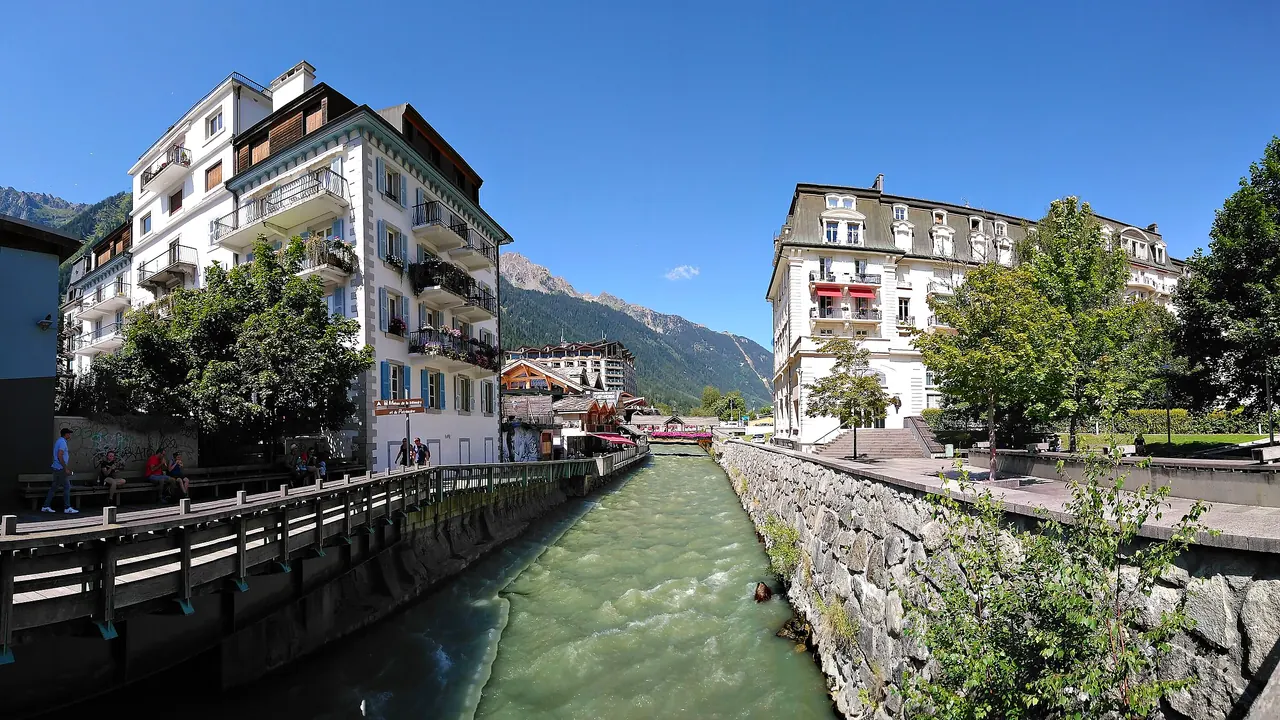
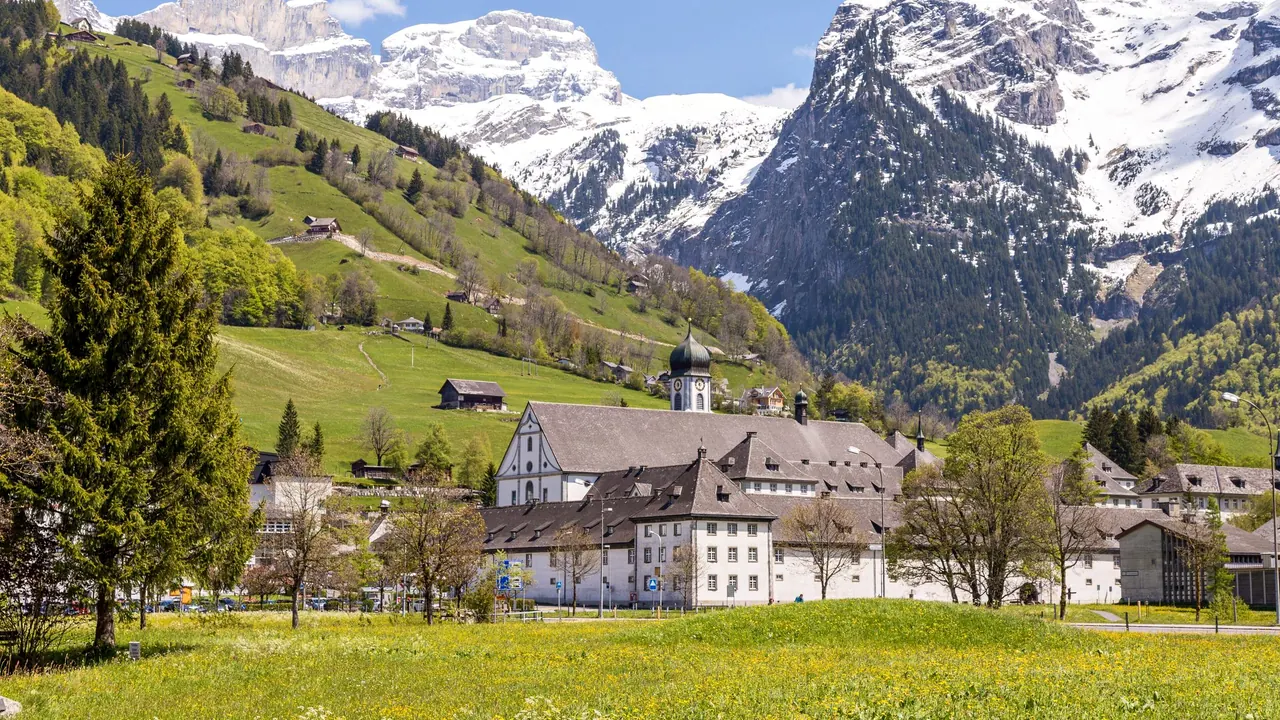
Photos: Chamonix by Tiia Monto, CC BY-SA 3.0, cropped; Engelberg by JoachimKohler-HB, CC BY-SA 4.0, cropped.
Chamonix or Engelberg?
Our verdict in twelve categories, each scored against the same fixed benchmark cities, and the climate month by month, so you can choose for your trip.
Choose Chamonix for
- nightlife
- food and drink
- shopping
Chamonix suits travellers who want the mountains at full scale and a town with some life once they come down. The Mont Blanc massif rises almost 4km above the valley, the Aiguille du Midi and the Mer de Glace railway start in the centre, and the guiding tradition here goes back to the birth of alpinism. After dark there is more going on, with Savoyard cooking, après-ski and a lane of late bars, and the spa on the Italian thermal model is a real reward after a long day.
Choose Engelberg for
- day trips
- families
- getting around
Engelberg is the better pick for a calmer, tidier Swiss stay, especially with children or for anyone who likes trips by train. The village is compact, Titlis puts glacier snow within reach of non-climbers, and Brunni's lakeside play areas are made for families. Lucerne and its lake are under an hour down the valley railway, which gives you more and easier outings than Chamonix's mountain roads, though you pay Swiss prices for all of it.
Scoreboard
Twelve categories on one fixed scale from 0 to 100. The shaded stretch is the gap between the two.
Your match
Pick a travel style or drag the sliders, and both match scores follow your weighting.
Wins on nightlife and food and drink with your weighting.
Wins on day trips and families with your weighting.
What matters to you?
Category by category
What the scores mean for a trip.
Beaches & swimming
Neither place is a swimming destination, and they solve the problem in different ways. Chamonix's summer bathing is a drive away, at little Lac de Passy with Mont Blanc ahead or at Lake Annecy for clearer, warmer water. Engelberg's swimmers take the train down to the lidos and lakeside meadows of Lake Lucerne, which makes a relaxed car-free day out.
Food & drink
Chamonix eats better and with more variety. Its Savoyard staples are built on Reblochon, Beaufort and Abondance from nearby alpages, the cheese shops and charcuteries make excellent picnics, and the international crowd supports bistros and a handful of serious kitchens alongside the fondue.
Engelberg's table is narrower: rösti, raclette and Älplermagronen in wood-panelled rooms and hotel dining rooms, with very little international cooking. Its one real food stop is the monastery's show dairy, where you can watch the cheese being made and buy it at the counter.
Culture & sights
Chamonix's past belongs to the climbers who made it famous, and Engelberg's to the monks who founded it. In Chamonix that means the first ascent of Mont Blanc in 1786, the first Winter Olympics, the Musée Alpin in a former Belle Époque palace hotel, the statues of the pioneers and the climbers' cemetery. You can see all of it in half a day.
Engelberg has one real sight, its Benedictine abbey, founded in 1120. The bright late-baroque church holds one of the largest organs in Switzerland. An hour there and a stroll past the old grand hotels is enough, so in both places culture is a break from the mountains rather than a reason to come.
Nightlife
Chamonix has a real night out by mountain standards. Après-ski spills from the slope-side bars into a lane of old-town pubs, where guides, seasonal workers and visitors mix late, and a few small clubs run into the early hours.
Engelberg's scene is a shorter, winter-only affair, with a couple of late bars and a small club kept going at weekends by freeriders and seasonal staff. In summer both towns go quiet, but Engelberg's evenings usually end with a single drink on a hotel terrace.
Nature & outdoors
Both are first-rate mountain bases, but Chamonix plays in a bigger league. The Aiguille du Midi lifts you to 3,842m among the glaciers and granite needles of Western Europe's highest massif, the Tour du Mont Blanc and Lac Blanc trails start in town, and the mountaineering, climbing and Vallée Blanche descent draw serious alpinists from everywhere.
Engelberg is gentler and more accessible. Titlis brings an ice cave and suspension bridge within reach of anyone, Brunni offers meadows and a via ferrata, and the Four Lakes walk over the Jochpass is a classic. Its steep Titlis north faces give it a strong freeride reputation in winter.
Day trips
Engelberg wins for outings because Lucerne is under an hour away by train. From there you get covered bridges, paddle steamers to Weggis and Vitznau, and onward routes to Schwyz, Einsiedeln's abbey and Zurich. Every trip begins with the same valley line, but the rail network makes it effortless.
Chamonix's choice crosses borders, with Courmayeur and Roman Aosta through the tunnel, Annecy and Geneva over an hour by road, and Martigny by mountain railway. It is more varied in nationality, but mountain roads make the days longer.
Good for families
Both work well for active families, and the difference is in the style. Engelberg is the more convenient package: short walks between hotel and lift, Brunni's lake with rafts and adventure trails, a playground at the Trübsee, and Lucerne's transport museum for wet days.
Chamonix has more variety, with the Merlet animal park's ibex and marmots, the summer luge, treetop courses and the red train to the Mer de Glace. Its steep terrain suits teenagers better, and there is less to fall back on when it rains.
Getting around
Both are compact and walkable, so you will not need a car in either. Engelberg is the simpler of the two: a single valley railway from Lucerne, lifts at the village edge and a free ski shuttle. Chamonix spreads its ski areas along the valley, so winter days mean crowded buses, though the guest card makes the buses and the Mont Blanc Express free.
Shopping & style
Chamonix is the better place to shop, as long as what you want is gear. Its pedestrian centre is lined with long-established climbing and ski specialists, and serious mountaineers save their big purchases for a visit, with génépi, Savoyard cheeses and massif crystals to take home.
Engelberg has well-stocked rental and sports shops, a few watch shops for tour groups, and little else. Its best souvenirs are edible, notably the monastery cheese and Swiss chocolate.
Affordability
Neither is cheap, but Chamonix leaves you more room to economise. Free valley transport, supermarkets, apartments and trails that start from the valley floor without a lift all help, and the shoulder seasons bring rates down noticeably.
Engelberg carries full Swiss pricing for hotels, meals and drinks, and the Titlis cable car is a large expense on its own. A Swiss travel pass and picnics take some of the edge off, but a stay here is the more costly of the two.
Live music & performing arts
Performance is thin in both, and what there is reflects each town's character. Chamonix's highlight is a summer jazz festival with sets played high in the mountains, plus mountain film evenings. Engelberg's is organ recitals and classical concerts in the baroque abbey church, and Lucerne's concert halls are less than an hour away for anyone wanting more.
Wellness & relaxation
Chamonix offers the more complete way to recover. Its large day spa on the Italian thermal model has hot outdoor pools facing the glaciers, and Saint-Gervais down the valley has warm springs with two centuries of bathing tradition.
Engelberg began as a health resort, and its quiet valley and clean air make it the calmer place in early summer or midweek. However, its spas are hotel facilities, with no thermal springs or public bathing culture.
When should you go?
Pick your month. The climate figures are measured averages, not a forecast.
Chamonix in July
Engelberg in July
Daytime high, °C
Rainfall in the month, mm
Where the figures come from
Chamonix's temperatures are measured 35 km from the centre, at Bourg-St-Maurice.
Chamonix has no rain gauge within 25 km of the centre, so its rainfall comes from a gridded climate dataset read at the destination rather than from a gauge further away.
Engelberg has no weather station within reach, so its figures come from a gridded climate model rather than a measured record, and read a broad area rather than one spot.
Temperature and rainfall are climate normals, averaged over the years shown. Chamonix: 1999-2020 (rainfall 1991-2020) normals, Bourg-St-Maurice (34.9 km from centre). Engelberg: 2001-2020 normals, NASA POWER reanalysis grid, no weather station within 90 km.
Chamonix has the warmer summer by a clear margin. July and August afternoons reach about 27°C, warm enough for a swim at Lac de Passy and for long, easy walks on the valley floor. Engelberg's summer peaks at about 21°C, good hiking weather but rarely warm enough to want a lake. Winter runs the same way: Engelberg's midwinter highs barely clear freezing, while Chamonix stays a few degrees milder.
The wet seasons are reversed. Chamonix is wettest in late autumn and early winter, with around 169mm in December, and high summer is its driest stretch. Engelberg gets most of its rain from May to August, about 158mm in August, and its late winter is comparatively dry. That makes Chamonix the safer choice for a summer of hiking and climbing, and Engelberg the steadier one for clear days on the snow in February and March. In both, the late autumn months are cool, damp and grey.
Which traveller are you?
On a food and nightlife trip, Chamonix is clearly the livelier choice. Fondue, tartiflette and Savoie wines sit beside bistros and a few ambitious hotel kitchens. After dark, an old-town lane of bars and a couple of clubs keep going long after Engelberg's evenings end.
On a family trip with children, Engelberg is the easier base. Everything is a short walk apart, Brunni's Härzlisee has rafts and stepping stones, and summer snow on Titlis thrills children. Lucerne's transport museum is a ready answer to a wet day.
For a relaxing and wellness trip, Chamonix offers more to soak in. It has a large thermal-style spa with hot outdoor pools under the glaciers, and Saint-Gervais's historic springs are close by. Engelberg is quieter, but its wellness depends on hotel spas.
Before you go
| Measure | Chamonix | Engelberg |
|---|---|---|
| Official language | French | French, German, Italian, Romansh |
| Currency | Euro (EUR) | Swiss Franc (CHF) |
| Sockets | CE230 V, 50 Hz | CJ230 V, 50 Hz |
| Driving side | Right | Right |
| Time zone | UTC+1, UTC+2 in summer | UTC+1, UTC+2 in summer |
| Emergency number | 112 | 112 |
| Elevation | 995 m | 1,015 m |
| Main airport | Geneva International Airport (GVA)68 km from centre150 non-stop destinations | Zürich Airport (ZRH)72 km from centre226 non-stop destinations |
| Public holidays this year | 11 days | 13 days |
By the numbers
| Measure | Chamonix | Engelberg |
|---|---|---|
| Population | 8,705 | 4,181 |
| People per km² | 75 | 56 |
| Museums within 10 km | 3 | 0 |
| UNESCO World Heritage sites within 50 km | 0 | 2 |
Where else could you go?
Every comparison below shares a destination with this one, so you can follow Chamonix or Engelberg somewhere new.
- Saint-Gervais-les-Bainsvs Chamonix
- Flainevs Chamonix
- Megèvevs Chamonix
- Samoënsvs Chamonix
- Andermattvs Engelberg
- Les Getsvs Chamonix