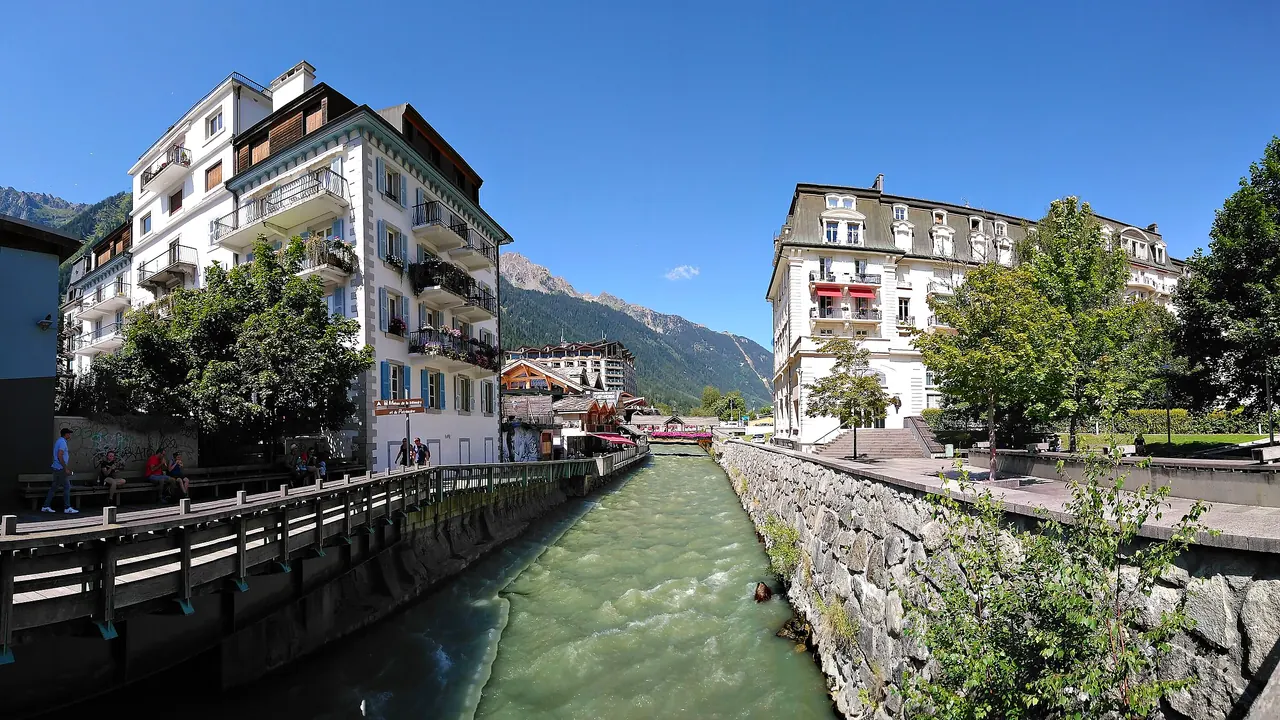
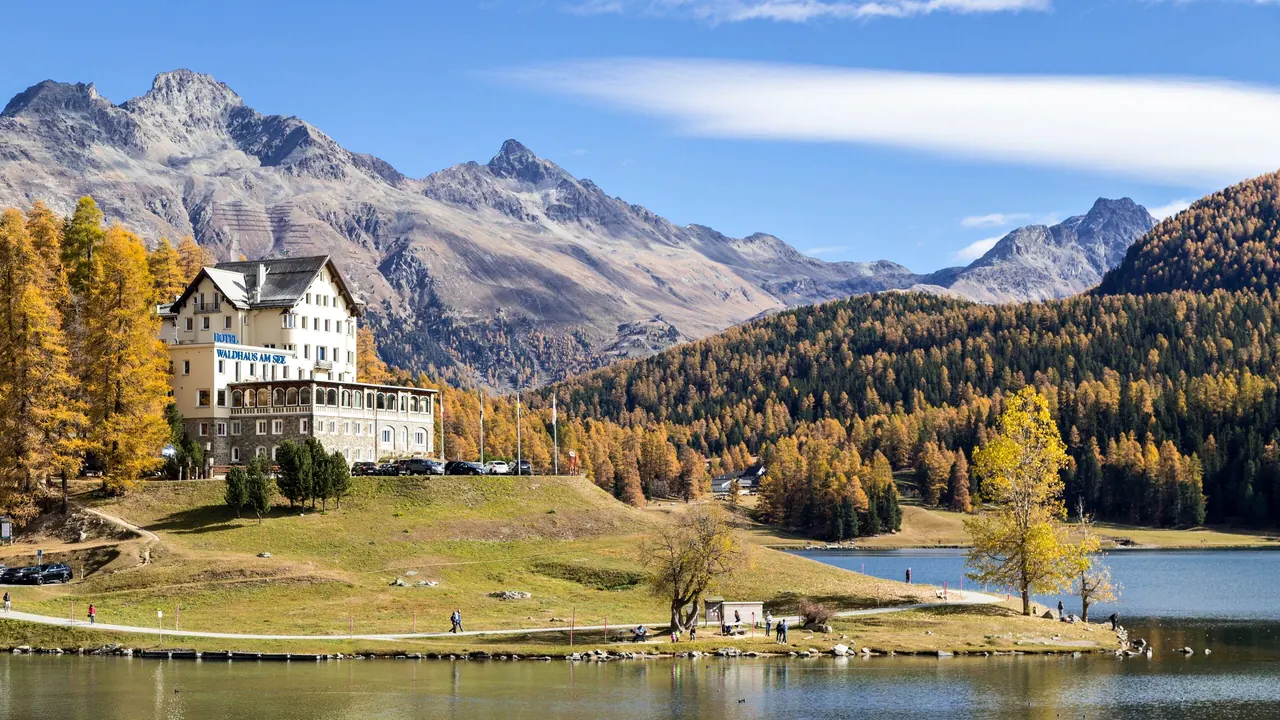
Photos: Chamonix by Tiia Monto, CC BY-SA 3.0, cropped; St. Moritz by JoachimKohler-HB, CC BY-SA 4.0, cropped.
Chamonix or St. Moritz?
Our verdict in twelve categories, each scored against the same fixed benchmark cities, and the climate month by month, so you can choose for your trip.
Choose Chamonix for
- prices
- day trips
- families
Choose Chamonix if the mountains are the whole point and you want to get high up into them. Cable cars lift you into glacier terrain, the Tour du Mont Blanc starts from the edge of town, and the world's oldest guiding company will take you climbing. It is also the livelier and slightly less expensive of the two. The bars are sociable, there are more activities for children, and day trips reach Italy, Switzerland, Annecy and Geneva.
Choose St. Moritz for
- shopping
- live music and the arts
- getting around
St. Moritz suits a calmer, more polished stay. Its wide, sunny Engadine valley is strung with lakes and has cross-country trails and kitesurfing. Grand hotel spas, serious restaurants and luxury boutiques make it as much about comfort as sport, and the trains and buses make a car unnecessary. Expect to pay heavily for all of it.
Scoreboard
Twelve categories on one fixed scale from 0 to 100. The shaded stretch is the gap between the two.
Your match
Pick a travel style or drag the sliders, and both match scores follow your weighting.
Too close to call, 1 point apart
Wins on prices and day trips with your weighting.
Wins on shopping and live music and the arts with your weighting.
What matters to you?
Category by category
What the scores mean for a trip.
Beaches & swimming
Neither town is a place to swim, and the difference lies in which water you can reach. Chamonix has Lac de Passy down the valley, with Mont Blanc behind it, and the warmer Lake Annecy makes an easy summer outing. The lakes around St. Moritz are glacier-fed and cold, Lej da Staz is warm enough to bathe in for only a few weeks, and Lake St. Moritz belongs to windsurfers in wetsuits.
Food & drink
Both eat like mountain resorts, but at different ends of the range. Chamonix serves Savoyard comfort food: fondue, raclette and tartiflette made with Reblochon and Beaufort. You eat it in refuges facing the glaciers, or put together a picnic from the cheese shops.
St. Moritz leans to the top end, with a striking number of serious kitchens in its grand hotels and long lunches on the terraces at Corviglia and Muottas Muragl. Engadine dishes such as capuns, pizzoccheri and nut tart are worth seeking out. In both towns, though, the choice thins quickly below the smartest places, and many kitchens close between seasons.
Culture & sights
You can see the sights of either town in an afternoon, and both lean on their Winter Olympic past. Chamonix's story is alpinism, told in the Musée Alpin, the statues of the first Mont Blanc climbers and the climbers' cemetery. St. Moritz has the stronger single draw in the Segantini Museum and its Alpine triptych, and it adds painted farmhouse rooms in the Engadin Museum and the Cresta Run, which is still in use.
Nightlife
Chamonix has much the livelier evenings. Après-ski spills from the foot of the slopes into a lane of pubs in the old town, where guides, seasonal workers and visitors mix until late, and a few small clubs carry on after that.
St. Moritz goes out in a different style: champagne in grand hotel bars, and exclusive clubs for those with an introduction, mostly between Christmas and early March. Outside those weeks the village is asleep by eleven, while Chamonix still has its summer terraces.
Nature & outdoors
Both are among the finest mountain country in the Alps, and the difference is in character. Chamonix is vertical. Glaciers and granite needles rise almost 4km above the town, the Aiguille du Midi reaches 3,842m, and people come for mountaineering, climbing and the Vallée Blanche.
St. Moritz is wider and gentler: a sunny high valley of lakes and larch forest. Cross-country skiing, kitesurfing on Lake Silvaplana and the walk to the Morteratsch glacier take the place of serious alpinism, and the Swiss National Park is close by.
Day trips
Chamonix reaches further and into more varied places. The Mont Blanc Tunnel brings Courmayeur and the Roman town of Aosta within easy reach. Annecy and Geneva are each a little over an hour away, and the train climbs over the border to Martigny.
St. Moritz has one superb outing in the Bernina line over the pass to Tirano. It also has pretty stops at Sils Maria, Soglio and the sgraffito villages of the Lower Engadine, but beyond those you find villages rather than towns.
Good for families
Chamonix gives children more to do. In summer there are the luge, the treetop courses, easy walks to lakes and the Merlet animal park with its marmots and ibex. The red train to the Mer de Glace is a hit at any age, though the highest cable cars are best skipped with small children.
St. Moritz has ski schools, sledging and skating on natural ice, but little else designed for children. Its adult, luxury tone leads many families to stay in the quieter villages nearby instead.
Getting around
You can manage without a car in either town, but St. Moritz is the easier of the two. The Rhaetian Railway and the Engadine buses link the whole valley and its lifts, although the village climbs steeply from Bad up to Dorf, with escalators to help.
Chamonix's centre is flat and easy to walk, and the guest card gives free buses and trains. Its ski areas are spread along the valley, however, so a winter stay means crowded ski buses.
Shopping & style
St. Moritz is the place for luxury shopping, with an unusual number of fashion, watch and jewellery boutiques around Via Serlas for so small a town. Chamonix sells mountain gear instead. Its climbing and ski shops, some run by the same families for generations, carry the kind of technical stock that serious alpinists save their big purchases for. Beyond that, both offer only local food, crafts and souvenirs.
Affordability
Both are costly, but Chamonix is the one a careful traveller can manage. The guest card makes valley transport free, apartments and supermarkets make self-catering easy, and many trails start without a lift.
St. Moritz is priced for wealthy winter guests, right down to a coffee. Many hotels include lifts and transport in the room, but even so, visitors on a budget usually sleep elsewhere in the Engadine and come in for the day.
Live music & performing arts
Neither town has a theatre or a concert season, but St. Moritz has more worth planning a trip around. The Engadin Festival brings chamber and classical concerts to churches and hotel halls, and winter adds a classical series. Both hold summer jazz festivals, and Chamonix's has some sets played high in the mountains, but otherwise it offers only church concerts and mountain film evenings, with Geneva the nearest place for opera.
Wellness & relaxation
St. Moritz is the better place simply to rest. Its spa history goes back to the iron-rich spring that is still used in the medical bath at St. Moritz Bad, and its hotel spas are among the most elaborate in the Alps. The dry, quiet weeks of summer and autumn suit doing very little.
In Chamonix, relaxing comes after the effort of the day. There is a large day spa with hot outdoor pools facing the glaciers, and the springs of Saint-Gervais are down the valley. The town itself is busy, though: days start early and the streets fill with climbers.
When should you go?
Pick your month. The climate figures are measured averages, not a forecast.
Chamonix in July
St. Moritz in July
Daytime high, °C
Rainfall in the month, mm
Where the figures come from
Chamonix's temperatures are measured 35 km from the centre, at Bourg-St-Maurice.
Chamonix has no rain gauge within 25 km of the centre, so its rainfall comes from a gridded climate dataset read at the destination rather than from a gauge further away.
St. Moritz has no rain gauge within 25 km of the centre, so its rainfall comes from a gridded climate dataset read at the destination rather than from a gauge further away.
Temperature and rainfall are climate normals, averaged over the years shown. Chamonix: 1999-2020 (rainfall 1991-2020) normals, Bourg-St-Maurice (34.9 km from centre). St. Moritz: 2015-2025 (rainfall 1991-2020) normals, Samedan (5.5 km from centre).
Chamonix sits lower and is much the warmer of the two. Summer days in the valley reach about 27°C in July, warm enough for a swim at Lac de Passy, and late spring and early autumn are pleasant for walking. Rain falls all year, though, and it is heaviest in early winter and in May, with around 169mm in December.
St. Moritz is far colder. Winter highs stay around freezing and July peaks near 20°C, so even midsummer is fresh hiking weather rather than swimming weather. Its rain pattern is the reverse of Chamonix's: winters are notably dry, while June to August are the wettest months. For a drier winter on snow, St. Moritz has the edge. For warm summer days in the valley, Chamonix does.
Which traveller are you?
On a trip on a tight budget, Chamonix is the realistic choice. Neither town is cheap, but Chamonix offers free valley transport, easy self-catering, picnic lunches and trails that need no lift. St. Moritz offers no cheap way to stay.
On a family trip with children, Chamonix has far more to keep them busy: the Merlet animal park, a summer luge, treetop courses and the little red train to the Mer de Glace. St. Moritz is safe and pleasant, but it is built around adult luxury.
For a shopping trip, St. Moritz wins if luxury is the aim, with fashion, watch and jewellery boutiques along Via Serlas. Chamonix's shops mostly sell technical mountain gear. They are superb for climbers and skiers but have little for anyone after clothes or design.
Before you go
| Measure | Chamonix | St. Moritz |
|---|---|---|
| Official language | French | French, German, Italian, Romansh |
| Currency | Euro (EUR) | Swiss Franc (CHF) |
| Sockets | CE230 V, 50 Hz | CJ230 V, 50 Hz |
| Driving side | Right | Right |
| Time zone | UTC+1, UTC+2 in summer | UTC+1, UTC+2 in summer |
| Emergency number | 112 | 112 |
| Elevation | 995 m | 1,822 m |
| Main airport | Geneva International Airport (GVA)68 km from centre150 non-stop destinations | Zürich Airport (ZRH)145 km from centre226 non-stop destinations |
| Public holidays this year | 11 days | 9 days |
By the numbers
| Measure | Chamonix | St. Moritz |
|---|---|---|
| Population | 8,705 | 5,027 |
| People per km² | 75 | 175 |
| Museums within 10 km | 3 | 7 |
| UNESCO World Heritage sites within 50 km | 0 | 2 |
Where else could you go?
Every comparison below shares a destination with this one, so you can follow Chamonix or St. Moritz somewhere new.
- Saint-Gervais-les-Bainsvs Chamonix
- Flainevs Chamonix
- Megèvevs Chamonix
- Samoënsvs Chamonix
- Les Getsvs Chamonix
- Avoriazvs Chamonix