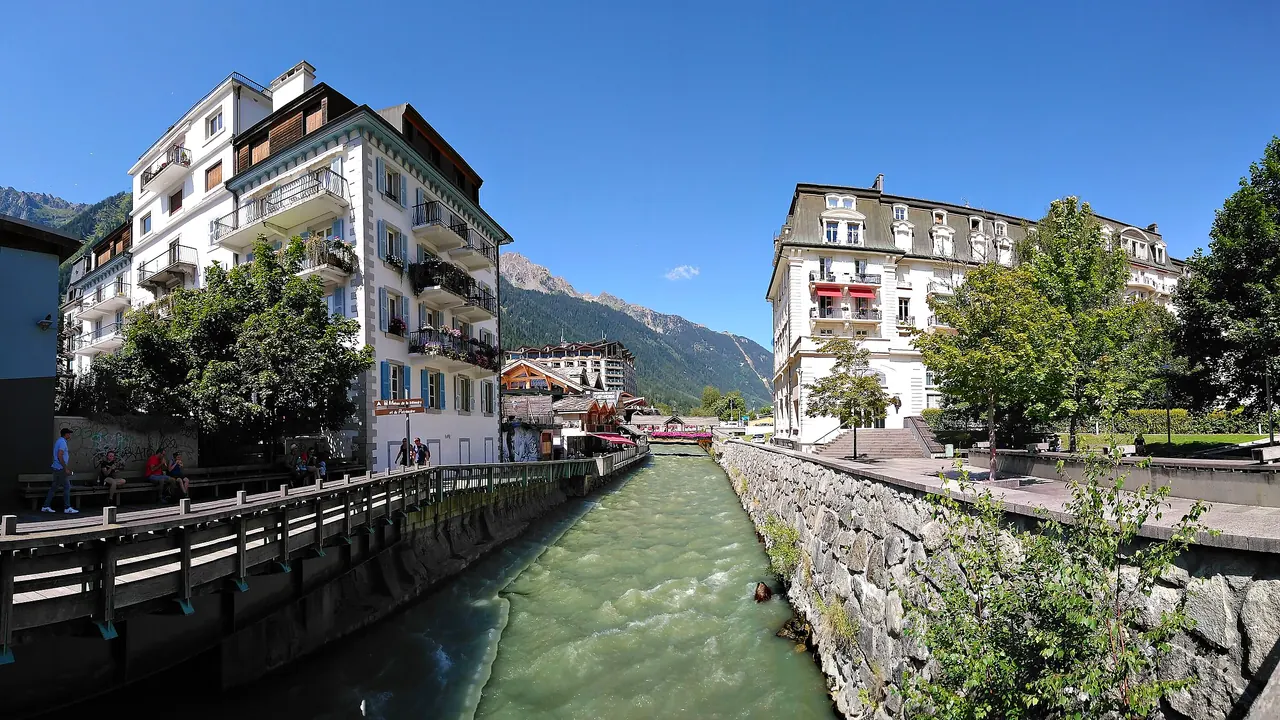
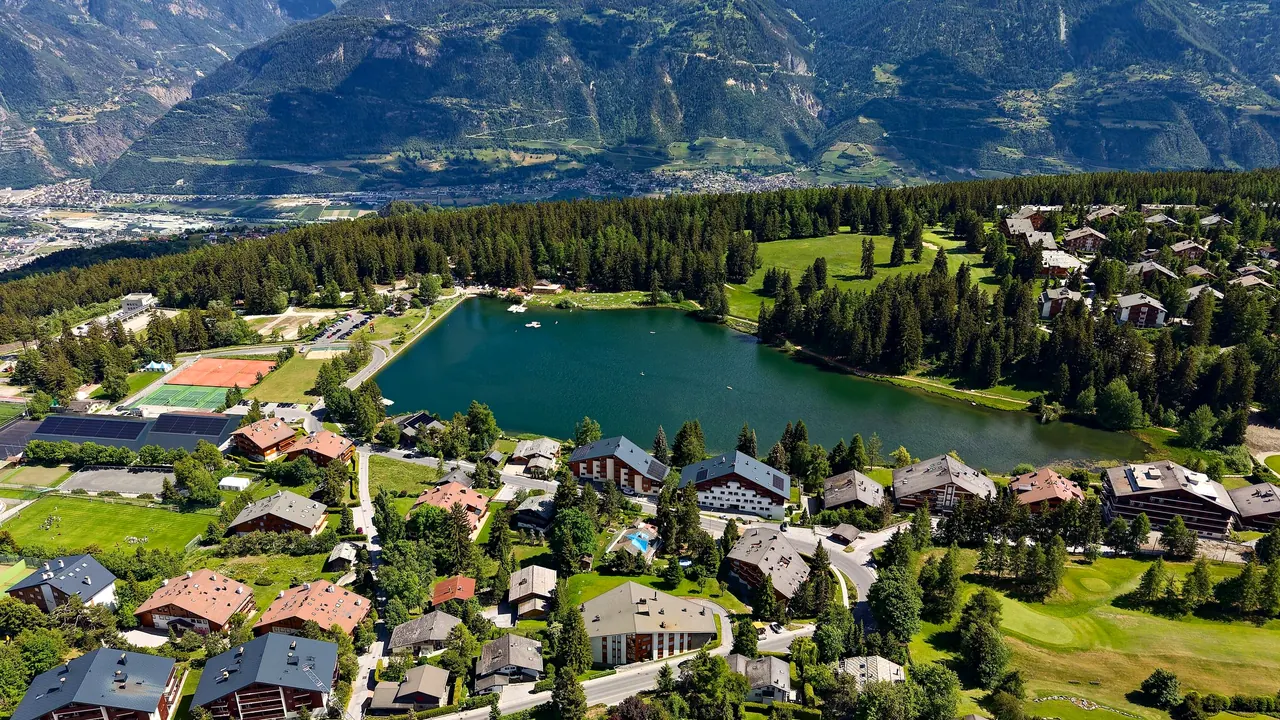
Photos: Chamonix by Tiia Monto, CC BY-SA 3.0, cropped; Crans-Montana by Daniel Reust, CC BY-SA 4.0, cropped.
Chamonix or Crans-Montana?
Our verdict in twelve categories, each scored against the same fixed benchmark cities, and the climate month by month, so you can choose for your trip.
Choose Chamonix for
- prices
- nightlife
- culture and sights
Chamonix suits travellers who come for the mountains themselves. It has the steeper skiing, the glacier descents, the cable cars into high-mountain terrain and a mountaineering heritage you can visit in its museums and the climbers' cemetery. Evenings are livelier too, with a young, mixed crowd of guides and seasonal workers. It is also the easier place to manage without a car and the less punishing on the wallet, although neither is cheap.
Choose Crans-Montana for
- shopping
- live music and the arts
- day trips
Crans-Montana is the better pick for a sunnier, calmer and more polished stay. Its broad, gentle pistes and level bisse paths suit intermediate skiers and relaxed walkers better than serious alpinists. Golf, designer boutiques and a festival or two fill the time off the hill, and the train down to Sierre opens up the castles and vineyards of the Rhône valley. Expect to pay for all of it.
Scoreboard
Twelve categories on one fixed scale from 0 to 100. The shaded stretch is the gap between the two.
Your match
Pick a travel style or drag the sliders, and both match scores follow your weighting.
Wins on prices and nightlife with your weighting.
Wins on shopping and live music and the arts with your weighting.
What matters to you?
Category by category
What the scores mean for a trip.
Beaches & swimming
Swimming is a summer afterthought in both places, possible in July and August and never the reason to come.
The real difference is distance. Chamonix has only its municipal pool in town, so a proper swim means driving down the Arve valley to Lac de Passy or going over an hour to Lake Annecy, which has the clearest and warmest water of the lot. Crans-Montana's bathing lakes, Lac Moubra and Lac Grenon, are on the plateau itself, with lawns, pontoons and pedalos a short walk or shuttle ride away.
Food & drink
Both kitchens are built on melted cheese, and neither is a reason to travel in itself. Chamonix is French Savoyard, with tartiflette, Reblochon and diots sausages. Its large international crowd also keeps up a broader everyday spread of bistros, burger places and pizzerias.
Crans-Montana is Swiss Valais, with raclette scraped from the half-wheel and plates of dried meat. Its strength is wine from the terraced vineyards just below, Petite Arvine and Cornalin among them, plus an easy choice of grand gastronomic dinners. The casual middle of the market is thin.
Culture & sights
Chamonix has more to see, because it has a story of its own. As the birthplace of alpinism and host of the first Winter Olympics, it fills a worthwhile half day with the Musée Alpin, the Espace Tairraz, the old guides' quarter and the climbers' cemetery.
Crans-Montana grew out of sanatoriums and hotels, and on the plateau there is no museum or monument worth planning around. For history, people go down into the Rhône valley.
Nightlife
Chamonix goes out harder. After après-ski, guides, seasonal workers and visitors crowd a lane of pubs in the old town, and a few small clubs stay open into the early hours. The crowd is young, loud and largely English-speaking.
Crans-Montana's evenings are dressier and quieter. People move from terraces to hotel bars and piano lounges, and a couple of clubs open at weekends for a well-heeled crowd. Outside the peak weeks the resort is asleep by ten.
Nature & outdoors
Both are first-rate mountain bases, but Chamonix offers the more extreme mountains. The Aiguille du Midi reaches 3,842m, and the town also has the Mer de Glace, the Vallée Blanche descent, steep ski areas and serious mountaineering, all starting at the foot of Western Europe's highest summit.
Crans-Montana is gentler and sunnier. From its south-facing terrace you look across to a run of Valais peaks, and about 140km of mostly intermediate pistes climb towards the Plaine Morte glacier. In summer the level bisse paths and the golf courses take the place of glaciers and granite needles.
Day trips
The two are about even for outings, but they reach them in different ways. Chamonix sits close to three borders. Courmayeur is only minutes away on the Italian side of the Mont Blanc Tunnel, and the Roman walls and theatre of Aosta lie further down that valley. Annecy's canals and Geneva's old town are each a little over an hour by car, and the Mont Blanc Express climbs into Switzerland as far as Martigny. A car helps, but the mountain roads make every trip longer than the map suggests.
Crans-Montana's outings run by train. The funicular down to Sierre meets the Rhône valley line, which puts the twin castles of Sion and the wine villages within easy reach, with Saint-Maurice abbey a little further. Chillon and the Lavaux terraces are about an hour and a half away. The trade-off is variety: Chamonix offers three countries, while nearly everything you can reach from Crans-Montana lies along the one valley.
Good for families
Both suit families who like being outdoors, and both have little to offer on a wet day. Chamonix has a few more set attractions: the Merlet animal park with its ibex and marmots, the little red train to the Mer de Glace, a summer luge and treetop courses. The compact centre is also easy with a pushchair, although the highest cable cars are no place for small children.
In Crans-Montana, the broad sunny slopes are kind to beginners, and the plateau lakes have playgrounds and pedalos. The resort is spread over a hillside, so with toddlers it pays to choose a base close to a shuttle stop.
Getting around
Chamonix is easier to get around. Its centre is flat and walkable, two of the big lift stations are in town, and the guest card makes the valley buses and trains free. The one weak spot is the crowded ski buses in winter.
Crans-Montana is easy to reach by funicular from the Swiss rail network, but on the plateau Crans, Montana and the lift bases are kilometres apart, with climbs between them. You will use the shuttle buses more than your feet.
Shopping & style
Crans-Montana has more to tempt a shopper, and of a very different kind. Crans packs watchmakers, jewellers, cashmere and designer ski wear into a few streets, aimed at wealthy winter guests.
Chamonix's shops are for equipment. Long-established climbing and ski stores carry technical gear and expert advice, which is worth saving a big purchase for. Beyond them there are mostly cheese, génépi and souvenirs.
Affordability
Neither is a budget destination, but Chamonix is clearly the easier one to manage. Free valley transport with the guest card, trails that start from the valley floor without a lift, supermarkets for picnics and noticeably cheaper shoulder seasons all help.
Crans-Montana is expensive in every season, and on top of that come Swiss restaurant and lift costs. Self-catering and visiting outside the peak weeks only soften the bill a little.
Live music & performing arts
Neither has a theatre or a concert season, but Crans-Montana has a bit more. Its spring festival, Caprices, brings electronic music to the slopes, and a summer series of chamber and classical concerts fills its churches and halls.
Chamonix has a summer jazz festival with some sets played high in the mountains, and the rest of its year comes down to mountain film evenings and the odd concert. For opera or an orchestra, both send you elsewhere.
Wellness & relaxation
Both are good places to unwind, in different ways. In Chamonix you relax after effort. A large thermal-style day spa has hot outdoor pools facing the glaciers, and the old springs at Saint-Gervais are a short drive away, but the town itself starts early and stays busy.
Crans-Montana was founded as a place to recover, and its sunshine and slow pace still make the whole stay more restful. The calm comes mostly from hotel spas open to outside guests and a half day at the Leukerbad hot pools.
When should you go?
Pick your month. The climate figures are measured averages, not a forecast.
Chamonix in July
Crans-Montana in July
Daytime high, °C
Rainfall in the month, mm
Where the figures come from
Chamonix's temperatures are measured 35 km from the centre, at Bourg-St-Maurice.
Chamonix has no rain gauge within 25 km of the centre, so its rainfall comes from a gridded climate dataset read at the destination rather than from a gauge further away.
Crans-Montana has no weather station within reach, so its figures come from a gridded climate model rather than a measured record, and read a broad area rather than one spot.
Temperature and rainfall are climate normals, averaged over the years shown. Chamonix: 1999-2020 (rainfall 1991-2020) normals, Bourg-St-Maurice (34.9 km from centre). Crans-Montana: 2001-2020 normals, NASA POWER reanalysis grid, no weather station within 90 km.
The data shows two quite different climates. Chamonix's valley floor warms to about 27°C in July, which makes summer pleasant for walking around town and warm enough for a lake swim in July and August, and it stays mild into September. Winters there are cold but not severe, at around 5°C by day in January. Crans-Montana sits higher and stays much cooler. Highs barely reach 18°C in midsummer, from December to February they stay below freezing, and its lakes are only good for swimming in the warmest summer weeks.
Rain falls in every month in both places. Chamonix is the wetter of the two overall, and its heaviest months are late autumn, early winter and May, with up to 169mm in December. Crans-Montana is drier in winter and wettest from May to August, so its clearest, crispest spell falls in the ski season, while Chamonix is at its most settled in high summer.
Which traveller are you?
For an outdoors trip, Chamonix is the stronger choice. Cable cars to the Aiguille du Midi, the Mer de Glace, the Tour du Mont Blanc and the world's oldest guiding company give climbers, hikers and expert skiers more serious terrain right from town.
On a shopping trip, Crans-Montana wins clearly. A handful of streets in Crans hold international fashion labels, Swiss watchmakers, jewellers and cashmere. In Chamonix you mostly find technical climbing and ski gear, and for fashion it sends you on to Geneva or Annecy.
Golfers should choose Crans-Montana. Its courses on the sunny plateau look across the Rhône valley to a line of Valais peaks, and they are among the most scenic in the Alps. Chamonix's summer is built around climbing, trail running and paragliding, not fairways.
Before you go
| Measure | Chamonix | Crans-Montana |
|---|---|---|
| Official language | French | French, German, Italian, Romansh |
| Currency | Euro (EUR) | Swiss Franc (CHF) |
| Sockets | CE230 V, 50 Hz | CJ230 V, 50 Hz |
| Driving side | Right | Right |
| Time zone | UTC+1, UTC+2 in summer | UTC+1, UTC+2 in summer |
| Emergency number | 112 | 112 |
| Elevation | 995 m | 1,495 m |
| Main airport | Geneva International Airport (GVA)68 km from centre150 non-stop destinations | Geneva International Airport (GVA)106 km from centre150 non-stop destinations |
| Public holidays this year | 11 days | 9 days |
By the numbers
| Measure | Chamonix | Crans-Montana |
|---|---|---|
| Population | 8,705 | 10,447 |
| People per km² | 75 | 175 |
| Museums within 10 km | 3 | 3 |
| UNESCO World Heritage sites within 50 km | 0 | 1 |
Where else could you go?
Every comparison below shares a destination with this one, so you can follow Chamonix or Crans-Montana somewhere new.
- Saint-Gervais-les-Bainsvs Chamonix
- Leukerbadvs Crans-Montana
- Flainevs Chamonix
- Megèvevs Chamonix
- Samoënsvs Chamonix
- Adelbodenvs Crans-Montana