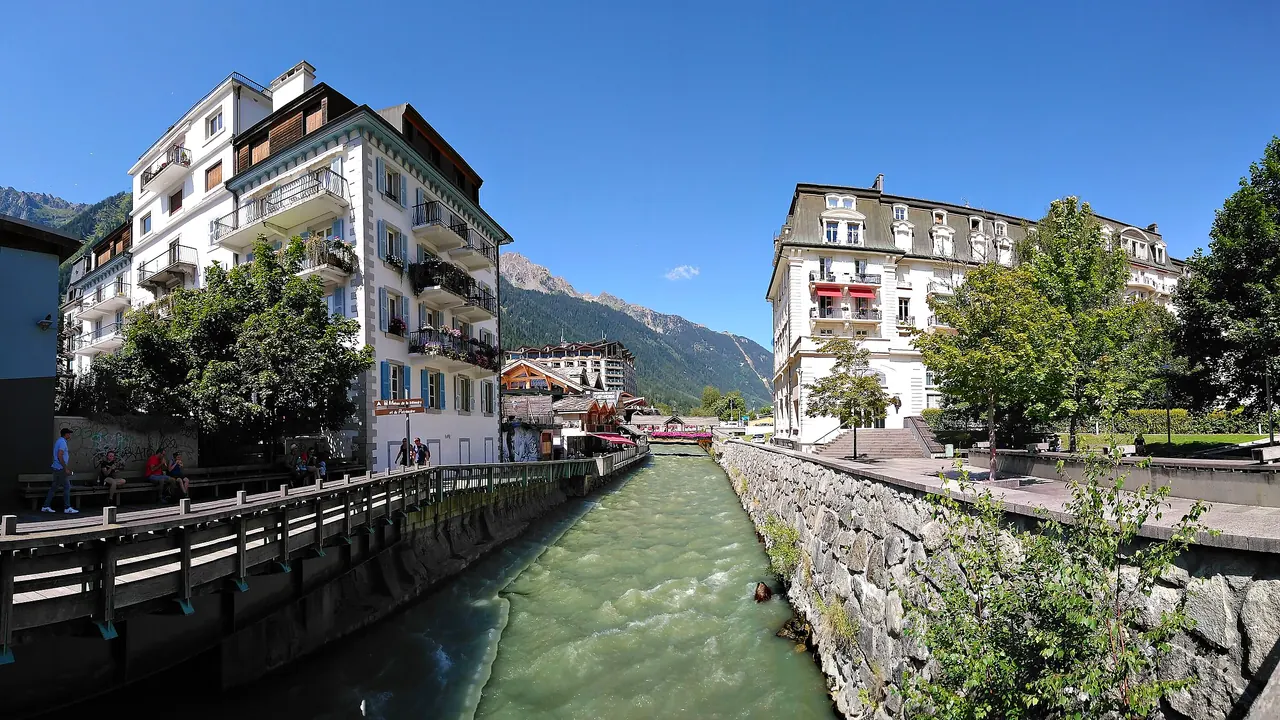
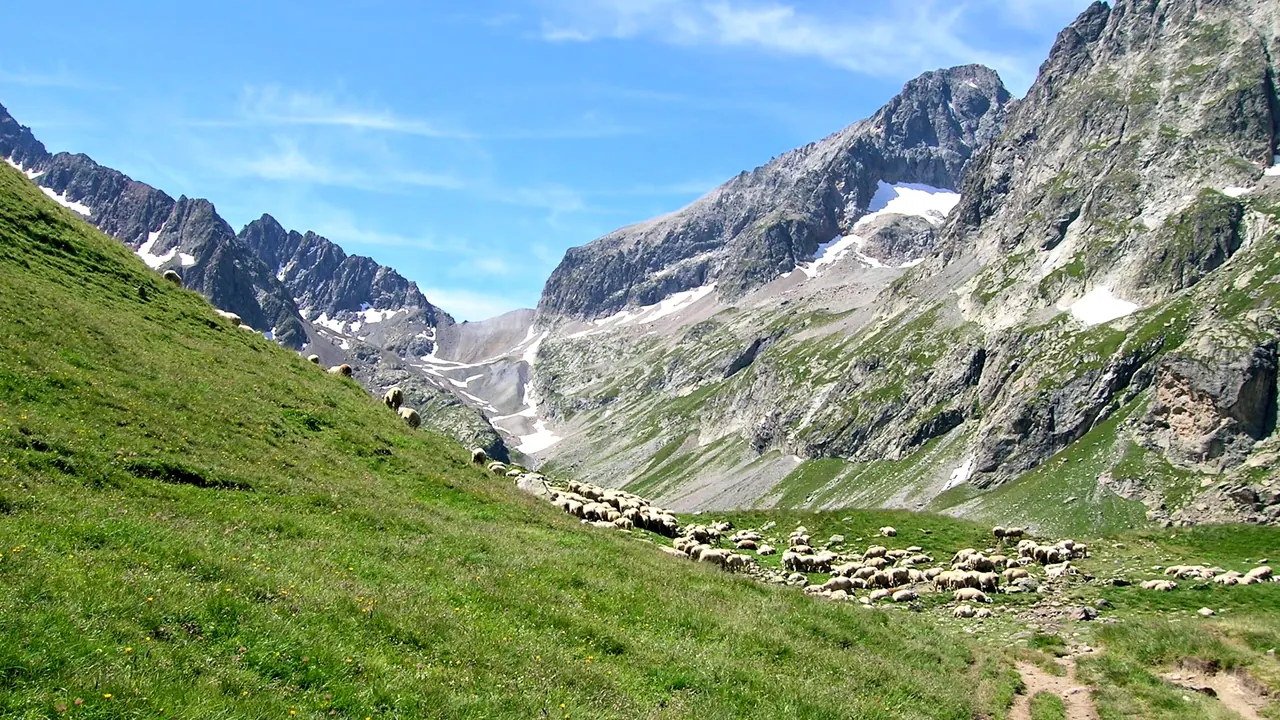
Photos: Chamonix by Tiia Monto, CC BY-SA 3.0, cropped; Les Deux Alpes by Zarelia Choutime, CC BY-SA 3.0, cropped.
Chamonix or Les Deux Alpes?
Our verdict in twelve categories, each scored against the same fixed benchmark cities, and the climate month by month, so you can choose for your trip.
Choose Chamonix for
- day trips
- getting around
- shopping
Chamonix suits travellers who want the mountains at their most serious and a real town around them. It has the high-mountain terrain of Mont Blanc reached by cable car straight from the centre, the history of alpinism in its museums and streets, and Italy, Switzerland, Annecy and Geneva within reach for a day out. Climbers, hikers on the Tour du Mont Blanc and anyone who wants a proper spa after a hard day will find more here, as long as they accept the cost.
Choose Les Deux Alpes for
- prices
- nightlife
- families
Les Deux Alpes makes more sense for a straightforward ski or bike week where the slopes start at the door. It costs less than Chamonix, its winter evenings along the main street are loud and sociable, and its glacier keeps skiing going well into summer while the lifts serve one of the larger bike parks in the Alps. Expect a purpose-built resort rather than a town, with little to see or do away from the mountain.
Scoreboard
Twelve categories on one fixed scale from 0 to 100. The shaded stretch is the gap between the two.
Your match
Pick a travel style or drag the sliders, and both match scores follow your weighting.
Wins on day trips and getting around with your weighting.
Wins on prices and nightlife with your weighting.
What matters to you?
Category by category
What the scores mean for a trip.
Beaches & swimming
Neither place is for swimmers, but Chamonix has the better summer water. Lac de Passy, lower down the Arve valley, has a grassy shore and a sandy strip facing the Mont Blanc massif and is warm enough in July and August, and the clear water of Lake Annecy is a little over an hour away.
In Les Deux Alpes the heated outdoor pool is really the only option, since the small lakes in the Oisans valley stay cold even in midsummer.
Food & drink
Both serve cheese-heavy mountain food, but Chamonix has more to it. Its Savoyard cooking uses Reblochon, Beaufort and Abondance from the surrounding alpages, refuges serve lunch on terraces facing the glaciers, and a few ambitious kitchens, some in the grand old hotels, sit alongside the bistros. The cheese shops and charcuteries also make for good picnics.
Les Deux Alpes adds Dauphiné ravioles and gratin dauphinois to the fondue and raclette, but its main street mostly offers brasseries, pizza and crêpes for skiers. There are few fine tables and almost no market or café life, and in both resorts many kitchens close between seasons.
Culture & sights
Neither is a sightseeing destination, but Chamonix has a story to tell. Alpinism began here with the first ascent of Mont Blanc in 1786, and the first Winter Olympics followed in 1924. The Musée Alpin in its Belle Époque palace, the old guides' quarter and the climbers' cemetery fill a good half-day.
Les Deux Alpes was built for skiing and has no real heritage of its own. Its sights are the ice sculptures in the glacier cave and the cobbled lanes of Venosc in the valley below, about an hour's wandering.
Nightlife
The two are about equally lively after dark, but in different ways. Les Deux Alpes is the louder winter party, with après-ski running straight down one long main street into pubs and a couple of clubs, and a young crowd of British, Dutch and Scandinavian groups.
Chamonix's evenings centre on a narrow lane in the old town, where guides, seasonal workers and visitors drink together until late. Its summer nights are better, with terrace drinking after long days on the hills, while Les Deux Alpes goes quiet outside the ski season and the peak summer weeks.
Nature & outdoors
Both are first-rate mountain bases, and Chamonix is one of the world's great ones. The Mont Blanc massif rises almost 4km above the town, the Aiguille du Midi reaches 3,842m, and the rack railway climbs to the Mer de Glace. Mountaineering, the Vallée Blanche and the Tour du Mont Blanc all start from the valley.
Les Deux Alpes looks across to La Meije and the Écrins and is more about lift-served sport: a long, high ski area, glacier skiing well into summer and a big bike park. Its best walking is in the Écrins national park, among high lakes, ibex and marmots.
Day trips
Chamonix has far more to offer for a day away. Courmayeur is through the Mont Blanc Tunnel, with the Roman walls and castles of the Aosta valley beyond. Annecy's canals and Geneva's lakefront are each a little over an hour away, and the Mont Blanc Express crosses into Switzerland to Martigny.
From Les Deux Alpes, outings mean winding roads and a car. Grenoble, the Château de Vizille and Vauban's fortified Briançon, reached over the Col du Lautaret past La Grave, make good days out, but winter driving slows them all.
Good for families
Both suit active families about equally well, but for different trips. Les Deux Alpes is built around a children's ski week, with beginner areas at the foot of the slopes, ski classes from a young age, childcare and the glacier ice cave as a treat.
Chamonix gives more variety in summer: ibex and marmots at the Merlet animal park, the little red train to the Mer de Glace and treetop courses. On a wet day, the Musée Alpin and the crystals at the Espace Tairraz give you something to do indoors, and Les Deux Alpes has no museums at all. Chamonix's highest cable cars are no place for toddlers, though.
Getting around
Chamonix is easier, both to reach and to move around. Most visitors arrive by shuttle from Geneva airport. The flat centre has the Aiguille du Midi and Montenvers stations in town, and buses and the Mont Blanc Express run the length of the valley, free with the guest card. The catch is packed ski buses in winter.
Les Deux Alpes is simple once you are there, with free shuttles along the main street and lifts leaving straight onto the slopes. Getting there is harder, as there is no railway, only a hairpin road up from Grenoble, and some lodgings sit up steep side streets.
Shopping & style
Chamonix is a real destination for mountain gear. Some of its climbing and ski shops go back generations, and climbers often save their big purchases for a visit, with rock crystals from the massif and Savoyard produce to take home as well.
Les Deux Alpes has rental and sports shops, a few boutiques and stalls of cheese and génépi, and nothing that would bring you there. For fashion, Chamonix has Geneva and Annecy nearby, while Les Deux Alpes depends on Grenoble.
Affordability
Both are expensive, but Les Deux Alpes costs less. It is cheaper than the fashionable resorts of the northern Alps, and summer brings lower room rates and a lift pass aimed at bikers and walkers.
Chamonix charges famous-resort prices, and the big cable cars, mountain guides and paragliding flights add up fast. It does have ways to save: free valley transport with the guest card, and trails that start from the valley floor without any lift.
Live music & performing arts
Neither offers much, but Chamonix has a bit more. Its long-running summer jazz festival puts some sets high in the mountains, and the rest of the year brings church concerts and mountain film evenings.
In Les Deux Alpes, live music means cover bands in the après-ski bars. For opera or an orchestra, Chamonix visitors go to Geneva and Les Deux Alpes visitors to Grenoble.
Wellness & relaxation
For a proper soak, Chamonix is better. Its large day spa, built on the Italian thermal model, has hot outdoor pools facing the glaciers, and the warm springs of Saint-Gervais-les-Bains are about 25 minutes down the valley.
Les Deux Alpes has an aquatic centre with saunas and a heated pool, plus small hotel spas, but no thermal tradition nearby. Its quietest spell is late summer, with clean air and quiet evenings facing the glacier, while Chamonix is calmest in the shoulder seasons up in the hamlets.
When should you go?
Pick your month. The climate figures are measured averages, not a forecast.
Chamonix in July
Les Deux Alpes in July
Daytime high, °C
Rainfall in the month, mm
Where the figures come from
Chamonix's temperatures are measured 35 km from the centre, at Bourg-St-Maurice.
Chamonix has no rain gauge within 25 km of the centre, so its rainfall comes from a gridded climate dataset read at the destination rather than from a gauge further away.
Les Deux Alpes has no weather station within reach, so its figures come from a gridded climate model rather than a measured record, and read a broad area rather than one spot.
Temperature and rainfall are climate normals, averaged over the years shown. Chamonix: 1999-2020 (rainfall 1991-2020) normals, Bourg-St-Maurice (34.9 km from centre). Les Deux Alpes: 2001-2020 normals, NASA POWER reanalysis grid, no weather station within 90 km.
The two climates are further apart than their Alpine settings suggest. Chamonix's valley floor gets properly warm in summer, with highs around 27°C in July. That is warm enough for a swim at Lac de Passy and for comfortable walks around town, and May, September and October are mild for hiking from the valley. Les Deux Alpes sits much higher and stays cool even in midsummer, with July and August highs of about 18°C, so bring layers on every walk. In winter it stays below freezing from December to February, dropping to around -3°C in January, while Chamonix's valley stays a few degrees above freezing at about 5°C.
Chamonix is also the wetter of the two all year. It is wettest in late autumn and winter, reaching about 169mm in December, and May is wet as well. Les Deux Alpes gets roughly half as much rain. Its wettest months are May and November, and February is its driest, with summer close behind. For a summer trip, Chamonix gives you warmth and Les Deux Alpes gives you cooler, fairly dry days.
Which traveller are you?
For an outdoors trip, Chamonix is the stronger pick. Cable cars lift you onto glaciers below Mont Blanc, the Tour du Mont Blanc and Lac Blanc trails start from town, and the world's oldest guiding company takes climbers up the peaks.
For a trip on a tight budget, Les Deux Alpes goes further. Pick a ski week in January or late March, away from the French school vacations, rent a self-catering apartment and cook most evenings instead of eating out.
For skiers who want snow in summer, Les Deux Alpes has something Chamonix cannot match: a glacier at around 3,600m that keeps lift-served skiing going well into the warm months. On the same trip you can ride the big bike park lower down.
Before you go
| Measure | Chamonix | Les Deux Alpes |
|---|---|---|
| Official language | French | French |
| Currency | Euro (EUR) | Euro (EUR) |
| Sockets | CE230 V, 50 Hz | CE230 V, 50 Hz |
| Driving side | Right | Right |
| Time zone | UTC+1, UTC+2 in summer | UTC+1, UTC+2 in summer |
| Emergency number | 112 | 112 |
| Elevation | 995 m | 1,650 m |
| Main airport | Geneva International Airport (GVA)68 km from centre150 non-stop destinations | Grenoble Alpes Isère Airport (GNB)74 km from centre16 non-stop destinations |
| Public holidays this year | 11 days | 11 days |
By the numbers
| Measure | Chamonix | Les Deux Alpes |
|---|---|---|
| Population | 8,705 | - |
| People per km² | 75 | - |
| Museums within 10 km | 3 | 0 |
| UNESCO World Heritage sites within 50 km | 0 | 1 |
Where else could you go?
Every comparison below shares a destination with this one, so you can follow Chamonix or Les Deux Alpes somewhere new.
- Alpe d'Huezvs Les Deux Alpes
- Saint-Gervais-les-Bainsvs Chamonix
- Flainevs Chamonix
- Megèvevs Chamonix
- Samoënsvs Chamonix
- Les Getsvs Chamonix