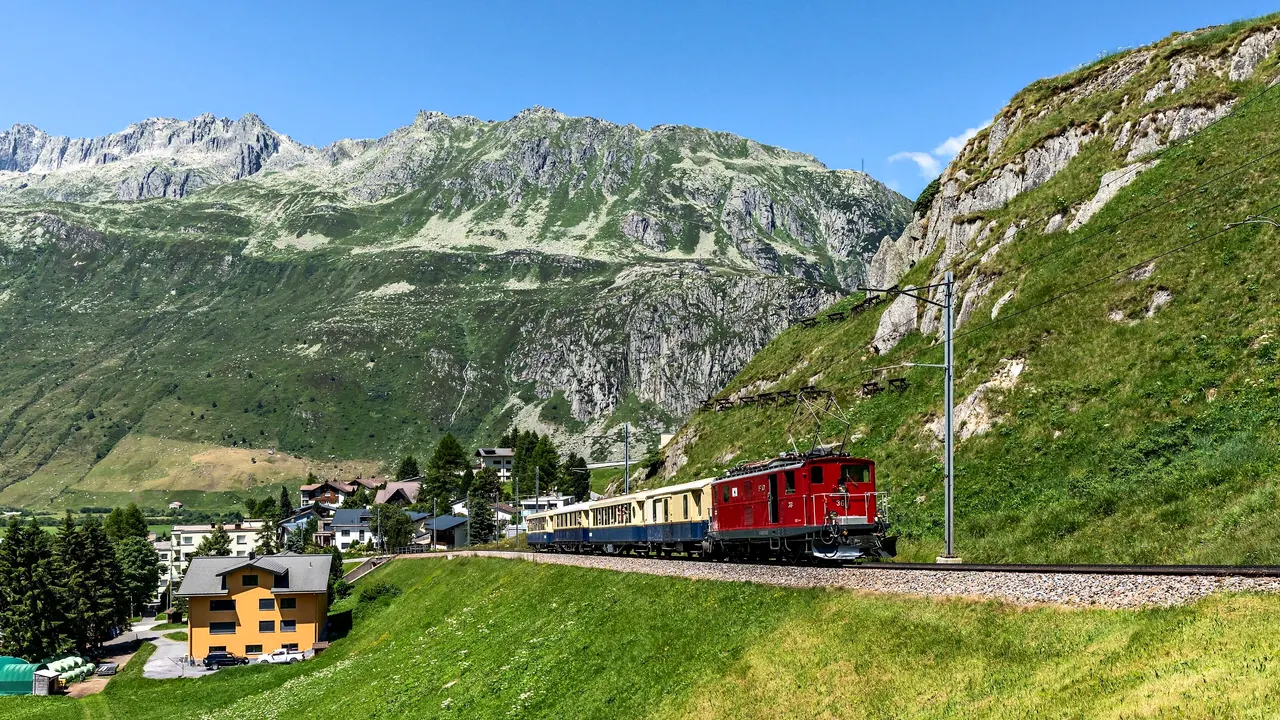
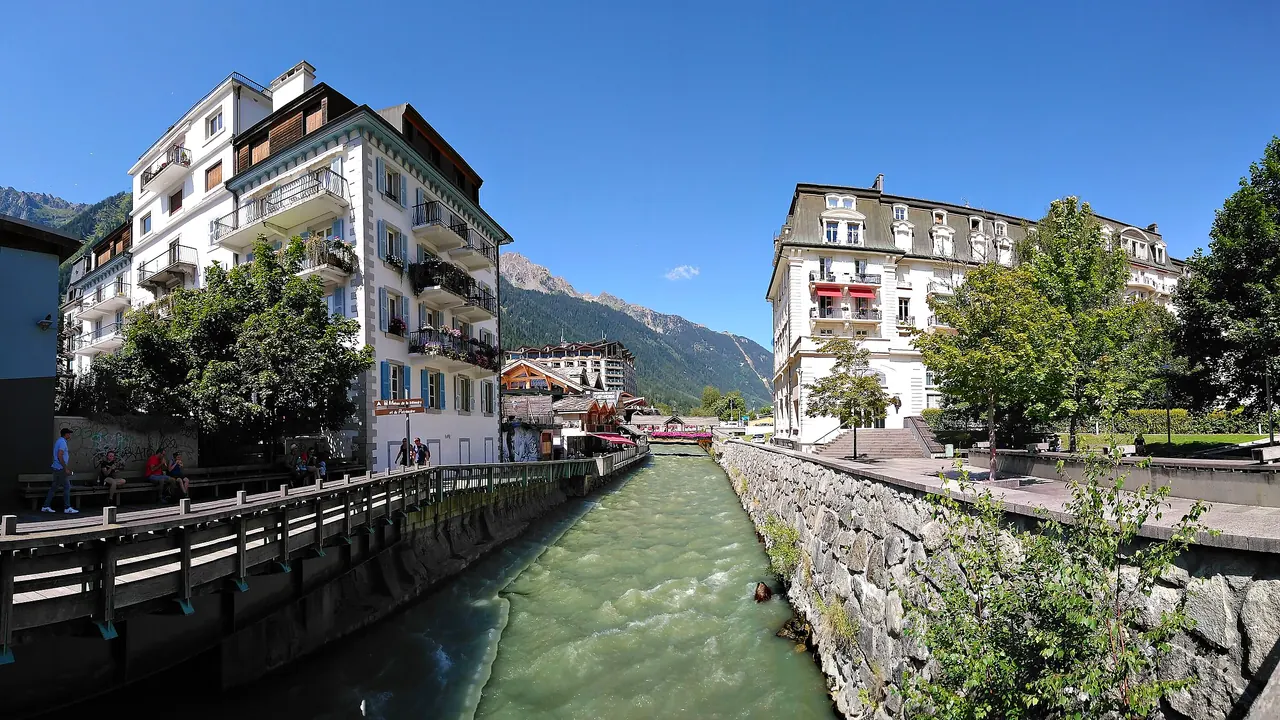
Photos: Andermatt by Kabelleger, CC BY-SA 4.0, cropped; Chamonix by Tiia Monto, CC BY-SA 3.0, cropped.
Andermatt or Chamonix?
Our verdict in twelve categories, each scored against the same fixed benchmark cities, and the climate month by month, so you can choose for your trip.
Choose Andermatt for
- live music and the arts
- day trips
- getting around
Andermatt suits travellers who want big mountains and a quiet village to come back to. The Gemsstock gives freeriders steep terrain straight from town. In summer the Furka, Gotthard, Oberalp and Susten passes are there for road cycling and hiking, and the railway and postbuses make a car unnecessary. Evenings are spent over dinner, in a lavish hotel spa or at a concert in the village hall, and the price of all that calm is one of the most expensive stays in the Alps.
Choose Chamonix for
- nightlife
- shopping
- families
Pick Chamonix if the mountains themselves are the point and you want company in them. Mont Blanc, the Aiguille du Midi and the oldest guiding company in the world make it the place for mountaineering, glacier skiing and long summer days on the trails. Back in town there is more to eat, more to do with children, livelier nights and a proper thermal-style spa. It is still costly, but the free valley transport and easy self-catering stretch a budget further.
Scoreboard
Twelve categories on one fixed scale from 0 to 100. The shaded stretch is the gap between the two.
Your match
Pick a travel style or drag the sliders, and both match scores follow your weighting.
Wins on live music and the arts and day trips with your weighting.
Wins on nightlife and shopping with your weighting.
What matters to you?
Category by category
What the scores mean for a trip.
Beaches & swimming
Neither place is for swimmers, but Chamonix at least gives you a summer swim. Around Andermatt, lakes such as the Oberalpsee stay too cold for most people even in August, so the hotel pool is your only real option.
Chamonix has Lac de Passy down the Arve valley, with a grassy shore and a strip of sand that gets warm enough in July and August. It also has an outdoor basin at the town pool, and Lake Annecy is a little over an hour away for a proper lake day.
Food & drink
Both serve hearty mountain cooking, but Chamonix gives you more choice for longer. Andermatt's wood-panelled inns do Älplermagronen, rösti and autumn game, and a few hotel dining rooms aim higher, but most visitors have tried everything within a few evenings.
Chamonix adds a whole Savoyard cheese repertoire, from tartiflette to raclette, made with Reblochon and Beaufort from nearby alpages. Its cheese shops and charcuteries are good for picnics, and the international crowd supports a wider run of bistros. Menus still repeat, and many places close between seasons.
Culture & sights
Both have about half a day to a day or two of sights, and in each the history is about mountains. Andermatt's is the history of crossing them: the Devil's Bridge in the Schöllenen gorge, the memorial to the Russian army's crossing of 1799, and the Gotthard hospice and fortress museums in summer. Chamonix tells the story of climbing them, through the Musée Alpin, the first ascent of Mont Blanc, the 1924 Winter Olympics and the climbers' cemetery.
Nightlife
Chamonix is the place for a night out. After après-ski, guides, seasonal workers and visitors fill a lane of pubs in the old town, and two or three small clubs run into the early hours, mostly with a young English-speaking crowd.
Andermatt has its own après-ski and a few bars in the village and hotel lobbies on good winter weekends, but no clubs. Outside the ski season, the evening ends by the fire.
Nature & outdoors
Both are first-rate Alpine bases, and Chamonix has the edge in sheer scale. Mont Blanc rises almost 4km above its valley floor, and the Aiguille du Midi lifts you to 3,842m among hanging glaciers. It also has the Vallée Blanche descent and the Tour du Mont Blanc, and summer adds climbing, paragliding and guided mountaineering.
Andermatt is quieter and more about roads and ridges. The Gemsstock has some of the most respected freeride terrain in the Alps, the four passes make classic cycling and motorcycling routes, and summer hikes lead to the source of the Rhine at Lake Toma.
Day trips
These two are about level, but the trips themselves differ. From Andermatt the outings are Swiss and easy by train: Lake Lucerne and Altdorf, Lucerne itself, the castles of Bellinzona to the south and the Glacier Express to the abbey at Disentis.
Chamonix works across borders. You can reach Courmayeur and the Roman town of Aosta through the Mont Blanc Tunnel, Annecy and Geneva by road, and Martigny on the Mont Blanc Express. A car helps for most of these.
Good for families
Chamonix has more for children to do. Beyond ski schools and sledging, it has the Merlet animal park with ibex and marmots, a summer luge, treetop adventure courses and the red train to the Mer de Glace, all from a small, walkable town.
Andermatt is safe and simple, with nursery slopes close to the hotels and gentle walks by its lakes. Beyond that, nothing there is aimed at families, and rainy days and teenage evenings are hard to fill. Even in Chamonix, the highest cable cars are no place for toddlers.
Getting around
Both are easy without a car, in different ways. Andermatt is tiny, with the station and Gemsstock cable car a short walk from the hotels. Trains run down the gorge and over the Oberalp, and postbuses climb the passes in summer.
Chamonix spreads along a valley. The guest card gives free buses and trains from Les Houches to Vallorcine, but the separate ski areas mean crowded ski buses on winter mornings.
Shopping & style
Chamonix is the better place to buy mountain gear. Its pedestrian centre is lined with climbing and ski shops, some generations old, and serious climbers save their big purchases for a visit. It also sells Savoyard cheeses, génépi and rock crystals from the massif.
Andermatt has hire shops, a few boutiques and local cheese and honey. For fashion, both send you elsewhere, Chamonix to Geneva or Annecy.
Affordability
Both are expensive, and Andermatt is the harder of the two on a budget. Its resort quarter is built around luxury hotels and apartments, and even simple lunches cost a lot. Older guesthouses and Swiss rail passes help only a little.
Chamonix gives you more ways to save. Valley transport is free with the guest card, apartments and supermarkets make self-catering easy, and many trails start from town without a lift. Late spring and autumn are noticeably cheaper.
Live music & performing arts
Andermatt is the better choice for live music, thanks to one building. Its modern concert hall hosts classical and chamber concerts and visiting Swiss orchestras through the main seasons, so you can plan an evening around it.
Chamonix has no concert season. Its music is mostly in summer, with a jazz festival that puts some sets high in the mountains, and otherwise just the odd church concert or mountain film night.
Wellness & relaxation
Chamonix offers more ways to relax. It has a large day spa built on the Italian thermal model, with hot outdoor pools facing the glaciers, and Saint-Gervais has warm springs about 25 minutes down the valley. The town itself is busy, though.
Andermatt's wellness is inside its hotels, some with very lavish spas open to non-residents, and it has no springs. What it does have is calm: little traffic and early nights.
When should you go?
Pick your month. The climate figures are measured averages, not a forecast.
Andermatt in July
Chamonix in July
Daytime high, °C
Rainfall in the month, mm
Where the figures come from
Andermatt has no weather station within reach, so its figures come from a gridded climate model rather than a measured record, and read a broad area rather than one spot.
Chamonix's temperatures are measured 35 km from the centre, at Bourg-St-Maurice.
Chamonix has no rain gauge within 25 km of the centre, so its rainfall comes from a gridded climate dataset read at the destination rather than from a gauge further away.
Temperature and rainfall are climate normals, averaged over the years shown. Andermatt: 1991-2020 normals, TerraClimate 4 km grid at the town, no weather station within 90 km. Chamonix: 1999-2020 (rainfall 1991-2020) normals, Bourg-St-Maurice (34.9 km from centre).
Andermatt has a short, cool summer. Even in July and August daytime highs reach only about 16°C, so June to September is for hiking and cycling once the passes open, and it is never beach weather. Summer is also the wettest part of its year, with rain peaking at around 166mm in June, so pack for showers. From December to April highs hover near 0°C, which is what keeps the snow deep and reliable. Late spring and late autumn fall between the two seasons.
Chamonix sits lower and is far warmer in summer, with July highs around 27°C. That is warm enough for swimming at Lac de Passy and pleasant for walking the valley floor, while the high peaks stay cold. Its rain is spread fairly evenly through the year but is heaviest in late autumn and winter, up to about 169mm in December, which falls as snow on the slopes. July to September is its driest and most settled stretch, and spring and autumn are mild for valley walks while Andermatt is still cold.
Which traveller are you?
For a food and nightlife trip, Andermatt's few inns and early nights are used up within days. Chamonix keeps going for longer, with Savoyard cheese cooking, a wider choice of bistros and a lane of old-town pubs and small clubs open late.
On a family trip with children, Andermatt suits a gentle week with little ones: everything is a short walk from the hotel and the nights are early. Chamonix suits active families with older children, who get more variety across a week and evenings that teenagers won't find dull.
On a culture and arts trip, neither place fills a week, but Andermatt has the edge. Its concert hall adds classical evenings to the Devil's Bridge and the Gotthard museums. Chamonix offers mountaineering history and very little live music.
Before you go
| Measure | Andermatt | Chamonix |
|---|---|---|
| Official language | French, German, Italian, Romansh | French |
| Currency | Swiss Franc (CHF) | Euro (EUR) |
| Sockets | CJ230 V, 50 Hz | CE230 V, 50 Hz |
| Driving side | Right | Right |
| Time zone | UTC+1, UTC+2 in summer | UTC+1, UTC+2 in summer |
| Emergency number | 112 | 112 |
| Elevation | 1,447 m | 995 m |
| Main airport | Zürich Airport (ZRH)91 km from centre226 non-stop destinations | Geneva International Airport (GVA)68 km from centre150 non-stop destinations |
| Public holidays this year | 14 days | 11 days |
By the numbers
| Measure | Andermatt | Chamonix |
|---|---|---|
| Population | 1,578 | 8,705 |
| People per km² | 25 | 75 |
| Museums within 10 km | 2 | 3 |
| UNESCO World Heritage sites within 50 km | 2 | 0 |
Where else could you go?
Every comparison below shares a destination with this one, so you can follow Andermatt or Chamonix somewhere new.
- Saint-Gervais-les-Bainsvs Chamonix
- Flainevs Chamonix
- Megèvevs Chamonix
- Samoënsvs Chamonix
- Engelbergvs Andermatt
- Les Getsvs Chamonix