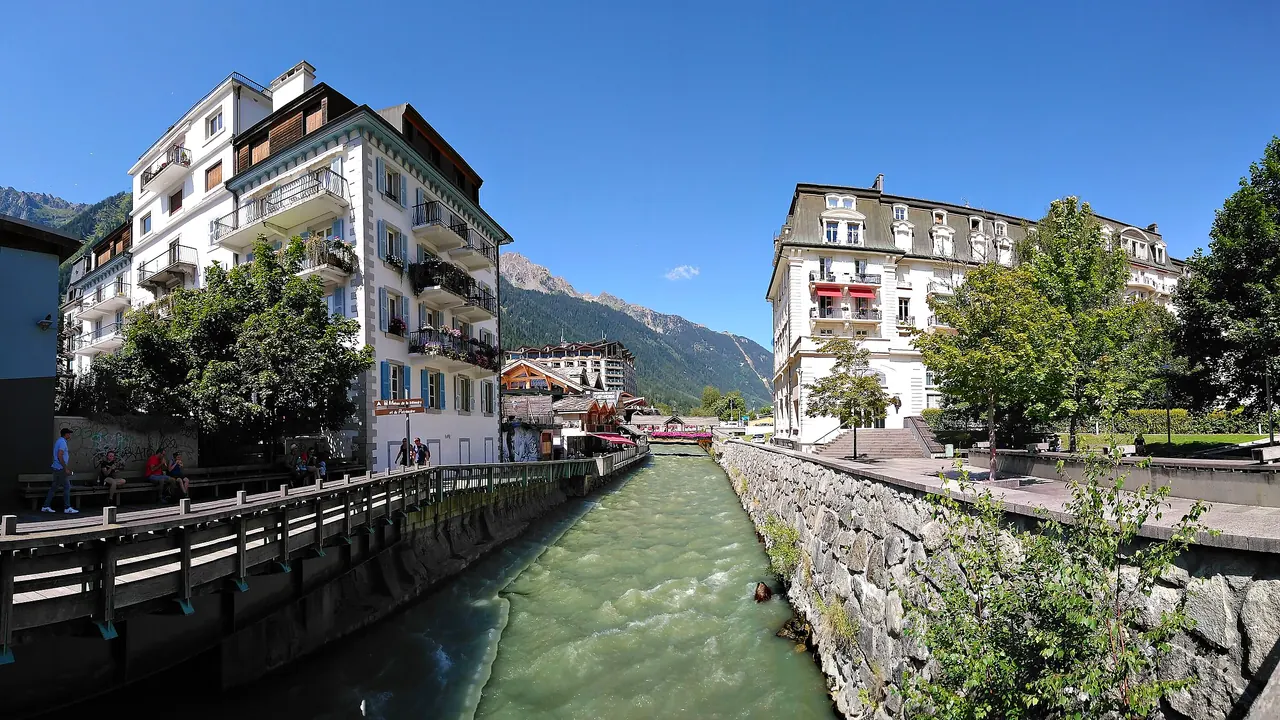
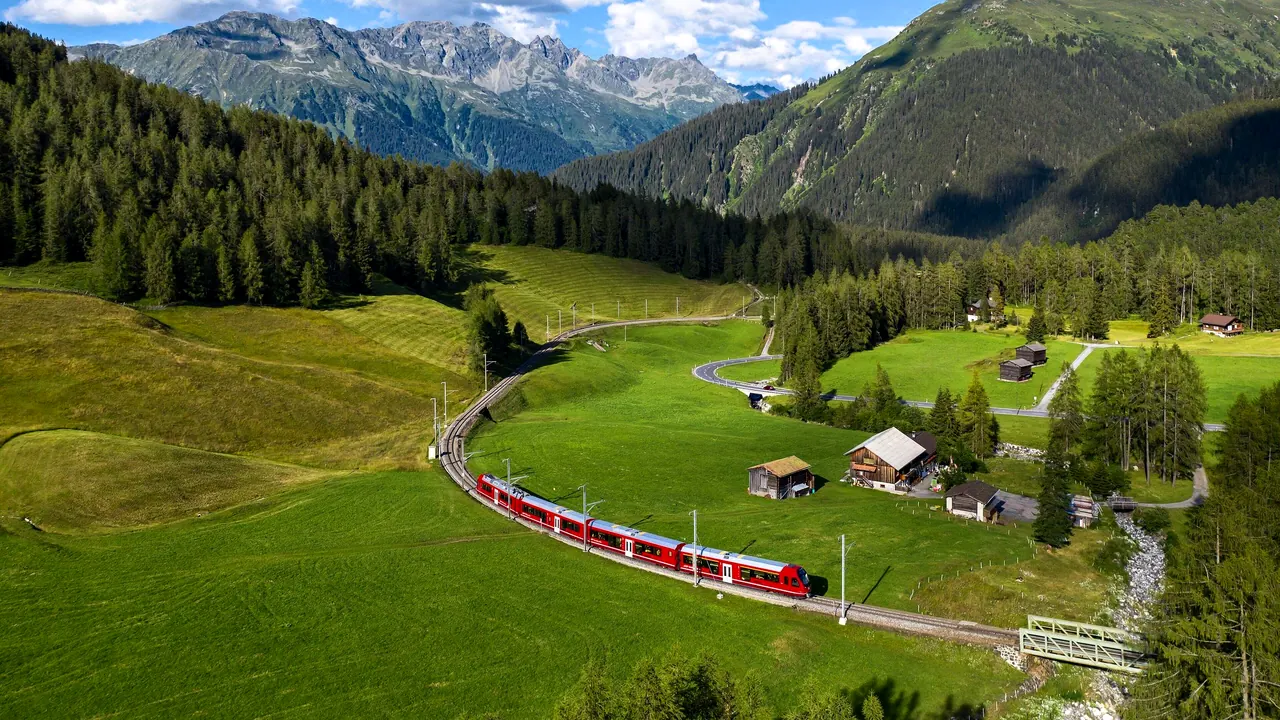
Photos: Chamonix by Tiia Monto, CC BY-SA 3.0, cropped; Davos by Kabelleger / David Gubler, CC BY-SA 4.0, cropped.
Chamonix or Davos?
Our verdict in twelve categories, each scored against the same fixed benchmark cities, and the climate month by month, so you can choose for your trip.
Choose Chamonix for
- nightlife
- prices
- shopping
Chamonix suits travellers who want the mountains at their most dramatic and a bit of life after dark. The cable cars lift you from town straight onto glaciers and granite, the guiding tradition makes serious climbing possible, and the evenings in the old-town lanes are noisier than anything Davos offers. It is also the slightly less punishing of the two on cost, and Annecy, Geneva and the Aosta valley are all within a day's reach.
Choose Davos for
- getting around
- culture and sights
- live music and the arts
Pick Davos for a calmer, more orderly mountain stay. The town runs smoothly without a car, the Rhaetian Railway turns every day trip into a scenic ride, and the cross-country trails, side valleys and sun terraces reward people who like long unhurried days outdoors. Its sanatorium past and the Kirchner collection give it a quieter, more reflective character than Chamonix.
Scoreboard
Twelve categories on one fixed scale from 0 to 100. The shaded stretch is the gap between the two.
Your match
Pick a travel style or drag the sliders, and both match scores follow your weighting.
Wins on nightlife and prices with your weighting.
Wins on getting around and culture and sights with your weighting.
What matters to you?
Category by category
What the scores mean for a trip.
Beaches & swimming
Neither town is a place to swim, and the difference is in the water. Chamonix's options are lakes that genuinely warm up in high summer: Lac de Passy below the town, with a sandy strip and Mont Blanc behind it, and Lake Annecy a little over an hour away, one of the warmest lakes in the Alps.
Davos has the Davosersee lido right at the edge of town, with lawns and a jetty, but the water stays chilly even in July. Most swimming there happens in the indoor leisure pool or a hotel pool.
Food & drink
Chamonix eats a little better. Fondue, raclette and tartiflette made with Reblochon and Beaufort sit alongside an international spread of bistros and a few ambitious kitchens, and the cheese shops and bakeries make picnic shopping a pleasure.
Davos offers Graubünden specialities such as capuns, pizokel, Bündnerfleisch and Nusstorte, best eaten in mountain huts, but town dining leans heavily on hotel restaurants and the menus thin out quickly. In both places many kitchens close between seasons.
Culture & sights
Chamonix's sights fill half a day, while Davos has enough for one or two, and the stories they tell are quite different. Chamonix tells the history of alpinism, from the first ascent of Mont Blanc to the first Winter Olympics, through the Musée Alpin, the pioneers' statues and the climbers' cemetery.
Davos has a more literary and artistic past: the tuberculosis sanatoria behind Thomas Mann's The Magic Mountain, the Schatzalp with its sun balconies, and the Kirchner Museum devoted to the Expressionist painter who worked in the valley.
Nightlife
Chamonix has the livelier evenings by some distance. Après-ski at the foot of the slopes moves on to a narrow old-town lane of pubs and bars where guides, seasonal workers and visitors mix late, and a couple of small clubs carry on into the small hours.
Davos has its après-ski too, below the Jakobshorn and Parsenn and along the Promenade, but it mostly happens in hotel bars and only runs past midnight at weekends and in peak weeks. In summer both towns settle into terrace drinks.
Nature & outdoors
Chamonix has the greater scale. The Mont Blanc massif rises almost 4km above town, and the Aiguille du Midi and the Mer de Glace railway put glaciers and high-mountain terrain within minutes, with mountaineering, via ferrata and paragliding as everyday activities.
Davos is gentler and more spread out: five ski areas, over 100km of cross-country trails into the Sertig and Dischma valleys, and dense summer hiking and biking networks. The Swiss National Park is within reach for a day.
Day trips
Chamonix has more variety on its doorstep because three countries meet here. Courmayeur and the Roman town of Aosta lie just through the Mont Blanc Tunnel, Annecy and Geneva are a little over an hour away, and the Mont Blanc Express crosses into Switzerland to Martigny.
Davos trips are mostly train rides, and very good ones: the Albula line over the Landwasser Viaduct to St Moritz, medieval Chur, and the painted houses of Guarda in the Lower Engadine. Beyond those, the bigger Swiss cities are too far for a comfortable return.
Good for families
Both work for families who like being outside, with ski schools, nursery slopes and easy summer walks. Chamonix adds a summer luge, treetop courses, the little red train to the Mer de Glace and the Merlet animal park, though its highest cable cars are unsuitable for small children.
Davos has long toboggan runs, the big natural ice rink and playgrounds at the top stations, and its indoor pool with slides is a stronger fallback on wet days than anything Chamonix offers.
Getting around
Davos is the easier place to get about. Rhaetian Railway stations at both Dorf and Platz, free buses along the main road and lifts leaving straight from town make a car unnecessary, and Zurich is a straightforward train journey away.
Chamonix's compact centre is a pleasure on foot, and buses and the Mont Blanc Express cover the valley for free with a guest card. The ski areas are scattered, though, so winter days involve crowded ski buses, and arrival usually means a shuttle from Geneva airport.
Shopping & style
Chamonix is the better place to shop, as long as you want mountain gear. Its pedestrian streets hold long-established climbing and ski shops with specialist knowledge that serious climbers save their purchases for, plus rock crystals from the massif and Savoyard cheeses and génépi.
Davos covers the basics along the Promenade, with outdoor shops, some Swiss watch and jewellery stores and delicatessens selling Bündnerfleisch and Nusstorte, but there is little to plan a trip around.
Affordability
Both are expensive, and Davos noticeably more so. Swiss prices apply to hotels, restaurants and lift passes alike, mountain huts charge for their setting, and in January the World Economic Forum makes rooms scarce.
Chamonix is costly in its peak weeks too, but apartments, supermarkets, free valley transport and trails that begin on the valley floor give budget-minded visitors more room to manage. In both, the shoulder seasons are cheaper but some lifts and businesses close.
Live music & performing arts
Neither town has a theatre or concert season, and the serious stuff is in Geneva or Zurich. What differs is the summer festival: Chamonix's is jazz, with some sets played high in the mountains, while Davos brings young classical musicians to play in its churches, hotels and unusual corners of the valley.
Wellness & relaxation
In Chamonix you unwind after hard effort, while Davos is built for slowing down. Chamonix has a large thermal-style day spa with hot outdoor pools facing the glaciers, and the historic baths of Saint-Gervais down the valley, but the town itself runs on early starts and climbers' energy.
Davos grew as a place to recover, and its dry air, hotel spas and sun terraces make for a slower pace, especially in summer. For real thermal bathing it relies on Scuol, about an hour away.
When should you go?
Pick your month. The climate figures are measured averages, not a forecast.
Chamonix in July
Davos in July
Daytime high, °C
Rainfall in the month, mm
Where the figures come from
Chamonix's temperatures are measured 35 km from the centre, at Bourg-St-Maurice.
Chamonix has no rain gauge within 25 km of the centre, so its rainfall comes from a gridded climate dataset read at the destination rather than from a gauge further away.
Davos's temperatures are measured 53 km from the centre, at S. Valentino Alla Muta.
Davos has no rain gauge within 25 km of the centre, so its rainfall comes from a gridded climate dataset read at the destination rather than from a gauge further away.
Temperature and rainfall are climate normals, averaged over the years shown. Chamonix: 1999-2020 (rainfall 1991-2020) normals, Bourg-St-Maurice (34.9 km from centre). Davos: 1991-2020 normals, S. Valentino Alla Muta (53.4 km from centre).
Chamonix's valley floor is the warmer of the two in summer, reaching around 27°C in July, warm enough to swim in Lac de Passy in July and August and comfortable for walking around town. Davos sits higher and stays cooler, peaking near 20°C, which is pleasant for hiking but never really swimming weather. Both are cold through winter, Davos noticeably so, with daytime highs barely above freezing from December to February.
The rain falls differently. Chamonix is damp all year, with its wettest spells in late autumn and winter, often arriving as snow, and no month that is reliably dry. Davos is much drier in winter, around 57mm in February, so its ski season brings more settled days, but its rain gathers in summer, peaking at about 142mm in August, when afternoon showers are common on the trails. September is a good month in both: still mild, and in Davos less wet than high summer.
Which traveller are you?
For a food and nightlife trip, Chamonix is the better bet. Its Savoyard cheese dishes, bistros and mountain restaurants offer more range, and après-ski spills into a lane of late-opening bars and small clubs, where Davos winds down much earlier.
On a trip on a tight budget, Chamonix stretches your money further, though neither is cheap. French prices sit below Swiss ones, and a lunch of Beaufort and fresh bread on the Grand Balcon trail costs little. In Davos, careful planning saves less, because nearly everything carries Swiss resort prices.
On a relaxing and wellness trip, Davos suits slow days better. The Schatzalp still recalls its sanatorium years, and gentle cross-country loops and winter paths into the Dischma valley make easy exercise. Chamonix's restful moments mostly come after hard days on the mountain.
Before you go
| Measure | Chamonix | Davos |
|---|---|---|
| Official language | French | French, German, Italian, Romansh |
| Currency | Euro (EUR) | Swiss Franc (CHF) |
| Sockets | CE230 V, 50 Hz | CJ230 V, 50 Hz |
| Driving side | Right | Right |
| Time zone | UTC+1, UTC+2 in summer | UTC+1, UTC+2 in summer |
| Emergency number | 112 | 112 |
| Elevation | 995 m | 1,559 m |
| Main airport | Geneva International Airport (GVA)68 km from centre150 non-stop destinations | Zürich Airport (ZRH)122 km from centre226 non-stop destinations |
| Public holidays this year | 11 days | 9 days |
By the numbers
| Measure | Chamonix | Davos |
|---|---|---|
| Population | 8,705 | 10,738 |
| People per km² | 75 | 38 |
| Museums within 10 km | 3 | 3 |
| UNESCO World Heritage sites within 50 km | 0 | 2 |
Where else could you go?
Every comparison below shares a destination with this one, so you can follow Chamonix or Davos somewhere new.
- Klostersvs Davos
- Arosavs Davos
- Saint-Gervais-les-Bainsvs Chamonix
- Flainevs Chamonix
- Megèvevs Chamonix
- Samoënsvs Chamonix