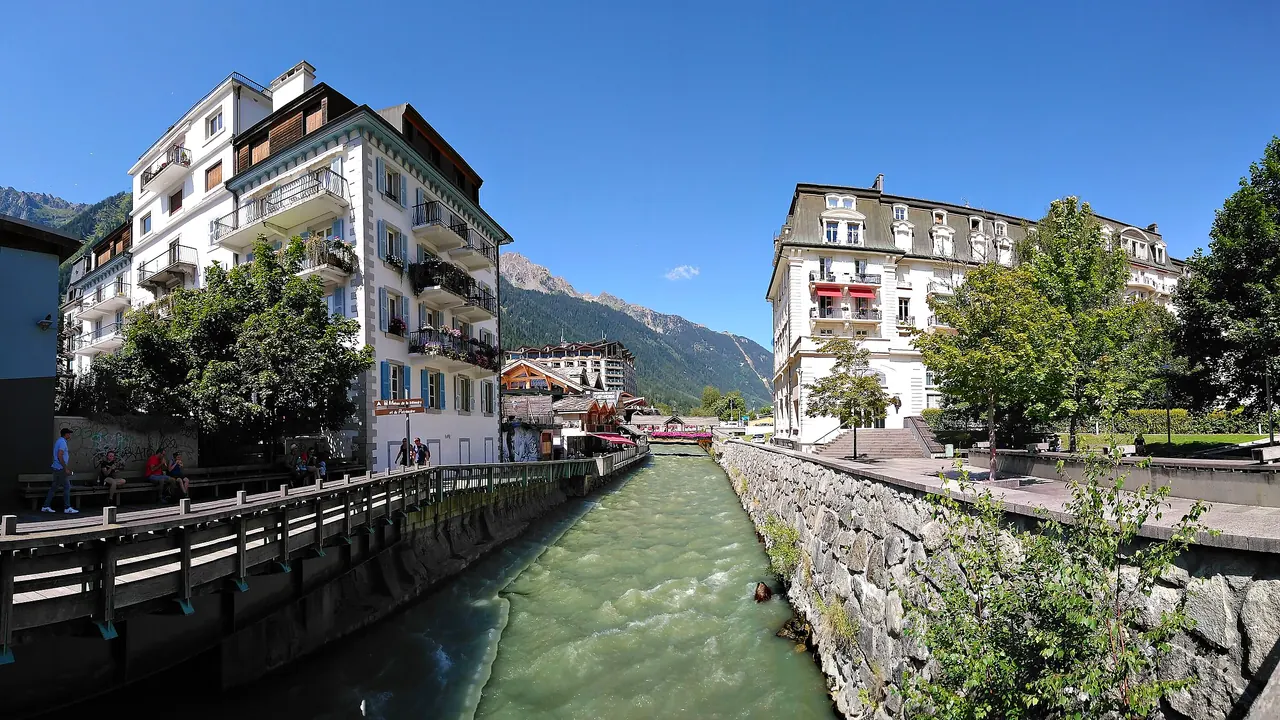
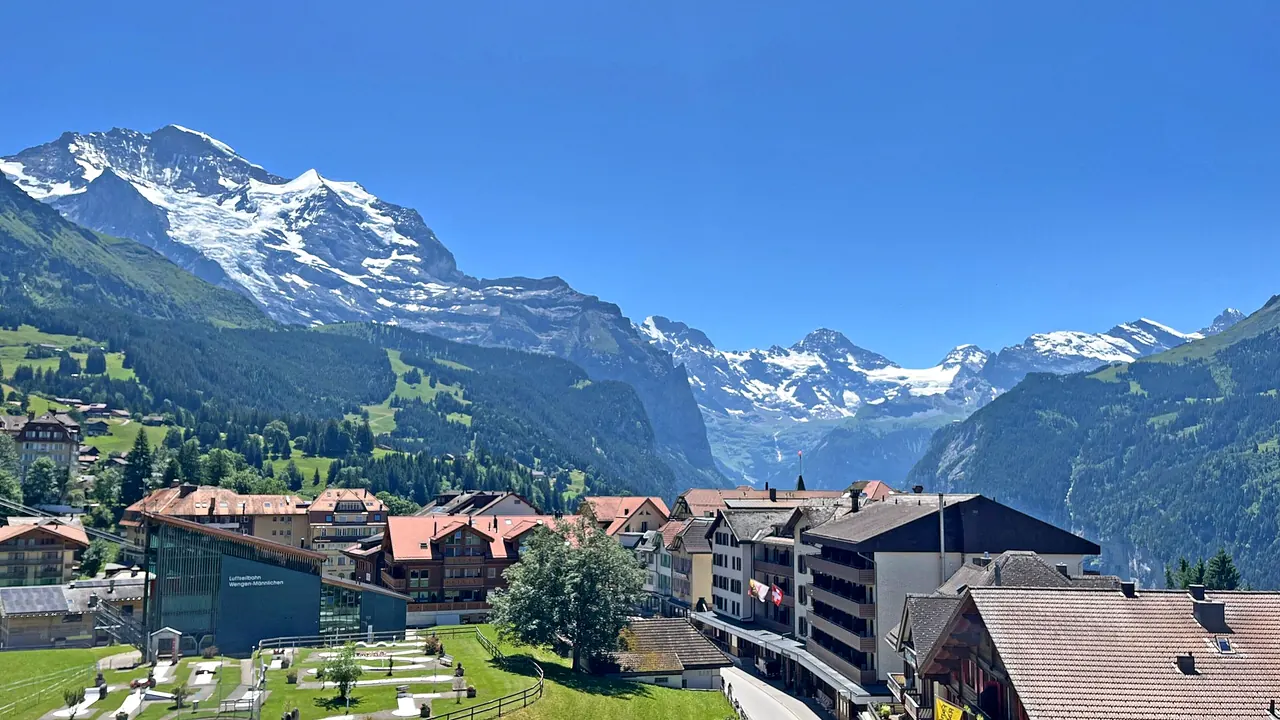
Photos: Chamonix by Tiia Monto, CC BY-SA 3.0, cropped; Wengen by Charles J. Sharp, CC BY-SA 4.0, cropped.
Chamonix or Wengen?
Our verdict in twelve categories, each scored against the same fixed benchmark cities, and the climate month by month, so you can choose for your trip.
Choose Chamonix for
- nightlife
- shopping
- food and drink
Chamonix suits the active, sociable traveller who wants serious mountains and a real town at the bottom of them. It is the place for glacier terrain, climbing, steep skiing and the Tour du Mont Blanc. Evenings bring fondue, a crowded après-ski lane and a proper spa. Italy, Switzerland and Lake Annecy are all within reach. It costs a lot, but it gives you more to do once you are off the hill.
Choose Wengen for
- getting around
Wengen is for those who want the mountains with almost nothing else around them. There are no cars, cowbells take the place of traffic, and from your balcony you look across to the Jungfrau. Trains carry you up to ridge walks and ski runs. Choose it for walking, skiing and quiet evenings, and accept thin food and going-out options and some of the highest prices in Europe.
Scoreboard
Twelve categories on one fixed scale from 0 to 100. The shaded stretch is the gap between the two.
Your match
Pick a travel style or drag the sliders, and both match scores follow your weighting.
Wins on nightlife and shopping with your weighting.
Wins on getting around with your weighting.
What matters to you?
Category by category
What the scores mean for a trip.
Beaches & swimming
Neither is a swimming destination, and both send you down to a lake on a hot day. The difference is how far you go. In Chamonix, Lac de Passy is in the same valley, with a sandy strip and Mont Blanc ahead. There is also an outdoor town pool in summer, and Lake Annecy is a longer drive.
From Wengen, you first take the rack railway down and travel on to the lidos of Lake Thun, which reaches about 20°C in a warm July. Lake Brienz is colder. A swim from Wengen takes about half a day.
Food & drink
Chamonix is the clear choice for eating. Its Savoyard cooking is built on Reblochon, Beaufort and Abondance from the surrounding alpages. Cheese shops and charcuteries make good picnics, and the international crowd supports bistros and a few serious kitchens in the grand hotels. Menus still repeat, and many places close between seasons.
Wengen's food mostly means hotel dining rooms and mountain huts serving rösti, fondue and veal in cream. Many guests book half-board. A terrace lunch facing the Jungfrau is the highlight, but the view does most of the work, and Interlaken is where you go for variety.
Culture & sights
Chamonix at least has a story it tells well. Alpinism began here with the first ascent of Mont Blanc in 1786, and the town hosted the first Winter Olympics. The Musée Alpin, the guides' quarter and the climbers' cemetery fill a curious half-day.
Wengen has no museum or monument to visit. You can stroll past its chalets, Belle Époque hotels from its English-resort years and a small church, but for any real sightseeing you go down the valley.
Nightlife
Chamonix has an actual night out, if a small one. After-ski starts at the foot of the slopes, moves to a narrow old-town lane of pubs where guides, seasonal workers and visitors mix, and ends in two or three small clubs on busy nights.
Wengen has a few bars that fill at the end of the ski day and a hotel bar that stays up later. Only the Lauberhorn race weekend in January turns into a real party. In summer the village is asleep early.
Nature & outdoors
Both are among the great Alpine settings, but they show the mountains differently. Chamonix is about height and seriousness. Cable cars lift you to 3,842m on the Aiguille du Midi among glaciers and granite needles. Mountaineering, climbing, paragliding, the Vallée Blanche descent and the Tour du Mont Blanc all start from town.
Wengen is about the view and walking. It sits on a sunny ledge above the waterfall-lined trough of Lauterbrunnen, facing the Eiger, Mönch and Jungfrau. The ridge walk from Männlichen to Kleine Scheidegg and the ski area shared with Grindelwald are easier to enjoy and less technical.
Day trips
The range of day trips is similar, but they feel different. From Chamonix, you are in another country quickly. Courmayeur and the Roman town of Aosta lie through the Mont Blanc Tunnel, Martigny is over the Swiss border by train, and Annecy and Geneva are each a little over an hour by car.
Wengen's outings run by train and lake steamer. There are castles at Thun, Oberhofen and Spiez, woodcarving in Brienz and the Ballenberg open-air museum. Bern's arcaded old town makes a long day. Every trip starts with the slow ride down to Lauterbrunnen.
Good for families
For families the two are close, and what matters is the age of your children. Chamonix's centre is small, flat and safe to wander, but the high mountains are not for little ones. The Aiguille du Midi cable car climbs too high and too fast for small children, and the glacier terrain and steep trails suit teenagers who want a real challenge more than toddlers.
Wengen makes the mountains easier for younger children. In summer, trains and cable cars turn the big views into short outings, and some trails are gentle enough for small legs. But the lanes are steep, and buggies struggle once the snow comes. Neither place has much for a rainy day, and both are expensive for feeding a family, with Wengen's half-board dining rooms leaving the least room to save.
Getting around
Wengen is a little easier to get around. You can cross the car-free village on foot in minutes, and the same rack railway goes on to Kleine Scheidegg and the Jungfraujoch, with a cable car up to Männlichen. Reaching the high mountains needs no planning. Reaching anywhere lower is slow.
Chamonix's flat centre is easy on foot, and buses and the Mont Blanc Express are free with the guest card. But its ski areas are spread along the valley, so winter means crowded ski buses, thin evening services and tight parking.
Shopping & style
Chamonix has one real speciality: technical mountain gear. Its centre is lined with climbing and ski shops, some run by the same families for generations. Climbers save their big purchases for a visit here. You can add Savoyard cheeses, génépi and rock crystals from the massif.
Wengen's short main street sells ski hire, outdoor basics, chocolate and groceries, and not much more. Neither suits a fashion trip, which means Geneva or Annecy from one and Bern from the other.
Affordability
Neither is cheap, but Chamonix gives you more ways to cut costs. Valley transport is free with the guest card, many trails start from the valley floor without a lift, and the late-spring and autumn shoulder seasons are noticeably cheaper.
Wengen charges Swiss resort prices for rooms, meals and drinks. Since every outing starts on a railway or cable car, the mountains themselves add to the bill, and the Jungfraujoch train costs the most. Self-catering chalets and rail passes help a little, but only a little.
Live music & performing arts
Both are thin on performance. Chamonix has a little more: a long-running summer jazz festival with some sets played high in the mountains, church concerts and mountain film evenings. For opera or an orchestra, Geneva is the place to go.
Wengen's live music is the odd yodelling or alphorn evening in a hotel and a brass band at village celebrations. Anything more means Interlaken or Bern.
Wellness & relaxation
Chamonix suits people who want to soak after a hard day. Its large day spa, built on the Italian thermal model, has hot outdoor pools under the glaciers. The old thermal springs of Saint-Gervais are about 25 minutes away. The town itself is busy and starts early.
Wengen's appeal is stillness rather than treatments. Without cars, you mostly hear cowbells and distant waterfalls. Saunas are limited to the larger hotels, and there are no public baths.
When should you go?
Pick your month. The climate figures are measured averages, not a forecast.
Chamonix in July
Wengen in July
Daytime high, °C
Rainfall in the month, mm
Where the figures come from
Chamonix's temperatures are measured 35 km from the centre, at Bourg-St-Maurice.
Chamonix has no rain gauge within 25 km of the centre, so its rainfall comes from a gridded climate dataset read at the destination rather than from a gauge further away.
Wengen has no weather station within reach, so its figures come from a gridded climate model rather than a measured record, and read a broad area rather than one spot.
Temperature and rainfall are climate normals, averaged over the years shown. Chamonix: 1999-2020 (rainfall 1991-2020) normals, Bourg-St-Maurice (34.9 km from centre). Wengen: 1991-2020 normals, TerraClimate 4 km grid at the town, no weather station within 90 km.
The two climates are very different. Chamonix's valley floor gets properly warm in summer, with highs of about 27°C in July, so June to August suits valley walks and terrace lunches, and in July and August Lac de Passy is warm enough for a swim. Wengen sits higher and stays fresh all summer, peaking around 16°C. That is good walking weather but never warm enough for a swim. Both are wintry from December to February, and Wengen's daytime highs stay close to 0°C, so its snow lasts well.
From autumn to early summer, Chamonix is the wetter of the two. It is dampest in November and December, with up to 169mm, and May is wet as well. Wengen gets less rain in winter, and its wettest months run from May to August, with around 113mm in June. In July and August the two get almost the same amount. September is drier above Lauterbrunnen and still mild down in Chamonix, so it suits walking in both.
Which traveller are you?
For a food and nightlife trip, Chamonix wins clearly. It has Savoyard cheese cooking, bistros and a few ambitious hotel kitchens, and after dark a lively after-ski lane and small clubs. Wengen's evenings mostly end after a half-board dinner.
On a relaxing and wellness trip, Chamonix is the better bet if a proper spa matters. It has hot outdoor pools facing the glaciers, and Saint-Gervais's thermal springs are down the valley. Wengen gives car-free silence and balcony views, but only hotel saunas.
On a family trip with young children, Wengen's lack of cars is its strongest point. Children can walk the village freely, and the nursery slopes sit right by the hotels. Chamonix has more organised fun, with the luge, the treetop courses and the Merlet animal park, but also traffic.
Before you go
| Measure | Chamonix | Wengen |
|---|---|---|
| Official language | French | French, German, Italian, Romansh |
| Currency | Euro (EUR) | Swiss Franc (CHF) |
| Sockets | CE230 V, 50 Hz | CJ230 V, 50 Hz |
| Driving side | Right | Right |
| Time zone | UTC+1, UTC+2 in summer | UTC+1, UTC+2 in summer |
| Emergency number | 112 | 112 |
| Elevation | 995 m | 1,274 m |
| Main airport | Geneva International Airport (GVA)68 km from centre150 non-stop destinations | Zürich Airport (ZRH)106 km from centre226 non-stop destinations |
| Public holidays this year | 11 days | 10 days |
By the numbers
| Measure | Chamonix | Wengen |
|---|---|---|
| Population | 8,705 | 1,116 |
| People per km² | 75 | 31 |
| Museums within 10 km | 3 | 2 |
| UNESCO World Heritage sites within 50 km | 0 | 1 |
Where else could you go?
Every comparison below shares a destination with this one, so you can follow Chamonix or Wengen somewhere new.
- Mürrenvs Wengen
- Grindelwaldvs Wengen
- Saint-Gervais-les-Bainsvs Chamonix
- Flainevs Chamonix
- Megèvevs Chamonix
- Samoënsvs Chamonix