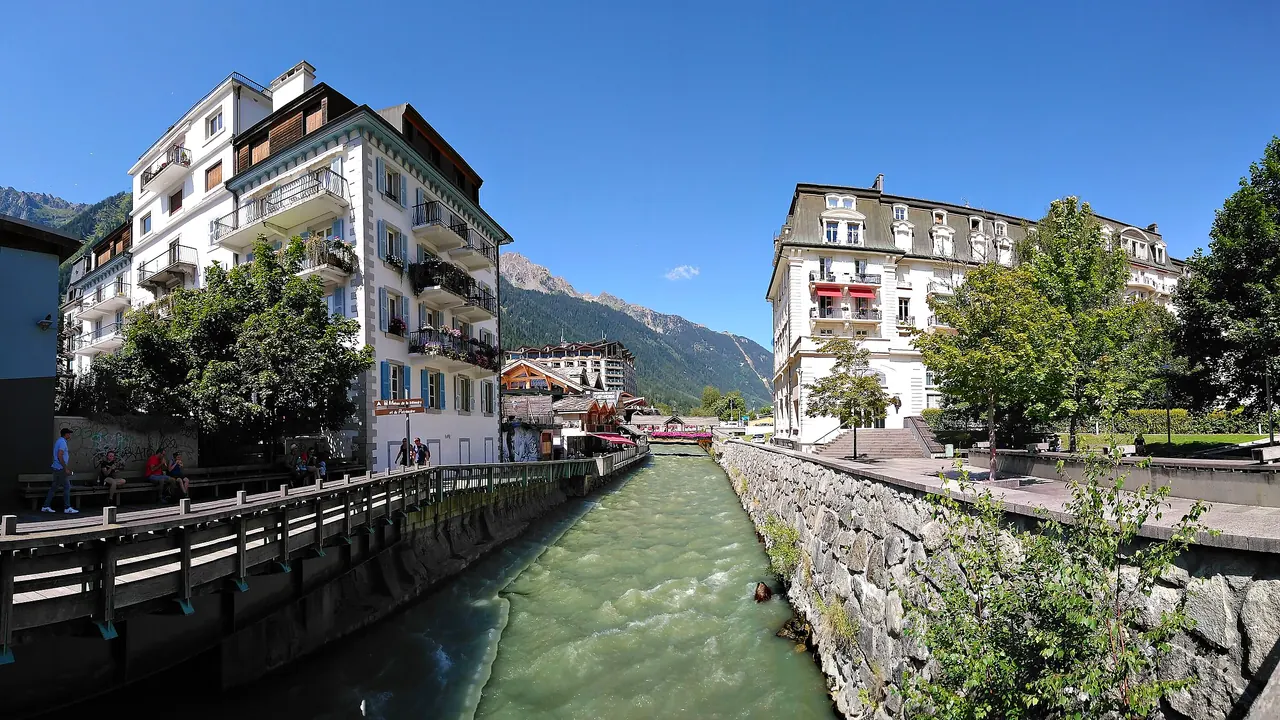
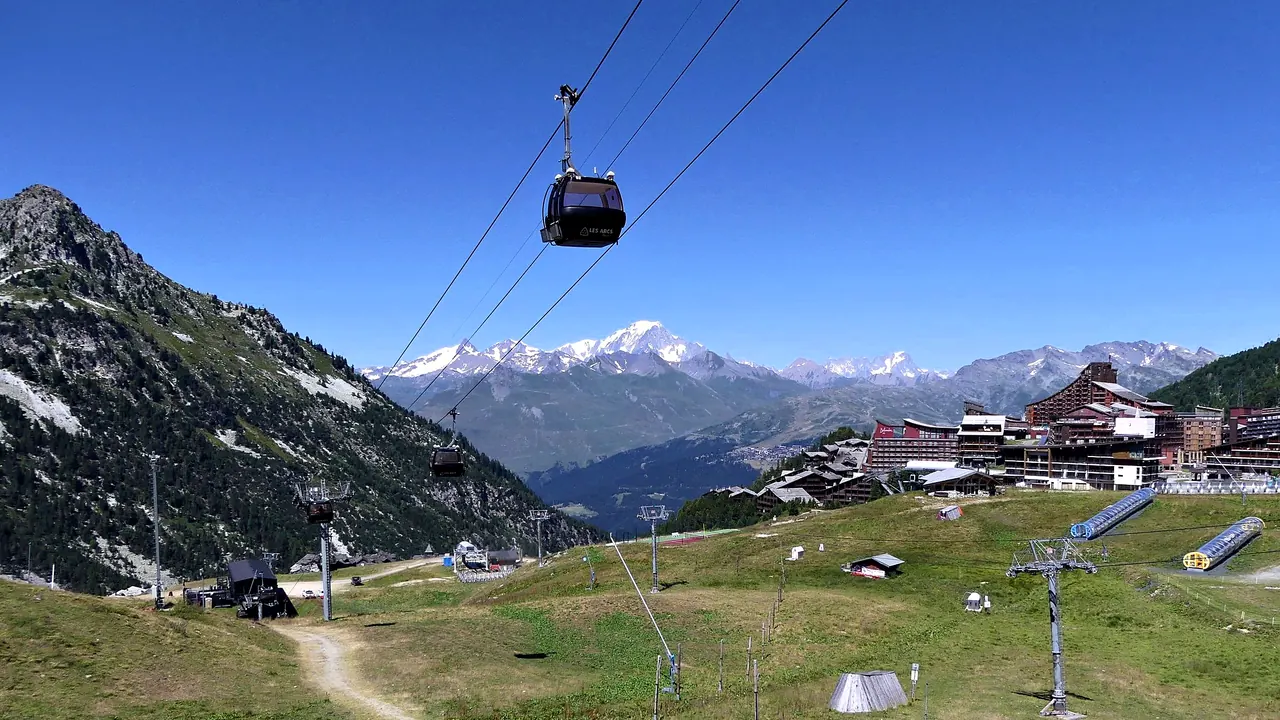
Photos: Chamonix by Tiia Monto, CC BY-SA 3.0, cropped; Les Arcs by Florian Pépellin, CC BY-SA 4.0, cropped.
Chamonix or Les Arcs?
Our verdict in twelve categories, each scored against the same fixed benchmark cities, and the climate month by month, so you can choose for your trip.
Choose Chamonix for
- nightlife
- day trips
- wellness
Chamonix suits travellers who want the mountains and a real town at the foot of them. It is the place for climbers, alpinists and hikers drawn to Mont Blanc's glaciers, and its evenings, restaurants, gear shops and glacier-view spa give a stay more variety than a purpose-built resort can. Italy, Switzerland, Geneva and Annecy are all within a day's reach, so it also works for a mixed trip.
Choose Les Arcs for
- families
- live music and the arts
- prices
Les Arcs is the better pick for a ski week with children. Its car-free villages have apartments opening straight onto the snow, the ski schools take the youngest beginners, and the slopes link with La Plagne to make one of the largest ski areas in the Alps. Choose it if long days on the pistes and quiet evenings matter more than nightlife, sightseeing or excursions.
Scoreboard
Twelve categories on one fixed scale from 0 to 100. The shaded stretch is the gap between the two.
Your match
Pick a travel style or drag the sliders, and both match scores follow your weighting.
Wins on nightlife and day trips with your weighting.
Wins on families and live music and the arts with your weighting.
What matters to you?
Category by category
What the scores mean for a trip.
Beaches & swimming
Neither place is for swimmers, but Chamonix at least has a lake nearby. Lac de Passy, just down the Arve valley, has a grassy shore and a sandy strip looking up at Mont Blanc, and Lake Annecy is a little over an hour away.
From Les Arcs, the water nearby means heated pools in the residences and small leisure lakes in the valley. A proper lake swim is about two hours away by road.
Food & drink
Both cook the same Savoyard repertoire of fondue, tartiflette, croziflette and Beaufort, but Chamonix has a wider choice around it. Its international crowd supports bistros and a few serious kitchens in the grand old hotels, and the town's cheese shops, charcuteries and bakeries make it easy to buy a picnic.
In Les Arcs, the best meals are long lunches in converted farm huts on the slopes. Back in the villages the choice comes down to pizzerias, crêperies and your own apartment kitchen, and the best local produce is down at the Beaufort cooperative in Bourg-Saint-Maurice.
Culture & sights
Neither is a sightseeing destination, and each needs no more than half a day, but the interest is very different. Chamonix tells the story of alpinism, from the first ascent of Mont Blanc in 1786 to the 1924 Winter Olympics, at the Musée Alpin, in the guides' quarter and in the climbers' cemetery.
The appeal of Les Arcs is its architecture. Charlotte Perriand's stepped apartment blocks at Arc 1600 and Arc 1800 attract design enthusiasts, while the older baroque chapels lie down in the Tarentaise.
Nightlife
Chamonix is where you go out. After après-ski, the night moves on to the pubs along a narrow lane in the old town, and a couple of small clubs stay open into the early hours on busy nights.
Les Arcs is mostly après-ski. Terrace bars at the foot of the slopes fill with DJs and dancing, and Arc 1800 has a late bar or two and a small club. Most guests are families in apartments, though, so most nights end early.
Nature & outdoors
Both are first-rate mountain bases, and Chamonix has the edge. Cable cars lift you straight from town to the glaciers below Mont Blanc, up the Aiguille du Midi or to the Mer de Glace, and this is where you find mountaineering with the world's oldest guiding company.
Les Arcs is stronger for covering distance on skis. Paradiski links it to La Plagne for huge mileage, with long descents from the Aiguille Rouge to the valley. In summer, its trails lead into the Vanoise National Park and there is rafting on the Isère.
Day trips
Chamonix's position near three borders gives it far more options. Through the tunnel, Courmayeur and Roman Aosta are close, the Mont Blanc Express runs to Martigny in Switzerland, and Geneva and Annecy are each a little over an hour away.
From Les Arcs, most outings are to other mountain places: Bourg-Saint-Maurice, the Beaufortain cheese villages, Val d'Isère and Tignes. Annecy is about two hours away, and Italy is only within reach in summer, when the Little St Bernard Pass is open.
Good for families
Les Arcs was designed for families on ski weeks, and it shows. Apartments sit on the snow in car-free villages, ski schools and kindergartens take the youngest children, and pools, sledging and ice skating fill the afternoons.
Chamonix works better for older children and teenagers who like being outdoors, with the Merlet animal park, the little red train and summer luge. The highest cable cars climb too high and too fast for toddlers.
Getting around
Both are easy without a car, in different ways. Chamonix is a compact, flat town, and its guest card gives free use of the buses and train along the valley. In winter, though, the ski areas are spread out, so expect crowded ski buses.
Les Arcs is reached by funicular from the railway station in Bourg-Saint-Maurice. Each village is walkable, but the villages lie well apart along a winding road, so you rely on shuttles or the lifts to get between them.
Shopping & style
Chamonix is worth shopping in if you climb or ski. Its gear shops, some of them run by the same families for generations, carry technical equipment and expert advice, and serious mountaineers save their big purchases for a visit here. There are also rock crystals from the massif.
Shopping in Les Arcs is practical: ski rental, basic outdoor clothing and small supermarkets. The cheese worth taking home is down in Bourg-Saint-Maurice.
Affordability
Both are expensive, especially in the school vacation weeks, and the ways to save differ. In Chamonix the free valley transport helps, and many trails start from the valley floor, so you can hike without buying a lift pass.
In Les Arcs, most of the cost is the ski week itself: passes for the large linked area, rental and ski school. Self-catering apartments, January or late March dates, or a summer stay bring the bill down noticeably.
Live music & performing arts
Neither offers a season of theatre or concerts, but Les Arcs has the more substantial event. Its summer classical festival, held since the 1970s, brings chamber music and a music academy to its halls and chapels for a few weeks in July.
Chamonix's highlight is a summer jazz festival with some sets played high in the mountains. For the rest of the year there are only mountain film evenings and the odd concert, and for opera you have to go to Geneva.
Wellness & relaxation
Chamonix does recovery better. Its large day spa, built on the Italian thermal model, has hot outdoor pools facing the glaciers, and the warm springs of Saint-Gervais are about 25 minutes away. The town itself is busy and starts early, though.
In Les Arcs, wellness means the pool and sauna in your residence or hotel, and the old spa towns are an hour down the valley. Its quiet summer paths and clean air are better for a slow week than Chamonix in high season.
When should you go?
Pick your month. The climate figures are measured averages, not a forecast.
Chamonix in July
Les Arcs in July
Daytime high, °C
Rainfall in the month, mm
Where the figures come from
Chamonix's temperatures are measured 35 km from the centre, at Bourg-St-Maurice.
Chamonix has no rain gauge within 25 km of the centre, so its rainfall comes from a gridded climate dataset read at the destination rather than from a gauge further away.
Les Arcs's temperatures are measured 43 km from the centre, at Grand St. Bernard / Grand Saint Bernard.
Les Arcs's station stands 199 m above the city centre, so the centre is likely a little warmer than the figures say.
Les Arcs has no rain gauge within 25 km of the centre, so its rainfall comes from a gridded climate dataset read at the destination rather than from a gauge further away.
Temperature and rainfall are climate normals, averaged over the years shown. Chamonix: 1999-2020 (rainfall 1991-2020) normals, Bourg-St-Maurice (34.9 km from centre). Les Arcs: 1991-2020 normals, Grand St. Bernard / Grand Saint Bernard (43.4 km from centre).
The two places sit at very different heights, and their climates show it. Chamonix's valley floor has a real summer. From June to September afternoons are warm, up to about 27°C in July, which suits hiking, lake swims lower down the valley in July and August, and evenings outdoors. Rain falls all year, and December is the wettest month at around 169mm, with May and November not far behind, as the snow builds for the ski season. Spring and autumn are mild enough for walking around town, though the high lifts and trails depend on conditions.
Les Arcs stays below freezing from November to March, which keeps the snow reliable for skiing. Sunshine climbs quickly from February into March, so late-season ski weeks are brighter. Even in July and August afternoons only reach about 12°C. Summer is cool and the sunniest time of year, peaking in July at just over 200 hours, with June and August close behind, so it suits hiking and biking rather than lazing about. November is the wettest month and December the darkest.
Which traveller are you?
On a food and nightlife trip, Chamonix is clearly the livelier of the two. It has bistros and ambitious hotel kitchens beside the fondue and raclette, après-ski bars, and a lane of pubs and small clubs where guides and seasonal workers stay out late.
On a family trip with young children, Les Arcs makes life easier. The villages are largely car-free, apartments open onto the snow, and ski schools and kindergartens take the smallest skiers. In Chamonix, by contrast, the highest cable cars are unsuitable for toddlers.
On a relaxing and wellness trip, Chamonix has more to offer. Its large thermal-style day spa has hot outdoor pools facing the glaciers, and the warm springs of Saint-Gervais are close by. Les Arcs mostly relies on the saunas and pools inside residences and hotels.
Before you go
| Measure | Chamonix | Les Arcs |
|---|---|---|
| Official language | French | French |
| Currency | Euro (EUR) | Euro (EUR) |
| Sockets | CE230 V, 50 Hz | CE230 V, 50 Hz |
| Driving side | Right | Right |
| Time zone | UTC+1, UTC+2 in summer | UTC+1, UTC+2 in summer |
| Emergency number | 112 | 112 |
| Elevation | 995 m | 2,273 m |
| Main airport | Geneva International Airport (GVA)68 km from centre150 non-stop destinations | Geneva International Airport (GVA)92 km from centre150 non-stop destinations |
| Public holidays this year | 11 days | 11 days |
By the numbers
| Measure | Chamonix | Les Arcs |
|---|---|---|
| Population | 8,705 | - |
| People per km² | 75 | - |
| Museums within 10 km | 3 | 0 |
| UNESCO World Heritage sites within 50 km | 0 | 0 |
Where else could you go?
Every comparison below shares a destination with this one, so you can follow Chamonix or Les Arcs somewhere new.
- La Rosièrevs Les Arcs
- La Plagnevs Les Arcs
- Saint-Gervais-les-Bainsvs Chamonix
- Tignesvs Les Arcs
- Flainevs Chamonix
- Val d'Isèrevs Les Arcs