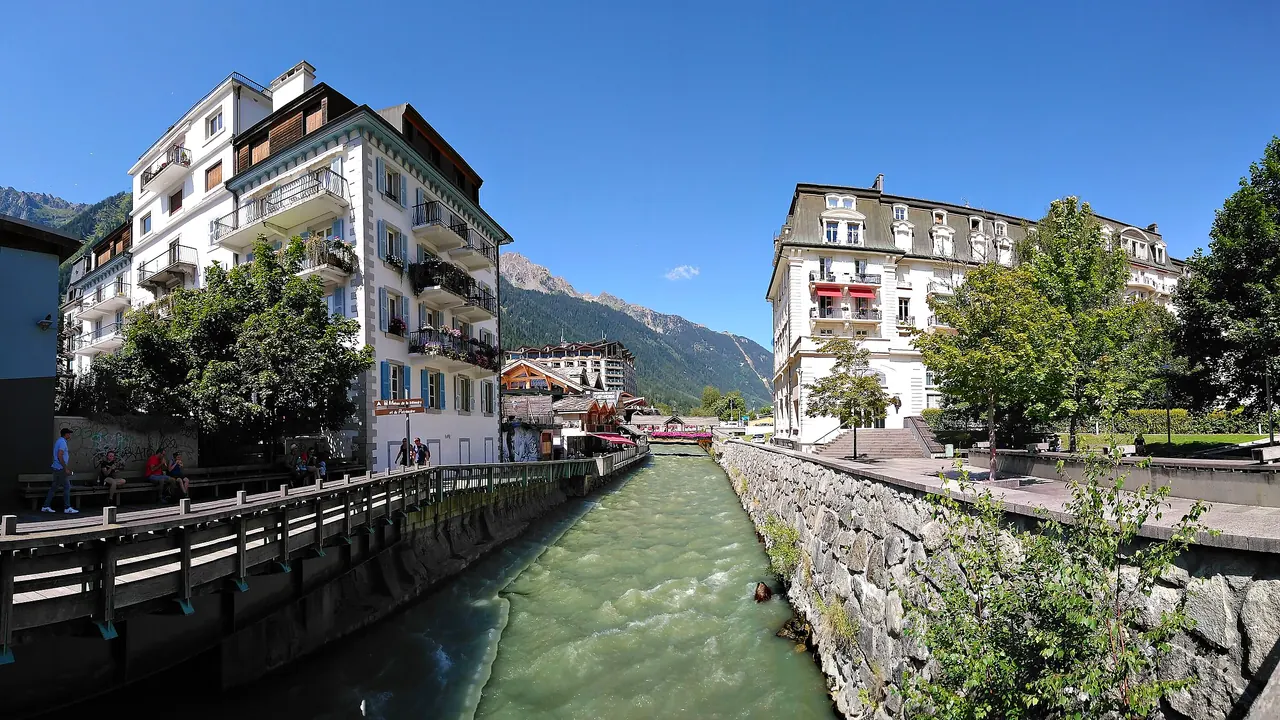
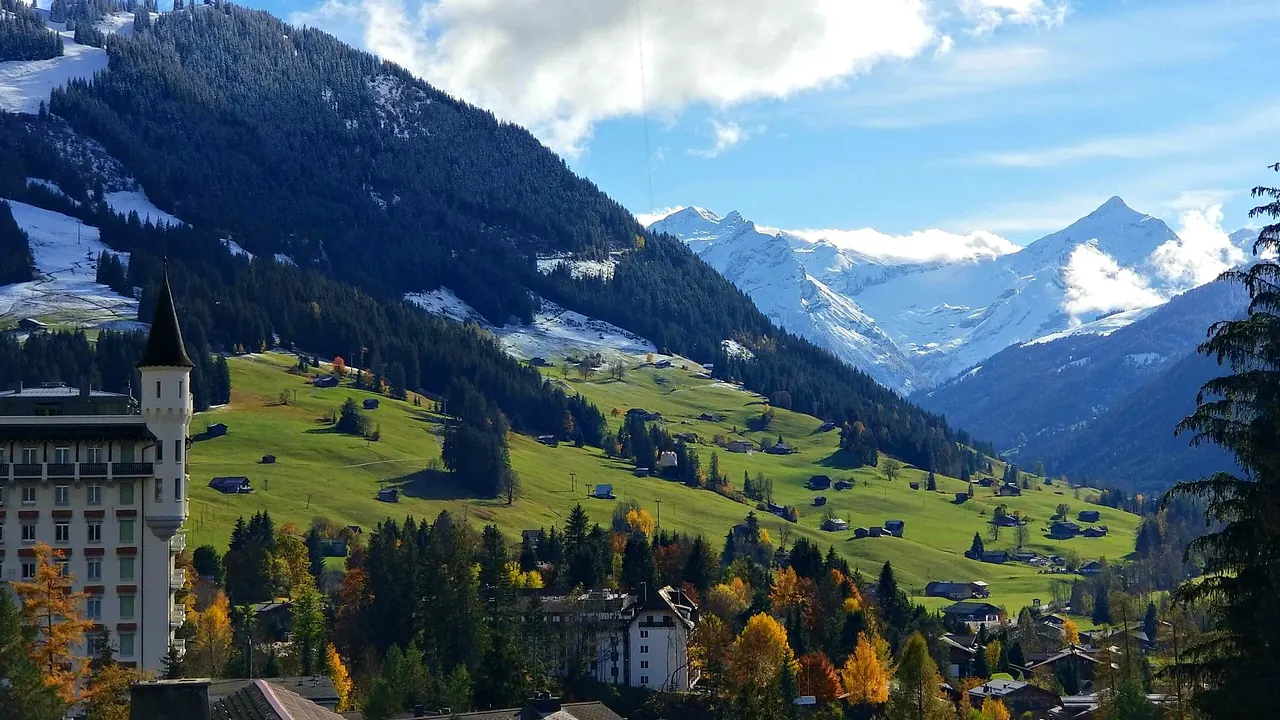
Photos: Chamonix by Tiia Monto, CC BY-SA 3.0, cropped; Gstaad by Samuel Barlow, CC BY-SA 4.0, cropped.
Chamonix or Gstaad?
Our verdict in twelve categories, each scored against the same fixed benchmark cities, and the climate month by month, so you can choose for your trip.
Choose Chamonix for
- nightlife
- prices
- nature and the outdoors
Chamonix is the choice for travellers who want the mountains to be the whole point. The Mont Blanc massif rises straight above the town, cable cars lift you onto glaciers within minutes, and the guiding, climbing and steep skiing are what people cross the world for. It also has more going on after dark, more for children to do, and, expensive as it is, it costs a good deal less than its Swiss rival.
Choose Gstaad for
- live music and the arts
- shopping
- day trips
Gstaad suits a slower, more polished stay. Its slopes and pastures are gentle rather than dramatic, the village is quiet and car-free at its heart, and the draw is comfort: grand hotel spas, a luxury shopping street and, in summer, a classical music festival of real standing. Come here for calm and refinement, not for adrenaline or a bargain.
Scoreboard
Twelve categories on one fixed scale from 0 to 100. The shaded stretch is the gap between the two.
Your match
Pick a travel style or drag the sliders, and both match scores follow your weighting.
Too close to call, 1 point apart
Wins on nightlife and prices with your weighting.
Wins on live music and the arts and shopping with your weighting.
What matters to you?
Category by category
What the scores mean for a trip.
Beaches & swimming
Neither is a place to swim, and both treat it as a summer afternoon extra. The difference is in the water itself. Chamonix has Lac de Passy down the valley, with a sandy strip, mountain views and water that warms enough in July and August, and Lake Annecy is close enough for a proper day at the lake.
Gstaad's lakes at Lauenen and Arnensee stay cold even at the height of summer, so most visitors end up in the heated valley pool or the hotel pool, with Lake Geneva a long trip over the pass.
Food & drink
Both are cheese country and neither is a food destination. Chamonix eats Savoyard: fondue, tartiflette and diots with Reblochon and Beaufort, plus a resort spread of bistros, burgers and pizza for an international crowd, so there is more casual choice but a lot of repetition.
Gstaad splits between gourmet dining rooms in the grand hotels and rustic huts on the slopes, with little in between. Its signature is local cheese, the curled Hobelkäse of Saanen and fire-made L'Etivaz from the valley dairies.
Culture & sights
Chamonix has the stronger story to tell. As the birthplace of alpinism and host of the first Winter Olympics, it has the Musée Alpin, the pioneers' statues and the climbers' cemetery, which add up to a satisfying half day.
Gstaad offers less still: no museums, just the carved timber chalets of the Saanenland and the medieval wall paintings in Saanen's church, best taken in on a stroll rather than planned around.
Nightlife
Chamonix goes out noticeably more. Winter après-ski spills from slope-side bars into a lane of pubs in the old town where guides, seasonal workers and visitors stay late, and a few small clubs carry on after that. The crowd is young, loud and largely English-speaking.
Gstaad's evenings are smaller and dressier, built around hotel bars, a couple of cellar clubs and private chalet parties in the peak weeks. In summer, both towns quieten down, but Gstaad more so, with most nights ending by the fire after dinner.
Nature & outdoors
Both are superb mountain bases, but Chamonix plays in a different league. It sits beneath the highest summit in Western Europe, with hanging glaciers, granite needles and lifts to almost 3,850m, plus the Vallée Blanche, mountaineering and paragliding for those who want the mountains at their most extreme.
Gstaad is pastoral by comparison: green valleys, gentle linked ski areas, cross-country trails and easy summer walks to Lauenensee and the Geltental waterfalls. Its home slopes are low, so Glacier 3000 is the place to go for high snow.
Day trips
Chamonix's outings cross borders, while Gstaad's follow a railway. From Chamonix, the tunnel puts Courmayeur and the Roman walls and theatre of Aosta in Italy within easy reach. Annecy's canals and Geneva's old town are about an hour by road, and the Mont Blanc Express climbs over to Martigny in Switzerland.
Gstaad sends you down the GoldenPass line to Montreux, the Castle of Chillon and the Lavaux vineyard terraces, or east to Lake Thun and the arcades of Bern, with Gruyères close by car. These are rewarding days out, but each one fills most of the day.
Good for families
Chamonix gives children more to do. Beyond ski schools and sledging, there is a summer luge, treetop courses, the little red train to the Mer de Glace and the Merlet animal park with its ibex and marmots. Its weak points are cost and the very high cable cars, which are not for toddlers.
Gstaad is calm and safe, with gentle beginner slopes, sleigh rides and farm animals on summer walks. With nothing built specifically for children and nothing to fall back on in the rain, it suits families wanting a quiet stay rather than a busy one.
Getting around
Both centres are compact and easy on foot. Chamonix runs its whole valley on buses and the Mont Blanc Express, free with the guest card, so you can do without a car, though winter ski buses get packed.
Gstaad links its scattered villages and lifts by GoldenPass trains and PostBuses up the side valleys, but services thin out in quiet months, and many guests lean on hotel shuttles or a car.
Shopping & style
Gstaad is the better place to shop if luxury is what you want. Its one pedestrian Promenade packs in watchmakers, jewellers, furs and designer labels to a degree remarkable for a village, along with Pays-d'Enhaut papercut art.
Chamonix is more specialised: generations-old climbing and ski shops whose technical kit draws mountaineers to buy here, then cheese, génépi and crystals. For fashion it sends you to Geneva.
Affordability
Neither is cheap, but Chamonix is far easier on the wallet. Self-catering apartments, supermarkets, free valley transport and trails that start without a lift all keep costs within reach, especially outside the peak weeks.
Gstaad sits at the very top of Swiss prices, with grand hotels and chalets dominating and few mid-range rooms. The realistic budget approach is to sleep down the valley in Saanen or Zweisimmen and come in for the day.
Live music & performing arts
Gstaad is clearly the place for music. The Menuhin Festival fills a summer of concerts by leading orchestras in a festival tent and the old churches of Saanen, Rougemont and Lauenen, and a winter chamber-music festival follows.
Chamonix has a summer jazz festival with some sets high in the mountains, plus mountain film evenings, but no season to speak of, so opera or a symphony means a trip to Geneva.
Wellness & relaxation
Chamonix has a big public day spa in a busy climbers' town, and Gstaad has lavish hotel spas in a quiet village. In Chamonix, anyone can soak in the hot outdoor pools and saunas under the glaciers, and the thermal springs of Saint-Gervais lie a short drive down the valley. The streets, though, fill with guides and climbers from early morning.
Gstaad has no springs or public baths. Its spas are built mainly for hotel guests, though some sell day passes. What it offers instead is stillness: a small, quiet centre, dark evenings and an easy pace that Chamonix rarely manages in high season.
When should you go?
Pick your month. The climate figures are measured averages, not a forecast.
Chamonix in July
Gstaad in July
Daytime high, °C
Rainfall in the month, mm
Where the figures come from
Chamonix's temperatures are measured 35 km from the centre, at Bourg-St-Maurice.
Chamonix has no rain gauge within 25 km of the centre, so its rainfall comes from a gridded climate dataset read at the destination rather than from a gauge further away.
Gstaad's temperatures are measured 78 km from the centre, at Les Eplatures.
Gstaad has no rain gauge within 25 km of the centre, so its rainfall comes from a gridded climate dataset read at the destination rather than from a gauge further away.
Temperature and rainfall are climate normals, averaged over the years shown. Chamonix: 1999-2020 (rainfall 1991-2020) normals, Bourg-St-Maurice (34.9 km from centre). Gstaad: 2010-2020 (rainfall 1991-2020) normals, Les Eplatures (77.5 km from centre).
Chamonix has the warmer summers. July highs reach about 27°C, enough to make a swim at Lac de Passy pleasant in July and August, while Gstaad peaks nearer 21°C, good walking weather but cool for bathing. Winter is cold in both from December to February, with Gstaad a couple of degrees colder, and late autumn turns grey and damp in each valley, which makes it the least rewarding time to visit.
Rain falls all year in both. From September to June Chamonix is clearly the wetter of the two, with the heaviest months in December, at about 169mm, and in May and November. Gstaad is drier through those months, and April is its calmest at about 76mm. In July and August the two are about level, with Gstaad slightly the wetter. For hiking, June to September suits both: Chamonix is warmer on the valley floor, and Gstaad is fresher on its pastures.
Which traveller are you?
On an outdoors trip, Chamonix is the clear pick. Cable cars to the Aiguille du Midi, the Tour du Mont Blanc and Lac Blanc trails, glacier skiing and the oldest guiding company in the world put serious high-mountain terrain on the doorstep.
For a shopping trip, Gstaad wins. Its short chalet-lined Promenade holds watchmakers, jewellers, cashmere and international fashion labels, while Chamonix's shops are almost all about technical gear, with Geneva or Annecy needed for anything more stylish.
For lovers of classical music, Gstaad has something Chamonix cannot match. The Menuhin Festival brings leading soloists and orchestras to a festival tent and the intimate village churches each summer, with chamber music returning in winter.
Before you go
| Measure | Chamonix | Gstaad |
|---|---|---|
| Official language | French | French, German, Italian, Romansh |
| Currency | Euro (EUR) | Swiss Franc (CHF) |
| Sockets | CE230 V, 50 Hz | CJ230 V, 50 Hz |
| Driving side | Right | Right |
| Time zone | UTC+1, UTC+2 in summer | UTC+1, UTC+2 in summer |
| Emergency number | 112 | 112 |
| Elevation | 995 m | 1,050 m |
| Main airport | Geneva International Airport (GVA)68 km from centre150 non-stop destinations | Geneva International Airport (GVA)94 km from centre150 non-stop destinations |
| Public holidays this year | 11 days | 10 days |
By the numbers
| Measure | Chamonix | Gstaad |
|---|---|---|
| Population | 8,705 | 2,960 |
| People per km² | 75 | - |
| Museums within 10 km | 3 | 0 |
| UNESCO World Heritage sites within 50 km | 0 | 4 |
Where else could you go?
Every comparison below shares a destination with this one, so you can follow Chamonix or Gstaad somewhere new.
- Saint-Gervais-les-Bainsvs Chamonix
- Flainevs Chamonix
- Megèvevs Chamonix
- Samoënsvs Chamonix
- Adelbodenvs Gstaad
- Crans-Montanavs Gstaad