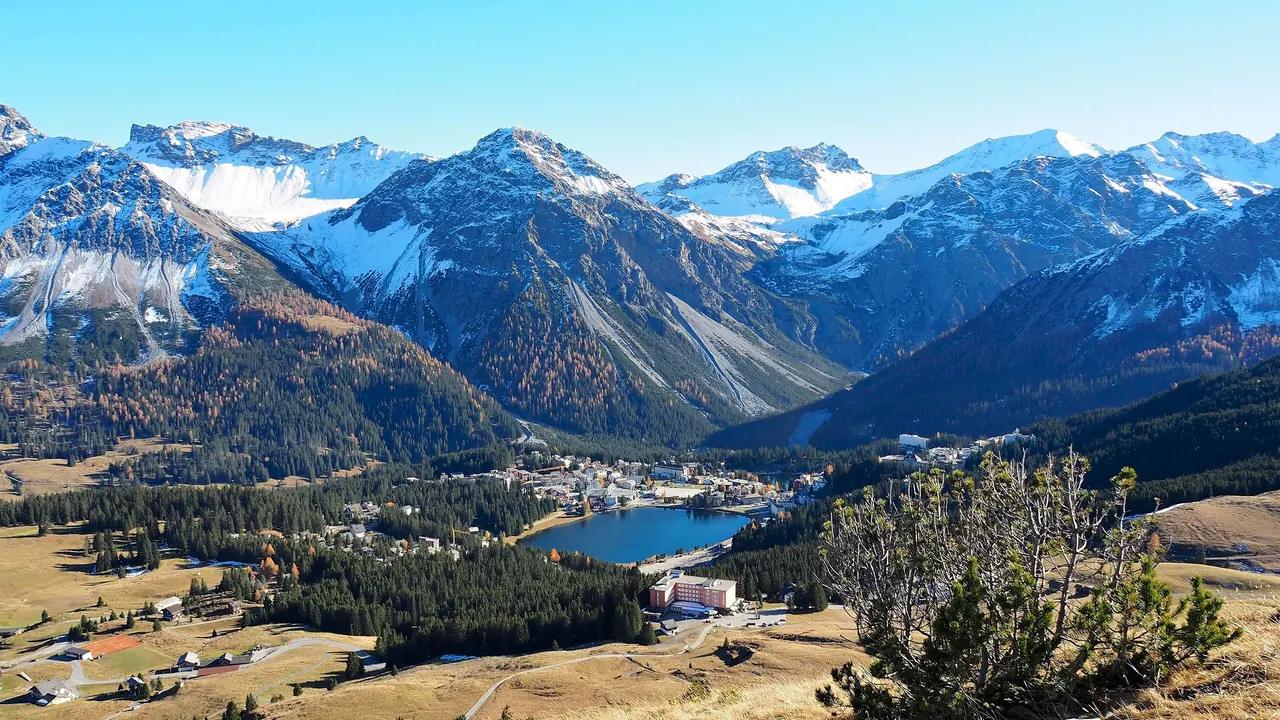
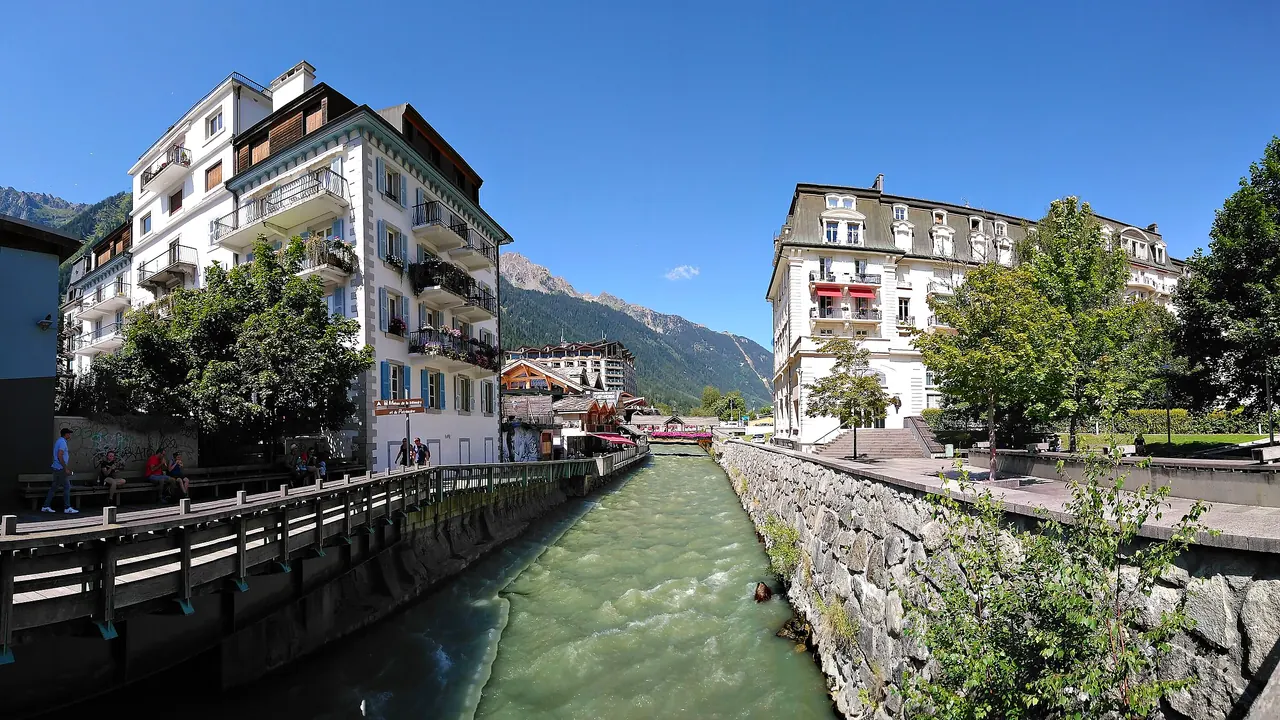
Photos: Arosa by Andres Passwirth, CC BY-SA 4.0, cropped; Chamonix by Tiia Monto, CC BY-SA 3.0, cropped.
Arosa or Chamonix?
Our verdict in twelve categories, each scored against the same fixed benchmark cities, and the climate month by month, so you can choose for your trip.
Choose Arosa for
- live music and the arts
- beaches
- wellness
Arosa suits travellers who want a calm, self-contained mountain stay. It sits at the end of its own valley, with lakes in the village, a large linked ski area over to Lenzerheide and gentle summer walking. Evenings are quiet and the village keeps the slow pace of its sanatorium years. It works best for skiers, walkers and couples who want to switch off, and who don't mind that almost everything happens within the same basin.
Choose Chamonix for
- day trips
- nightlife
- shopping
Chamonix is the choice for people who come for big mountains and want more going on around them. Glaciers, mountaineering and the cable car to the Aiguille du Midi are on a different scale, and the evenings are livelier. Italy, Annecy and Geneva all make easy day trips. It is busier, younger and less restful, but there is more to fill a week, and it is slightly easier on the wallet.
Scoreboard
Twelve categories on one fixed scale from 0 to 100. The shaded stretch is the gap between the two.
Your match
Pick a travel style or drag the sliders, and both match scores follow your weighting.
Wins on live music and the arts and beaches with your weighting.
Wins on day trips and nightlife with your weighting.
What matters to you?
Category by category
What the scores mean for a trip.
Beaches & swimming
Neither place is a swimming destination, but in Arosa the water is closer to hand. The Untersee lido, with its lawn and jetty, is in the village itself, and the Obersee and Schwellisee make a cold dip after a hike. The water stays cool and the season lasts a few weeks in high summer.
In Chamonix, the only swimming on the doorstep is the town pool with its summer outdoor basin. Lac de Passy is further down the Arve valley, and Lake Annecy, warmer and clearer, needs a full day out by car.
Food & drink
Both towns cook cheese-heavy Alpine food, from two different regional traditions. In Arosa it is Graubünden cooking: capuns, barley soup and air-dried meat, best eaten on the terraces of the mountain huts. Apart from a few hotel dining rooms for special evenings, the choice is narrow.
Chamonix has more depth. Savoyard tartiflette, Reblochon and diots come with Savoie white wines, the cheese shops and bakeries are made for picnics, and the international crowd keeps bistros and a few ambitious kitchens going. In both towns, many places close between seasons.
Culture & sights
Chamonix has the richer story to tell, though in either town the sights fill half a day at most. Arosa's heritage fits into an afternoon: the late 15th-century Bergkirchli standing alone on its meadow above Innerarosa, the Schanfigg local history museum, and the grand hotels left over from its years as a tuberculosis cure resort.
Chamonix is where alpinism began, with the first ascent of Mont Blanc, and it hosted the first Winter Olympics. The Musée Alpin in a former Belle Époque palace hotel, the Espace Tairraz with its glaciers and crystals, the old guides' quarter and the climbers' cemetery tell that history in more depth than anything in Arosa.
Nightlife
Chamonix is clearly the livelier of the two after dark. In winter, après-ski moves on to a narrow old-town lane of pubs and bars where guides, seasonal workers and visitors stay out late, and a few small clubs keep going into the early hours. The crowd is young and largely English-speaking.
Arosa's evenings are smarter and more sedate: slope-side après-ski, hotel bars and a couple of small clubs at weekends. The January gay ski week is the liveliest time of its year, and in summer the village is in bed early.
Nature & outdoors
Arosa is a fine mountain base in its own right. It sits in a basin of larches and lakes at 1,800m below the Weisshorn, with reliable snow, a ski area linked to Lenzerheide, and hiking and biking routes over the passes. Marmots on the upper meadows and the bear sanctuary bring wildlife close to the village, and it suits skiers and walkers more than climbers.
Chamonix works on a far bigger scale. The Mont Blanc massif rises almost 4km above its low valley floor, and the cable car to the Aiguille du Midi lifts visitors right up among hanging glaciers and granite needles. It is a world centre for mountaineering, the Vallée Blanche and the Tour du Mont Blanc.
Day trips
Chamonix has far more within reach because it sits close to three countries. Through the Mont Blanc Tunnel lie Courmayeur and the Roman town of Aosta. Annecy and Geneva are a little over an hour by car, and the Mont Blanc Express crosses into Switzerland at Martigny.
From Arosa, every outing starts with the hour-long train down to Chur, a fine old town with a Romanesque cathedral. Maienfeld, Vaduz and the Albula line are possible beyond it, but each takes two hours or more.
Good for families
Both suit outdoor families about equally well. Each has ski schools, sledging and easy summer walks, and both are hard to fill on a rainy day.
Arosa is the gentler, quieter setting, with lakes, playgrounds, the bear sanctuary and free buses for tired legs. Chamonix has more to do, from the summer luge and treetop courses to the Merlet animal park and the little red train to the Mer de Glace, although its highest cable cars are not for small children.
Getting around
Neither needs a car, but they are laid out differently. Arosa climbs a hillside, so the free buses between the station, the lake and the lifts save a lot of stairs. Every trip out of the village runs down the single railway to Chur.
Chamonix has a small, flat centre with two of the big lift stations in town. Buses and the Mont Blanc Express are free with the guest card and connect the hamlets along the valley. Because its ski areas are spread out, winter means crowded ski buses.
Shopping & style
Chamonix is the better place to shop, as long as you want mountain gear. Its pedestrian streets are lined with climbing, ski and outdoor shops, some run by the same families for generations. It also sells Savoyard cheese, génépi and rock crystals from the massif.
Arosa's main street covers rental, outdoor basics, chocolate and a few boutiques for hotel guests. For real choice you have to go to Chur from Arosa, or to Geneva or Annecy from Chamonix.
Affordability
Arosa is the harder of the two on any budget, because it adds Swiss price levels on top of resort ones. The heaviest costs land in the ski season, when hotel rooms, lift tickets and equipment hire all peak together. A summer stay brings the bill down and the guest card adds a few extras, but a week here still costs more than the same week on the French side of the Alps.
In Chamonix the spending depends more on what you do. Rooms and restaurant meals are dear at Christmas, in the February school weeks and in high summer, but the big bills come from the mountain itself: the high cable cars, a guide for a glacier day or a paragliding flight. Outside those peaks, a stay in June or September costs a good deal less, as long as you accept that some lifts will be shut.
Live music & performing arts
Arosa has the slightly fuller calendar. A long-established comedy festival in December is staged partly outdoors in the snow, and summer chamber concerts fill its churches, including the Bergkirchli.
Chamonix's highlight is its summer jazz festival, with some sets played high in the mountains. Otherwise there are only church concerts and mountain film evenings, and for opera you have to go to Geneva.
Wellness & relaxation
Both suit a restful stay about equally, but in different ways. In Arosa the calm is the point: a slow village built for recovery in dry mountain air, hotel spas looking out on the peaks, lake walks and early nights.
Chamonix is about unwinding after effort. A large Italian-style day spa has hot outdoor pools facing the glaciers, and Saint-Gervais-les-Bains, down the valley, has warm springs. The town itself is busy and starts early, so the shoulder seasons or the upper hamlets are quieter.
When should you go?
Pick your month. The climate figures are measured averages, not a forecast.
Arosa in July
Chamonix in July
Daytime high, °C
Rainfall in the month, mm
Where the figures come from
Arosa's temperatures are measured 31 km from the centre, at Samedan.
Arosa has no rain gauge within 25 km of the centre, so its rainfall comes from a gridded climate dataset read at the destination rather than from a gauge further away.
Chamonix's temperatures are measured 35 km from the centre, at Bourg-St-Maurice.
Chamonix has no rain gauge within 25 km of the centre, so its rainfall comes from a gridded climate dataset read at the destination rather than from a gauge further away.
Temperature and rainfall are climate normals, averaged over the years shown. Arosa: 2015-2025 (rainfall 1991-2020) normals, Samedan (31.2 km from centre). Chamonix: 1999-2020 (rainfall 1991-2020) normals, Bourg-St-Maurice (34.9 km from centre).
Arosa has a true high-altitude climate. Winter days stay around freezing, about -1°C in January, which keeps the snow reliable, and late winter is the driest part of the year, so January to March is the time for skiing. Summer is short and mild, reaching only about 20°C in July. That is ideal for hiking, but the lakes are only just warm enough to swim in. Summer is also the wettest season, with around 159mm in August, so a walking trip from June to September needs room for rainy days.
Chamonix's valley floor lies much lower and is noticeably warmer. Summer days reach about 27°C in July, warm enough for Lac de Passy and the town's outdoor pool, and July and August are its least rainy months. Spring and autumn are comfortable for walking around the valley. Winter in town is milder than in Arosa, but it is also wetter, with the heaviest month around 169mm in December.
Which traveller are you?
For a food and nightlife trip, Chamonix is the clear pick. Savoyard cooking, good cheese shops and a handful of ambitious kitchens give more choice at the table, and the old-town lane of pubs keeps going long after Arosa's hotel bars have closed.
On a relaxing and wellness trip, Arosa suits better. The village grew up around recovery in dry mountain air and still keeps a slow rhythm, with hotel spas facing the peaks and lakeside walks. Chamonix's spa is excellent, but its streets fill early with climbers.
On a tight budget, Chamonix is the gentler of two expensive resorts. Free valley transport, easy self-catering and trails that start without a lift pass all stretch money further. Arosa leans upscale, and apartments are almost the only way to save.
Before you go
| Measure | Arosa | Chamonix |
|---|---|---|
| Official language | French, German, Italian, Romansh | French |
| Currency | Swiss Franc (CHF) | Euro (EUR) |
| Sockets | CJ230 V, 50 Hz | CE230 V, 50 Hz |
| Driving side | Right | Right |
| Time zone | UTC+1, UTC+2 in summer | UTC+1, UTC+2 in summer |
| Emergency number | 112 | 112 |
| Elevation | 1,775 m | 995 m |
| Main airport | Zürich Airport (ZRH)114 km from centre226 non-stop destinations | Geneva International Airport (GVA)68 km from centre150 non-stop destinations |
| Public holidays this year | 9 days | 11 days |
By the numbers
| Measure | Arosa | Chamonix |
|---|---|---|
| Population | 3,185 | 8,705 |
| People per km² | 21 | 75 |
| Museums within 10 km | 1 | 3 |
| UNESCO World Heritage sites within 50 km | 2 | 0 |
Where else could you go?
Every comparison below shares a destination with this one, so you can follow Arosa or Chamonix somewhere new.
- Lenzerheidevs Arosa
- Davosvs Arosa
- Saint-Gervais-les-Bainsvs Chamonix
- Flainevs Chamonix
- Klostersvs Arosa
- Megèvevs Chamonix