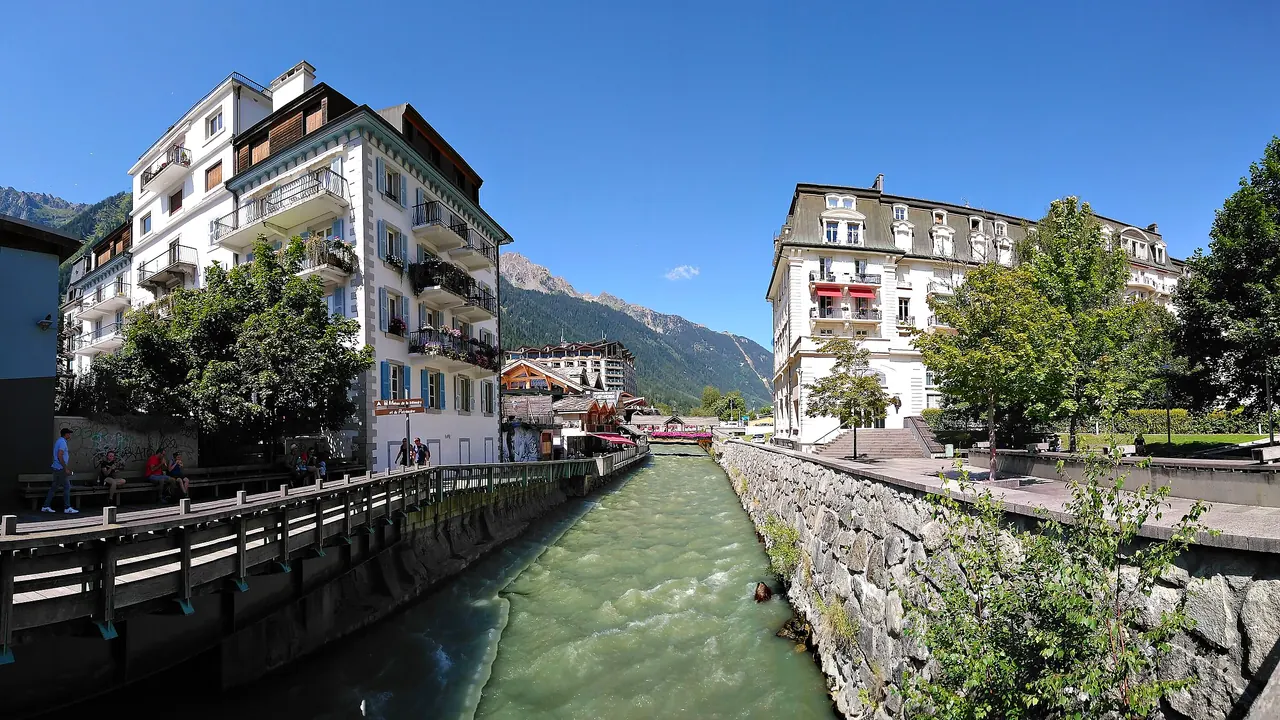
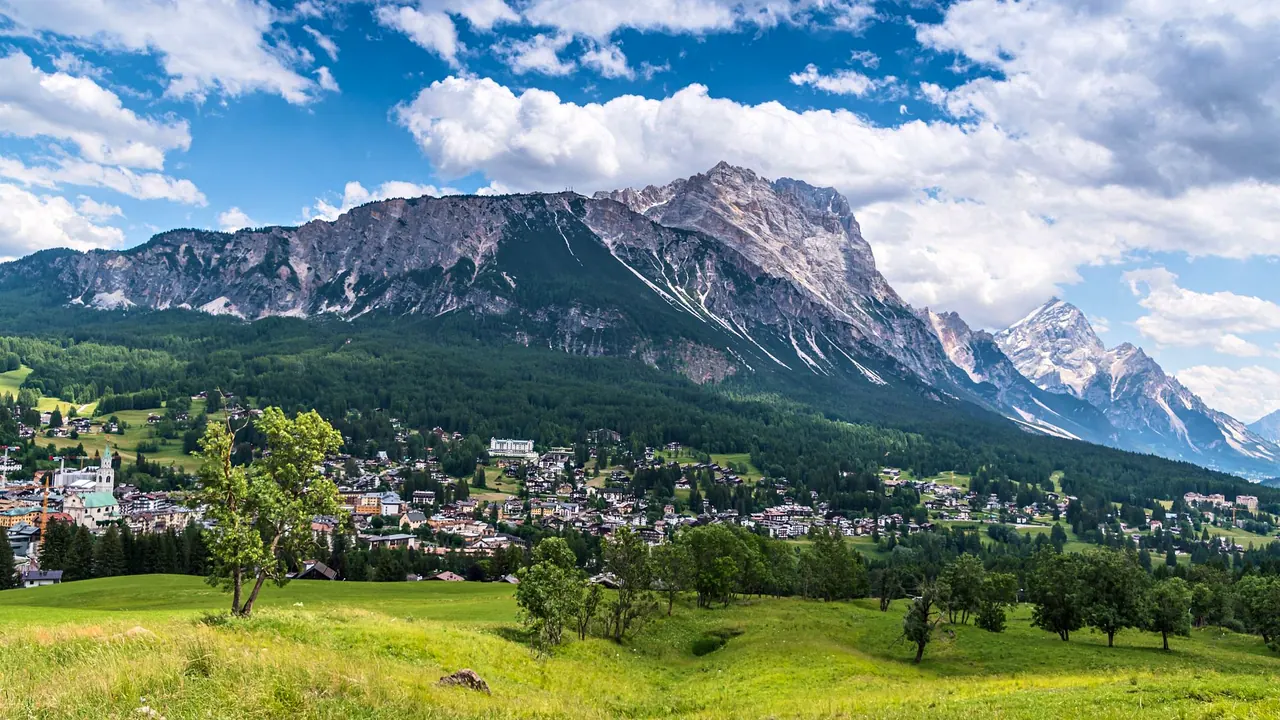
Photos: Chamonix by Tiia Monto, CC BY-SA 3.0, cropped; Cortina d'Ampezzo by Andreas Neubauer, Pexels License.
Chamonix or Cortina d'Ampezzo?
Our verdict in twelve categories, each scored against the same fixed benchmark cities, and the climate month by month, so you can choose for your trip.
Choose Chamonix for
- getting around
- nightlife
- day trips
Chamonix is the better pick for an active, sociable trip with plenty of options. It sits under the glaciers of Western Europe's highest summit, the cable cars leave from the town centre, and you can get there easily on a shuttle from Geneva. Free valley trains and buses join up the hamlets, and France, Italy and Switzerland are all within a day's reach. The evenings are livelier too, with an English-speaking crowd of climbers, guides and seasonal workers. It suits active families and anyone who wants plenty to do once the boots come off.
Choose Cortina d'Ampezzo for
- shopping
- food and drink
- culture and sights
Cortina d'Ampezzo is the slower, more polished of the two, and it rewards travellers who come mainly for the scenery. A ring of pale Dolomite towers surrounds the town, and hut-to-hut trails and the huge Dolomiti Superski area start from it. The evenings are an Italian passeggiata and a long dinner rather than a night out, and the Corso Italia offers the kind of luxury shopping Chamonix doesn't have. Choose it for a quiet, scenic stay, as long as you're happy to drive in or come by coach and to pay luxury-resort prices.
Scoreboard
Twelve categories on one fixed scale from 0 to 100. The shaded stretch is the gap between the two.
Your match
Pick a travel style or drag the sliders, and both match scores follow your weighting.
Wins on getting around and nightlife with your weighting.
Wins on shopping and food and drink with your weighting.
What matters to you?
Category by category
What the scores mean for a trip.
Beaches & swimming
Neither of these is a swimming destination, but Chamonix at least gives you somewhere to bathe in summer. Lac de Passy, lower down the Arve valley, has a sandy strip and warms up enough for a swim in July and August. The clear water of Lake Annecy makes a good day out about an hour away, and the town pool has an outdoor basin in summer.
Cortina's lakes, Ghedina and Pianozes, are fed by snowmelt and stay cold even in August, so they're better for walking round than swimming in. The Adriatic is more than two hours' drive away, so in practice swimming means a hotel pool.
Food & drink
Both towns serve hearty mountain food at a similar standard, and the best meals in each are often on a hut terrace. The difference is in the cooking. Chamonix is all Savoyard cheese: Reblochon in tartiflette, Beaufort in fondue, and diots sausages with Savoie whites. Its international crowd also supports burger and pizza places alongside the bistros.
Cortina cooks Ampezzan food with a Venetian accent, such as beetroot-filled casunziei with poppy seeds, polenta with game, and barley soup. It's served in stube-style dining rooms with Veneto and South Tyrolean wines. Cortina has less variety and fewer cheap options, while Chamonix's menus can feel repetitive and many places close outside the main seasons.
Culture & sights
Neither town is a place for sightseeing, and each takes about an afternoon. Chamonix's story is mountaineering. Alpinism began here with the first ascent of Mont Blanc in 1786, and the Musée Alpin, the guides' quarter and the climbers' cemetery all tell that story.
Cortina has a little more art and history. The Rimoldi collection of twentieth-century Italian art and the 1956 Olympic ice stadium are the highlights in town. Its most memorable heritage is up on Lagazuoi and the Cinque Torri, where First World War tunnels and trenches are preserved along the old front line.
Nightlife
Chamonix is clearly the place for going out. Après-ski at the foot of the slopes leads on to a row of pubs in a narrow old-town lane, where guides, seasonal workers and visitors stay late. On busy nights a couple of small clubs keep going into the early hours, though summer is quieter and the shoulder seasons are very quiet.
Cortina's evenings are about being seen rather than staying out late. You'll find drinks after the lifts close, a stroll along the Corso Italia and a long dinner. Only in the peak winter weeks do a few smart bars and a club stay open late for a well-dressed Italian crowd.
Nature & outdoors
This is the one category where both towns are among the best in the world, and the difference is in the landscape itself. Chamonix lies beneath ice and granite. Glaciers hang above the valley, the Aiguille du Midi climbs to 3,842m, and the Mer de Glace and the Vallée Blanche descent are on the doorstep. It's also a historic base for serious mountaineering with a guide.
Cortina is surrounded by the pale, jagged Dolomites: the Tofane, Cristallo and the Cinque Torri, with the Tre Cime and Lago di Misurina within an hour. Its strengths are long hut-to-hut trails such as the Alta Via 1, some of the oldest via ferrata routes in the Alps, and miles of connected pistes in the Dolomiti Superski area.
Day trips
Chamonix's position near three countries gives it the wider choice. Through the Mont Blanc Tunnel are Courmayeur and the Roman town of Aosta. Annecy's canals and Geneva's lakefront are each about an hour away by car, and the Mont Blanc Express runs over to Martigny in Switzerland.
From Cortina, most outings head deeper into the mountains. The best towns are in South Tyrol, such as San Candido, Brunico, and Bolzano with its Iceman, about two hours away. Venice is possible, but at two and a half hours each way by coach it makes a long day.
Good for families
Both towns suit outdoor families, but Chamonix has more built for children. There's the Merlet park in Les Houches, where ibex and marmots roam a hillside facing Mont Blanc, as well as a summer luge, treetop courses and the rack railway to the Mer de Glace. Its drawbacks are the highest cable cars, which climb too fast for small children, and steep terrain that suits teenagers better.
Cortina offers ski schools at Socrepes, public skating at the Olympic stadium, gentle trails to huts with meadows, and a rope park in the forest. Beyond that it has no attractions aimed at children, so a rainy day with young ones can drag.
Getting around
Chamonix is much easier to get to and to get around. Shuttles run from Geneva airport, and buses and the Mont Blanc Express link the valley from Les Houches to Vallorcine. They're free with a guest card, so you can easily manage without a car. Winter ski buses get packed, though.
Cortina's centre is just as walkable, but it has had no railway since 1964. You arrive by coach from Venice or after a long drive, and buses to the passes and the Tre Cime run on a limited service. Most visitors who want to explore the wider Dolomites end up hiring a car.
Shopping & style
Cortina offers more for anyone who shops for style. The Corso Italia is a polished strip of luxury fashion, jewellers and furriers, anchored by the multi-storey Cooperativa. There are also wood carving and filigree shops for local crafts.
Chamonix's strength is technical gear. Its climbing and ski shops, some run by the same families for generations, are worth saving a big equipment purchase for. Beyond that you'll find cheeses, génépi and rock crystals, and for fashion you'd go to Geneva or Annecy.
Affordability
Both towns are expensive, but Chamonix is slightly easier on a budget. Valley transport is free with the guest card, apartments and supermarkets make self-catering easy, and many trails start on the valley floor without a lift ticket.
Cortina charges luxury-resort prices in winter and August, and its restaurants are priced to match. Meals at the rifugi are the best value for money, and late September is cheaper. Even so, many budget travellers stay in a cheaper valley nearby and drive in.
Live music & performing arts
Neither town has a theatre or concert season, so live performance is mostly a summer event in both. Chamonix leans towards jazz, with a long-running festival that puts some sets high in the mountains, and mountain film evenings fill the rest of the year. Cortina hosts chamber and classical festivals in churches and halls, plus a programme of summer talks. For opera or an orchestra, Chamonix at least has Geneva within reach.
Wellness & relaxation
Chamonix has the edge, mainly because of public bathing. Its large day spa has hot outdoor pools and saunas facing the glaciers, which is perfect after a day's skiing. Saint-Gervais, down the valley, has warm springs in a wooded gorge with a thermal tradition dating back two centuries.
Cortina has no thermal springs, so relaxing here means hotel spas with hay baths and indoor pools. Its other appeal is calm: an afternoon on a hut terrace in June or September. Both towns feel crowded in their peak weeks.
When should you go?
Pick your month. The climate figures are measured averages, not a forecast.
Chamonix in July
Cortina d'Ampezzo in July
Daytime high, °C
Rainfall in the month, mm
Where the figures come from
Chamonix's temperatures are measured 35 km from the centre, at Bourg-St-Maurice.
Chamonix has no rain gauge within 25 km of the centre, so its rainfall comes from a gridded climate dataset read at the city rather than from a gauge further away.
Temperature and rainfall are climate normals, averaged over the years shown. Chamonix: 1999-2020 (rainfall 1991-2020) normals, Bourg-St-Maurice (34.9 km from centre). Cortina d'Ampezzo: 1991-2020 normals, Dobbiaco (22.5 km from centre).
In both valleys, summer is for hiking and winter is for snow, but the rain falls at opposite times of year. Chamonix is wet in every month and wettest in early winter, with about 169mm in December. July and August are its driest months, with highs around 27°C that are pleasant for the trails and warm enough for a mountain lake. Cortina is the reverse. Its winters are very dry, with barely 20mm to 30mm a month, so midwinter is usually crisp and settled. Its summers bring the most rain, with July the wettest month, often as afternoon showers.
Cortina also runs cooler all year. It sits near freezing at midday in January, and even July and August only reach about 22°C, which is ideal for long walks but too cold for any swimming. June and September are pleasant shoulder months in both places, with Chamonix a few degrees milder in each.
Which traveller are you?
On a food and nightlife trip, Chamonix is the stronger pick. Dinner leads into a long, sociable evening among climbers and seasonal workers, well past the hour when Cortina has gone quiet after its passeggiata, though its cooking is just as good.
On a family trip with children, Chamonix makes the days easier to fill. There is more aimed at children between hikes, and free trains and buses mean no car seats or parking. Cortina suits families content to be outdoors all day.
For a shopping trip, Cortina is the better choice if you enjoy an afternoon of upmarket browsing and fine local crafts on one polished street. Chamonix rewards a different shopper, the climber or skier buying serious gear with expert advice.
Before you go
| Measure | Chamonix | Cortina d'Ampezzo |
|---|---|---|
| Official language | French | Italian |
| Currency | Euro (EUR) | Euro (EUR) |
| Sockets | CE230 V, 50 Hz | CFL230 V, 50 Hz |
| Driving side | Right | Right |
| Time zone | UTC+1, UTC+2 in summer | UTC+1, UTC+2 in summer |
| Emergency number | 112 | 112 |
| Elevation | 995 m | 1,224 m |
| Main airport | Geneva International Airport (GVA)68 km from centre150 non-stop destinations | Venice Marco Polo Airport (VCE)116 km from centre103 non-stop destinations |
| Public holidays this year | 11 days | 13 days |
By the numbers
| Measure | Chamonix | Cortina d'Ampezzo |
|---|---|---|
| City population | 8,705 | 5,546 |
| People per km² | 75 | 22 |
| Museums within 10 km | 3 | 3 |
| UNESCO World Heritage sites within 50 km | 0 | 1 |
Where else could you go?
Every comparison below shares a destination with this one, so you can follow Chamonix or Cortina d'Ampezzo somewhere new.
- Annecyvs Chamonix
- Genevavs Chamonix
- Lausannevs Chamonix
- Innsbruckvs Cortina d'Ampezzo
- Turinvs Chamonix
- Interlakenvs Chamonix