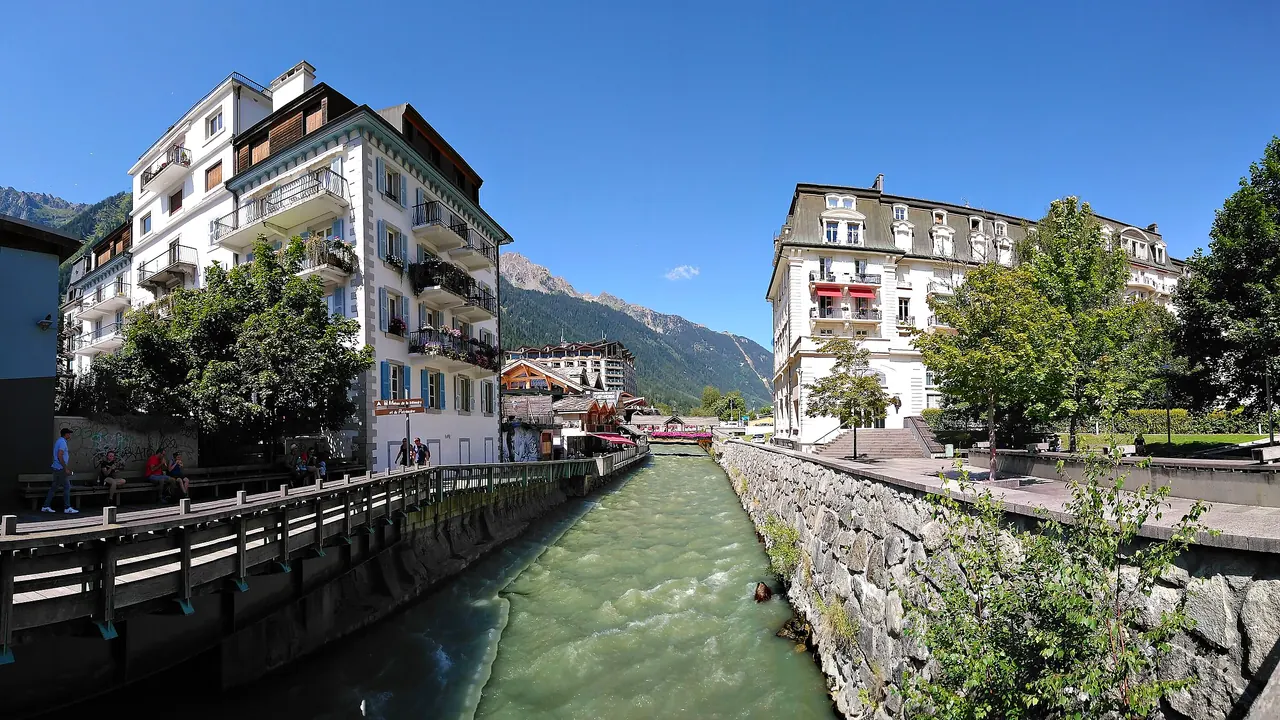
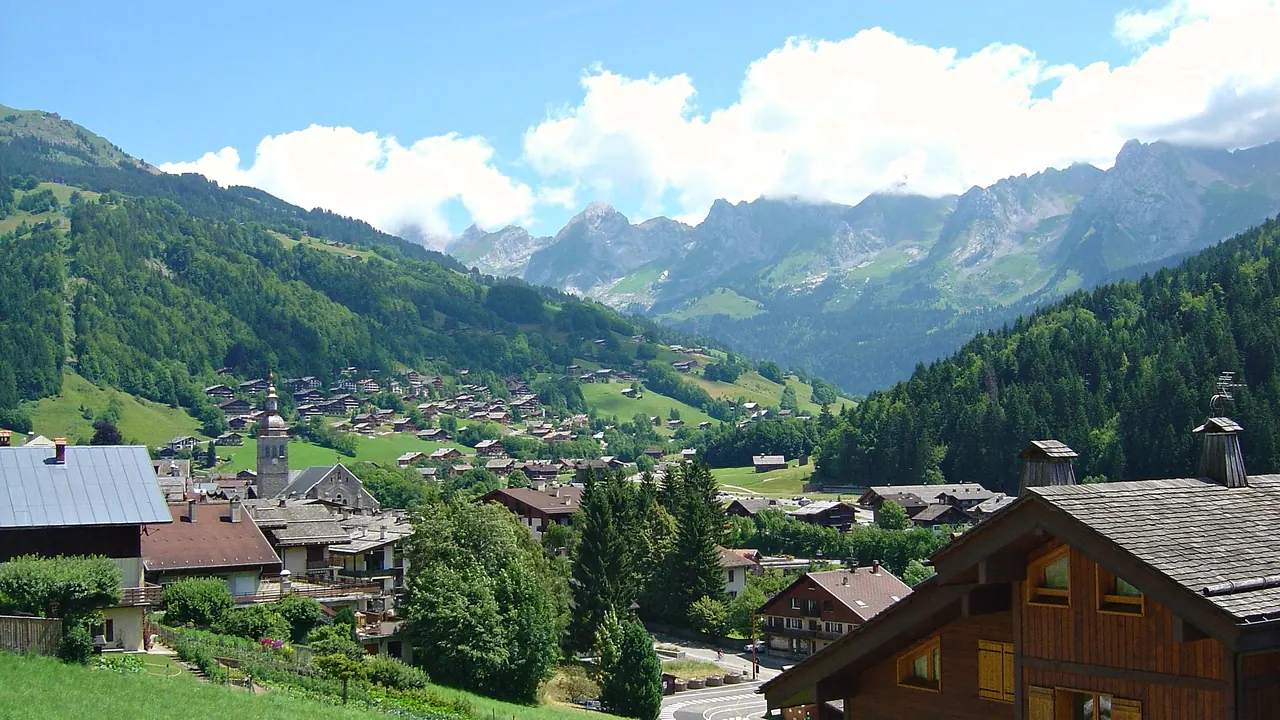
Photos: Chamonix by Tiia Monto, CC BY-SA 3.0, cropped; Le Grand-Bornand by Anthospace, CC BY-SA 3.0, cropped.
Chamonix or Le Grand-Bornand?
Our verdict in twelve categories, each scored against the same fixed benchmark cities, and the climate month by month, so you can choose for your trip.
Choose Chamonix for
- nightlife
- getting around
- shopping
Chamonix is the choice if the mountains themselves are the point. Cable cars carry you into glacier country above the town, and the valley is the birthplace of alpinism. It suits climbers, serious skiers, trail runners and anyone who wants to stand at the foot of Mont Blanc. It also has more going on after dark, an easier way around without a car and a proper spa to finish the day. In return it is pricier, busier and wetter.
Choose Le Grand-Bornand for
- beaches
- prices
- families
Le Grand-Bornand is a quieter and cheaper mid-mountain village, built around families. Its ski slopes and hiking pastures sit under the limestone Aravis, gentler than Chamonix's granite and ice. Reblochon is made on the farms around you, and Lake Annecy is close enough for regular summer afternoons. Choose it if you want calm evenings, children who are easy to look after and a stay that costs less, and you are happy to drive for anything beyond the valley.
Scoreboard
Twelve categories on one fixed scale from 0 to 100. The shaded stretch is the gap between the two.
Your match
Pick a travel style or drag the sliders, and both match scores follow your weighting.
Wins on nightlife and getting around with your weighting.
Wins on beaches and prices with your weighting.
What matters to you?
Category by category
What the scores mean for a trip.
Beaches & swimming
Neither place is for a beach vacation, but Le Grand-Bornand makes swimming easier. Lake Annecy's lawns, pontoons and small beaches at Talloires, Menthon-Saint-Bernard and Sevrier are about 40 minutes away by car, close enough to make several afternoons of a summer week.
Chamonix's nearest swim is little Lac de Passy, down the Arve valley with Mont Blanc in front of you, plus the town's outdoor pool. Annecy is more than an hour away from there, so the lake becomes a single day out.
Food & drink
Both kitchens are built on Savoyard cheese, tartiflette and fondue. Chamonix offers more beyond that. Its international crowd supports bistros, pizza places and a few ambitious dining rooms in the grand old hotels, and refuge terraces look straight onto the glaciers.
Le Grand-Bornand is narrower but closer to the source. You can buy Reblochon at the farm on the morning it was made, and the weekly market fills the village with cheese and charcuterie. For anything beyond mountain staples, though, people drive to Annecy.
Culture & sights
Chamonix has the somewhat richer heritage, and the more distinctive one, because its story belongs to the wider world. Modern mountaineering was born in this valley, and the town also staged the first Winter Olympics in 1924. Inside, the Musée Alpin and the Espace Tairraz cover climbing history, glaciers and the crystals of the massif. Outside, the bronze pioneers in the centre, the guides' old quarter and the climbers' graves are part of the same story. A morning or an afternoon covers all of it.
Le Grand-Bornand's past is that of an ordinary farming valley rather than a famous chapter in history. You can see the onion-domed tower of its baroque church, broad-roofed wooden chalets dotted over the slopes, and an old farmhouse kept to show how families lived and made cheese. It makes a pleasant stroll, not a reason to come, and neither place suits a trip built around museums or old towns.
Nightlife
Chamonix is the only one of the two with a night out. In winter, après-ski starts at the foot of the slopes, then moves to a lane of pubs in the old town where guides, seasonal workers and visitors stay late, with a couple of small clubs after that. The crowd is young and largely English-speaking.
Le Grand-Bornand has a few après-ski bars in the village and at Chinaillon, and that is the evening. It has no clubs, and families tend to be in bed early.
Nature & outdoors
Both are superb mountain bases, but Chamonix plays in a higher league. Lifts rise from town to the Aiguille du Midi at 3,842m and to the Mer de Glace. You can do the Vallée Blanche descent, go mountaineering with the oldest guiding company in the world or set off on the Tour du Mont Blanc from the valley floor.
Le Grand-Bornand is mid-mountain country, with peaks around 2,500m under the Aravis limestone. It gives you open, pastoral ski slopes, cross-country trails and summer walks to high chalets. Road cyclists come for the Col de la Colombière and its Tour de France history. It feels gentler and less dramatic, and less weather-exposed.
Day trips
The day-trip options are about as good in both places, but they point in different directions. Chamonix looks across borders. Courmayeur and the Roman town of Aosta are through the Mont Blanc Tunnel, and the Mont Blanc Express runs to Martigny in Switzerland, so you can go without a car.
Le Grand-Bornand looks down to the lowlands. Annecy is only about 40 minutes away, and Chambéry's castle and medieval Yvoire are both within reach. Almost every outing needs a car.
Good for families
Chamonix gives families plenty to look at. The little red train to the Mer de Glace delights children of every age, the Merlet animal park in Les Houches sets ibex and marmots against Mont Blanc, and summer adds treetop courses and a luge. The highest cable cars and steep glacier terrain suit teenagers rather than toddlers, though, and wet days leave little to fall back on.
Le Grand-Bornand is the easier choice with young children because it was built for them. There are snow gardens and nursery slopes in the village and at Chinaillon, and in summer there are farm visits, river play and the August children's festival, all at a size that is easy to manage. It has no big attractions, and Lake Annecy is a drive away.
Getting around
Chamonix is much easier without a car. Valley buses and the Mont Blanc Express link Les Houches to Vallorcine, they are free with the guest card, and shuttles come straight up from Geneva airport. The catch is the packed ski buses in winter.
Le Grand-Bornand's free shuttles cover the village, Chinaillon and the lifts, but the valley has no railway and few buses beyond. For the lake, trailheads or day trips you need a car, often on slow mountain roads.
Shopping & style
Chamonix has the better shopping, as long as you want gear. Its pedestrian streets hold generations-old climbing and ski shops, and serious mountaineers save up their big purchases for them. You will also find rock crystals from the massif and a few mountain-chic boutiques.
Le Grand-Bornand's shops are practical rental and outdoor stores and delis. The weekly market, with Reblochon and local honey, is the best of it.
Affordability
Le Grand-Bornand is the gentler bill. It is more modest than the famous high-altitude resorts, self-catering apartments are the norm, and summer plus the quiet January and March weeks bring real savings.
Chamonix's name and its big cable cars carry a premium, and guides or a paragliding flight are a serious extra. Free valley transport, picnics and trails that start from the valley floor without a lift soften the cost somewhat.
Live music & performing arts
There is little live culture in either valley, but each has one festival that suits a different visitor. Le Grand-Bornand's long-running Au Bonheur des Mômes gives it the edge, filling the village with street theatre, circus and puppetry for a week every August.
Chamonix's summer jazz festival puts some sets high in the mountains. Outside that, both places come down to the occasional church concert, and Geneva or Annecy for a real stage.
Wellness & relaxation
For proper pampering, Chamonix wins. Its large Italian-style day spa has hot outdoor pools facing the glaciers, and the old thermal springs of Saint-Gervais are about 25 minutes away. The town itself is busy and starts early, though.
Le Grand-Bornand has only hotel saunas and hot tubs, but it offers a different kind of rest. Quiet days, cow bells and nothing to rush for, especially off-peak and in early summer.
When should you go?
Pick your month. The climate figures are measured averages, not a forecast.
Chamonix in July
Le Grand-Bornand in July
Daytime high, °C
Rainfall in the month, mm
Where the figures come from
Chamonix's temperatures are measured 35 km from the centre, at Bourg-St-Maurice.
Chamonix has no rain gauge within 25 km of the centre, so its rainfall comes from a gridded climate dataset read at the destination rather than from a gauge further away.
Le Grand-Bornand's temperatures are measured 45 km from the centre, at Bourg-St-Maurice.
Le Grand-Bornand has no rain gauge within 25 km of the centre, so its rainfall comes from a gridded climate dataset read at the destination rather than from a gauge further away.
Temperature and rainfall are climate normals, averaged over the years shown. Chamonix: 1999-2020 (rainfall 1991-2020) normals, Bourg-St-Maurice (34.9 km from centre). Le Grand-Bornand: 1999-2020 (rainfall 1991-2020) normals, Bourg-St-Maurice (44.7 km from centre).
The two valleys have almost the same temperatures through the year, so the real difference is rain. Winter highs sit around 5°C in both, which is ski season rather than weather for wandering about. Spring warms steadily, and June to August is the time for hiking and lake swimming, with July peaking near 27°C. The lakes are only really swimmable in July and August. September is still mild and good for walking, and by November the cold and the wet have returned.
Chamonix is the wetter of the two all year round. It sees about 169mm in December and has a damp spike in May, where Le Grand-Bornand gets about 106mm. The Aravis village is noticeably drier in spring and autumn, which makes the shoulder months there a slightly safer bet for walking. Midsummer is the most settled stretch in both.
Which traveller are you?
On a food and nightlife trip, Chamonix is the clear pick. Its long après-ski, the late bars along the old-town lane and a few small clubs mean a real night out, and there are bistros and ambitious kitchens beyond fondue. Le Grand-Bornand goes to bed early.
On a family trip with young children, Le Grand-Bornand suits better. The resort is built around families, with snow gardens, nursery slopes and farm visits to watch Reblochon being made. Its August children's festival brings street theatre and circus. Chamonix's highest cable cars are too much for toddlers.
On a trip on a tight budget, Le Grand-Bornand stretches your money further. Self-catering is the norm and the quieter January and March weeks are much cheaper. Chamonix's big cable cars, guides and peak-season rooms add up quickly, although its free valley transport does help.
Before you go
| Measure | Chamonix | Le Grand-Bornand |
|---|---|---|
| Official language | French | French |
| Currency | Euro (EUR) | Euro (EUR) |
| Sockets | CE230 V, 50 Hz | CE230 V, 50 Hz |
| Driving side | Right | Right |
| Time zone | UTC+1, UTC+2 in summer | UTC+1, UTC+2 in summer |
| Emergency number | 112 | 112 |
| Elevation | 995 m | 892 m |
| Main airport | Geneva International Airport (GVA)68 km from centre150 non-stop destinations | Geneva International Airport (GVA)41 km from centre150 non-stop destinations |
| Public holidays this year | 11 days | 11 days |
By the numbers
| Measure | Chamonix | Le Grand-Bornand |
|---|---|---|
| Population | 8,705 | 2,050 |
| People per km² | 75 | 33 |
| Museums within 10 km | 3 | 1 |
| UNESCO World Heritage sites within 50 km | 0 | 2 |
Where else could you go?
Every comparison below shares a destination with this one, so you can follow Chamonix or Le Grand-Bornand somewhere new.
- La Clusazvs Le Grand-Bornand
- Saint-Gervais-les-Bainsvs Chamonix
- Flainevs Chamonix
- Megèvevs Le Grand-Bornand
- Megèvevs Chamonix
- Samoënsvs Chamonix