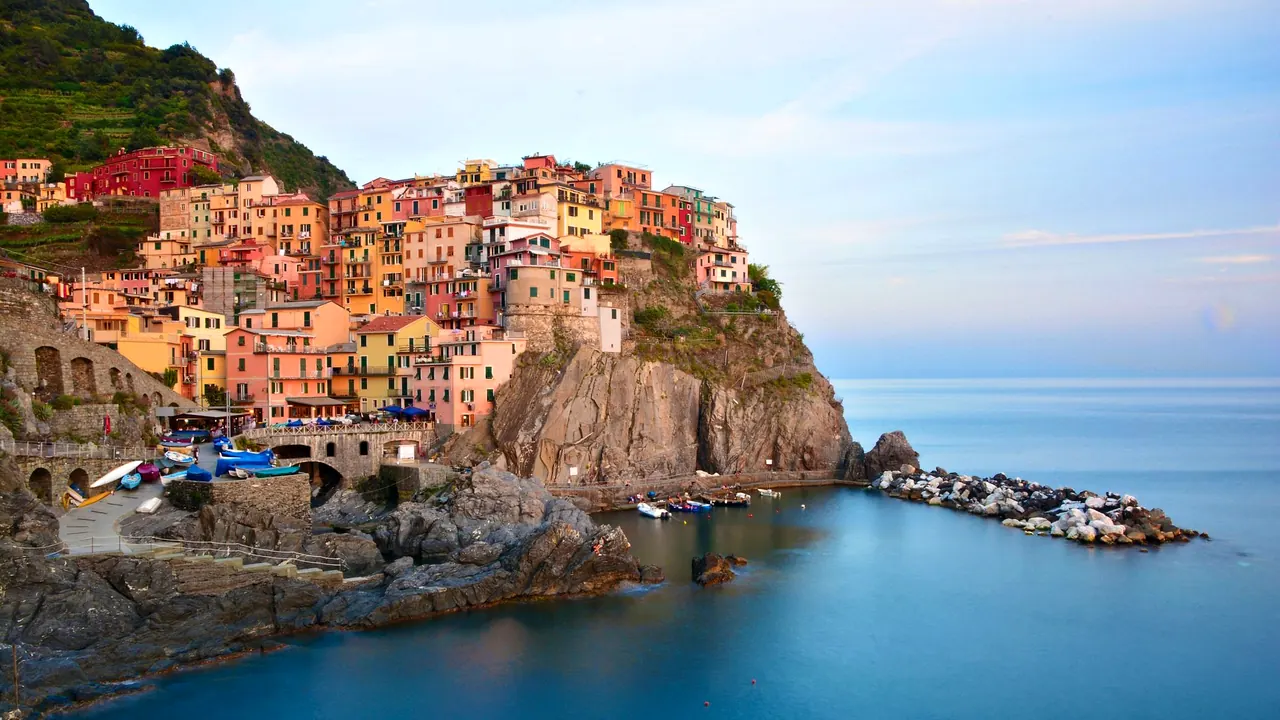
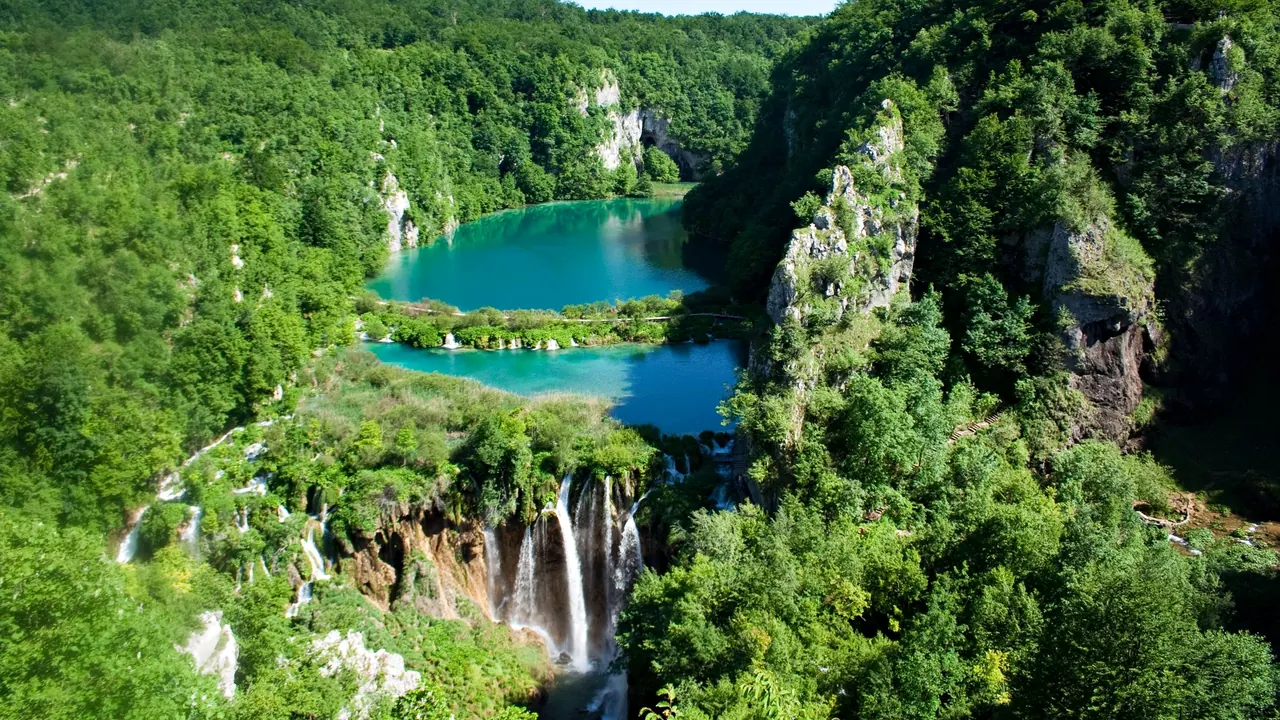
Photos: Cinque Terre by Narcisa Aciko, Pexels License; Plitvice Lakes by Pablo BM from London, England, CC BY 2.0, cropped.
Cinque Terre or Plitvice Lakes?
Our verdict in twelve categories, each scored against the same fixed benchmark cities, and the climate month by month, so you can choose for your trip.
Choose Cinque Terre for
- beaches
- day trips
- food and drink
Cinque Terre is the better pick if you want the sea to be part of the trip. You get swims off the rocks between walks, a proper beach at Monterosso, Ligurian food and wine on harbour walls, and a coastal railway that puts Pisa, Lucca, Portofino and Genoa within a day. It suits couples and active adults who don't mind steps, crowds and paying a lot for a small room.
Choose Plitvice Lakes for
- prices
- families
- nature and the outdoors
Plitvice Lakes is a trip built around one great natural sight: the terraced lakes, waterfalls and beech forest, best walked early before the groups arrive. It's easier with children, cheaper to stay in, and calm in the evenings. You give up swimming, food of any range and nearly everything to do after dark. Most people stop here for a night or two between Zagreb and the Croatian coast.
Scoreboard
Twelve categories on one fixed scale from 0 to 100. The shaded stretch is the gap between the two.
Your match
Pick a travel style or drag the sliders, and both match scores follow your weighting.
Wins on beaches and day trips with your weighting.
Wins on prices and families with your weighting.
What matters to you?
Category by category
What the scores mean for a trip.
Beaches & swimming
Cinque Terre has the sea: clear, warm water all summer and a real sandy and pebbly beach at Monterosso. The other villages are rocky, so you swim off slipways and rock shelves rather than lie on sand. Levanto and the coves near Portovenere add more choice.
Plitvice has no swimming at all where you would most want it, because bathing in the lakes is strictly forbidden. The nearest option is the cool, green Korana river around Korana village and Slunj. If beach days matter to you, Plitvice is a stop on the way to the coast, not the place to have them.
Food & drink
Cinque Terre eats better and lighter. You get trofie with pesto, focaccia and farinata from bakery counters, Monterosso's anchovies, fried seafood in paper cones, and the terraced white wine alongside the sweet Sciacchetrà. The choice is narrow and many menus in the busy villages are aimed at day-trippers, but a good meal is not hard to find.
Plitvice offers heavier country cooking: spit-roast lamb and suckling pig, river trout, and dishes slow-cooked under an iron bell in roadside inns. It's filling and honest, but much of it is made for tour groups. There are no markets and no café culture, and after one good lamb dinner the menus start to repeat.
Culture & sights
In both places the World Heritage listing is for the landscape rather than for buildings, but Cinque Terre has far more built heritage to walk through. Its five medieval villages, their striped Ligurian Gothic churches, the watchtower above Vernazza and the hillside sanctuaries are themselves the sights.
Plitvice's built heritage fits into an afternoon. The highlights are the mill village of Rastoke, the ruined walls of Drežnik and the memorials to the first deaths of the 1990s war.
Nightlife
Neither place is for a night out. Cinque Terre at least gives you a sunset glass of wine on a harbour wall and a few bars in Monterosso and Riomaggiore that stay open a little later in summer. At Plitvice the evening ends with dinner and perhaps a local brandy, and the villages are silent soon after dark.
Nature & outdoors
Both trips are built around the outdoors, and Plitvice has the more remarkable single sight. Its sixteen lakes step down through a limestone valley, linked by travertine barriers and waterfalls down to the Veliki slap, with boardwalks right over the falls. Around them you have beech and fir forest, the Barać caves, rafting on the Korana and the Una, and the Velebit ridges for longer hikes.
Cinque Terre's outdoors means walking a coastline. The Sentiero Azzurro runs between the villages through vines and olives, the Sentiero Rosso follows the ridge, and kayaks and dive boats go out into the marine reserve. That variety comes from having the sea alongside the hills.
Day trips
Cinque Terre is the far better base for day trips because the coastal railway does the work. Portovenere and Lerici are a boat ride away. Sarzana and the Carrara quarries are a short hop, Pisa and Lucca are both easy days by train, and Portofino and Genoa are to the north.
From Plitvice the good outings are close by: Rastoke, Bihać and the Una falls across the Bosnian border, and the Tesla birthplace at Smiljan. Zadar and Zagreb are long drives, which is why most visitors move on to them rather than visit them for the day.
Good for families
Cinque Terre is a coast of steps. Corniglia sits high above its station, a pushchair is no use in the stepped alleys, and summer trains and paths are packed. It suits older children who like to walk, or younger ones based in flat Monterosso near its gently shelving beach.
Plitvice is the gentler choice with children. The boardwalks, the clear water full of fish, the boat across Kozjak and the shoreline train hold their attention, and shorter circuits fit into a few hours. Farmstay guesthouses add animals. Toddlers still need a hand, as the boardwalks are narrow and most of them lack railings.
Getting around
Cinque Terre is easier to get around without a car. A local train links all five villages through tunnels a few minutes apart, ferries call at most harbours in season, and you can walk the paths between villages. A car is a burden on the narrow roads. The hard parts are the crammed summer carriages and the climbs.
Plitvice is simple inside the park, with signed circuits, boats and trains. Outside it, local transport is thin, so reaching Rastoke or the wider countryside really needs a car.
Shopping & style
Cinque Terre's village shops give you a little more to bring home: pesto, jarred anchovies, lemon liqueur and bottles of the terraced white and Sciacchetrà, along with some ceramics and linen. At Plitvice you're down to the kiosks at the park entrances and roadside farm stalls selling cheese, honey, jams and fruit brandy. In both places the souvenirs worth having are the edible ones, and you won't find any fashion.
Affordability
Plitvice is the cheaper stay. Family-run guesthouses in the outlying villages are reasonable and the country inns are generous. The main costs are the summer park fee and the hotels right at the gates, and both are much easier to manage in spring or autumn.
Cinque Terre's food and trains are affordable. The problem is its few small village rooms, which cost far more in season than comparable rooms elsewhere on the Italian coast. That is why many visitors sleep in La Spezia or Levanto.
Live music & performing arts
Neither place has a performing arts life worth planning around. Cinque Terre has the odd summer concert in a church or square and processions with bands on feast days. Plitvice's equivalent is folk music at a village festival. For a play or an orchestra, you'd go to La Spezia or Genoa from one, and to Zagreb or Zadar from the other.
Wellness & relaxation
Calm rather than treatments is what both trips offer, and in both it disappears at midday in summer when the crowds arrive. In Cinque Terre it comes from car-free villages and a terrace above the sea once the day visitors have gone, and the most you'll find in the way of treatments is the occasional massage at a guesthouse.
Plitvice's quiet is more rural. You get farmhouse guesthouses among meadows and fir forest, clean air and near silence after dark, plus a few hotel saunas and small spa rooms. For the calmest stay, pick an outlying village and walk the lakes early.
When should you go?
Pick your month. The climate figures are measured averages, not a forecast.
Cinque Terre in July
Plitvice Lakes in July
Daytime high, °C
Rainfall in the month, mm
Where the figures come from
Cinque Terre's temperatures are measured 78 km from the centre, at Pisa / S. Giusto.
Cinque Terre has no rain gauge within 25 km of the centre, so its rainfall comes from a gridded climate dataset read at the destination rather than from a gauge further away.
Plitvice Lakes has no weather station within reach, so its figures come from a gridded climate model rather than a measured record, and read a broad area rather than one spot.
Temperature and rainfall are climate normals, averaged over the years shown. Cinque Terre: 1991-2020 normals, Pisa / S. Giusto (77.8 km from centre). Plitvice Lakes: 2001-2020 normals, NASA POWER reanalysis grid, no weather station within 90 km.
Cinque Terre's beach season runs from June to September. The sea is warm enough for a long swim through the summer and reaches about 25°C in August. July and August are also very hot, around 30°C, which makes the cliff paths hard going at midday. May and late September are the sweet spot for walking. The weather turns sharply in autumn: October and November are by far the wettest months, at about 170mm each. Winter is mild but grey.
Plitvice is inland and higher up, so it's cooler all year. Summer highs stay in the mid-20s, which is comfortable for a full day on the boardwalks. Winter is properly cold, with daytime highs near 3°C and snow on the frozen falls. Rain comes in every month, and most heavily from September to November. Late spring, when the falls carry the most water, and early autumn, when the forests turn colour, are the best times to come.
Which traveller are you?
For a beach and sun trip, Cinque Terre is the only real option. Its warm, clear sea, the sand at Monterosso and the swims off rocks at Vernazza and Manarola make summer days easy. At Plitvice, swimming is banned in the lakes and the Adriatic is two hours away.
On a family trip with children, Plitvice works better. The boardwalks over the water, the fish, the electric boat and the little train delight school-age children. Cinque Terre's stepped villages, packed trains and steep paths wear out small legs and make a pushchair useless.
On a tight budget, Plitvice goes further. Village guesthouses are reasonably priced and country inns serve big portions, especially in spring or autumn. In Cinque Terre the scarce village rooms cost a lot, so budget travellers usually sleep in La Spezia or Levanto and take the train in.
Before you go
| Measure | Cinque Terre | Plitvice Lakes |
|---|---|---|
| Official language | Italian | Croatian |
| Currency | Euro (EUR) | Euro (EUR) |
| Sockets | CFL230 V, 50 Hz | CF230 V, 50 Hz |
| Driving side | Right | Right |
| Time zone | UTC+1, UTC+2 in summer | UTC+1, UTC+2 in summer |
| Emergency number | 112 | 112 |
| Main airport | Pisa International Airport (PSA)82 non-stop destinations | Zagreb Franjo Tuđman International Airport (ZAG)66 non-stop destinations |
| Public holidays this year | 13 days | 14 days |
By the numbers
| Measure | Cinque Terre | Plitvice Lakes |
|---|---|---|
| Swim season, months above 21 °C | 4 months | - |
Where else could you go?
Every comparison below shares a destination with this one, so you can follow Cinque Terre or Plitvice Lakes somewhere new.
- Portofinovs Cinque Terre
- Krkavs Plitvice Lakes
- Tuscanyvs Cinque Terre
- Elbavs Cinque Terre
- Lake Gardavs Cinque Terre
- Bračvs Plitvice Lakes