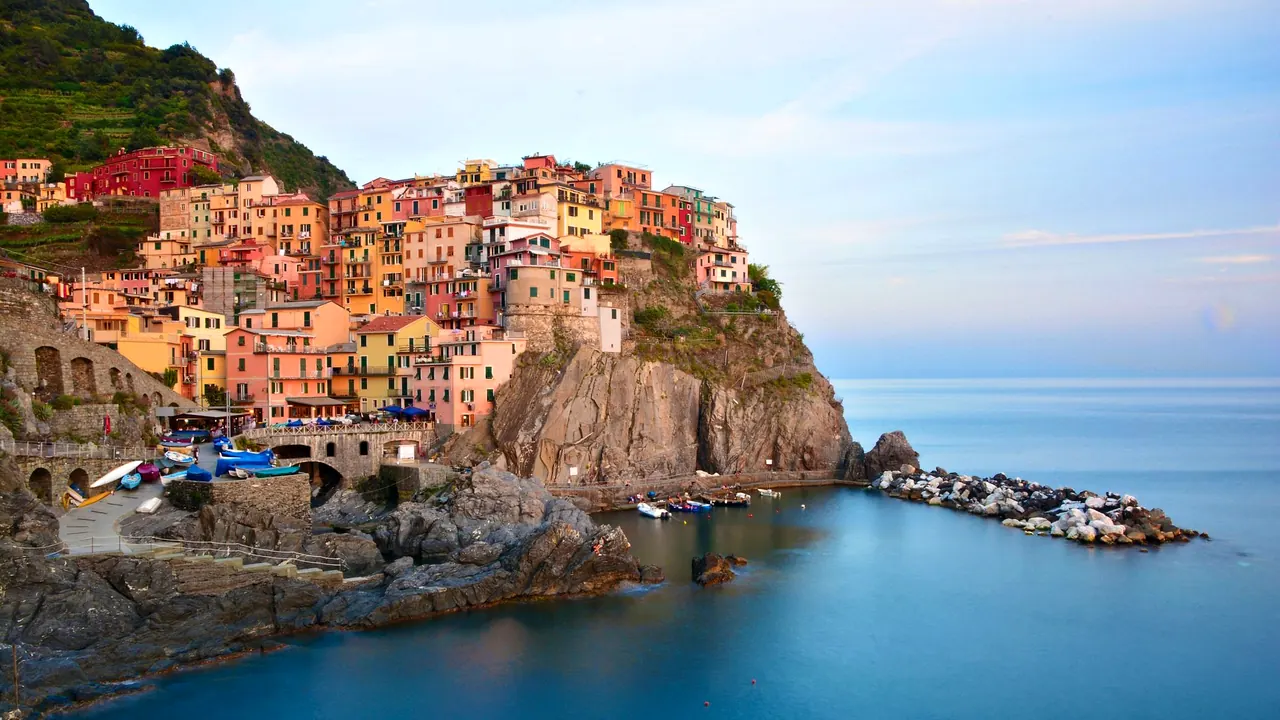
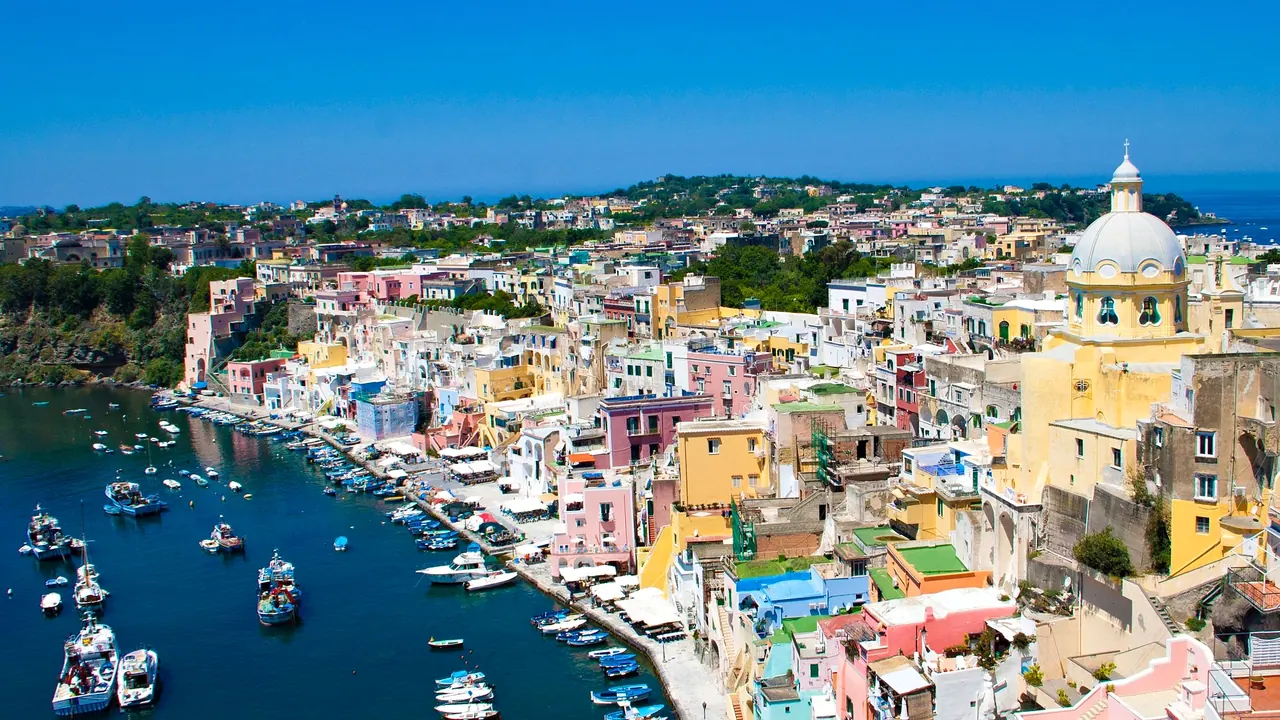
Photos: Cinque Terre by Narcisa Aciko, Pexels License; Procida by DIANA.GRYGAROVA, CC BY-SA 4.0, cropped.
Cinque Terre or Procida?
Our verdict in twelve categories, each scored against the same fixed benchmark cities, and the climate month by month, so you can choose for your trip.
Choose Cinque Terre for
- nature and the outdoors
- culture and sights
- getting around
Cinque Terre is the choice for walkers. The cliff paths between the five villages, the ridge trail above them and the mule tracks down through the vineyards make the trip, and the coastal train lets you walk one way and ride back. The food is a little better too, with Ligurian pesto, focaccia and Monterosso's anchovies, and the terraced villages are a sight in their own right. In return you get steep steps everywhere, crowded summer trains and rooms that cost more.
Choose Procida for
- wellness
- families
- prices
Procida suits travellers who want to slow down and swim. Its volcanic sand coves at Chiaiolella and Ciraccio slope gently and make for easy family beach days, and the island is calmer and cheaper to stay on. It is also a better base for outings: Ischia's thermal pools, the Roman sites around Pozzuoli and Baia, and Naples itself are all a short boat ride away. There is far less to walk once you are there, and every outing depends on the ferry timetable.
Scoreboard
Twelve categories on one fixed scale from 0 to 100. The shaded stretch is the gap between the two.
Your match
Pick a travel style or drag the sliders, and both match scores follow your weighting.
Too close to call, level with your weighting
Wins on nature and the outdoors and culture and sights with your weighting.
Wins on wellness and families with your weighting.
What matters to you?
Category by category
What the scores mean for a trip.
Beaches & swimming
Procida has the edge for beach days. It has several sand coves, though the sand is dark and volcanic: Chiaiolella and the long curve of Ciraccio in the south-west, Chiaia below Terra Murata, and the sheltered little Pozzo Vecchio. Boat trips reach other coves that you can only get to from the sea.
Cinque Terre has one real beach town, Monterosso, with sand and fine pebble at Fegina packed tight with umbrellas in summer. Everywhere else you swim off rock shelves and slipways at Vernazza, Manarola and Riomaggiore. These are lovely for a dip after a walk, but you cannot spend a lazy day on them.
Food & drink
Cinque Terre eats a little better, thanks to Liguria's distinctive cooking. Trofie with pesto, farinata and focaccia from the bakery counter and Monterosso's marinated anchovies are all worth seeking out, and the terraces produce a crisp white and the sweet Sciacchetrà to drink with them.
Procida's table is narrower: the morning's fish at the harbour trattorias of Corricella and Marina Grande, a lemon salad with mint and chilli, and the lemon-cream pastry called lingua. Both have a short range of dishes. In Cinque Terre's busiest villages many menus are written for day-trippers, while on Procida many places shut out of season.
Culture & sights
Cinque Terre gives you more to see, because the sight is a whole UNESCO-listed coast. Five villages sit on rock above the sea, surrounded by dry-stone terraces, and you add striped Ligurian Gothic churches, the Doria tower at Vernazza and hillside sanctuaries.
Procida has its high point at Terra Murata, with the Abbey of San Michele and its maritime ex-votos and the former prison of Palazzo d'Avalos on guided tours. Below it lies the pastel harbour of Corricella. Neither has a museum of any size, and both can be seen in a day or two of slow walking.
Nightlife
Both are quiet after dark, and neither has clubs. Cinque Terre's evenings come down to sunset wine on a harbour wall and a few later bars in Monterosso and Riomaggiore. Procida's waterfront bars at Marina Grande and Chiaiolella stay lively until about midnight in high summer. For a real night out you go to La Spezia from Cinque Terre, or take a ferry to Naples or Ischia from Procida, where getting back is the catch.
Nature & outdoors
This is where Cinque Terre clearly leads, and it is the reason most people go. The Sentiero Azzurro runs along the cliffs between the villages, the Sentiero Rosso follows the wooded ridge above, and old mule tracks link the two. It is all national park and marine reserve, with kayaking to the grottoes and diving below the cliffs.
Procida is low and gentle, with crater bays, walled lemon gardens and lookouts rather than trails. Its one wild corner, the Vivara reserve, opens only for limited guided visits. Snorkelling and a boat trip round the island fill a few days, but not a walking trip.
Day trips
Procida is the better base for outings, because so much lies within a short boat ride. Ischia is a quarter of an hour away and Pozzuoli's Roman amphitheatre about half an hour. From there you can reach Baia's sunken villas and Greek Cuma, and Naples and Herculaneum are close behind. The last ferry back sets the limit on every day out.
Cinque Terre's outings run along the railway: Portovenere and Lerici across the gulf, Sarzana and the Carrara quarries, Pisa and Lucca in Tuscany, and Portofino and Genoa up the Riviera. It is a broad mix, though the trains take longer than Procida's crossings.
Good for families
Procida is the easier island with children. Its sandy beaches slope gently into warm water, trattorias are relaxed about children, and no journey takes long. The drawback is the narrow lanes with no pavements and steady traffic, which are tiring with a pushchair.
Cinque Terre is harder work, with villages built of steps and Corniglia far above its station. It suits older children who like to walk, or families who base themselves in flat Monterosso by its beach.
Getting around
Cinque Terre is a little simpler to get around. A local train runs through the tunnels and links every village within minutes, summer ferries call at most harbours and the trails join one village to the next. The village centres are car-free, and the price is crammed platforms in summer and a great many stairs.
Procida is small enough that nothing is far. Buses and three-wheeled taxis run from Marina Grande, and plenty of visitors use a bicycle or scooter. Walking is less pleasant than it sounds, because the main lanes are narrow, walled and busy with traffic. Neither place needs a car.
Shopping & style
Neither is a place to shop, and both sell mostly edible souvenirs, linen and ceramics. Cinque Terre's best buys are jars of pesto and anchovies and bottles of Sciacchetrà. Procida's are hand-painted ceramics and lemon products along Via Roma, and Naples is close at hand if you want real shops.
Affordability
Procida is the more affordable of the two. It costs less to stay on than its better-known neighbours in the gulf, and pizzas, pastries, buses and a beach day without a sunbed cost little, though July and August still push room rates up.
Cinque Terre's few, small village rooms cost well above the Italian coastal norm in season, and you pay to use the park's paths. Focaccia, fried fish and the cheap train keep daily costs down, and many budget travellers sleep in La Spezia or Levanto instead.
Live music & performing arts
Neither offers much: no theatre, no concert hall, only the odd summer concert in a church or square. The occasions are religious. Cinque Terre's villages have processions and bands for their patron saints. Procida has the Good Friday Misteri, when hand-built biblical tableaux are carried from Terra Murata to the sea. For opera or an orchestra you go to Genoa or La Spezia from one and to Naples from the other.
Wellness & relaxation
Procida is the more restful choice. Its slow harbour lunches and quiet minor lanes are made for doing very little, and Ischia's hot springs and thermal gardens make an easy day of soaking with a boat back by evening.
Cinque Terre has no bathing tradition. Its calm depends on timing: car-free villages and sea-view terraces feel peaceful in the early morning or in spring and autumn, but far less so when the lanes fill on a summer afternoon.
When should you go?
Pick your month. The climate figures are measured averages, not a forecast.
Cinque Terre in July
Procida in July
Daytime high, °C
Rainfall in the month, mm
Where the figures come from
Cinque Terre's temperatures are measured 78 km from the centre, at Pisa / S. Giusto.
Cinque Terre has no rain gauge within 25 km of the centre, so its rainfall comes from a gridded climate dataset read at the destination rather than from a gauge further away.
Procida's temperatures are measured 32 km from the centre, at Grazzanise.
Temperature and rainfall are climate normals, averaged over the years shown. Cinque Terre: 1991-2020 normals, Pisa / S. Giusto (77.8 km from centre). Procida: 1991-2020 (rainfall 1971-2000) normals, Grazzanise (32.2 km from centre).
Cinque Terre and Procida follow much the same Mediterranean year, with Procida a touch warmer throughout. On Cinque Terre the sea is warm enough for swimming from June to September. Procida's stays warm enough into October, at about 22°C, so its beach season runs a few weeks longer. Both are sunniest and driest in midsummer. July is the driest month on the Ligurian coast, at about 24mm, and on Procida June and July are the driest. Highs of around 30°C in July and August suit a beach day but make Cinque Terre's stepped coastal path hard going at midday.
For walking on Cinque Terre, April, May and early September are best, with mild days and plenty of sunshine. The rain builds through late September, and October and November are the wettest months on the Ligurian coast, at about 170mm or more each. That kind of rain can close stretches of the trails. Procida's autumn is wet too, though a little less so. Winter is cool and damp in both places, with highs in the low teens, and there is little reason to go then.
Which traveller are you?
On an outdoors trip, Cinque Terre wins easily. The Sentiero Azzurro and the higher ridge path give you days of real walking through vineyards and pine woods, with kayaking along the marine reserve as well. Procida has viewpoints and short headland paths, and you run out of them fast.
On a family trip with young children, Procida is the easier island. Chiaiolella and Ciraccio have gently shelving sand, distances are short and trattorias welcome children. Cinque Terre's vertical villages and packed summer trains are hard going, and only Monterosso has a proper beach.
For a relaxing and wellness trip, choose Procida. Its quiet lanes and long harbour lunches set a slower pace, and Ischia's hot springs and thermal gardens are a quarter of an hour away by boat. Cinque Terre has neither, and its lanes fill with crowds on summer afternoons.
Before you go
| Measure | Cinque Terre | Procida |
|---|---|---|
| Official language | Italian | Italian |
| Currency | Euro (EUR) | Euro (EUR) |
| Sockets | CFL230 V, 50 Hz | CFL230 V, 50 Hz |
| Driving side | Right | Right |
| Time zone | UTC+1, UTC+2 in summer | UTC+1, UTC+2 in summer |
| Emergency number | 112 | 112 |
| Main airport | Pisa International Airport (PSA)82 non-stop destinations | Naples International Airport (NAP)131 non-stop destinations |
| Public holidays this year | 13 days | 13 days |
By the numbers
| Measure | Cinque Terre | Procida |
|---|---|---|
| Population | - | 10,092 |
| People per km² | - | 2,347 |
| Swim season, months above 21 °C | 4 months | 5 months |
Where else could you go?
Every comparison below shares a destination with this one, so you can follow Cinque Terre or Procida somewhere new.
- Ischiavs Procida
- Caprivs Procida
- Portofinovs Cinque Terre
- Amalfi Coastvs Procida
- Tuscanyvs Cinque Terre
- Elbavs Cinque Terre