Italy
Assisi
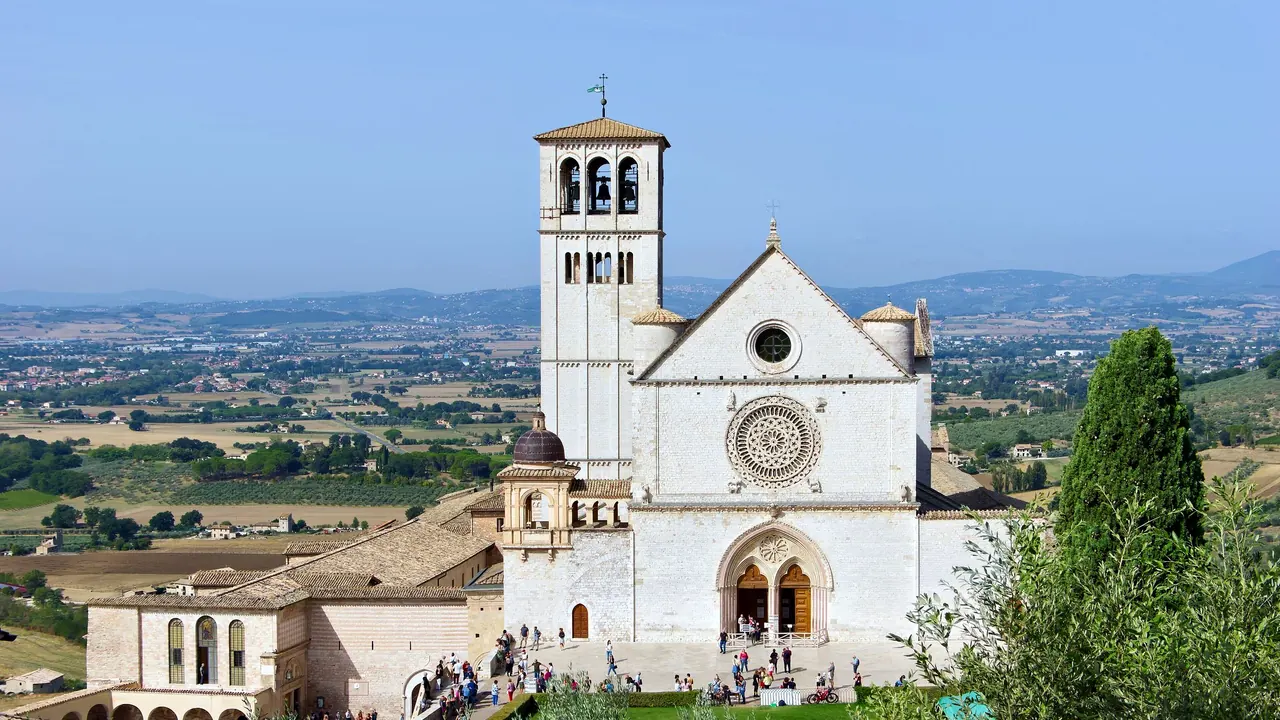
The Basilica of San Francesco above the Umbrian plain
- Day trips86
- Culture & sights70
- Nature & outdoors62
Photo: Berthold Werner, CC BY-SA 4.0, cropped
Match
41
Every category weighted equally
- Beach & sun38
- Culture & arts47
- Food & nightlife37
- Family trip45
- Outdoors50
- Relax & unwind42
- Shopping & style39
- On a budget43
Assisi in twelve categories
Our verdict on each, scored 0 to 100 against the same fixed benchmark cities, so a score means the same thing on every page.
Beaches & swimming. Scores 8 out of 100.
Food & drink. Scores 40 out of 100.
Culture & sights. Scores 70 out of 100.
Nightlife. Scores 6 out of 100.
Nature & outdoors. Scores 62 out of 100.
Day trips. Scores 86 out of 100.
Good for families. Scores 28 out of 100.
Getting around. Scores 55 out of 100.
Shopping & style. Scores 22 out of 100.
Affordability. Scores 58 out of 100.
Live music & performing arts. Scores 22 out of 100.
Wellness & relaxation. Scores 40 out of 100.
Assisi category by category
Beaches & swimming
8Assisi is a hill town in the middle of Italy, about two hours from either coast, so this is not a place for a beach vacation. The nearest swimming is at Lake Trasimeno, about 45 minutes away by car, where small lido beaches at towns like Passignano and Castiglione del Lago give warm but shallow, slightly murky water in July and August. For anything else, look for a hotel or agriturismo with a pool.
Food & drink
40Assisi eats the way Umbria does: simple, rural and built on excellent produce. Expect hand-rolled strangozzi pasta with black truffle, lentils from Castelluccio, grilled lamb and pork, wild boar, and torta al testo, a griddled flatbread filled with cured meats or greens. The olive oil from the slopes of Monte Subasio is among the best in Italy, and the reds of nearby Montefalco, Sagrantino above all, are worth looking for.
The range is narrow, though. Restaurants near the Basilica of San Francesco and along the main streets often serve set menus to tour groups, and the better meals are in small trattorias on the side lanes or in country agriturismi below the town. There is no street-food culture, no market hall and little fine dining.
Culture & sights
70Assisi exists for one of the great monuments of Europe. The Basilica of San Francesco is two churches stacked on the hillside: the dim, low Lower Church with frescoes by Cimabue, Simone Martini and Pietro Lorenzetti, and the bright Upper Church lined with the cycle of the life of Saint Francis traditionally given to Giotto. Together with the town around it, it is a UNESCO World Heritage Site.
The rest of the town is pink and white Subasio stone, stepped lanes and small piazzas. The Roman Temple of Minerva stands in Piazza del Comune, the striped Basilica of Santa Chiara holds the crucifix said to have spoken to Francis, and the Rocca Maggiore castle looks over the Umbrian valley. Below the walls are San Damiano and Santa Maria degli Angeli, which encloses the tiny Porziuncola chapel. Two days covers it all calmly.
Nightlife
6There is essentially no nightlife. Once the day-trippers leave, Assisi goes quiet. Evenings mean a long dinner, a glass of Sagrantino in a small wine bar and a walk through floodlit lanes that are empty by eleven. That stillness is part of the appeal for many visitors. Anyone wanting bars and late nights should stay in Perugia, the student city half an hour away.
Nature & outdoors
62Monte Subasio rises right behind the town, and its regional park is the main reason to bring walking shoes. A path climbs through holm-oak woods to the Eremo delle Carceri, the hermitage where Francis prayed, and carries on to bare, grassy summit meadows at about 1,290m with views over the whole Umbrian valley. In spring the slopes are covered in wildflowers.
The country below is gentle: olive groves, vineyards and a flat valley floor good for cycling between Spello, Bevagna and Montefalco. The wilder Valnerina, Monte Cucco with its caves and gorges, and, further off, the Sibillini mountains and the flowering plain of Castelluccio make bigger days out by car. Summers are hot and best for early starts. Autumn is the finest season for walking.
Day trips
86This is Assisi's great strength as a base. The heart of Umbria lies around it: Spello with its flower-decked lanes about ten minutes away, Perugia with its Etruscan arch and National Gallery of Umbria about half an hour away, and Spoleto, with its cathedral and Ponte delle Torri aqueduct, about 45 minutes by train. Gubbio, the grey medieval town of the Palazzo dei Consoli, and hilltop Todi are each about an hour away.
Further out, Orvieto's cathedral facade justifies a full day, Deruta is the Umbrian ceramics town, and the wine villages of Montefalco and Bevagna make a relaxed afternoon. Cortona and Montepulciano across the Tuscan border are within reach too. Trains link Assisi to Perugia, Spello, Foligno and Spoleto. For the smaller hill towns a car makes things much easier.
Good for families
28Assisi is safe, small and calm, and children are welcomed warmly, but very little is made for them. The sights are churches and frescoes that need silence, the streets are steep and often stepped, which is hard with a pushchair, and summer afternoons are hot. Older children usually like the Rocca Maggiore castle and the walk up Monte Subasio. Families do better at an agriturismo with a pool in the valley, visiting the town in short trips.
Getting around
55The historic centre is small enough to walk end to end in twenty minutes, but it climbs steeply from the Basilica of San Francesco up to Piazza del Comune and the cathedral, so expect stairs and slopes. Cars are restricted inside the walls, and paid car parks and lifts at the edges help.
The railway station is in Santa Maria degli Angeli on the valley floor, about 4km below, linked to the old town by local bus or taxi. Regional trains run along the valley to Perugia, Spello, Foligno and Spoleto. Beyond that line, buses are sparse, and most visitors exploring Umbria hire a car.
Shopping & style
22Shopping in Assisi is mostly about the pilgrimage: rosaries, Tau crosses and Franciscan souvenirs fill the streets around the basilicas. Among them are some worthwhile local goods, such as Umbrian hand-woven linens with traditional Assisi embroidery, painted ceramics from nearby Deruta, olive oil, truffle products and Sagrantino wine. Beyond that there is no fashion, design or market scene to speak of.
Affordability
58Assisi is moderately priced for Italy and fair value for a famous destination. The basilicas and most churches are free to enter, and only the Rocca, a few small museums and the Roman forum charge admission. Religious guesthouses run by convents offer simple, clean rooms at low cost, and agriturismi in the valley are good value. Hotels inside the walls cost more around Easter and big feast days, and the restaurants nearest the basilicas charge for the location. Eating a little away from the main streets pays off.
Live music & performing arts
22The performing arts here are mostly sacred and seasonal. Organ recitals and choral concerts are held in the Basilica of San Francesco and other churches, especially around religious feasts. In spring, the Calendimaggio festival fills the town with medieval costume, song and processions between its two rival quarters. Down in Santa Maria degli Angeli a theatre stages musicals and touring shows. For anything more, such as opera, regular concerts or the famous summer jazz festival, visitors go to Perugia.
Wellness & relaxation
40Assisi has no bathing culture and only a handful of spas, mostly in country hotels and agriturismi in the valley. What it has instead is quiet. Early mornings and evenings, after the tour groups have gone, are as still as anywhere in Italy, and many visitors come for retreats in convent guesthouses, silent walks to the Eremo delle Carceri and long, unhurried meals. The calm is real, but it comes from the place's spirit rather than from any treatments.
When should you go?
Pick a month to see what it is like. The climate figures are measured averages, not a forecast.
Assisi in July
Daytime high, °C
Rainfall in the month, mm
The whole year
Shaded against this city’s own year: the deepest cell is its best month for that figure and the palest its weakest.
Where the figures come from
Assisi's temperatures are measured 51 km from the centre, at Frontone.
Assisi has no rain gauge within 25 km of the centre, so its rainfall comes from a gridded climate dataset read at the city rather than from a gauge further away.
Temperature and rainfall are climate normals, averaged over the years shown. Assisi: 1991-2020 normals, Frontone (50.5 km from centre).
Before you go
| Measure | Assisi |
|---|---|
| Official language | Italian |
| Currency | Euro (EUR) |
| Sockets | CFL230 V, 50 Hz |
| Driving side | Right |
| Time zone | UTC+1, UTC+2 in summer |
| Emergency number | 112 |
| Elevation | 424 m |
| Main airport | Perugia San Francesco d'Assisi – Umbria International Airport (PEG)9 km from centre17 non-stop destinations |
| Public holidays this year | 13 days |
By the numbers
| Measure | Assisi |
|---|---|
| City population | 27,605 |
| People per km² | 147 |
| Museums within 10 km | 14 |
| UNESCO World Heritage sites within 50 km | 2 |
Compare Assisi with
Every comparison with a written verdict behind it.
- Amalfi
- Antibes
- Bari
- Bergamo
- Bled
- Bologna
- Cannes
- Catania
- Como
- Cortina d'Ampezzo
- Dubrovnik
- Florence
- Genoa
- Graz
- Innsbruck
- La Spezia
- Lecce
- Ljubljana
- Lucca
- Lugano
- Matera
- Milan
- Monaco
- Mostar
- Naples
- Nice
- Padua
- Palermo
- Piran
- Pisa
- Portofino
- Positano
- Pula
- Rome
- Rovinj
- Saint-Tropez
- Salerno
- San Marino
- Sarajevo
- Siena
- Sorrento
- Split
- Syracuse, Sicily
- Taormina
- Trieste
- Turin
- Venice
- Verona
- Zadar
- Zagreb