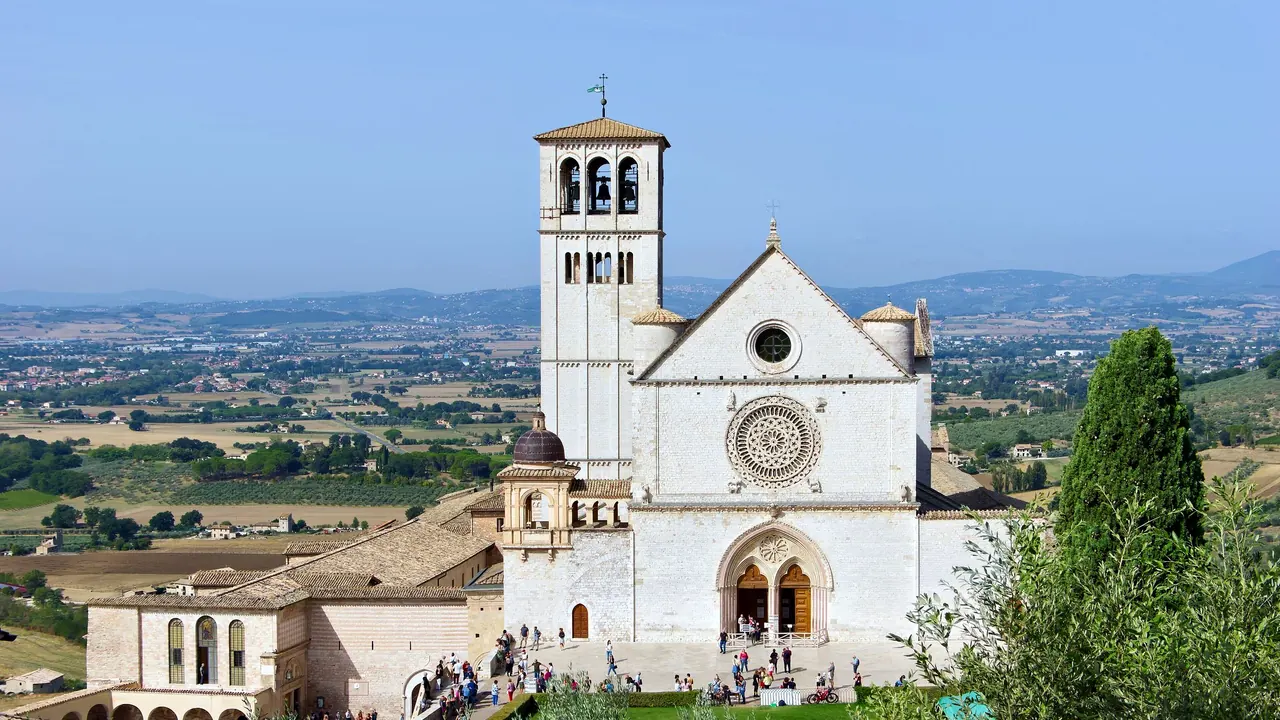
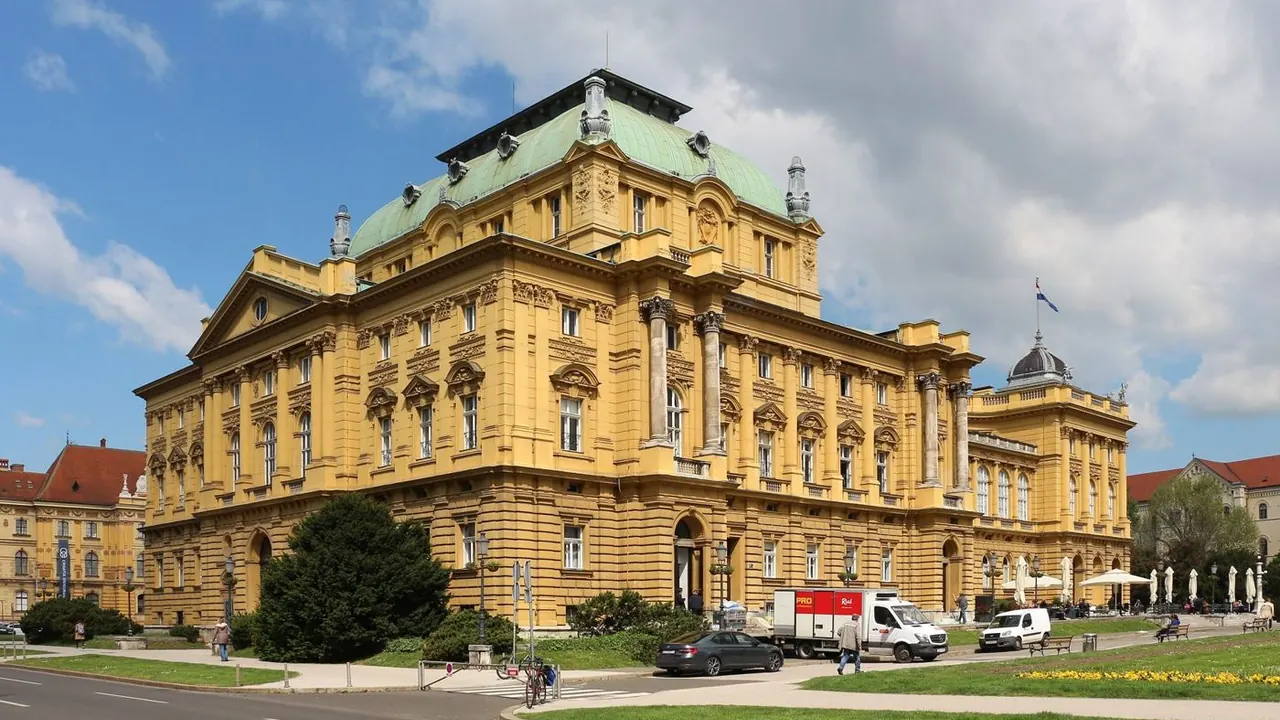
Photos: Assisi by Berthold Werner, CC BY-SA 4.0, cropped; Zagreb by Bernard Gagnon, CC BY-SA 4.0, cropped.
Assisi or Zagreb?
Our verdict in twelve categories, each scored against the same fixed benchmark cities, and the climate month by month, so you can choose for your trip.
Choose Assisi for
- day trips
- culture and sights
- wellness
Assisi suits a traveller who wants one extraordinary monument and a quiet base among the Umbrian hill towns. The Basilica of San Francesco, with its frescoed upper and lower churches, is the main reason to come, and the town around it is easy to take slowly. From there, Spello, Perugia, Spoleto, Gubbio and Orvieto make a different outing every day. Evenings are for dinner and a walk through empty lanes. Anyone who wants bars, concerts or a lively street life will find nothing of that here.
Choose Zagreb for
- nightlife
- live music and the arts
- families
Zagreb is the better pick for a rounded city stay with more going on after dark. Trams make it easy to cover, Dolac market and the café terraces give the days a rhythm, and the evenings offer the bars of Tkalčićeva, the National Theatre or a concert at Lisinski. It is also much easier with children. Its sights are pleasant rather than world-famous, so come for the everyday life of a Central European capital rather than for one great monument.
Scoreboard
Twelve categories on one fixed scale from 0 to 100. The shaded stretch is the gap between the two.
Your match
Pick a travel style or drag the sliders, and both match scores follow your weighting.
Wins on day trips and culture and sights with your weighting.
Wins on nightlife and live music and the arts with your weighting.
What matters to you?
Category by category
What the scores mean for a trip.
Beaches & swimming
Neither city is a beach destination. Both are around two hours from the sea, and they offer much the same kind of summer swim, just in different settings. From Assisi it is a 45-minute drive to the small lidos on Lake Trasimeno, where the water is warm, shallow and a little cloudy. Many visitors simply stay somewhere with a pool. Zagreb has its swimming inside the city: Jarun has pebbly shores with lifeguards, and Bundek is a smaller lake across the Sava. Both are a tram ride away, not a drive.
Food & drink
Zagreb gives you more ways to eat. Every morning Dolac market sells farm cheese, vegetables and flowers, the coffee culture shapes the whole day, and there are hearty dishes like štrukli and turkey with mlinci, plus wine from Plešivica and Zagorje. Fine dining is limited, but there is enough variety for a week.
Assisi's cooking is excellent at its best but narrow: truffled strangozzi, Castelluccio lentils, torta al testo, Subasio olive oil and Sagrantino from Montefalco. You need to look for it, though, because the streets near the basilica serve set menus to tour groups. The good meals are in side-lane trattorias and agriturismi in the valley.
Culture & sights
Assisi has the stronger heritage, because it is built around one of Europe's great artistic monuments. The double Basilica of San Francesco, with its Giotto cycle and Cimabue frescoes, is the centrepiece. Santa Chiara, the Roman Temple of Minerva and the Porziuncola chapel inside Santa Maria degli Angeli complete a UNESCO-listed pilgrimage town.
Zagreb offers more variety but less depth. You get the medieval Upper Town with St Mark's tiled roof, the Austro-Hungarian Green Horseshoe and a set of solid collections, from the Mimara to the Museum of Broken Relationships, plus the arcades of Mirogoj. It is a pleasant two days, but nothing in it matches the basilica.
Nightlife
Zagreb has a real evening life and Assisi has almost none. Café-bars on Tkalčićeva and around Flower Square move from coffee to cocktails and craft beer as the evening goes on. In summer the crowd heads to the lakeside clubs at Jarun, and students keep alternative venues open all year. It is relaxed rather than wild.
In Assisi an evening is a long dinner, a glass of Sagrantino and a walk through floodlit lanes that are empty by eleven. Anyone who wants more has to make the half-hour trip to Perugia.
Nature & outdoors
Both have a wooded mountain right on the doorstep, so the outdoors is equally good, but the walks feel different. Monte Subasio carries meaning as well as views: the path climbs past Francis's hermitage at the Eremo delle Carceri to open meadows above the Umbrian valley, and the Valnerina and Sibillini are further off. Medvednica is more of an everyday city escape. A tram and bus reach its beech woods and mountain huts, Maksimir and the Sava embankments are good for running, and Plitvice's waterfalls make a long day out.
Day trips
This is where Assisi stands out. A cluster of first-rate hill towns lies within an hour: Spello, Perugia, Spoleto with its Ponte delle Torri, Gubbio and Todi. Orvieto's cathedral and the Tuscan towns of Cortona and Montepulciano are within reach for a full day. Trains run along the valley, but the smaller towns are much easier with a car.
Zagreb's outings are pleasant but less striking. There is Trakošćan castle and the Zagorje countryside, baroque Varaždin, Samobor and its cream cake, and Karlovac's star-shaped fortress. Ljubljana works as a long day, but no single trip has the pull of an Orvieto or a Gubbio.
Good for families
Zagreb is much easier with children. The Lower Town is flat, trams take pushchairs, and there is plenty to fill a few days: the zoo in Maksimir, the old trams and mock mine at the Tesla technical museum, the tiny funicular and the swimming lakes in summer.
Assisi is safe and children are made welcome, but the sights are frescoed churches that need silence, and the stepped streets are hard work with a pushchair. Families usually stay at a valley agriturismo with a pool and visit the town in short trips. Older children will still enjoy the Rocca Maggiore.
Getting around
Zagreb is the simpler city to get around. The flat Lower Town is easy on foot, a dense network of blue trams covers the rest, and the funicular saves the climb to the Upper Town. You only need a car for Plitvice or the Zagorje castles.
Assisi is small enough to cross in twenty minutes, but it is nearly all slopes and stairs. The station is 4km below the town in Santa Maria degli Angeli, and away from the valley rail line buses are few, so exploring Umbria properly usually means hiring a car.
Shopping & style
Neither city is a shopping destination, but Zagreb has more range. Ilica has chains, local fashion and a few small design shops, and there is Dolac's covered hall for food and the Sunday flea market on Britanski trg. Good things to bring home are licitar hearts, lace and a Croatian necktie. Assisi's streets are mostly rosaries and Tau crosses. In among them you can find Assisi-embroidered linen, Deruta ceramics, truffle products and Sagrantino.
Affordability
Costs are much the same, and the savings come from different places. In Assisi the basilicas are free to enter, and convent guesthouses and valley agriturismi keep beds cheap, but hotels inside the walls cost more around Easter. Zagreb keeps day-to-day spending low through cheap trams, market food and inexpensive museum entry, while cocktails and the best hotels cost what they would in Western Europe.
Live music & performing arts
Zagreb has a proper cultural calendar and Assisi does not. The Croatian National Theatre stages opera and ballet, the Zagreb Philharmonic plays at Lisinski, and there are the Zagreb Soloists, jazz clubs and summer concerts in Upper Town courtyards. Much of the spoken theatre is in Croatian.
Assisi's music is mostly sacred: organ recitals and choirs in the basilica around feast days. In spring the Calendimaggio festival fills the town with medieval song and processions. For opera or Perugia's summer jazz festival, you have to travel.
Wellness & relaxation
Assisi is the more restful place, even though it has almost no spas. The calm comes from the town itself: convent retreats, silent walks up to the Eremo delle Carceri and lanes that are almost empty once the tour groups leave.
Zagreb offers slow café mornings and shady parks, but it is still a capital city. Its proper soaking is at the thermal resorts in Zagorje, such as Tuheljske and Stubičke Toplice, about an hour's drive away.
When should you go?
Pick your month. The climate figures are measured averages, not a forecast.
Assisi in July
Zagreb in July
Daytime high, °C
Rainfall in the month, mm
Where the figures come from
Assisi's temperatures are measured 51 km from the centre, at Frontone.
Assisi has no rain gauge within 25 km of the centre, so its rainfall comes from a gridded climate dataset read at the city rather than from a gauge further away.
Temperature and rainfall are climate normals, averaged over the years shown. Assisi: 1991-2020 normals, Frontone (50.5 km from centre). Zagreb: 1991-2020 (sunshine 1981-2010, rainfall 1981-2010) normals, Zagreb / Gric (0.6 km from centre).
The two cities have much the same temperatures through the year. Both are cold in winter and reach about 30°C in July, but their rain comes at opposite times. Assisi is driest in high summer, with only 34mm in July, so July and August are the reliable months for a swim at Lake Trasimeno, though the steep lanes are hard work at midday. For walking the town and the paths on Monte Subasio, late April to June is the best stretch, warm and still fairly dry. From September the rain builds through October to the wettest month, November.
Zagreb gets its rain in summer instead. June and August each bring over 100mm, so the safer months are April, with mild days around 18°C and little rain, and July, which is drier and the sunniest month of the year. July is also the time for a swim at Jarun or Bundek, though it is hot for long walks. Autumn stays damp through November, and from December to February both cities are too cold for comfortable sightseeing.
Which traveller are you?
On a culture and arts trip built around painting and architecture, Assisi is worth the journey for its own sake. One masterpiece of early Italian art is the reason to come, and nearby hill towns add another fresco cycle or cathedral almost every day. Choose Zagreb only if an evening at the opera matters more.
For a food and nightlife trip, Zagreb is the only real option of the two. Its markets, terraces and bars carry you from morning into the evening, and there are still places open after dinner. Assisi offers a fine rural meal and then a silent town.
On a family trip with children, Zagreb makes things simple. You can stay in the centre, get around without a car, and break up each day with a museum, a park or a swim. Assisi works better as a short outing from a country stay than as a base.
Before you go
| Measure | Assisi | Zagreb |
|---|---|---|
| Official language | Italian | Croatian |
| Currency | Euro (EUR) | Euro (EUR) |
| Sockets | CFL230 V, 50 Hz | CF230 V, 50 Hz |
| Driving side | Right | Right |
| Time zone | UTC+1, UTC+2 in summer | UTC+1, UTC+2 in summer |
| Emergency number | 112 | 112 |
| Elevation | 424 m | 127 m |
| Main airport | Perugia San Francesco d'Assisi – Umbria International Airport (PEG)9 km from centre17 non-stop destinations | Zagreb Franjo Tuđman International Airport (ZAG)11 km from centre66 non-stop destinations |
| Public holidays this year | 13 days | 14 days |
By the numbers
| Measure | Assisi | Zagreb |
|---|---|---|
| City population | 27,605 | 767,131 |
| People per km² | 147 | - |
| Museums within 10 km | 14 | 27 |
| UNESCO World Heritage sites within 50 km | 2 | 0 |
Where else could you go?
Every comparison below shares a destination with this one, so you can follow Assisi or Zagreb somewhere new.