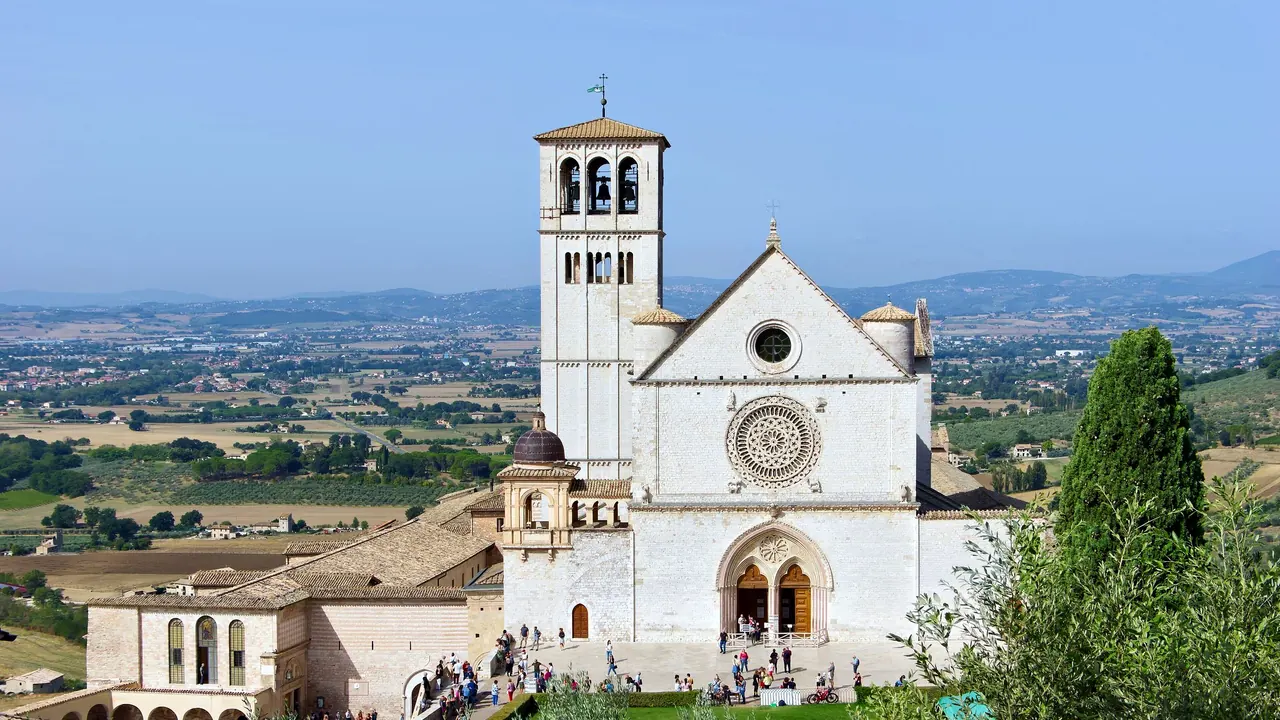
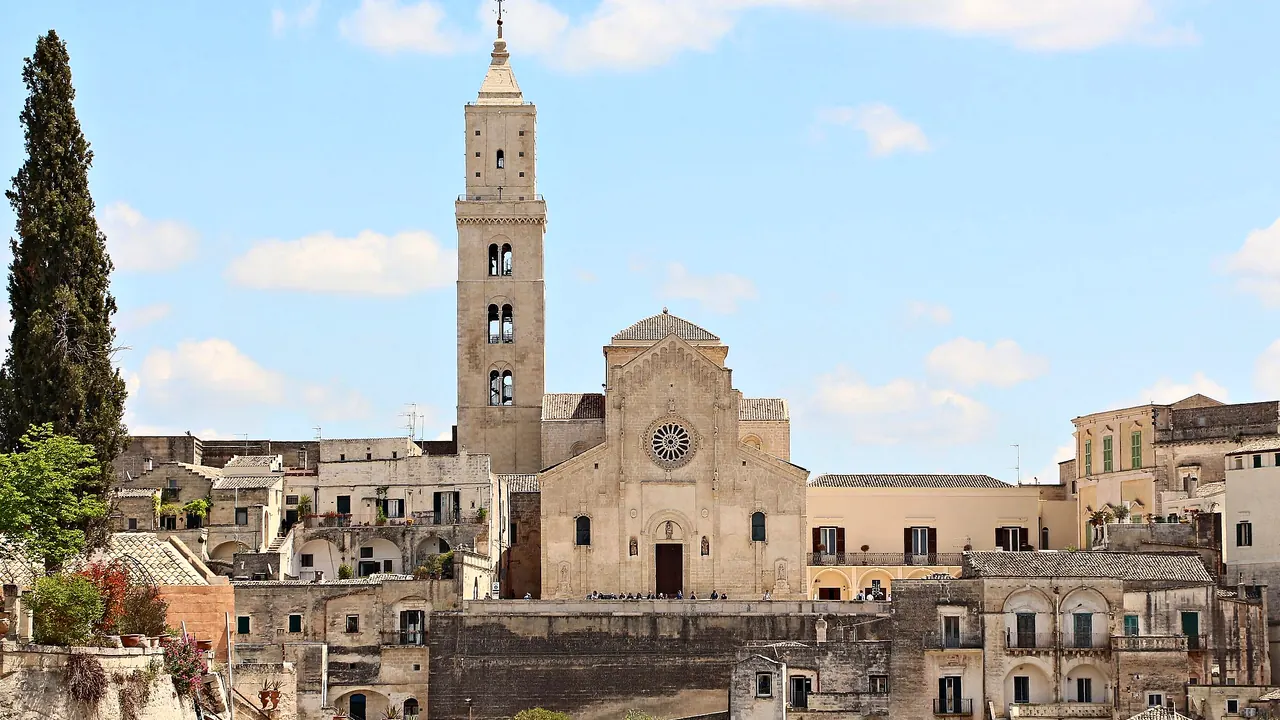
Photos: Assisi by Berthold Werner, CC BY-SA 4.0, cropped; Matera by Bernard Gagnon, CC BY 4.0, cropped.
Assisi or Matera?
Our verdict in twelve categories, each scored against the same fixed benchmark cities, and the climate month by month, so you can choose for your trip.
Choose Assisi for
- getting around
- day trips
- wellness
Assisi suits a slower, more contemplative trip through the heart of Umbria. The town is built around the Basilica of San Francesco and its frescoes, the evenings are almost silent, and regional trains run along the valley to Spello, Perugia and Spoleto, so it works well as a base for hill towns, wine villages and walks on Monte Subasio. Pilgrims, art lovers and anyone after real stillness will feel at home here.
Choose Matera for
- beaches
- nightlife
- food and drink
Matera is the stranger and warmer of the two. The cave districts of the Sassi above the Gravina gorge look like nowhere else in Italy, the food is a little more varied, and summer evenings have terrace bars and a passeggiata, though still no real nightlife. Sandy Ionian beaches and the trulli of Puglia are within driving distance, so travellers with a hire car who want sightseeing with a swim or two will get more from it.
Scoreboard
Twelve categories on one fixed scale from 0 to 100. The shaded stretch is the gap between the two.
Your match
Pick a travel style or drag the sliders, and both match scores follow your weighting.
Wins on getting around and day trips with your weighting.
Wins on beaches and nightlife with your weighting.
What matters to you?
Category by category
What the scores mean for a trip.
Beaches & swimming
Neither town is on the coast, but Matera is much better placed for a swim. About 45 minutes away, the Ionian shore around Metaponto and Policoro has wide sandy beaches backed by pine woods, with shallow, warm water that suits children. The Adriatic coves of Puglia are further on.
From Assisi the sea is about two hours away in either direction. The nearest swimming is at the little lido beaches on Lake Trasimeno, where the water is warm but murky. In practice, a pool at your agriturismo is the realistic option.
Food & drink
Both towns serve honest rural cooking with little street food and no market halls, but Matera eats a little better. Pane di Matera, peperoni cruschi, crapiata and hand-made cavatelli give it a stronger identity, and the trattorias in the upper town around Via Ridola are good and fairly priced.
Assisi has excellent ingredients: black truffle on strangozzi, Castelluccio lentils, Subasio olive oil and Sagrantino from Montefalco. The problem is that the streets nearest the basilica are full of set menus for tour groups. To eat well you have to look for side-lane trattorias or the agriturismi in the valley.
Culture & sights
Both towns are equally strong for sightseeing, but in very different ways. Assisi is about art and faith. The two stacked churches of the Basilica of San Francesco hold frescoes by Giotto, Cimabue and Simone Martini, and the Temple of Minerva, Santa Chiara and the Porziuncola complete a pilgrimage town made of pink stone.
Matera is about a place lived in since prehistory. You explore the cave homes and carved rock churches of Sasso Caveoso and Sasso Barisano, walk through the Palombaro Lungo cistern under the main piazza, and see Carlo Levi's panorama at Palazzo Lanfranchi. Assisi rewards close looking indoors, while Matera's best moment is standing over the gorge at dusk.
Nightlife
Neither town has a night out, but Matera at least has an evening. In summer the passeggiata along Via del Corso, a few late cave wine bars and cocktail terraces above the lit Sassi, and a small student crowd keep things going for a while.
In Assisi the lanes are empty by eleven, and an evening means a glass of Sagrantino and a walk under the floodlights. For bars you would need to go to Perugia, half an hour away.
Nature & outdoors
Holm-oak woods and wildflower meadows on Monte Subasio, or the bare limestone of the Murgia: the walking is equally good in both towns, but it feels very different underfoot. From Assisi a path climbs through shady woods past the Eremo delle Carceri to open grassland at about 1,290m, and below the town the olive groves and flat valley floor make easy cycling between Spello, Bevagna and Montefalco.
Matera's landscape is drier and starts at the edge of town. You drop into the Gravina gorge, cross the stream and climb onto a stony plateau of wild thyme, where abandoned rock churches and Neolithic village sites look back at the Sassi and kestrels nest in the cliffs. For longer days by car, Assisi has the Valnerina and the Sibillini, while Matera has the sandstone peaks of the Lucanian Dolomites and the forests of Pollino.
Day trips
Assisi is the stronger base, because so much lies close by and part of it can be reached by train. Spello is minutes away, and Perugia, Spoleto, Gubbio, Todi and Orvieto follow, along with Deruta's ceramics and the Tuscan towns of Cortona and Montepulciano.
Matera's outings are excellent too: Altamura, the trulli of Alberobello, the white towns of the Valle d'Itria, Castel del Monte, ghostly Craco and the mountain villages of Castelmezzano and Pietrapertosa. Almost all of them need a car, though, and the distances are longer.
Good for families
Assisi's answer for families is to stay outside it, at an agriturismo with a pool in the valley, and come up for short visits to the Rocca Maggiore or a walk on Monte Subasio. The frescoed churches need quiet, which is hard on younger children.
Matera gives curious older children a little more inside the town: cave houses, the walk-through cistern under the main piazza and a scramble down into the gorge. With a car, the shallow sandy beaches of the Ionian coast make an easy break. In both towns, though, the stepped lanes rule out a pushchair, so bring a baby carrier.
Getting around
Assisi is somewhat easier. Its small walled centre is steep, but car parks and lifts at the edges help. Regional trains from the station in Santa Maria degli Angeli run along the valley to Perugia, Spello and Spoleto, so you can see a fair amount without a car.
On foot, Matera is simple: the upper town is flat and the Sassi lie just below, down tiring stairs. Leaving it is the hard part. Matera has no main-line railway, only a slow narrow-gauge line to Bari, and buses are sparse, so a hire car matters more here.
Shopping & style
Neither town is a place to shop seriously, and in both the things worth taking home are local crafts and food rather than fashion. In Assisi they are mixed in with the rosaries, Tau crosses and Franciscan souvenirs that fill the streets around the basilicas, so it takes some looking to find the hand-woven linens with Assisi embroidery, Deruta ceramics, Subasio olive oil and bottles of Sagrantino.
Matera's workshops in the Sassi sell the cuccù, a painted terracotta whistle shaped like a cockerel, along with tufa carvings and papier-mâché. Dried peppers and Aglianico also pack well. The town has something Assisi lacks, too: a stretch of ordinary Italian high-street shops along Via del Corso in the upper town.
Affordability
Costs are similar in both towns, and they are cheaper than the big Italian cities. The ways to save differ. Assisi has free basilicas and simple convent guesthouses, though rooms inside the walls cost more around Easter and feast days. In Matera the cave hotels in the Sassi are the expensive part, so staying in the newer town a short walk away keeps costs down.
Live music & performing arts
Live performance is thin in both towns, so plan around particular occasions. Assisi offers organ and choral music in its basilicas and the medieval song and costume of Calendimaggio in spring, and Perugia is close for opera and jazz. Matera's big night is the Festa della Bruna, when a papier-mâché float is torn apart, and in summer there are open-air concerts and a jazz festival set against the Sassi.
Wellness & relaxation
Assisi's calm is spiritual and comes with the place. People come for retreats in convent guesthouses, silent walks up to the Eremo delle Carceri and the stillness that settles once the tour groups have gone. The few spas are in country hotels down in the valley.
Matera relies on pace more than on retreats, but it has the more unusual spa: hotel pools cut into candlelit cave rooms. Neither town has thermal baths. Matera is most restful from autumn to spring, with early mornings in the Sassi and the light fading over the gorge in the evening.
When should you go?
Pick your month. The climate figures are measured averages, not a forecast.
Assisi in July
Matera in July
Daytime high, °C
Rainfall in the month, mm
Where the figures come from
Assisi's temperatures are measured 51 km from the centre, at Frontone.
Assisi has no rain gauge within 25 km of the centre, so its rainfall comes from a gridded climate dataset read at the city rather than from a gauge further away.
Matera has no rain gauge within 25 km of the centre, so its rainfall comes from a gridded climate dataset read at the city rather than from a gauge further away.
Temperature and rainfall are climate normals, averaged over the years shown. Assisi: 1991-2020 normals, Frontone (50.5 km from centre). Matera: 2005-2025, 10 years observed (rainfall 1991-2020) normals, Matera / Martella (4.8 km from centre).
Assisi is the cooler of the two all year. Spring and autumn are its best seasons for walking the stepped lanes and the slopes of Monte Subasio. July reaches about 30°C, so summer sightseeing is best done early. Winter is cold and grey, and rain builds through autumn to a peak of about 94mm in November.
Matera runs a few degrees warmer, with milder winters and a hotter summer, when the bare plateau reaches about 32°C in July. The upside is the sea: the Ionian coast warms to around 26°C in August and stays pleasant for swimming from June to September. May, June and late September suit both the Sassi and the gorge. Like Assisi, Matera is at its wettest in late autumn.
Which traveller are you?
On a beach and sun trip, Matera is the clear choice. The long sandy beaches near Metaponto and Policoro are a short drive away and the water is calm and warm in summer. From Assisi the only swimming is a shallow lake lido or a hotel pool.
For a food and nightlife trip, Matera again comes out ahead, though neither town is lively. Its Basilicata cooking has more range, the upper town has good trattorias, and in summer there are cave wine bars and a passeggiata. Assisi goes quiet after dinner.
For a short city break, Assisi is easier. Regional trains reach the valley below the town, the compact centre takes two calm days, and the basilicas are free to enter. Matera is off the national rail network, so even getting there takes longer.
Before you go
| Measure | Assisi | Matera |
|---|---|---|
| Official language | Italian | Italian |
| Currency | Euro (EUR) | Euro (EUR) |
| Sockets | CFL230 V, 50 Hz | CFL230 V, 50 Hz |
| Driving side | Right | Right |
| Time zone | UTC+1, UTC+2 in summer | UTC+1, UTC+2 in summer |
| Emergency number | 112 | 112 |
| Elevation | 424 m | 401 m |
| Main airport | Perugia San Francesco d'Assisi – Umbria International Airport (PEG)9 km from centre17 non-stop destinations | Bari Karol Wojtyła International Airport (BRI)54 km from centre104 non-stop destinations |
| Public holidays this year | 13 days | 13 days |
By the numbers
| Measure | Assisi | Matera |
|---|---|---|
| City population | 27,605 | 59,685 |
| People per km² | 147 | 152 |
| Museums within 10 km | 14 | 8 |
| UNESCO World Heritage sites within 50 km | 2 | 1 |
| Swim season, months above 21 °C | - | 5 months |
Where else could you go?
Every comparison below shares a destination with this one, so you can follow Assisi or Matera somewhere new.