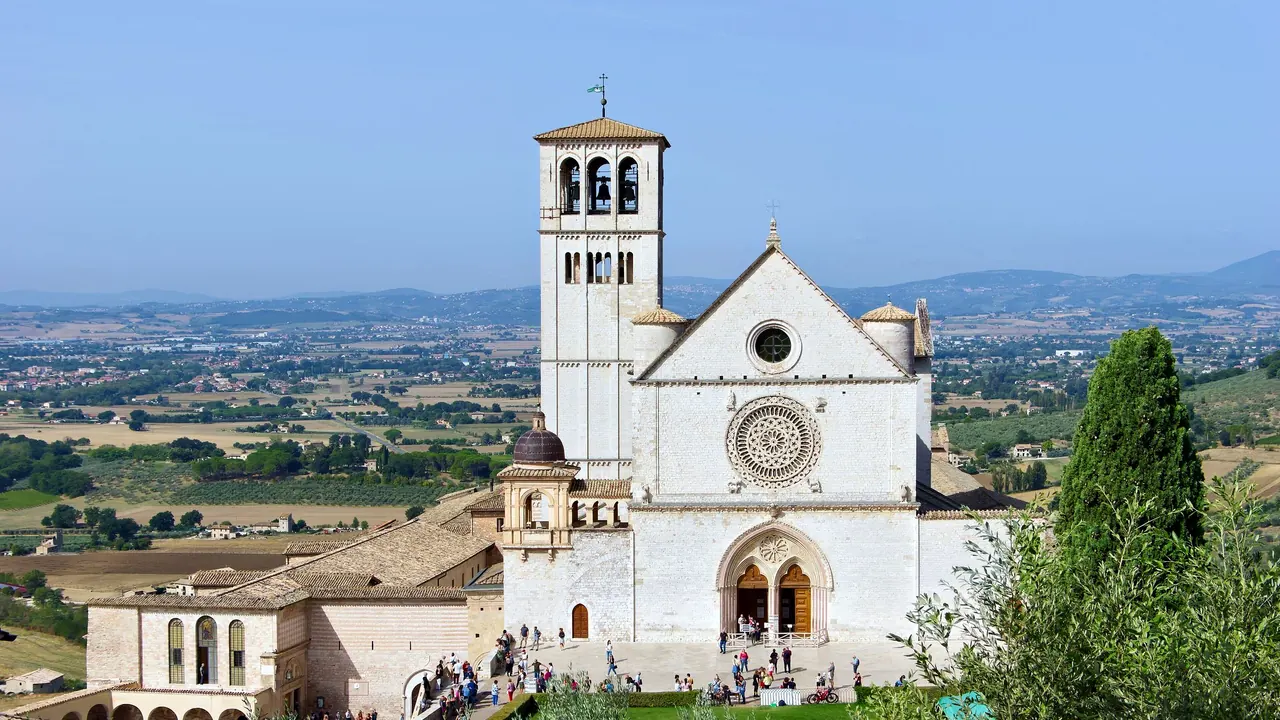
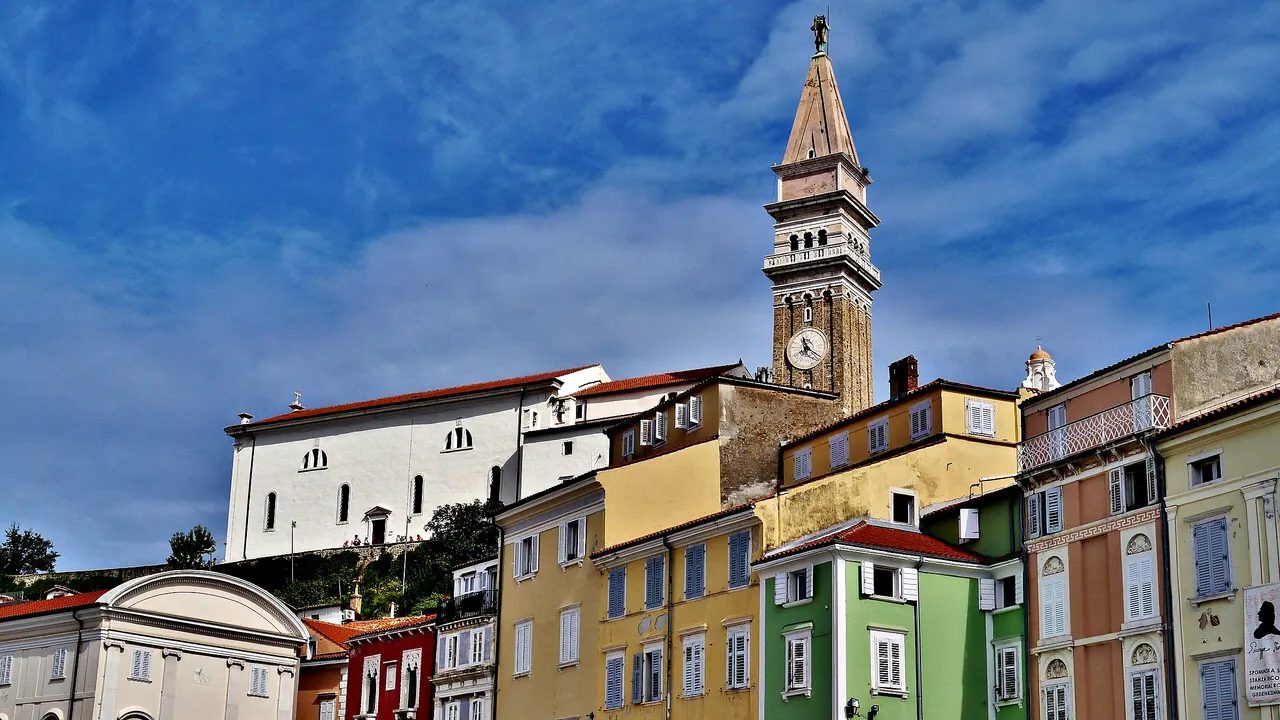
Photos: Assisi by Berthold Werner, CC BY-SA 4.0, cropped; Piran by Zairon, CC BY-SA 4.0, cropped.
Assisi or Piran?
Our verdict in twelve categories, each scored against the same fixed benchmark cities, and the climate month by month, so you can choose for your trip.
Choose Assisi for
- culture and sights
- prices
- day trips
Assisi is for travellers who come for art, faith and the hill towns of central Italy. The Basilica of San Francesco and its frescoes alone justify the journey, and from here Spello, Perugia, Spoleto, Gubbio and Orvieto are all within easy reach. It suits couples and slower travellers who like quiet evenings, a walk up Monte Subasio and slightly lower costs, and who don't need the sea.
Choose Piran for
- beaches
- families
- wellness
Pick Piran if the sea matters. Swimming from the rocks below the walls, the car-free Venetian peninsula and the salt-pan spas of the coast make it the better place to slow down for a few days, and it is easier with children. The old town fills a day rather than two, but Trieste, Croatian Istria and the Karst give a week of outings for anyone with a car.
Scoreboard
Twelve categories on one fixed scale from 0 to 100. The shaded stretch is the gap between the two.
Your match
Pick a travel style or drag the sliders, and both match scores follow your weighting.
Wins on culture and sights and prices with your weighting.
Wins on beaches and families with your weighting.
What matters to you?
Category by category
What the scores mean for a trip.
Beaches & swimming
This is the widest gap between the two. Assisi sits in the hills of central Italy, two hours from either coast, and the nearest swimming is at Lake Trasimeno's shallow, rather murky lidos about 45 minutes away. Beyond that, it comes down to a pool at your hotel or agriturismo.
Piran is built for the water, though not for lying on sand. People swim off concrete platforms, rocks and ladders below the walls and around the Punta, and there's a small pebble cove at Fiesa. For sunbeds and sand you go along the shore to Portoroz or to the cliff-backed bay at Strunjan.
Food & drink
Neither town is a destination for eating in its own right. Both have a narrow choice, and in both the meals near the main sights are the weakest. The difference is between land and sea. Assisi serves Umbrian country cooking: strangozzi with black truffle, Castelluccio lentils, wild boar, torta al testo and big Sagrantino reds from Montefalco.
Piran serves fish by the harbour: grilled squid, mussels and scampi buzara, with white Malvazija or dark Refosk and salt from the local pans. Both share fine olive oil and truffles from the hills, but for real variety you have to leave town: to the agriturismi in the valley below Assisi, or into the Istrian hinterland from Piran.
Culture & sights
Assisi is in a different league. The Basilica of San Francesco, two churches stacked on the hillside with the Saint Francis fresco cycle in the Upper Church, is a UNESCO site and one of the great monuments of Europe. The Temple of Minerva, Santa Chiara, the Rocca Maggiore and the Porziuncola below the town add up to two full days.
Piran's appeal is the town as a whole: Venetian Gothic houses around oval Tartini Square, the campanile of St George and the medieval walls above the red roofs. Its maritime museum and Minorite cloister are pleasant but small, and a single day of wandering covers it.
Nightlife
Both are early-to-bed towns, but Piran has a little more life. A sunset glass on the Punta or Tartini Square is the usual evening, and Portoroz, a few minutes away, adds beach bars, a casino and a few clubs in summer.
Assisi is empty by eleven once the day-trippers leave, with a long dinner and perhaps a wine bar as the whole evening. Anyone wanting late nights would stay in Perugia instead.
Nature & outdoors
Both offer gentle country, with Assisi a little ahead for walkers. Monte Subasio rises right behind the town, with a path through holm-oak woods to the Eremo delle Carceri and on to open summit meadows at about 1,290m. The Valnerina and the Sibillini mountains are within driving range for bigger days.
Piran's outdoors are coastal and flatter: the flysch cliffs and path at Strunjan, wading birds among the Secovlje salt pans, and kayaking under the cliffs. Inland, the Parenzana cycle route and the Skocjan caves on the Karst fill out the list.
Day trips
Both make good bases, but Assisi is surrounded by a denser cluster of places worth the trip. Spello is ten minutes away, Perugia half an hour, and Spoleto, Gubbio and Todi around an hour. Orvieto, Deruta and the Tuscan towns of Cortona and Montepulciano are within reach, and several of these can be reached by train.
Piran's strength is variety across borders: Habsburg Trieste, Rovinj and Porec in Croatian Istria, Predjama Castle and Ljubljana in Slovenia, and boats to Venice in summer. Most of these outings need a car, though.
Good for families
Piran is the more practical choice with children. The car-free old town and flat seafront are safe to roam, the sea is calm and warm in summer, the harbour aquarium suits younger children, and Portoroz has a shallow sandy beach.
Assisi welcomes children but gives them little to do. Its frescoed churches expect silence, its stepped streets defeat pushchairs and its summer afternoons are hot. Older children may enjoy the Rocca Maggiore and Monte Subasio, but families usually stay at a valley agriturismo with a pool and visit the town in short trips.
Getting around
Within town, Piran is easier. The peninsula is car-free, mostly level along the water and crossed in a quarter of an hour, and a shuttle bus runs in from the garage and along to Portoroz. Assisi is just as compact but climbs steeply from the basilica to the cathedral, and its station lies about 4km below in Santa Maria degli Angeli.
For going further, the advantage swings. Assisi sits on a rail line to Perugia, Spello, Foligno and Spoleto, while Piran has no railway and only slow buses into Istria and the Karst.
Shopping & style
Neither town is a place to shop, and fashion, design and proper markets are missing from both. What separates them is the kind of trade. Assisi's follows the pilgrims, so devotional goods crowd the lanes near the basilicas, but among them are crafts with real substance: embroidered Umbrian linen and Deruta's painted pottery are worth wrapping carefully for the journey home.
Piran's harbour stalls are seaside rather than sacred, and its crafts are thinner on the ground. Its strength is the larder, and salt flower from the Secovlje pans is the one souvenir you won't find elsewhere, along with coastal wine and oil. Assisi matches it with truffles and Sagrantino, so for edible gifts the two are level. For anything more, Piran at least has Trieste within an hour.
Affordability
Assisi is the cheaper of the two. Its basilicas and most churches are free to enter, convent guesthouses offer simple rooms at low cost and valley agriturismi are good value. Only the restaurants beside the basilicas and the busy feast days push prices up.
Piran is pricier, mainly because of the season. In July and August, rooms in the old town are scarce and expensive, and the waterfront tables charge for the view. Staying in Portoroz or visiting outside high summer brings costs down, and the swimming and walking cost nothing.
Live music & performing arts
There's little in either town, and what there is depends on the calendar. Assisi follows the religious year, with organ and choral concerts in the basilicas around the feasts and the costumed Calendimaggio festival in spring, while Perugia, nearby, has the opera and the famous summer jazz.
Piran's music is concentrated in summer, with classical concerts honouring Tartini in its churches, the monastery cloister and the main square. Come out of season and there's very little on.
Wellness & relaxation
Piran is the better choice for treatments. Portoroz grew up as a spa resort, using seawater, brine and salt-pan mud, there's an open-air thalasso spa among the lagoons at Secovlje, and Strunjan has a seawater health resort.
Assisi offers a different kind of rest: convent retreats, silent walks to the Eremo delle Carceri and the stillness of the lanes once the tour groups have gone. Spas there are few and mostly in country hotels below the town.
When should you go?
Pick your month. The climate figures are measured averages, not a forecast.
Assisi in July
Piran in July
Daytime high, °C
Rainfall in the month, mm
Where the figures come from
Assisi's temperatures are measured 51 km from the centre, at Frontone.
Assisi has no rain gauge within 25 km of the centre, so its rainfall comes from a gridded climate dataset read at the city rather than from a gauge further away.
Temperature and rainfall are climate normals, averaged over the years shown. Assisi: 1991-2020 normals, Frontone (50.5 km from centre). Piran: 2005-2020 (sunshine 1991-2020, rainfall 1991-2020) normals, Portoroz (1.2 km from centre).
Assisi is at its best in spring and early autumn. April and May are mild enough for the climb between the basilicas and the walk up Monte Subasio, and September stays warm before the rain builds through October and November. July and August reach about 30°C, which makes the steep, stepped lanes hard going in the afternoon, although July is also the driest month. Winters are cold for a hill town, at around 7°C in January.
Piran has the same summer heat, but on the coast it means swimming weather. The sea reaches 25°C in July and August, and July is both the sunniest month and one of the drier ones, so midsummer is the surest time for the water. Outside summer, the rain is the catch. May is already fairly wet, and September, October and November are the wettest months of the year, each over 110mm. A September trip gets you a sea that is still warm, but expect a fair share of showers. Winter is milder here than in Assisi.
Which traveller are you?
On a beach and sun trip, Piran is the clear choice. You can swim straight from the seafront into clear, warm Adriatic water, there's sand at Portoroz and quieter coves at Strunjan. Landlocked Assisi offers only lake lidos and hotel pools.
For a culture and arts trip, Assisi wins. The Basilica of San Francesco, with frescoes by Giotto, Cimabue and Simone Martini, is a sight of European rank, and Perugia, Spoleto and Orvieto are close by. Piran is a lovely townscape but has modest museums.
On a family trip with children, Piran is easier. The old town is closed to cars, the seafront is flat and the sea is calm, and there's an aquarium and a shallow sandy beach next door. Assisi's silent churches and stepped streets ask a lot of children.
Before you go
| Measure | Assisi | Piran |
|---|---|---|
| Official language | Italian | Slovene |
| Currency | Euro (EUR) | Euro (EUR) |
| Sockets | CFL230 V, 50 Hz | CF230 V, 50 Hz |
| Driving side | Right | Right |
| Time zone | UTC+1, UTC+2 in summer | UTC+1, UTC+2 in summer |
| Emergency number | 112 | 112 |
| Elevation | 424 m | 7 m |
| Main airport | Perugia San Francesco d'Assisi – Umbria International Airport (PEG)9 km from centre17 non-stop destinations | Trieste Airport (TRS)34 km from centre32 non-stop destinations |
| Public holidays this year | 13 days | 21 days |
By the numbers
| Measure | Assisi | Piran |
|---|---|---|
| City population | 27,605 | 3,787 |
| People per km² | 147 | 85 |
| Museums within 10 km | 14 | 5 |
| UNESCO World Heritage sites within 50 km | 2 | 4 |
| Swim season, months above 21 °C | - | 4 months |
Where else could you go?
Every comparison below shares a destination with this one, so you can follow Assisi or Piran somewhere new.