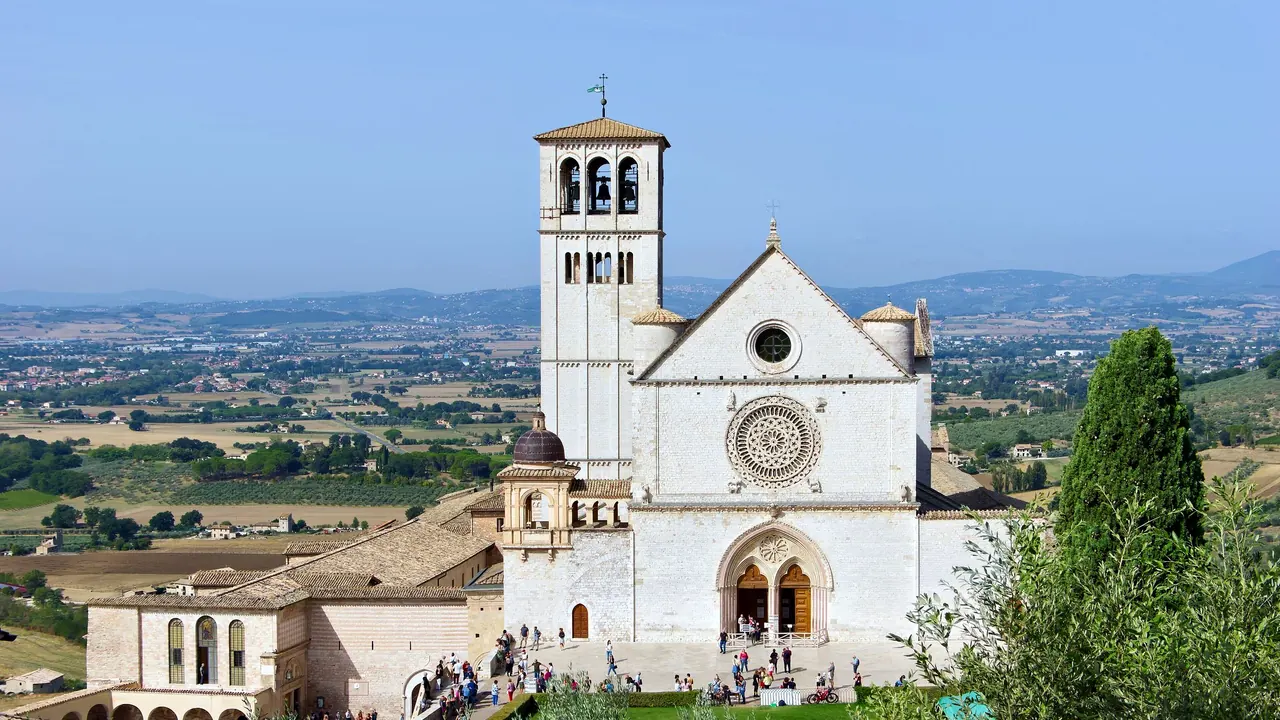
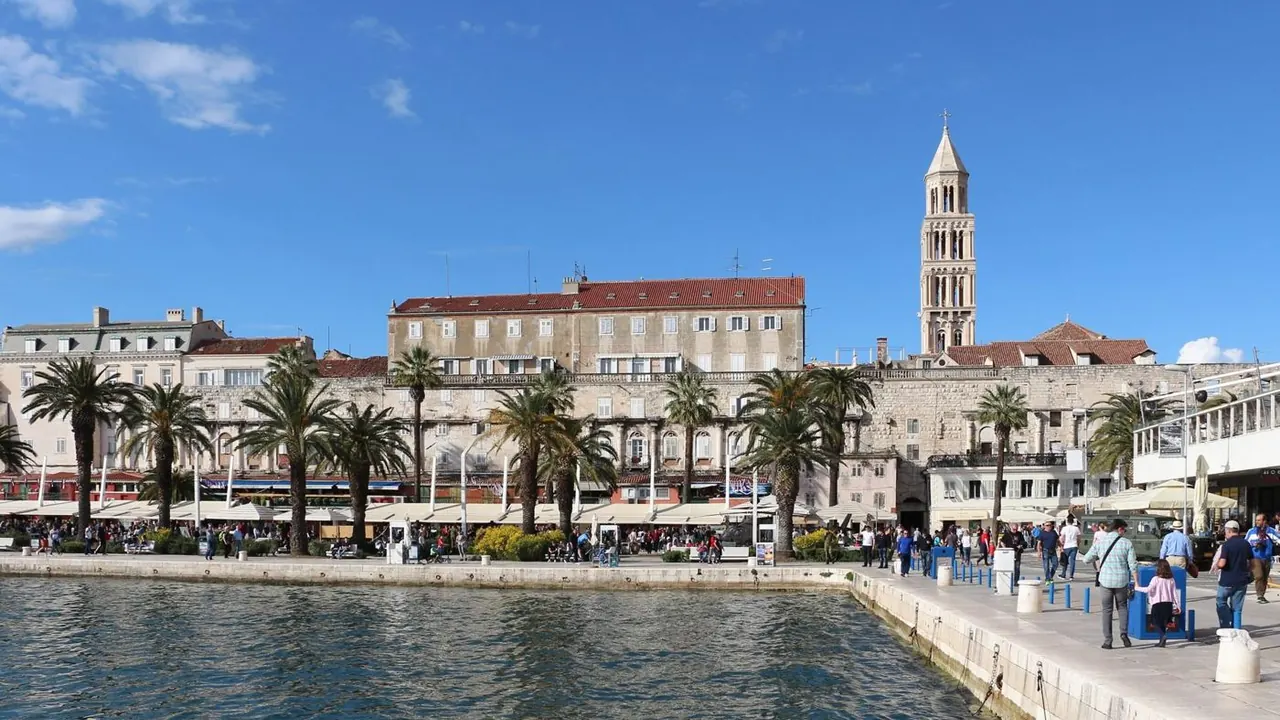
Photos: Assisi by Berthold Werner, CC BY-SA 4.0, cropped; Split by Bernard Gagnon, CC BY-SA 4.0, cropped.
Assisi or Split?
Our verdict in twelve categories, each scored against the same fixed benchmark cities, and the climate month by month, so you can choose for your trip.
Choose Assisi for
- prices
- day trips
- culture and sights
Assisi suits a slow, quiet trip built around art, faith and the hill towns of central Italy. The Basilica of San Francesco is the reason to come, and the town also makes a better base for touring: Spello, Perugia, Spoleto, Gubbio and Orvieto all lie within easy reach by train or car. It costs less too, especially if you sleep in a convent guesthouse or a valley agriturismo. You will find no beach and almost nothing to do after dinner.
Choose Split for
- beaches
- nightlife
- families
Split is the choice if you want the sea and a full summer evening in the same trip as your history. You can swim within walking distance of a lived-in Roman palace, ferries carry you to Brač and Hvar, and Marjan and the coastal mountains are close for hiking. It is livelier and easier with children, but July and August make it noticeably dearer.
Scoreboard
Twelve categories on one fixed scale from 0 to 100. The shaded stretch is the gap between the two.
Your match
Pick a travel style or drag the sliders, and both match scores follow your weighting.
Wins on prices and day trips with your weighting.
Wins on beaches and nightlife with your weighting.
What matters to you?
Category by category
What the scores mean for a trip.
Beaches & swimming
Split wins easily. You can walk from Diocletian's Palace to the shallow sandy bay of Bačvice or to the pine-shaded coves around Marjan, and ferries reach longer, calmer beaches on Brač, Šolta and Hvar. Most of the city shore is pebble or concrete, though, and it fills up in midsummer.
Assisi sits on a hillside far from either coast. The closest swimming is at the small lidos on Lake Trasimeno, where the water is warm but slightly murky, so for a cool-off during your stay it is better to book somewhere with a pool.
Food & drink
Split eats from the sea: grilled fish and squid, black risotto, and octopus slow-cooked under the peka bell. Its fish market and the Pazar give you real markets to browse, and the best meals are in family konobas in Varoš.
Assisi's cooking is inland and earthier: truffled strangozzi, Castelluccio lentils, wild boar, oil from the slopes of Monte Subasio and Sagrantino from Montefalco. The choice in town is narrow, however, and set menus crowd the streets near the basilica. Neither city does much fine dining, so Split's lead comes from variety and its markets.
Culture & sights
The two are evenly matched, but the experiences differ. Assisi is about art and devotion: the stacked churches of San Francesco, with frescoes by Cimabue, Simone Martini and the Giotto cycle, set within a UNESCO-listed town of pink stone, Santa Chiara and the Porziuncola.
Split's treasure is architecture you live inside. Diocletian's Palace is a working neighbourhood, with the cathedral built into the emperor's mausoleum and the original layout preserved in the vaults below. The Meštrović Gallery adds modern sculpture. In both places two days covers the main sights.
Nightlife
There is a real gap here, at least in summer. Split's evenings move from the Riva into small bars in the palace alleys and on to beach bars and clubs at Bačvice, which stay open until the early hours. From October to May that shrinks to a few bars.
Assisi goes still once the day visitors leave. A night there means a long dinner, a glass of Sagrantino and a walk through floodlit lanes, and anyone after a night out has to go to Perugia.
Nature & outdoors
Split has more range, because it combines mountain and sea. Marjan's forest park starts at the edge of the old town, Mosor and Biokovo give real ridge hikes, and the Cetina canyon at Omiš offers rafting and canyoning. Add Krka's waterfalls and kayaking or sailing among the islands.
Assisi's outdoors is gentler and more contemplative: the climb up Monte Subasio past the Eremo delle Carceri to open summit meadows, and easy cycling through the olive groves between Spello and Montefalco. The Valnerina and the Sibillini are bigger days out by car.
Day trips
This is where Assisi comes out ahead. Spello is minutes away, Perugia half an hour, and Spoleto is on the same railway line. Gubbio, Todi, Orvieto, Deruta and the Tuscan towns of Cortona and Montepulciano complete a dense ring of hill towns, though a car helps for the smaller ones.
Split's trips are fewer but more varied: UNESCO-listed Trogir and Šibenik, Roman Salona and Klis Fortress on land, and Hvar, Brač and Vis by sea. The ferries make this easy in summer, but in winter it takes more planning.
Good for families
Split is the easier choice with children. Bačvice's shallow water suits small paddlers, Marjan gives shade and room to run, and a ferry to an island usually wins them over. The midsummer heat and crowds are the main drawbacks.
Assisi is safe and welcoming, but its steep, stepped streets are hard with a pushchair, and its frescoed churches ask for silence. The Rocca Maggiore and a walk on Monte Subasio work for older children, and most families do better in a valley agriturismo with a pool.
Getting around
In Split, the palace, the Riva, Varoš, the markets and Bačvice all lie within a short, car-free walk, and the ferry port, bus station and railway station sit together on the harbour. Polished stone steps inside the palace are the main nuisance.
Assisi's centre is small, but it climbs hard from the basilica up to Piazza del Comune. The station is 4km below in Santa Maria degli Angeli. Valley trains serve Perugia and Spoleto, but buses beyond that line are sparse, so most visitors end up hiring a car.
Shopping & style
Neither city is a shopping destination, but Split offers a little more. Marmontova has the mainstream fashion chains, and the Pazar by the palace's east gate is a pleasant place for figs, honey and local brandies.
In Assisi, rosaries and Franciscan souvenirs dominate, but look among them for embroidered Assisi linens, Deruta ceramics and truffle products. In both places, the olive oil and wine are what is worth carrying home.
Affordability
Assisi is the cheaper of the two. The basilicas and most churches are free, convent guesthouses give clean, simple rooms at low cost, and valley agriturismi are good value. Prices rise mainly around Easter and the big feast days.
Split costs most in July and August, when rooms near the old town match large Western European cities, fish is sold by weight and ferries add up for a family. In May, June, late September and winter it is far more reasonable.
Live music & performing arts
Split has the fuller stage. The Croatian National Theatre puts on opera and ballet through the season, and the Split Summer Festival stages open-air performances in the Peristyle. Klapa harmony singing often echoes in the palace vestibule.
Assisi's offer is mostly sacred: organ recitals and choirs in the basilicas, plus the costumed rivalry of Calendimaggio in spring. For opera or the famous summer jazz festival, people go to Perugia.
Wellness & relaxation
Neither city has a bathing tradition, and spas in both are mostly hotel affairs, so the difference lies in the kind of calm. Assisi's is spiritual: convent retreats, silent walks to the Eremo and empty early-morning lanes.
Split offers the Dalmatian idleness called fjaka: long coffees on the Riva and the pine woods of Marjan. That calm is easiest to find outside midsummer, when the old town turns loud and the islands make a better retreat.
When should you go?
Pick your month. The climate figures are measured averages, not a forecast.
Assisi in July
Split in July
Daytime high, °C
Rainfall in the month, mm
Where the figures come from
Assisi's temperatures are measured 51 km from the centre, at Frontone.
Assisi has no rain gauge within 25 km of the centre, so its rainfall comes from a gridded climate dataset read at the city rather than from a gauge further away.
Temperature and rainfall are climate normals, averaged over the years shown. Assisi: 1991-2020 normals, Frontone (50.5 km from centre). Split: 1991-2020 (sunshine 1971-2000, rainfall 1981-2010) normals, Split / Marjan (0.9 km from centre).
Assisi is at its best in spring and early autumn. In April, May, September and October the days are mild enough for steep lanes and walks on Monte Subasio. June to August bring heat close to 30°C, so walking is for early mornings. Rain builds through autumn and November is the wettest month, and winter days around 7°C make it a cool, quiet place for churches and museums rather than the countryside.
Split runs warmer all year and its season is set by the sea. Swimming is good from June to September, when the water reaches about 25°C in August, and it is often still pleasant into early October. High summer is hot and very sunny, which suits the beach but not hiking. October brings the heavy rain, which peaks at around 100mm in November. Winters are milder than in Assisi but grey and damp.
Which traveller are you?
On a beach and sun trip, Split is the only real option. Bačvice and the Marjan coves are a short walk from the old town, island ferries lead to longer beaches, and Assisi's nearest swim is a shallow lake almost an hour away.
For a trip on a tight budget, Assisi stretches money further. Its basilicas are free, convents offer simple rooms cheaply, and agriturismi are good value. In summer Split charges big-city room rates, and its island ferries soon add up.
For a food and nightlife trip, choose Split. Its fish market, konobas in Varoš and Dalmatian wines give more to explore, and summer nights carry on in the palace bars and around Bačvice. Assisi's lanes are empty by eleven.
Before you go
| Measure | Assisi | Split |
|---|---|---|
| Official language | Italian | Croatian |
| Currency | Euro (EUR) | Euro (EUR) |
| Sockets | CFL230 V, 50 Hz | CF230 V, 50 Hz |
| Driving side | Right | Right |
| Time zone | UTC+1, UTC+2 in summer | UTC+1, UTC+2 in summer |
| Emergency number | 112 | 112 |
| Elevation | 424 m | 0 m |
| Main airport | Perugia San Francesco d'Assisi – Umbria International Airport (PEG)9 km from centre17 non-stop destinations | Split Saint Jerome Airport (SPU)12 km from centre69 non-stop destinations |
| Public holidays this year | 13 days | 14 days |
By the numbers
| Measure | Assisi | Split |
|---|---|---|
| City population | 27,605 | 160,577 |
| People per km² | 147 | - |
| Museums within 10 km | 14 | 11 |
| UNESCO World Heritage sites within 50 km | 2 | 4 |
| Swim season, months above 21 °C | - | 4 months |
Where else could you go?
Every comparison below shares a destination with this one, so you can follow Assisi or Split somewhere new.