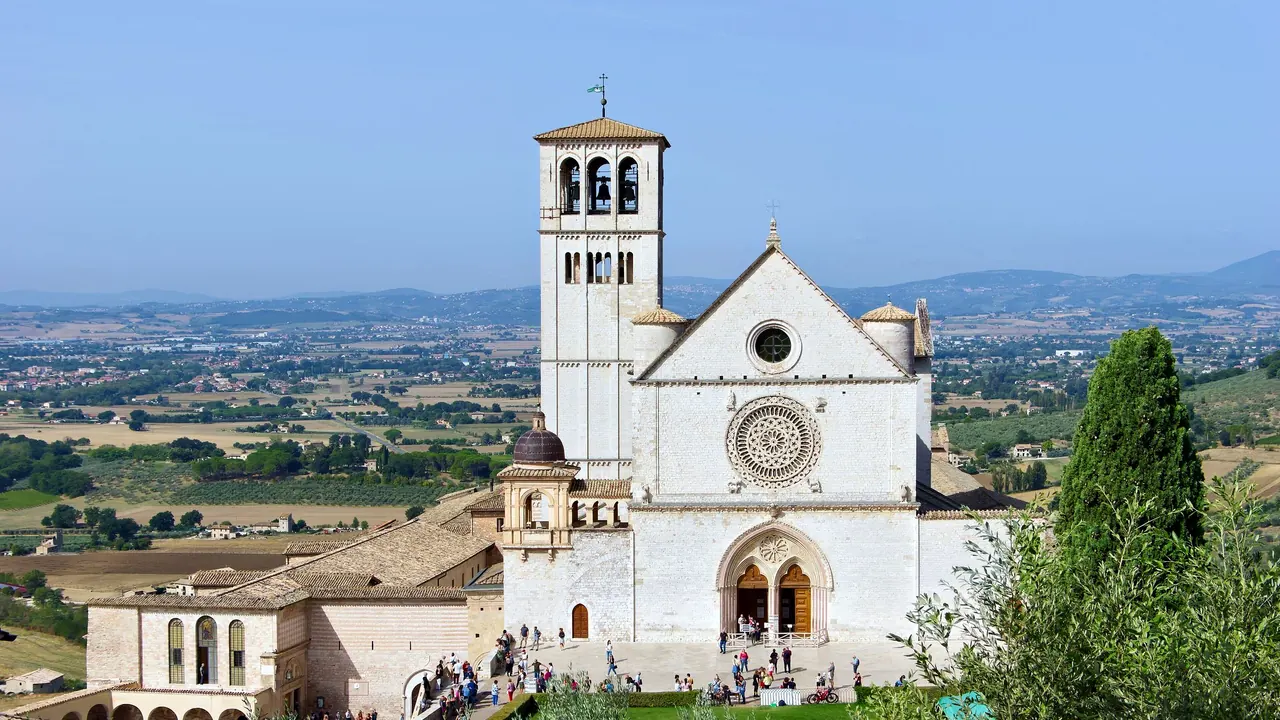
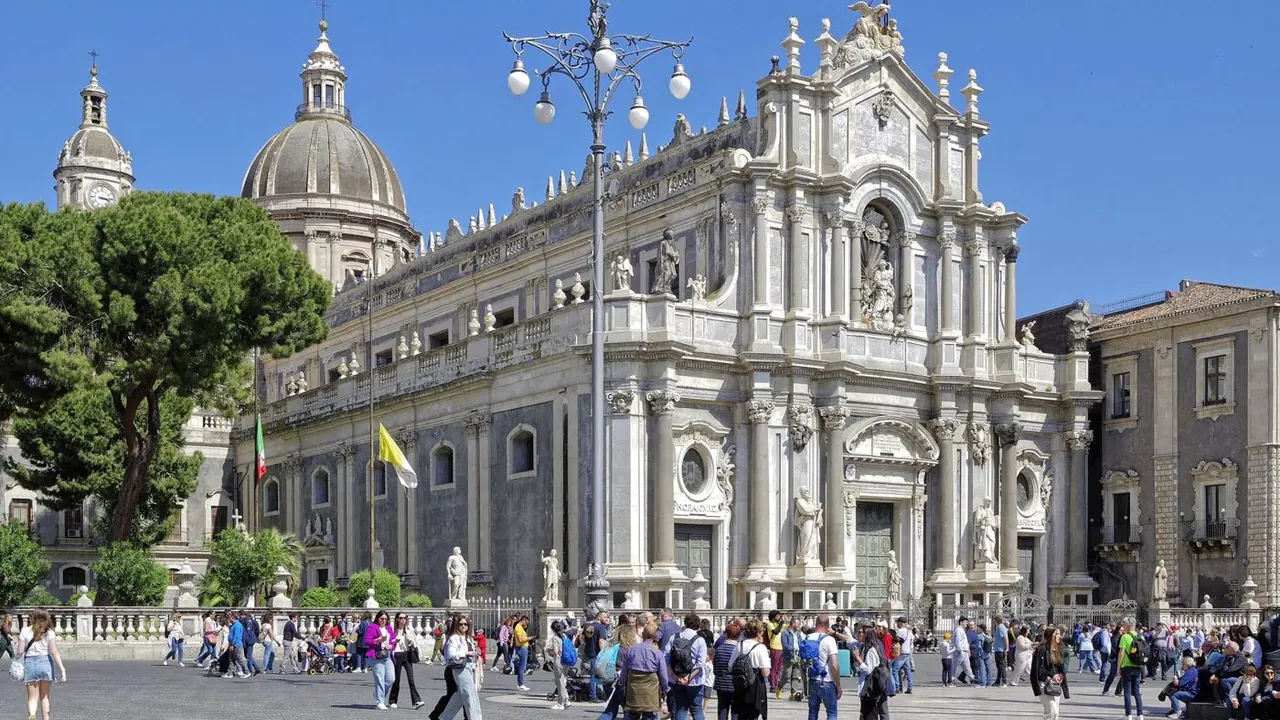
Photos: Assisi by Berthold Werner, CC BY-SA 4.0, cropped; Catania by Berthold Werner, CC BY-SA 4.0, cropped.
Assisi or Catania?
Our verdict in twelve categories, each scored against the same fixed benchmark cities, and the climate month by month, so you can choose for your trip.
Choose Assisi for
- wellness
- culture and sights
- getting around
Assisi suits a slower, quieter trip built around art, faith and the Umbrian countryside. The Basilica of San Francesco and its frescoes are the main reason to come, the lanes go still once the day-trippers leave, and Monte Subasio starts right behind the town. Choose it if your perfect evening is a long dinner followed by an empty floodlit street, and you would rather spend your days touring hill towns than lying on a beach.
Choose Catania for
- beaches
- nightlife
- food and drink
For a livelier trip with the sea close by, Catania is the pick: it has a coast, a volcano and late nights out. Swimming off the lava rocks, climbing towards Etna's craters, eating at market counters and drinking outside bars past midnight are all part of an ordinary day there. It suits travellers who want energy, heat and good food more than calm.
Scoreboard
Twelve categories on one fixed scale from 0 to 100. The shaded stretch is the gap between the two.
Your match
Pick a travel style or drag the sliders, and both match scores follow your weighting.
Wins on wellness and culture and sights with your weighting.
Wins on beaches and nightlife with your weighting.
What matters to you?
Category by category
What the scores mean for a trip.
Beaches & swimming
These two are about as far apart as Italian destinations get on swimming. Assisi sits in the hills about two hours from either coast, and the nearest water is Lake Trasimeno, whose small lidos are warm but shallow and slightly murky; otherwise a pool at an agriturismo has to do.
Catania has the sea on its doorstep and two kinds of shore. La Playa gives a long, easy, crowded stretch of sand with beach clubs, while the black lava coast at Aci Castello and Aci Trezza means swimming off ladders into very clear water beside the sea stacks.
Food & drink
Catania is the stronger eating city by some way. Its cooking happens on the street and at the counter: cone-shaped arancini, fried crispelle, granita with brioche for breakfast, smoky grills on Via Plebiscito and the morning's catch cooked around La Pescheria. Etna's volcanic wines add real interest.
Assisi eats well but narrowly, with rural Umbrian dishes such as strangozzi with black truffle, Castelluccio lentils and torta al testo, plus Subasio olive oil and Montefalco's Sagrantino. The catch is that many tables near the basilica serve set menus to groups, so the good meals take some seeking out on side lanes or in the valley.
Culture & sights
Assisi has the edge, because it holds one of Europe's supreme works of art. The two stacked churches of the Basilica of San Francesco, with frescoes by Cimabue, Simone Martini, Lorenzetti and the Saint Francis cycle given to Giotto, outweigh anything single in Catania. Add the Temple of Minerva, Santa Chiara and the Porziuncola, and two days are well filled.
Catania's appeal is more of a whole townscape: a late-baroque city of black lava and pale limestone, rebuilt after 1693, with Via dei Crociferi, the vast Benedictine monastery and Roman remains showing through. Its museums are modest, so it rewards walking more than looking at paintings.
Nightlife
Catania goes out; Assisi goes to bed. In Catania a large student population keeps the lanes around Piazza Bellini and Via Gemmellaro full of drinkers until well past midnight, and in summer the beach clubs at La Playa become open-air dance floors, though serious clubbing is thin.
Assisi offers a glass of Sagrantino and a walk through deserted lanes, and anyone wanting more has to make the half-hour trip to Perugia.
Nature & outdoors
Catania has the bigger landscape by far. Etna rises to about 3,300m, often smoking, with a cable car from the Rifugio Sapienza, walks across recent lava flows and old craters, and even small winter ski areas. The Alcantara Gorge, the Nebrodi forests and snorkelling or kayaking among the sea stacks add variety.
Assisi's outdoors is gentler and closer to hand: Monte Subasio climbs straight from the town through holm-oak woods to grassy summit meadows, with wildflowers in spring. The valley below is good for cycling between Spello, Bevagna and Montefalco, and the Sibillini make a longer drive.
Day trips
Both are excellent bases, so the choice is about what you want to see. From Assisi the excursions are Umbrian hill towns, close together and often reachable by regional train: Spello, Perugia, Spoleto, then Gubbio, Todi, Orvieto's cathedral and the Tuscan border towns of Cortona and Montepulciano.
From Catania the range is wider in era: the Greek theatres of Siracusa and Taormina, the baroque showpieces of Noto, Modica and Ragusa Ibla, and the Roman mosaics of Piazza Armerina. The distances are longer, though, and in both places a car makes the smaller towns much easier.
Good for families
Catania is the easier pick with children, mainly because of what lies outside the city. La Playa's sand shelves gently, a walk on Etna's old craters thrills older children, and the Etnaland theme and water park fills a hot day. The city itself is harder work, with heavy traffic, narrow pavements and little shade.
Assisi is safe and calm, but its sights are churches that need silence and its stepped streets defeat pushchairs. Beyond the Rocca Maggiore and a walk on Subasio, families usually do best staying at a valley agriturismo with a pool and visiting town in short bursts.
Getting around
Assisi is slightly easier to manage. The walled town can be crossed on foot in twenty minutes, cars are kept out, and regional trains run along the valley to Perugia, Spello and Spoleto. The price is steepness, with stairs and slopes everywhere, and the station lies about 4km below, so a bus or taxi is needed.
Catania's centre along Via Etnea and around Piazza del Duomo is flat enough and walkable, but beyond it things get tiring: one metro line, slow buses in heavy traffic and drivers who do not always stop for pedestrians. Parking a hire car in the centre is a struggle.
Shopping & style
Catania offers more to browse, though neither is a shopping destination. Via Etnea is a long run of Italian chains and fashion stores, and the daily La Fiera market around Piazza Carlo Alberto is loud and lively, while Bronte pistachio creams, Etna wines and Caltagirone ceramics make good things to take home.
Assisi's streets are given over mostly to rosaries and Tau crosses. In among them are worthwhile Umbrian linens with Assisi embroidery, Deruta ceramics, olive oil and truffle products, but there is no fashion or market scene at all.
Affordability
The two cost much the same, and the savings come in different places. In Assisi the basilicas are free to enter and convent guesthouses offer simple rooms cheaply, while prices inside the walls climb around Easter and the main feasts.
Catania's bargain is food: street food makes a full meal for little, and buses are inexpensive. Summer rooms, beach-club sunbeds and guided trips to Etna's summit craters are where the costs build up, and in both places a hire car adds noticeably to the budget.
Live music & performing arts
Catania is clearly ahead. As Bellini's birthplace it has the Teatro Massimo Bellini, a grand nineteenth-century opera house with a real opera and symphonic season, and the Sicilian puppet theatre of knights and Saracens is still performed. In summer, concerts move into courtyards and ancient theatres.
Assisi's music is sacred and occasional: organ recitals and choirs in the basilica, and the medieval costume and song of Calendimaggio in spring. For opera or the summer jazz festival, visitors head to Perugia.
Wellness & relaxation
Neither city is a spa destination, but Assisi is the more restful place. Its calm comes from the town itself: still early mornings, convent retreats, silent walks up to the Eremo delle Carceri, with a few spas in valley hotels.
Catania is noisy and full of traffic, and its spas are mostly in coastal resorts or on Etna's lower slopes. What helps there is the pace of the day, with long lunches and an evening passeggiata, and the volcano's quieter villages make a calmer base.
When should you go?
Pick your month. The climate figures are measured averages, not a forecast.
Assisi in July
Catania in July
Daytime high, °C
Rainfall in the month, mm
Where the figures come from
Assisi's temperatures are measured 51 km from the centre, at Frontone.
Assisi has no rain gauge within 25 km of the centre, so its rainfall comes from a gridded climate dataset read at the city rather than from a gauge further away.
Temperature and rainfall are climate normals, averaged over the years shown. Assisi: 1991-2020 normals, Frontone (50.5 km from centre). Catania: 1991-2020 (sunshine 1961-1990, rainfall 1971-2000) normals, Catania / Fontanarossa (5.2 km from centre).
Assisi is at its best in May and again in September and early October, when the days are mild enough to walk its steep lanes and climb Subasio in comfort. High summer is hot, around 30°C in July, so walks need early starts. Winter is cold, near 7°C in January, and autumn is the wetter season, with rain building through October and November.
Catania is warmer all year and the clear choice for anything involving the sea. Summer is almost rainless and very sunny, with highs around 32°C in August. That is beach weather, but hard going on the city's shadeless streets. The sea is warm enough to swim from June into October and peaks near 26°C. For sightseeing and walks on Etna, April, May and September are the pleasantest months: warm, dry and bright. From October the rain arrives in earnest, with about 123mm that month, and the rest of late autumn and early winter stays wet, so a trip then needs some flexibility.
Which traveller are you?
On a beach and sun trip, Catania is the only real option. It has sand at La Playa, clear water off the lava platforms of the Riviera dei Ciclopi and a long swimming season, while Assisi is inland and has only Lake Trasimeno's shallow lidos.
For a food and nightlife trip, Catania wins easily. Arancini, granita and the fish market of La Pescheria fill the days, and the bars around Piazza Bellini stay busy late. Assisi offers fine Umbrian cooking but goes quiet by eleven.
On a relaxing and wellness trip, Assisi suits better. Neither city is strong on spas, but Assisi's calm is real: convent retreats, silent walks to the Eremo delle Carceri and still evenings, where Catania means traffic, noise and a crowded centre.
Before you go
| Measure | Assisi | Catania |
|---|---|---|
| Official language | Italian | Italian |
| Currency | Euro (EUR) | Euro (EUR) |
| Sockets | CFL230 V, 50 Hz | CFL230 V, 50 Hz |
| Driving side | Right | Right |
| Time zone | UTC+1, UTC+2 in summer | UTC+1, UTC+2 in summer |
| Emergency number | 112 | 112 |
| Elevation | 424 m | 7 m |
| Main airport | Perugia San Francesco d'Assisi – Umbria International Airport (PEG)9 km from centre17 non-stop destinations | Catania-Fontanarossa Airport (CTA)4 km from centre96 non-stop destinations |
| Public holidays this year | 13 days | 13 days |
By the numbers
| Measure | Assisi | Catania |
|---|---|---|
| City population | 27,605 | 311,584 |
| People per km² | 147 | 1,704 |
| Museums within 10 km | 14 | 25 |
| UNESCO World Heritage sites within 50 km | 2 | 3 |
| Swim season, months above 21 °C | - | 5 months |
Where else could you go?
Every comparison below shares a destination with this one, so you can follow Assisi or Catania somewhere new.
- Taorminavs Catania
- Syracuse, Sicilyvs Catania
- San Marinovs Assisi
- Sienavs Assisi
- Romevs Assisi
- Florencevs Assisi