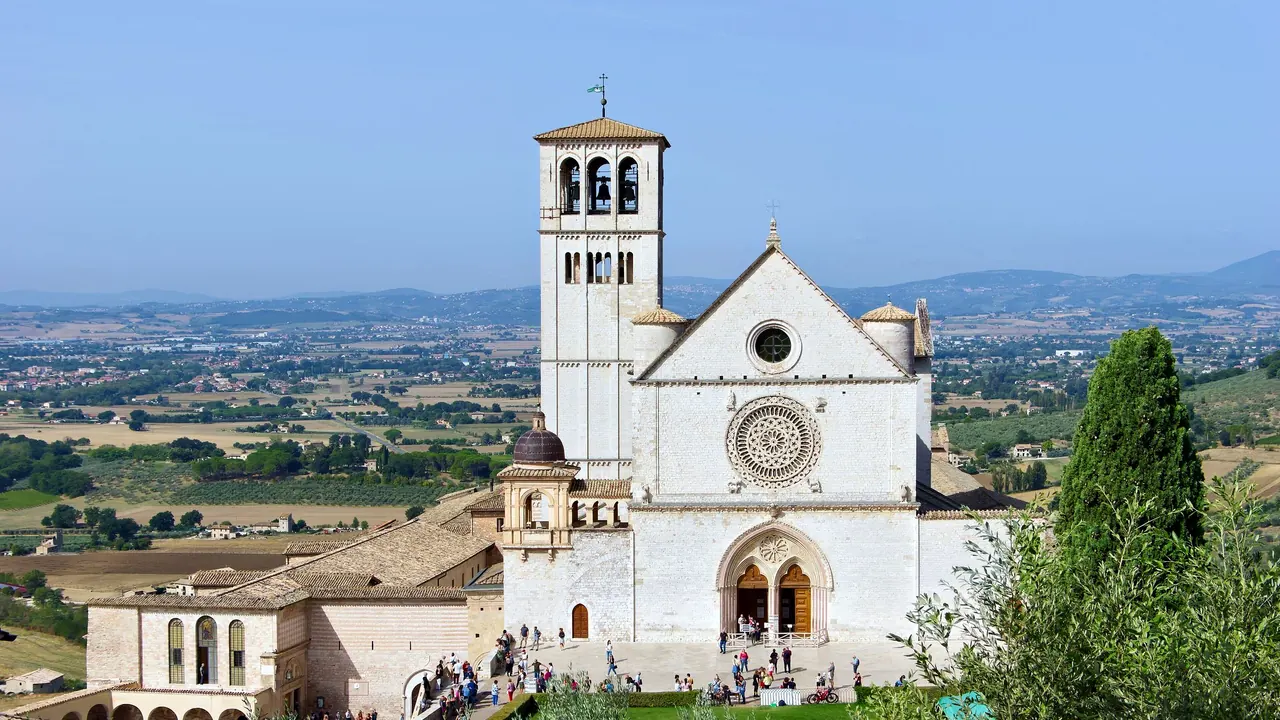
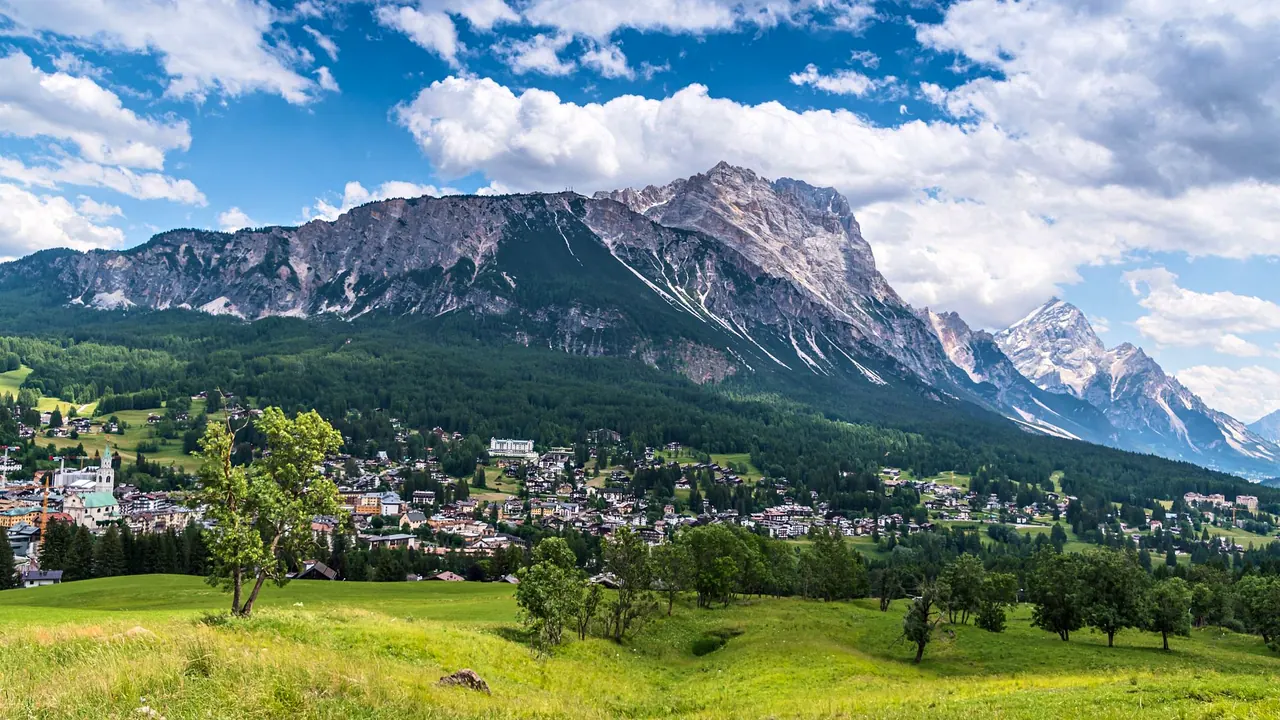
Photos: Assisi by Berthold Werner, CC BY-SA 4.0, cropped; Cortina d'Ampezzo by Andreas Neubauer, Pexels License.
Assisi or Cortina d'Ampezzo?
Our verdict in twelve categories, each scored against the same fixed benchmark cities, and the climate month by month, so you can choose for your trip.
Choose Assisi for
- culture and sights
- prices
- day trips
Assisi suits the traveller who wants art, history and a good base for exploring. The Basilica of San Francesco and its frescoes are reason enough to come, the stone lanes reward slow wandering, and Perugia, Spello, Spoleto and Gubbio are all close enough for easy days out. It is also far kinder on the wallet.
Choose Cortina d'Ampezzo for
- nature and the outdoors
- families
- shopping
Choose Cortina d'Ampezzo if the mountains are the point of the trip. The Dolomites rise straight from the town, with lifts onto the peaks, the Dolomiti Superski area in winter, and hut-to-hut trails and via ferrata in summer. It costs a great deal more and has few sights, but for skiing or hiking Assisi cannot compete with it.
Scoreboard
Twelve categories on one fixed scale from 0 to 100. The shaded stretch is the gap between the two.
Your match
Pick a travel style or drag the sliders, and both match scores follow your weighting.
Wins on culture and sights and prices with your weighting.
Wins on nature and the outdoors and families with your weighting.
What matters to you?
Category by category
What the scores mean for a trip.
Beaches & swimming
Neither town is a swimming destination, and both are two hours or more from the sea. The difference is the water nearby. From Assisi, the small lidos at Passignano and Castiglione del Lago on Lake Trasimeno give warm, shallow swimming in summer, while Cortina's alpine lakes such as Ghedina and Pianozes stay cold with snowmelt and are better for a walk than a swim. In both places, a hotel pool is the realistic option.
Food & drink
Both eat about equally well, but the food is very different. Assisi serves Umbrian farm cooking: strangozzi with black truffle, Castelluccio lentils, torta al testo, Monte Subasio olive oil and Sagrantino from Montefalco. The best of it is in side-lane trattorias and agriturismi, not the set-menu places near the basilica.
Cortina's cooking is alpine with a Venetian touch: casunziei with poppy seeds, polenta with game, barley soup. Its best meals come on rifugio terraces among the peaks. It has more polished dining rooms for its wealthy visitors, but in both towns the range is narrow and there is little street food.
Culture & sights
Here Assisi is in a different class. The Basilica of San Francesco, with frescoes by Cimabue, Simone Martini and Lorenzetti and the cycle attributed to Giotto, is one of Europe's great monuments. The whole town of pink Subasio stone around it, from the Temple of Minerva to the Rocca Maggiore, shares its UNESCO listing.
Cortina has a pleasant centre, the ice stadium from the 1956 Olympics and three small museums, the best of which is the Rimoldi art collection. Together they fill a wet afternoon. Its most striking history is the First World War front on Lagazuoi and the Cinque Torri, which takes a day out in the mountains rather than a sightseeing stroll.
Nightlife
Neither is a place for nights out, but Cortina has a little more going on. There are après-ski drinks and the evening stroll along Corso Italia, and in the peak winter weeks a few smart bars and a club stay open late. In summer it is quiet.
Assisi is quieter still: dinner, a glass of Sagrantino and a walk through floodlit lanes that are empty by eleven. Anyone who wants bars heads to Perugia, half an hour away.
Nature & outdoors
Cortina wins this outright. The Dolomites ring the town, and lifts from the centre climb onto the Tofane, Cristallo and Cinque Torri. The Tre Cime and Lago di Misurina are under an hour away. Winter brings world-class skiing, and summer brings hut-to-hut trails, via ferrata and climbing.
Assisi's outdoors is gentler and smaller in scale. There is the climb through holm-oak woods to the Eremo delle Carceri and the open meadows of Monte Subasio, cycling across the valley to Spello and Montefalco, and longer drives to the Valnerina or the Sibillini. It suits walkers rather than mountaineers.
Day trips
Assisi is by far the better base. Spello is minutes away and Perugia and Spoleto are short train rides. Gubbio, Todi, Orvieto, Deruta and the Montefalco wine villages fill more days, and the Tuscan towns of Cortona and Montepulciano are within reach too.
From Cortina, most outings go into the mountains. The nearest towns worth a visit are San Candido, Dobbiaco and Brunico in South Tyrol. Bolzano, home of the Iceman, is about two hours away, and Venice makes a long day by coach.
Good for families
Cortina is the easier choice with children, as long as they enjoy being outdoors. Ski schools, beginner slopes at Socrepes, public skating at the Olympic stadium, easy lake walks and a forest rope park keep them busy, though wet days drag and costs add up.
Assisi is calm and safe, but it is built around churches that need silence, steep stepped lanes that are hard with a pushchair and hot summer afternoons. Older children enjoy the Rocca Maggiore. Families do best staying at a valley agriturismo with a pool.
Getting around
Assisi is easier to reach and to travel on from. Its centre is walkable but steep. The railway station in Santa Maria degli Angeli, about 4km below the town, has regional trains to Perugia, Spello, Foligno and Spoleto.
Cortina's flat centre is quicker on foot, but the town has had no railway since 1964. Getting there means a coach from Venice or a long drive, and buses up to the passes are limited. In both places, a hire car opens up the wider region.
Shopping & style
Cortina has the better shopping, even though it is almost all on one street. Corso Italia has luxury fashion, jewellers and upmarket mountain wear. Its anchor is the Cooperativa di Cortina, a store founded in 1893, and there is wood carving and filigree for local craft.
Assisi's streets are mostly given over to religious souvenirs. The things worth buying there are food and crafts: embroidered Umbrian linen, Deruta ceramics, olive oil, truffles and Sagrantino.
Affordability
Assisi costs far less. The basilicas are free to enter, convent guesthouses have simple rooms at low cost and valley agriturismi are good value. Only the restaurants nearest the basilicas and hotels on feast days push prices up.
Cortina is one of the most expensive resorts in Italy, with luxury hotel and restaurant prices in winter and August, plus lift passes and equipment hire. Rifugio meals and the quieter months soften the bill, but many visitors on a budget stay in cheaper valleys nearby.
Live music & performing arts
Neither has a real arts calendar, but Assisi offers a little more through the year. Organ recitals and choral concerts fill its basilicas around religious feasts, the Calendimaggio festival brings medieval song and processions in spring, and a theatre in Santa Maria degli Angeli stages touring shows. Perugia is close for opera and jazz.
In Cortina, music is mostly a summer affair, with chamber and classical festivals in churches, halls and sometimes mountain settings, plus a few concerts at Christmas and New Year.
Wellness & relaxation
The two offer different kinds of rest. Cortina's hotels have proper Alpine spas with saunas, steam rooms, hay baths and indoor pools for after the slopes. In June and September, the quiet weeks bring clear air and slow afternoons on hut terraces.
Assisi has few treatments, mostly in country hotels in the valley, but it offers a deeper stillness: convent retreats, silent walks to the Eremo delle Carceri and evenings after the tour groups have left. Neither has thermal baths or a bathing tradition.
When should you go?
Pick your month. The climate figures are measured averages, not a forecast.
Assisi in July
Cortina d'Ampezzo in July
Daytime high, °C
Rainfall in the month, mm
Where the figures come from
Assisi's temperatures are measured 51 km from the centre, at Frontone.
Assisi has no rain gauge within 25 km of the centre, so its rainfall comes from a gridded climate dataset read at the city rather than from a gauge further away.
Temperature and rainfall are climate normals, averaged over the years shown. Assisi: 1991-2020 normals, Frontone (50.5 km from centre). Cortina d'Ampezzo: 1991-2020 normals, Dobbiaco (22.5 km from centre).
Assisi is at its best in spring and autumn. April, May, September and early October are warm enough for comfortable walks on its steep lanes and the Subasio paths. July and August reach around 30°C, which is hot for climbing streets in the afternoon but warm enough for a swim in Lake Trasimeno. Rain builds through the autumn to a peak in November of about 94mm, and winter highs stay in single figures.
Cortina runs on a different calendar. In midwinter, highs sit around 0°C, which suits the ski season, and December to March are the driest months. Summer stays fresh at about 22°C, good for hiking while Assisi is hot, but it is also the wettest time of year, with about 130mm in July, so pack for wet days. September is mild and noticeably drier than midsummer.
Which traveller are you?
On a culture and arts trip, Assisi is the clear choice. Nothing in Cortina compares with the frescoed Basilica of San Francesco, Santa Chiara or the Temple of Minerva, and church concerts and Calendimaggio add music that Cortina offers only in summer.
For an outdoors trip, Cortina d'Ampezzo wins easily. Lifts rise from the town into the Dolomites, the Tre Cime and the Alta Via 1 are close by, and winter brings the Dolomiti Superski area. Monte Subasio is lovely walking, but smaller in scale.
On a trip on a tight budget, Assisi works far better. You see the town on foot, regional trains reach Perugia, Spello and Spoleto, and side-lane trattorias feed you simply. In Cortina, even reaching the mountains costs extra, from lifts and ski hire to a car.
Before you go
| Measure | Assisi | Cortina d'Ampezzo |
|---|---|---|
| Official language | Italian | Italian |
| Currency | Euro (EUR) | Euro (EUR) |
| Sockets | CFL230 V, 50 Hz | CFL230 V, 50 Hz |
| Driving side | Right | Right |
| Time zone | UTC+1, UTC+2 in summer | UTC+1, UTC+2 in summer |
| Emergency number | 112 | 112 |
| Elevation | 424 m | 1,224 m |
| Main airport | Perugia San Francesco d'Assisi – Umbria International Airport (PEG)9 km from centre17 non-stop destinations | Venice Marco Polo Airport (VCE)116 km from centre103 non-stop destinations |
| Public holidays this year | 13 days | 13 days |
By the numbers
| Measure | Assisi | Cortina d'Ampezzo |
|---|---|---|
| City population | 27,605 | 5,546 |
| People per km² | 147 | 22 |
| Museums within 10 km | 14 | 3 |
| UNESCO World Heritage sites within 50 km | 2 | 1 |
Where else could you go?
Every comparison below shares a destination with this one, so you can follow Assisi or Cortina d'Ampezzo somewhere new.
- San Marinovs Assisi
- Innsbruckvs Cortina d'Ampezzo
- Sienavs Assisi
- Venicevs Cortina d'Ampezzo
- Paduavs Cortina d'Ampezzo
- Romevs Assisi