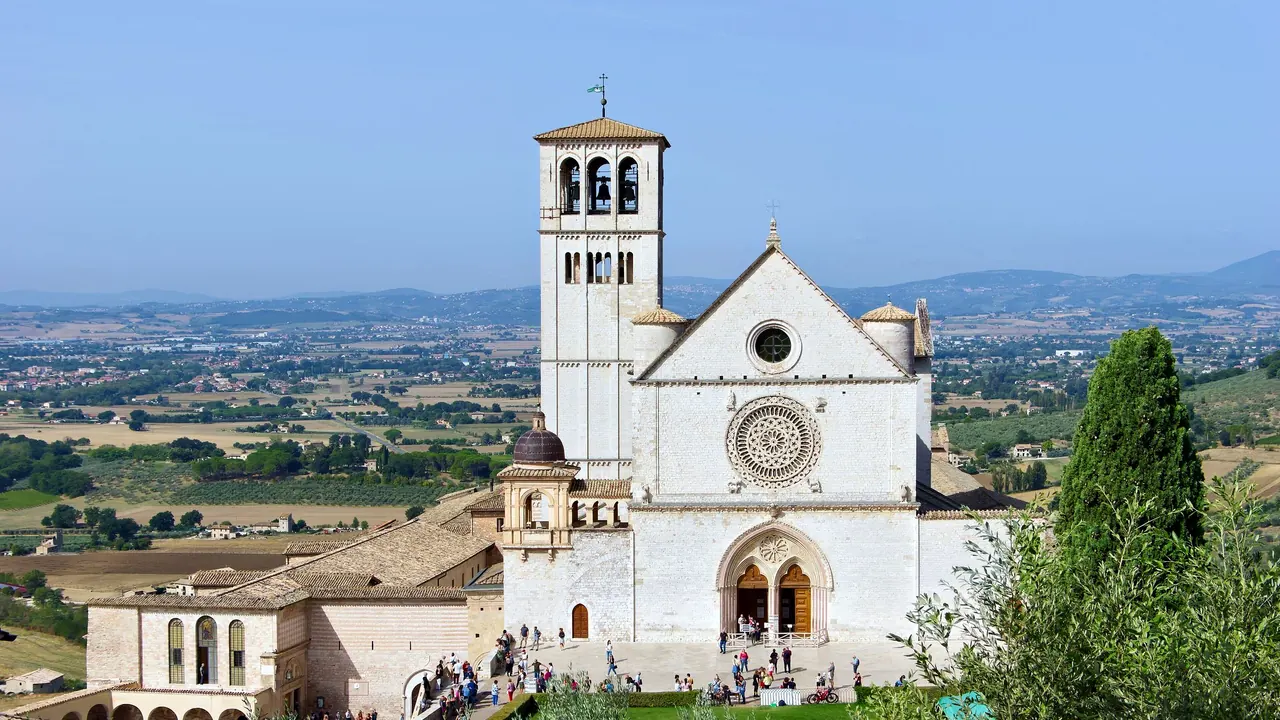
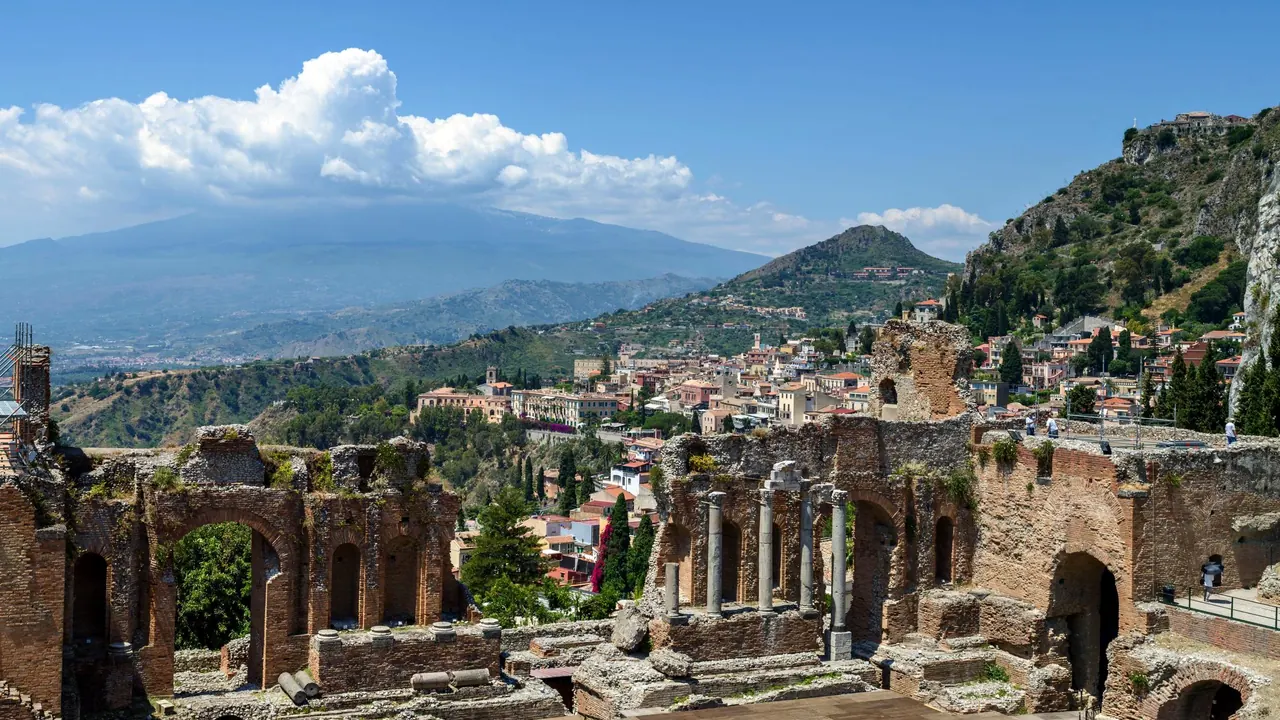
Photos: Assisi by Berthold Werner, CC BY-SA 4.0, cropped; Taormina by Reinhard Bruckner, Pexels License.
Assisi or Taormina?
Our verdict in twelve categories, each scored against the same fixed benchmark cities, and the climate month by month, so you can choose for your trip.
Choose Assisi for
- prices
- culture and sights
- day trips
Assisi suits travellers who want art, faith and quiet more than sun. The Basilica of San Francesco and its frescoes are among the great sights of Europe, and the town makes a calm, fairly priced base for touring Umbria's hill towns by train or car. Evenings are still and early, and that stillness is much of the point.
Choose Taormina for
- beaches
- nightlife
- nature and the outdoors
Choose Taormina for a Mediterranean vacation with the sea below and Etna above. It has swimming in clear coves, volcano walks, more character at the table and a livelier evening scene. The trade-off is cost: it is far pricier than Assisi, and its sights fill a day rather than a week.
Scoreboard
Twelve categories on one fixed scale from 0 to 100. The shaded stretch is the gap between the two.
Your match
Pick a travel style or drag the sliders, and both match scores follow your weighting.
Wins on prices and culture and sights with your weighting.
Wins on beaches and nightlife with your weighting.
What matters to you?
Category by category
What the scores mean for a trip.
Beaches & swimming
This is Taormina's ground entirely. A cable car drops from town to the glassy coves of Mazzarò and Isola Bella, which are good for snorkelling, and Giardini Naxos and Letojanni add longer sandy and shingle stretches. The local beaches are narrow pebble strips, though, and fill early in summer.
Assisi has no coast within easy reach. The nearest swimming is at the shallow lido beaches of Lake Trasimeno, so a hotel pool is the realistic option.
Food & drink
Taormina eats better and with more range: Sicilian seafood such as swordfish and raw red prawns, pasta alla Norma, granita and brioche for breakfast, a top tier of refined cooking and Etna's Nerello Mascalese and Carricante wines. On Corso Umberto you pay for the setting.
Assisi's cooking is earthier and narrower: strangozzi with black truffle, Castelluccio lentils, torta al testo, Subasio olive oil and Montefalco Sagrantino. The good meals are in side-lane trattorias and country agriturismi, not near the basilica.
Culture & sights
Assisi is in another league here. The two stacked churches of the Basilica of San Francesco hold one of the finest fresco ensembles in Italy, and the Temple of Minerva, Santa Chiara and the Porziuncola fill two calm days.
Taormina's Greek theatre, with Etna framed in its broken stage, is an unforgettable single sight, and Palazzo Corvaja and the Duomo add some Arab-Norman character. Beyond that the list is short and there are no major museums.
Nightlife
Neither is a party town, but Taormina at least has evenings out: aperitivo in Piazza IX Aprile, piano bars over the sea and a few beach clubs near Mazzarò that stay open late in summer. Assisi is silent by eleven, and anyone wanting bars goes to Perugia.
Nature & outdoors
Taormina has the bigger outdoors, because it has Etna: lava flows, the Silvestri craters, guided trips towards the summit, winter skiing and vineyards on its flanks. Add the Alcantara gorges and diving and kayaking in the Isola Bella marine reserve.
Assisi's landscape is gentler but still rewarding. Monte Subasio rises behind the town, with a path to the Eremo delle Carceri and summit meadows, and the flat valley floor is good for cycling between Spello and Montefalco.
Day trips
Assisi has the edge as a base, because Umbria's hill towns sit close around it. Spello is minutes away, Perugia and Spoleto are an easy train ride, and Gubbio, Todi, Orvieto and Tuscan border towns such as Cortona make full days out, most easily by car.
Taormina's nearer outings are easy too. Catania, with its black lava-stone baroque and fish market, is about an hour down the coast, Messina about an hour north, and Castelmola, Savoca and Etna's wine villages are close. The finest trips take longer, though: Syracuse and Ortigia are about two hours away, and the Val di Noto makes a long day.
Good for families
Taormina works better with children, though neither town is built for them. The cable car to the sea, gelato, snorkelling at Isola Bella and lava fields on Etna give school-age children real things to do, and Giardini Naxos is flatter and sandier for little ones.
In Assisi the sights are churches that need silence and the lanes are stepped and hot in summer. The Rocca Maggiore and a walk on Subasio are the highlights, and a valley agriturismo with a pool makes a better base.
Getting around
Both are small, steep towns walked on foot, with stairs at every turn, and both need a car for the countryside. The difference is the railway. In Assisi the station is about 4km below in the valley, with trains along the Umbrian line to Perugia and Spoleto.
In Taormina the station is by the sea, with coastal trains and coaches to Catania, Messina and Syracuse, and a cable car links town and beach.
Shopping & style
Taormina offers more to browse. Corso Umberto has coral and cameo dealers, linen shops, resort-wear boutiques and Caltagirone majolica, though much of it is aimed at visitors.
Assisi's streets are mostly rosaries and Tau crosses. The goods worth seeking out are Assisi embroidery, Deruta ceramics and Sagrantino wine.
Affordability
Assisi is the far kinder town for your wallet. The basilicas cost nothing to enter, convent guesthouses are cheap and simple, and eating a few lanes away from the main sights keeps meals reasonable.
Taormina is the priciest place in eastern Sicily, with grand hotels, scarce mid-range rooms in summer and resort prices on the Corso. Sleeping in Giardini Naxos or coming outside summer softens the cost.
Live music & performing arts
Taormina has the more memorable stage: summer concerts, opera and ballet in the Greek theatre with Etna behind, plus a long-running film festival. Off-season it goes quiet. Assisi's music is sacred, with organ and choral concerts in the basilicas and the medieval Calendimaggio festival in spring.
Wellness & relaxation
Both offer calm rather than a bathing culture, but of different kinds. Assisi's is spiritual: convent retreats, silent walks to the Eremo and empty evening lanes.
Taormina's comes with comfort: hotel spas on sea terraces with volcanic mud treatments, and long lunches in the Villa Comunale's shade. That peace thins out in August.
When should you go?
Pick your month. The climate figures are measured averages, not a forecast.
Assisi in July
Taormina in July
Daytime high, °C
Rainfall in the month, mm
Where the figures come from
Assisi's temperatures are measured 51 km from the centre, at Frontone.
Assisi has no rain gauge within 25 km of the centre, so its rainfall comes from a gridded climate dataset read at the city rather than from a gauge further away.
Taormina's temperatures are measured 45 km from the centre, at Messina.
Taormina has no rain gauge within 25 km of the centre, so its rainfall comes from a gridded climate dataset read at the city rather than from a gauge further away.
Temperature and rainfall are climate normals, averaged over the years shown. Assisi: 1991-2020 normals, Frontone (50.5 km from centre). Taormina: 1991-2020 normals, Messina (45.1 km from centre).
Assisi has a proper inland climate. Winters are cold for sightseeing, with highs of about 7°C in January. July and August reach about 30°C, which makes the steep lanes tiring by afternoon. Late spring and September to early October are the most comfortable months for walking, and from October the rain builds to a wet November.
Taormina is mild all year and keeps working in winter, when days are around 15°C, though that is also the rainiest stretch, from October to January. Summer is hot, almost dry and very sunny, and the sea is warm enough to swim in from June to October, peaking at about 26°C in August. May, June and late September give warm days without the worst of the heat.
Which traveller are you?
For a beach and sun trip, Assisi is out of the running, two hours from either coast with only the shallow lidos of Lake Trasimeno. Taormina has clear coves at Isola Bella and Mazzarò, sandier stretches at Giardini Naxos and sea warm enough from June to October.
On a culture and arts trip, Assisi gives far more. The Basilica of San Francesco, with Giotto and Cimabue on its walls, is a world-class monument, and Perugia, Spoleto and Orvieto are easy to reach. Taormina's Greek theatre is superb but stands nearly alone.
On a trip on a tight budget, Assisi is easier to keep cheap. Regional trains reach Perugia, Spello and Spoleto without a car, and walking on Monte Subasio costs nothing. In Taormina, buses, bakery snacks and granita cost little, but Etna and the inland villages mean a paid tour or a hire car.
Before you go
| Measure | Assisi | Taormina |
|---|---|---|
| Official language | Italian | Italian |
| Currency | Euro (EUR) | Euro (EUR) |
| Sockets | CFL230 V, 50 Hz | CFL230 V, 50 Hz |
| Driving side | Right | Right |
| Time zone | UTC+1, UTC+2 in summer | UTC+1, UTC+2 in summer |
| Emergency number | 112 | 112 |
| Elevation | 424 m | 204 m |
| Main airport | Perugia San Francesco d'Assisi – Umbria International Airport (PEG)9 km from centre17 non-stop destinations | Catania-Fontanarossa Airport (CTA)47 km from centre96 non-stop destinations |
| Public holidays this year | 13 days | 13 days |
By the numbers
| Measure | Assisi | Taormina |
|---|---|---|
| City population | 27,605 | 10,471 |
| People per km² | 147 | 799 |
| Museums within 10 km | 14 | 5 |
| UNESCO World Heritage sites within 50 km | 2 | 2 |
| Swim season, months above 21 °C | - | 5 months |
Where else could you go?
Every comparison below shares a destination with this one, so you can follow Assisi or Taormina somewhere new.
- Cataniavs Taormina
- Syracuse, Sicilyvs Taormina
- San Marinovs Assisi
- Sienavs Assisi
- Romevs Assisi
- Florencevs Assisi