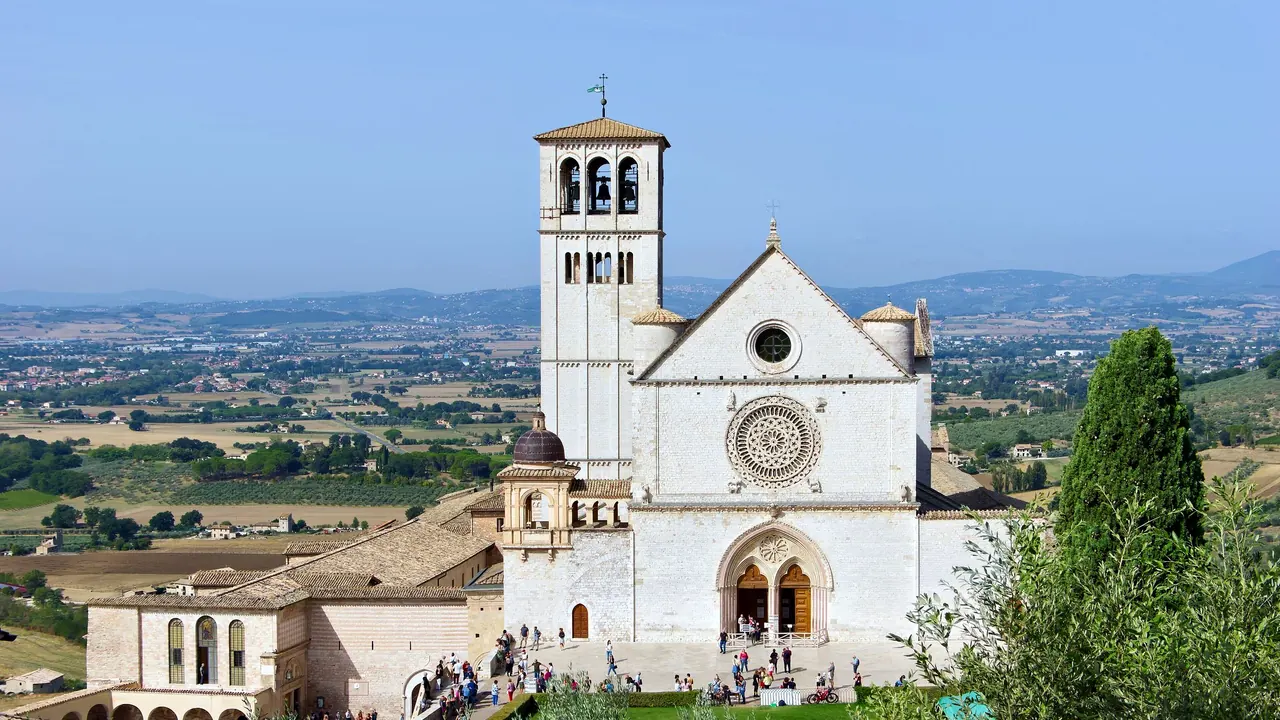
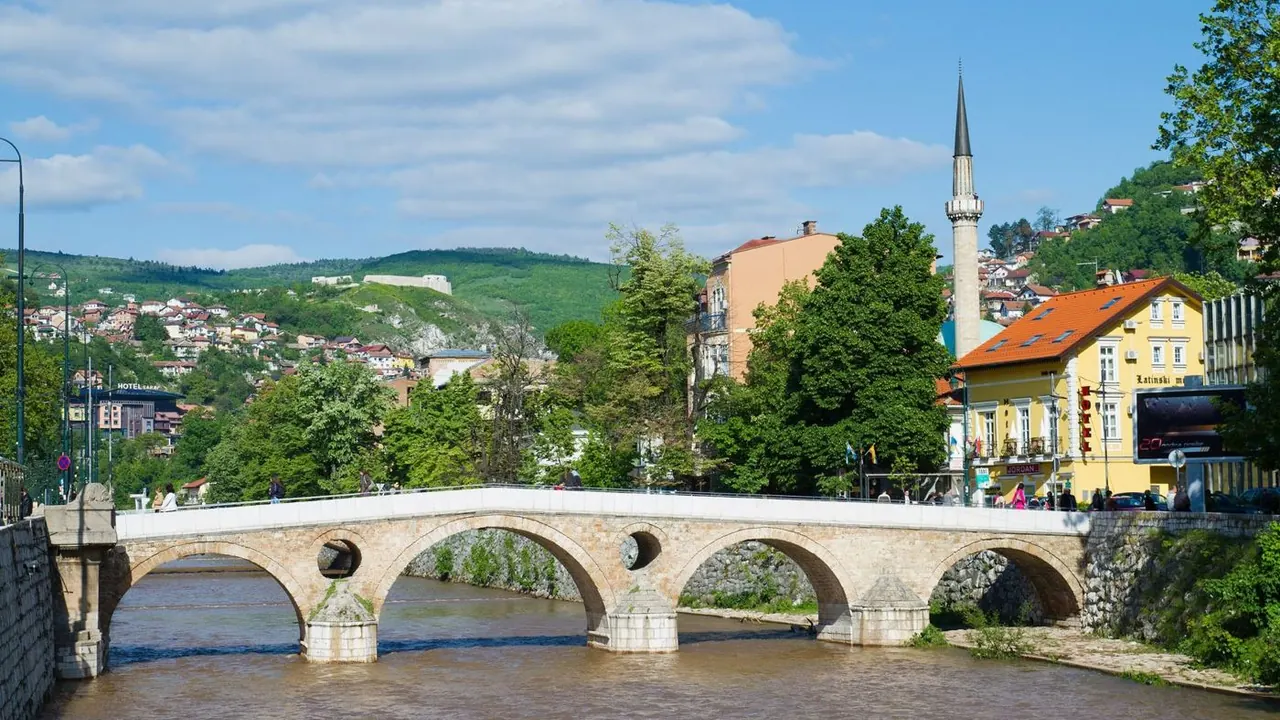
Photos: Assisi by Berthold Werner, CC BY-SA 4.0, cropped; Sarajevo by Tumi-1983, CC0.
Assisi or Sarajevo?
Our verdict in twelve categories, each scored against the same fixed benchmark cities, and the climate month by month, so you can choose for your trip.
Choose Assisi for
- day trips
- culture and sights
- beaches
Assisi suits a slow, reflective trip built around art and the Umbrian countryside. The frescoes of the Basilica of San Francesco are the draw, and the town makes an excellent base for Spello, Perugia, Spoleto, Gubbio and Orvieto. Evenings are quiet by design, so it works best for travellers who want calm lanes after dark, long rural dinners and a car for the hill towns.
Choose Sarajevo for
- nightlife
- prices
- food and drink
Sarajevo is the livelier and cheaper choice, and it rewards anyone curious about history that still feels close. Ottoman bazaar, Austro-Hungarian avenues and the memory of the siege sit within a short walk of each other. The mountains begin at the edge of town, the café-bars stay full into the night and the grill food is cheap and good. Pick it for a sociable, varied trip with an outdoor side.
Scoreboard
Twelve categories on one fixed scale from 0 to 100. The shaded stretch is the gap between the two.
Your match
Pick a travel style or drag the sliders, and both match scores follow your weighting.
Wins on day trips and culture and sights with your weighting.
Wins on nightlife and prices with your weighting.
What matters to you?
Category by category
What the scores mean for a trip.
Beaches & swimming
Neither town works for a beach vacation, and the swimming each offers is a short side trip. From Assisi it is a 45-minute drive to the small lido beaches of Lake Trasimeno, where the water is warm but shallow.
Sarajevo's options are colder and wilder: mountain rivers and the Jablanica lake to the south. The Adriatic is too far for a day, so plan a separate stay on the coast. In both places a hotel pool is the easier answer.
Food & drink
Sarajevo has the stronger food scene. Its cooking has a distinct Ottoman-Balkan character you can taste on every corner of Baščaršija, from ćevapi in somun bread to burek sold by weight. Bosnian coffee with rahat lokum is a ritual worth slowing down for.
Assisi's strength lies in its ingredients rather than its restaurants. There is truffle on strangozzi, Monte Subasio olive oil and Sagrantino from Montefalco, but the eating near the basilicas leans towards tour-group set menus. To eat well there, you have to seek out side-lane trattorias or a country agriturismo.
Culture & sights
These two are close, but they offer different things. Assisi has one overwhelming monument, the double Basilica of San Francesco with its fresco cycles. Around it stand a Roman temple, Santa Chiara and the Porziuncola in a single coherent town of pink stone. If great religious art is what moves you, Assisi has the edge.
Sarajevo's culture is about layers and recent history rather than masterpieces. In a few streets you pass mosque, synagogue and two cathedrals, then the Latin Bridge of 1914. The siege is close at hand in the Tunnel of Hope and the War Childhood Museum. It is less beautiful than Assisi, but often more affecting.
Nightlife
Sarajevo is far ahead here. Its café-bars fill from the afternoon, and the streets around Ferhadija stay busy on warm nights. Students keep a handful of cellar bars and small clubs open past midnight at weekends. The scene is more about cheap drinks and conversation than dancing.
Assisi has almost nothing after dark beyond a glass of Sagrantino and a stroll through floodlit, empty lanes. Night owls staying there have to go to Perugia.
Nature & outdoors
Monte Subasio gives Assisi a fine walk straight from the town walls. The path climbs through holm oaks to the Eremo delle Carceri and on to open summit meadows at about 1,290m, which are thick with flowers in spring. Below, the flat valley is good for easy cycling between olive groves and vineyards, but for real mountains you have to drive to the Valnerina or the Sibillini.
Around Sarajevo the mountains are bigger, wilder and much closer. A cable car climbs from the edge of the Old Town to Mount Trebević. The Olympic ranges of Jahorina and Bjelašnica, under an hour away, offer skiing in winter and hiking on open ridges in summer, with the shepherds' village of Lukomir above the Rakitnica canyon beyond.
Day trips
Assisi is the better base by a distance. Spello is ten minutes away, Perugia half an hour and Spoleto under an hour by train. Gubbio, Todi, Orvieto and the Tuscan towns of Cortona and Montepulciano are all within a day, so you could fill a week without repeating yourself.
From Sarajevo, the main outing is Mostar, reached by a fine train ride down the Neretva gorge, and you can break the journey at Konjic. South of Mostar, Blagaj's dervish house and the fortress village of Počitelj fill out the day, best reached by car or tour. Travnik and the Višegrad bridge are rewarding too, but the roads are slow and winding.
Good for families
Neither is designed for children, but Sarajevo gives them more to do. Its flat Old Town is easy with a pushchair, and there is the Trebević cable car, a carriage ride to the streams of Vrelo Bosne, a small zoo and gentle winter skiing.
Assisi is safe and calm, but its stepped streets, silent churches and hot afternoons test younger children. Families usually do better staying at a valley agriturismo with a pool and making short visits to the town.
Getting around
Both are manageable on foot, and the difference is mainly in shape. Assisi's centre is tiny but steep, climbing on stairs and slopes from the basilica to Piazza del Comune. Its station is 4km away down in the valley, and a hired car is almost essential for the hill towns.
Sarajevo stretches along a flat valley floor. The old tram line runs from Baščaršija out to Ilidža, and cheap taxis cover what the tram misses. The hillside districts are as steep as anything in Assisi, though.
Shopping & style
Sarajevo offers more to browse. On Kazandžiluk you can watch coppersmiths hammering coffee sets, and the Bezistan and nearby lanes sell kilims, slippers and filigree, though you should sort the craft from the souvenir stock.
Assisi's streets are mostly rosaries and Franciscan keepsakes. The worthwhile buys are a few local goods: embroidered Umbrian linen, Deruta ceramics, olive oil and Sagrantino.
Affordability
Sarajevo is markedly cheaper, one of the least expensive capitals in Europe. Meals, trams, taxis and central hotels all come in well below what you would pay in Italy.
Assisi is reasonable for such a famous place. The basilicas are free and convent guesthouses keep rooms cheap, but restaurants by the basilicas charge for their position, and hotels inside the walls cost more on feast days.
Live music & performing arts
In Assisi, live music is mostly sacred: organ recitals and choral concerts in the basilicas, plus the costumed song and processions of Calendimaggio in spring. For opera, regular concerts or jazz, you have to go to Perugia.
A visitor to Sarajevo has more to book. The National Theatre stages drama, opera and ballet through the season, and the Philharmonic plays regularly. The autumn MESS theatre festival and the November jazz festival are the high points, and you may hear sevdah love songs in traditional restaurants. Most plays are in the local language, though.
Wellness & relaxation
The two are about level, but they offer rest in different ways. Assisi's calm is spiritual: convent retreats, a silent walk to the Eremo delle Carceri and empty lanes at dawn, with spas only in a few country hotels.
Sarajevo has actual waters. The thermal springs at Ilidža have been used since Roman times and now feed a spa with warm pools at the end of the tram line. The shaded avenue to Vrelo Bosne is close by, though winter smog takes some of the peace away.
When should you go?
Pick your month. The climate figures are measured averages, not a forecast.
Assisi in July
Sarajevo in July
Daytime high, °C
Rainfall in the month, mm
Where the figures come from
Assisi's temperatures are measured 51 km from the centre, at Frontone.
Assisi has no rain gauge within 25 km of the centre, so its rainfall comes from a gridded climate dataset read at the city rather than from a gauge further away.
Temperature and rainfall are climate normals, averaged over the years shown. Assisi: 1991-2020 normals, Frontone (50.5 km from centre). Sarajevo: 1991-2020 (rainfall 1971-2000) normals, Sarajevo-Bejelave (2 km from centre).
Both towns have cold winters and hot summers, and spring and autumn are the best seasons for walking. Assisi gets the hotter summer, with July highs around 30°C. That makes the steep lanes tiring in the afternoon, though it is the season for a swim at Lake Trasimeno. Its rain is moderate for most of the year and builds through autumn to a peak of about 94mm in November. May, June and September are the sweet spot.
Sarajevo is a little cooler in summer and colder in winter, with December and January highs of only 4°C. Rain falls fairly evenly all year, and June is actually the wettest month at about 95mm, usually as short showers between long sunny spells. July is the sunniest month, with about 257 hours of sunshine. From late May to September the city is warm and the mountains are open for hiking. In winter the skiing takes over, but the valley can feel grey down below.
Which traveller are you?
For a food and nightlife trip, Sarajevo is the clear pick. Ćevapi grills, pita bakeries and slow Bosnian coffee give it a real food identity, and its café-bars and student cellar bars keep going late. Assisi is quiet and empty soon after dinner.
On a trip on a tight budget, Sarajevo stretches your money much further. Guesthouses, trams, taxis, museum entry and meals all cost little. Assisi is fair value for Italy, with free basilicas and cheap convent rooms, but its everyday costs are higher.
On a culture and arts trip centred on great painting and architecture, Assisi wins. Giotto, Cimabue and Simone Martini fill the Basilica of San Francesco, and Perugia, Spoleto and Orvieto are within easy reach. Sarajevo's history is gripping, but its sights are compact rather than grand.
Before you go
| Measure | Assisi | Sarajevo |
|---|---|---|
| Official language | Italian | Croatian, Serbian, Bosnian |
| Currency | Euro (EUR) | Convertible Mark (BAM) |
| Sockets | CFL230 V, 50 Hz | CF230 V, 50 Hz |
| Driving side | Right | Right |
| Time zone | UTC+1, UTC+2 in summer | UTC+1, UTC+2 in summer |
| Emergency number | 112 | 112 |
| Elevation | 424 m | 518 m |
| Main airport | Perugia San Francesco d'Assisi – Umbria International Airport (PEG)9 km from centre17 non-stop destinations | Sarajevo International Airport (SJJ)7 km from centre38 non-stop destinations |
| Public holidays this year | 13 days | 8 days |
By the numbers
| Measure | Assisi | Sarajevo |
|---|---|---|
| City population | 27,605 | 275,524 |
| People per km² | 147 | 1,947 |
| Museums within 10 km | 14 | 26 |
| UNESCO World Heritage sites within 50 km | 2 | 1 |
Where else could you go?
Every comparison below shares a destination with this one, so you can follow Assisi or Sarajevo somewhere new.
- Mostarvs Sarajevo
- San Marinovs Assisi
- Sienavs Assisi
- Romevs Assisi
- Florencevs Assisi
- Dubrovnikvs Sarajevo