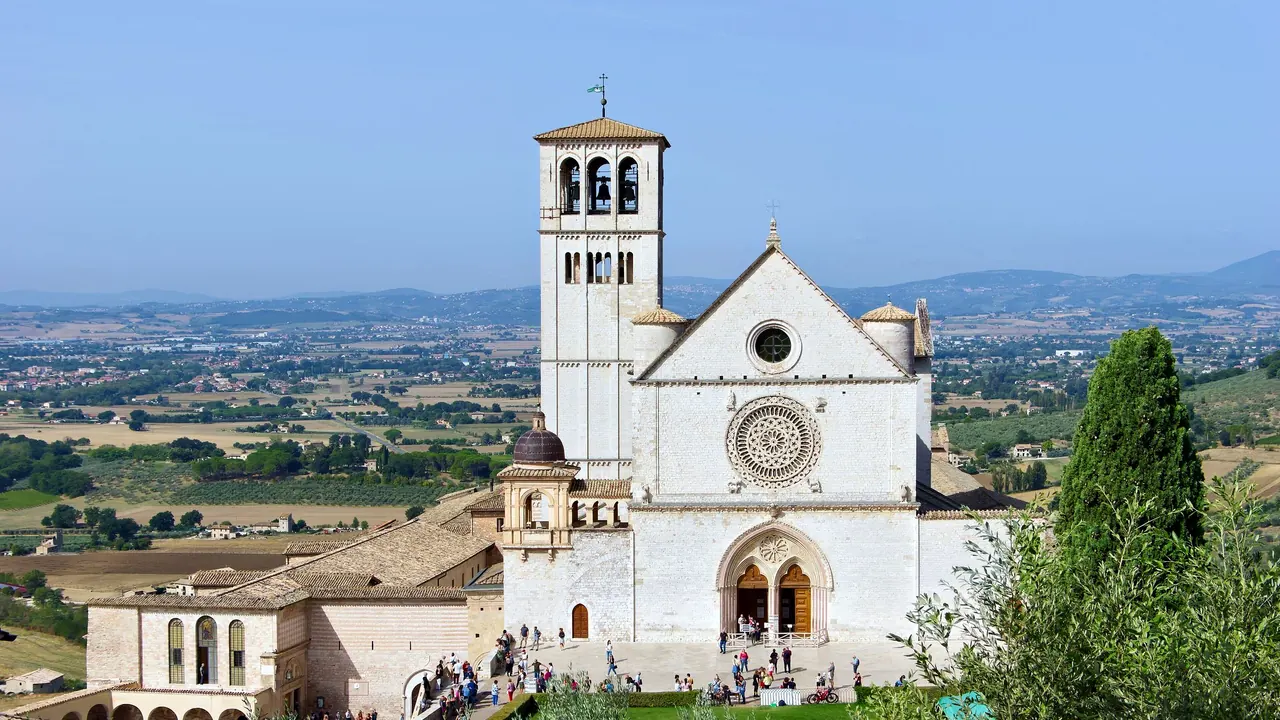
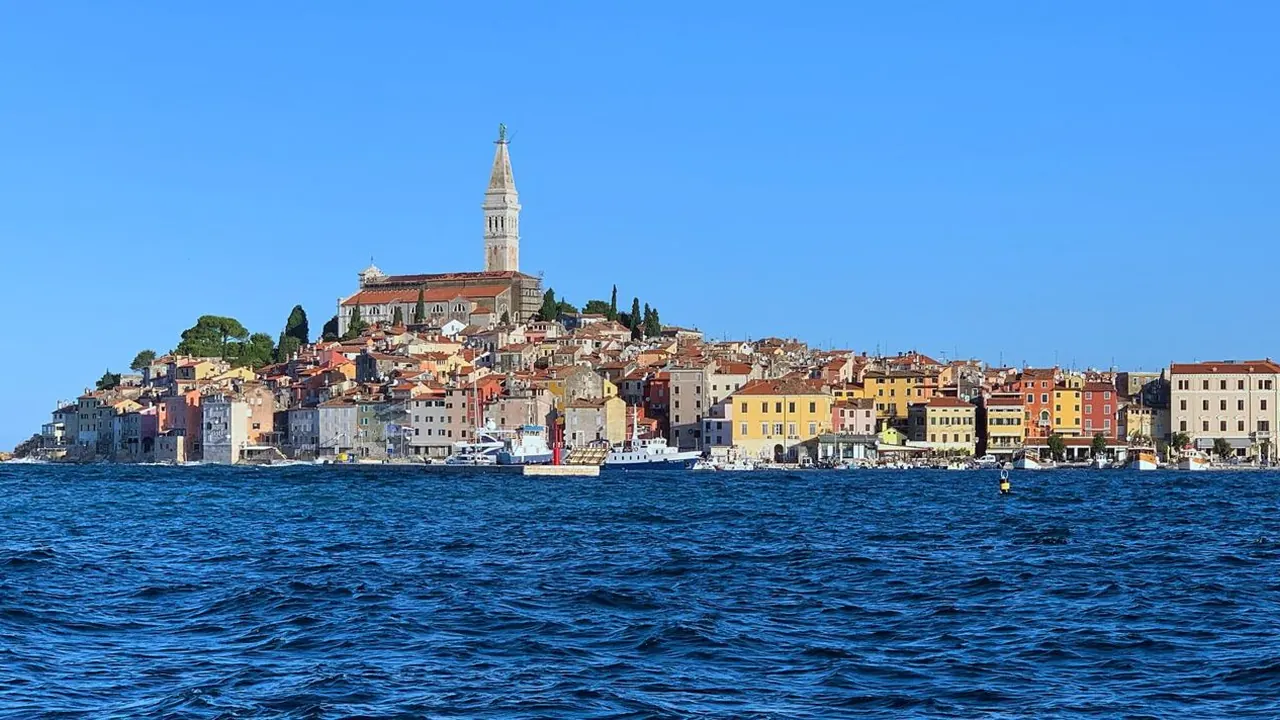
Photos: Assisi by Berthold Werner, CC BY-SA 4.0, cropped; Rovinj by Vyacheslav Bukharov, CC BY-SA 4.0, cropped.
Assisi or Rovinj?
Our verdict in twelve categories, each scored against the same fixed benchmark cities, and the climate month by month, so you can choose for your trip.
Choose Assisi for
- culture and sights
- prices
- day trips
Assisi is the choice for travellers who come for art, faith and history. The Basilica of San Francesco and its frescoes are among the great sights of Europe, and the town makes an outstanding base for exploring the hill towns of Umbria. It is also the easier place to keep costs down. Expect quiet evenings, no beach and not much aimed at children.
Choose Rovinj for
- beaches
- families
- nightlife
Rovinj is better for a summer by the sea. It has clear Adriatic water, swimming off the rocks below the old town, boat trips to the islands and a slower pace that suits couples and families. It also has the livelier evenings of the two. It costs more and has a shorter list of sights, but for sun, swimming and long dinners on the harbour it is the stronger pick.
Scoreboard
Twelve categories on one fixed scale from 0 to 100. The shaded stretch is the gap between the two.
Your match
Pick a travel style or drag the sliders, and both match scores follow your weighting.
Wins on culture and sights and prices with your weighting.
Wins on beaches and families with your weighting.
What matters to you?
Category by category
What the scores mean for a trip.
Beaches & swimming
This is the biggest gap between the two towns. Assisi is landlocked, about two hours from either coast. The best it can manage is a swim at the small lido beaches of Lake Trasimeno or in a hotel pool.
Rovinj has real Adriatic swimming. The water is very clear, and limestone ledges, pebble coves and bathing platforms run for kilometres into the Golden Cape. The islands offer quieter coves. There is no sand, though, so bring water shoes.
Food & drink
Both towns cook from rich farming regions, and truffles and fine olive oil turn up in both. Assisi's food is Umbrian and comes from the land: strangozzi pasta, Castelluccio lentils, wild boar and torta al testo flatbread, with Sagrantino to drink. Its range is narrow, and the set menus near the basilica are best avoided.
Rovinj has slightly more to offer. To the inland Istrian pasta and Malvazija wine it adds grilled fish, scampi buzara and a few ambitious restaurants. Both towns have tourist menus on the main streets, so in either place the better meals are found in the countryside.
Culture & sights
Assisi is well ahead here. The double Basilica of San Francesco, with its Lower and Upper Churches, is a UNESCO-listed masterpiece, and the town around it adds the Temple of Minerva, Santa Chiara, the Rocca Maggiore and the Porziuncola chapel below. It takes a couple of unhurried days to see properly.
In Rovinj, the main sight is the town itself: pastel Venetian houses climbing to St Euphemia's bell tower, plus the small Batana House about the local fishing boats. It is very photogenic, but you will finish it in an afternoon.
Nightlife
Neither town is lively after dark, but Rovinj has more going on. In summer the waterfront cocktail and wine bars fill up, people drink on the rocks at sunset, and a couple of places for dancing open late in high season.
Assisi empties once the day-trippers have left. A glass of Sagrantino and a walk through floodlit lanes is about all there is, and for proper bars you need Perugia, half an hour away.
Nature & outdoors
The two are about level for the outdoors, but the landscapes could hardly be more different. Assisi has a mountain behind it. On Monte Subasio you can walk through oak woods to the Eremo delle Carceri and on to summit meadows at about 1,290m, and the Valnerina and the Sibillini mountains are within driving distance for bigger days.
Rovinj's outdoors is mostly on the water. It suits sea kayaking, paddleboarding and diving around the islands, gentle cycling in the Golden Cape park and boat trips up the Lim Fjord, but it has nothing with the height of Subasio.
Day trips
Both towns make good bases, but Assisi has the stronger set of trips. Spello, Perugia, Spoleto, Gubbio, Todi and Orvieto are all close, each with something substantial to see, and some can be reached by train.
From Rovinj you can visit Pula's Roman amphitheatre, the mosaics of Porec, the hill towns of Motovun and Groznjan and the Brijuni islands, and Trieste and Piran are further out. These trips nearly all need a car.
Good for families
The difference is in where a child's day happens. In Assisi most of it happens outside the walls. The town itself is made for quiet reflection, with frescoed churches that need hushed voices and stepped lanes that wear small legs out on a hot afternoon. Apart from the castle and the climb up Subasio for older children, the swimming and space to run around are at a farm stay down in the valley.
In Rovinj the fun is right by the door. Children can go in and out of the sea all day, ride bikes along the shore paths and play in the shade of the pines. Croatian evenings start late, so they come out to dinner with everyone else, and the big campsites around town are designed for families. The price is a rocky shore that calls for water shoes and an adult nearby, and steep, polished cobbles in the old town.
Getting around
Getting around is about equally easy, and the two have a lot in common: both old towns are car-free, compact and steep. The difference is in how you reach the region beyond. Assisi has a railway line along the valley to Perugia, Spello and Spoleto, although the station is about 4km below the old town.
Rovinj has no trains at all, only intercity buses. On the other hand, its seafront promenade and taxi boats mean that in town you hardly need any transport.
Shopping & style
Neither town is a shopping destination, and both mostly sell local produce such as truffles, olive oil and wine. Rovinj has slightly more to browse thanks to the galleries and artists' studios along Grisia.
In Assisi, Franciscan souvenirs dominate. Among them you can still find Umbrian embroidered linens and Deruta ceramics.
Affordability
Assisi is noticeably easier on the budget. The basilicas are free to enter, convent guesthouses offer simple rooms at low cost, and the agriturismi in the valley are good value.
Rovinj is one of the dearer towns on the Croatian coast, especially in July and August, and fish sold by weight soon adds up. Apartments, campsites and the shoulder months help keep costs down.
Live music & performing arts
Assisi has a little more to hear, and its music follows the church calendar. There are organ and choral music in the basilicas on feast days, and each spring Calendimaggio turns the town into a costumed contest of song and pageantry between its upper and lower quarters. A theatre down in Santa Maria degli Angeli puts on touring shows, and Perugia, a short train ride away, has opera and Umbria Jazz.
Rovinj's performances follow the summer rather than the feasts. There is open-air music on the squares and the harbour, the odd classical concert in St Euphemia, and sometimes the chance to hear bitinada, the local unaccompanied singing linked to the batana boats. Out of season there is almost nothing on, and for big summer concerts people go to Pula's Roman arena.
Wellness & relaxation
Assisi's calm is spiritual rather than pampering. It comes from convent retreats, silent walks up to the Eremo delle Carceri and lanes that are empty early in the morning, and the few spas are out in the valley's country hotels.
Rovinj relaxes you in a more physical way. The resort hotels along the Golden Cape have pools, saunas and treatments, and late swims and evening walks in the pines do the rest. In July and August the harbour gets crowded, so the quiet is easiest to find in May, June and September.
When should you go?
Pick your month. The climate figures are measured averages, not a forecast.
Assisi in July
Rovinj in July
Daytime high, °C
Rainfall in the month, mm
Where the figures come from
Assisi's temperatures are measured 51 km from the centre, at Frontone.
Assisi has no rain gauge within 25 km of the centre, so its rainfall comes from a gridded climate dataset read at the city rather than from a gauge further away.
Rovinj's temperatures are measured 64 km from the centre, at Trieste.
Rovinj has no rain gauge within 25 km of the centre, so its rainfall comes from a gridded climate dataset read at the city rather than from a gauge further away.
Temperature and rainfall are climate normals, averaged over the years shown. Assisi: 1991-2020 normals, Frontone (50.5 km from centre). Rovinj: 1991-2020 normals, Trieste (63.7 km from centre).
Both towns are at their best in late spring and early autumn, though for different reasons. Assisi sits inland on a hillside, so July and August reach about 30°C. That is too hot for climbing its stepped lanes in the afternoon, and walks need to start early. May, June and September are the best months for walking around the town and up Monte Subasio. The rain builds through autumn to about 94mm in November, and winter days are cold and grey.
Rovinj has a similar temperature curve, but the sea changes its year. The water is warm enough for comfortable swimming from June to September and reaches about 26°C in August. July is the sunniest month, with around 300 hours of sun. From October the rain picks up and it stays wet into winter, the swimming season is over and the town goes quiet. Outside summer, Assisi has more to offer.
Which traveller are you?
On a beach and sun trip, Rovinj is the clear choice. You can swim from the rocks right in town, the pine-shaded coves of the Golden Cape are close by, and taxi boats run to the islands. Assisi is hours from the coast, and its nearest swimming is a shallow lake.
For a culture and arts trip, choose Assisi. The Basilica of San Francesco has frescoes by Cimabue and Giotto's circle, the town also has the Roman Temple of Minerva and Santa Chiara, and Perugia, Spoleto and Orvieto are all within reach. In Rovinj you can see the main sights in one afternoon.
On a family trip with children, Rovinj works better. It has boat rides, gelato on the harbour, flat park paths for pushchairs, and resorts with pools and playgrounds. Assisi's silent churches, steep steps and hot afternoons give young children little to do.
Before you go
| Measure | Assisi | Rovinj |
|---|---|---|
| Official language | Italian | Croatian |
| Currency | Euro (EUR) | Euro (EUR) |
| Sockets | CFL230 V, 50 Hz | CF230 V, 50 Hz |
| Driving side | Right | Right |
| Time zone | UTC+1, UTC+2 in summer | UTC+1, UTC+2 in summer |
| Emergency number | 112 | 112 |
| Elevation | 424 m | 0 m |
| Main airport | Perugia San Francesco d'Assisi – Umbria International Airport (PEG)9 km from centre17 non-stop destinations | Pula Airport (PUY)31 km from centre34 non-stop destinations |
| Public holidays this year | 13 days | 14 days |
By the numbers
| Measure | Assisi | Rovinj |
|---|---|---|
| City population | 27,605 | 12,968 |
| People per km² | 147 | - |
| Museums within 10 km | 14 | 1 |
| UNESCO World Heritage sites within 50 km | 2 | 1 |
| Swim season, months above 21 °C | - | 4 months |
Where else could you go?
Every comparison below shares a destination with this one, so you can follow Assisi or Rovinj somewhere new.